
Crystal guide
Aquamarine Meaning, Properties and Care
Aquamarine is the blue to blue-green variety of beryl, a beryllium aluminium silicate (Be3Al2Si6O18), and a close relative of emerald. At Mohs 7.5 to 8 it resists everyday scratches, though it is brittle, and most cut stones are clear to the eye. Heat treatment that shifts the colour from green toward blue is routine, so ask which colour is natural. In tradition it is a stone of the sea, calm and clear speech.
At a glance
- Formula Be3Al2Si6O18: aquamarine is blue to blue-green beryl, the same mineral as emerald.
- Mohs 7.5 to 8, hard against scratches, but brittle with imperfect cleavage, so a hard knock can chip or split it.
- Heat treatment is routine and usually pushes the colour from green toward blue: ask which, in writing.
- The March birthstone and the 19th anniversary gem. Care: warm soapy water and a soft brush.
Quick facts
| Family | Beryllium aluminium silicate (beryl group), the blue to blue-green variety of beryl |
|---|---|
| Chemical formula | Be3Al2Si6O18 |
| Crystal system | Hexagonal, in six-sided prismatic crystals that are often striated along their length |
| Mohs hardness | 7.5–8 |
| Luster | Vitreous to resinous, with imperfect cleavage in one direction and a conchoidal to irregular fracture; brittle |
| Transparency | Transparent to translucent; most cut stones are eye-clean |
| Natural colors | pale blue, greenish blue, blue-green |
| Main localities | Brazil (Minas Gerais); Pakistan; Kenya; Madagascar; Mozambique; Nigeria; Zambia; USA (Colorado, California); China; Myanmar; Russia; Ukraine |
| Common treatments | heat treatment is routine and usually gives a more bluish appearance, heat is also used to reduce yellow and green tones, deep blue Maxixe-type beryl gets its colour from irradiation and is a different material, ask the seller to say in writing whether the colour is natural |
| Birth month | March (on every modern list) |
Looking for the month? March birthstone guide
Aquamarine at a glance, in pictures
Chakras (traditional)
Hardness range
Natural colors
- pale blue
- greenish blue
- blue-green
Traditionally linked to
- Zodiac
- Pisces
- Element
- Water
Common forms of Aquamarine
- Rough raw chunk
- Faceted cut gem
- Bead drilled bead
How hard is Aquamarine?
- Talc 1
- Gypsum 2
- Copper coin ~ 3
- Calcite 3
- Fluorite 4
- Apatite 5
- Glass ~ 5.5
- Steel knife ~ 5.5
- Orthoclase 6
- Quartz 7
- Aquamarine 7.5–8
- Topaz 8
- Corundum 9
- Diamond 10
What it is and where it comes from
Aquamarine is the blue to blue-green variety of beryl, the mineral family that also holds emerald, morganite and golden beryl. A trace of iron in the crystal gives the pale blue, while a different form of iron gives yellow tones, which is why green-tinged stones are common.
The name joins the Latin words for water and of the sea. The colour is usually a light, pastel greenish blue, and the preferred tone is a moderately strong blue that is slightly greenish.
More on its history
Aquamarine forms in granite pegmatites and in beryllium-rich hot-water veins. The crystals are six-sided prisms that can grow longer than a foot, and the largest gem-quality crystal mined so far is about 19 inches long.
Minas Gerais in Brazil has been an important source for about two centuries. Pakistan supplies stones from high in the Karakoram mountains, and Kenya, Madagascar, Nigeria, Zambia and Mozambique are also mined.
Much cut aquamarine is clear to the eye and large clean stones are available. Because the colour is light, cutting matters: a well-cut stone shows more life and colour than a dull one.
Aquamarine is dichroic, meaning it shows near colourless in one direction and a stronger blue in another when viewed through a dichroscope.
The Dom Pedro aquamarine, a carved obelisk of about 10,363 carats now at the Smithsonian, is believed to be the largest cut aquamarine. The stone has also been carved into Greek intaglios, Chinese seals and Japanese netsuke.
Aquamarine through time
-
1677
The English word "aquamarine" is first recorded, from the Latin for seawater.
-
1936
Brazil gives Eleanor Roosevelt a 1,298-carat step-cut aquamarine, one of the largest cut stones known.
-
1971
Colorado names aquamarine its state gem, after the stones found around Mount Antero.
-
1990
Hydrothermally grown blue beryl from the USSR is described in English-language gemology for the first time.
In crystal tradition
What follows is belief and folklore, passed down in crystal tradition. It is not measured fact.
Traditionally associated with: calm, clear speech, courage.
Aquamarine is the sailor's stone in tradition. Mariners were said to carry it to calm the waves and stay safe at sea, and it was believed to bring happiness to a marriage. These are beliefs, not effects of the stone.
Older lore says beryl protects the wearer in battle and in legal disputes, makes them hard to defeat and friendly, and sharpens the mind.
Modern crystal tradition links aquamarine with the Throat chakra, the element Water, and calm, clear speech. Zodiac links vary from one tradition to another, with Pisces the one most often named. Treat all of this as folklore.
How to care for Aquamarine
- Water Safe
- Sunlight Unknown
- Salt Unknown
- Heat Caution
- Ultrasonic Caution
- Chemicals Unknown
Safe = fine as a rule · Caution = only briefly or gently · Avoid = can damage the stone · Unknown = no reliable guidance.
Clean aquamarine with warm water, mild dish soap and a soft toothbrush, scrubbing behind the stone where dirt collects. Ultrasonic cleaners are usually fine, but not for a stone with fractures or liquid inclusions. Intense heat can make a stone a little more brittle, so keep it away from very hot water and steam. Aquamarine is hard but brittle, so take it off for the gym and heavy work.
Real or fake? Look-alikes and treatments
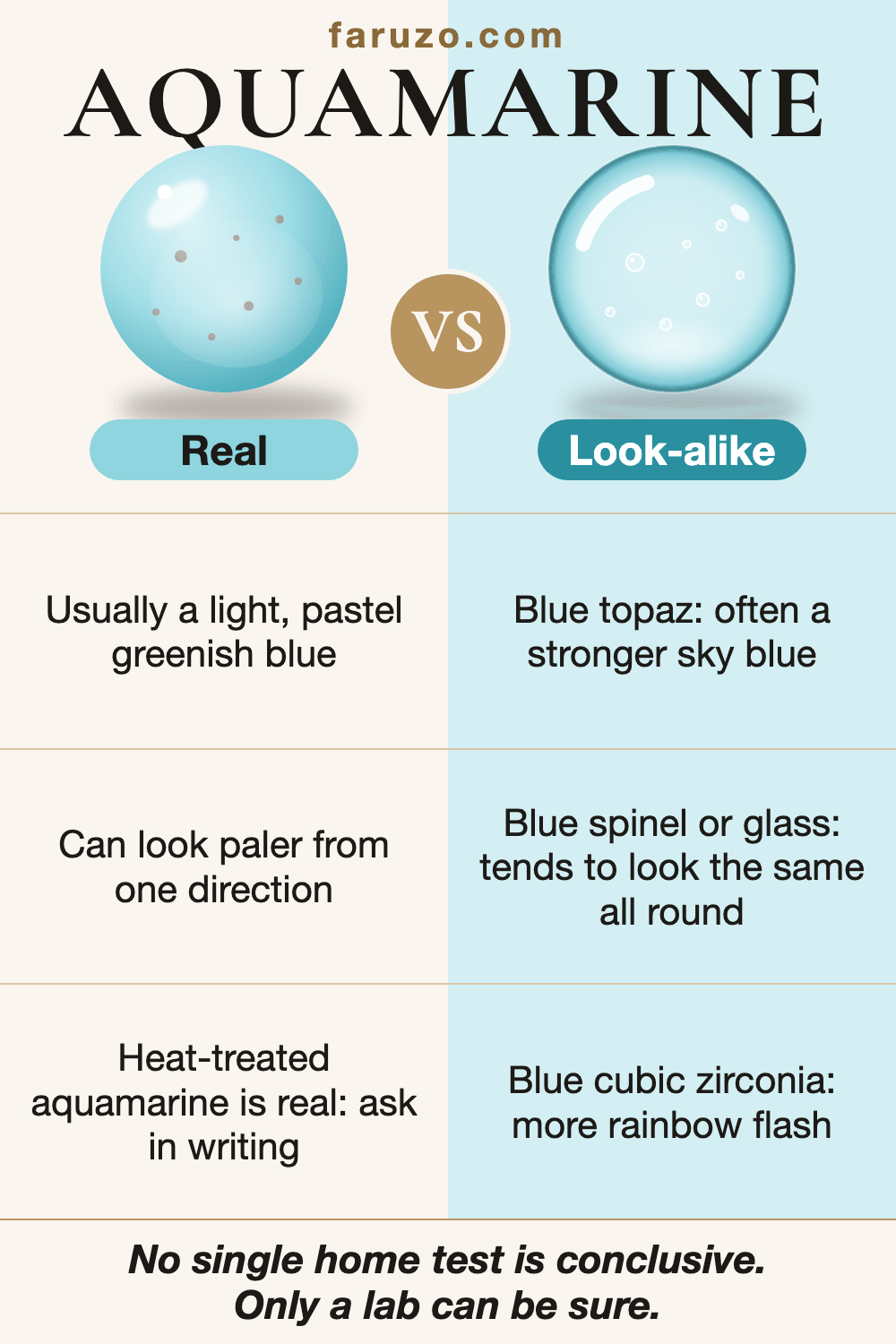
Often confused with
- Blue topaz
- Blue spinel
- Synthetic spinel
- Blue glass
- Blue cubic zirconia
Common look-alikes
- Blue topaz. Blue topaz is a different gemstone that is often sold in a similar blue. Strong blue topaz is usually colourless topaz that has been irradiated, and it tends to be a more saturated sky blue than aquamarine's light, slightly greenish blue. Topaz also has perfect cleavage, so it can split along a flat plane. A lab can confirm.
- Blue spinel. Blue spinel is a separate mineral with a hardness of about 8. It is singly refractive, so it tends not to show aquamarine's change from near colourless to stronger blue in different directions. A lab can confirm.
- Synthetic spinel. Lab-made spinel is a common stand-in for birthstones because it can be made in many colours. Sold as aquamarine it is a different stone, and only testing can separate it reliably.
- Blue glass. Glass can be made in almost any colour and is a long-standing imitation of aquamarine. It tends to be less brilliant than a gem and may show round gas bubbles under a loupe.
- Blue cubic zirconia. Cubic zirconia is a lab-made material that can be made in almost any colour. It is harder than aquamarine (about 8.5) and shows more fire, meaning stronger rainbow flashes, than a typical aquamarine.
Safe checks you can do
- Ask the seller in writing whether the stone is natural aquamarine, heat-treated aquamarine, lab-grown beryl, or another material such as topaz, spinel, glass or cubic zirconia.
- Check the colour. Aquamarine is usually a light, pastel blue to slightly greenish blue. A deep, vivid, even blue can point to treated topaz, glass or another material.
- Turn the stone in the light. Aquamarine can look near colourless in one direction and a stronger blue in another, while glass tends to look the same all round.
- Do not rely on clarity. Much cut aquamarine is clean to the eye, so a flawless look proves little, and a few inclusions do not by themselves make a stone fake.
- Do not scratch-test or heat-test a stone you plan to keep. In most cases a lab can separate natural, treated and lab-grown stones with chemical and spectrum testing.
Wearing Aquamarine
Ring
Careful
It can split along a flat plane if knocked.
Bracelet
Careful
A knock on a bracelet can split it along a flat plane.
Pendant
Careful
It can split along a flat plane, so keep it protected.
Earrings
Careful
A flat-plane split is possible, so keep earrings for dressy wear.
Guide for everyday wear, based on hardness and care notes. Safe, Careful or Avoid.
At Mohs 7.5 to 8, aquamarine resists everyday scratches, but it is brittle and has imperfect cleavage, so a sharp knock can chip an edge, split it along a flat plane or open a flaw, especially in a stone with fractures. Rings, bracelets, pendants and earrings all call for care: a protective setting helps, and bracelets take the most knocks. Take it off for the gym and heavy work, and ask whether yours is natural, heated or lab-grown.
Related stones
Questions about Aquamarine
What does aquamarine mean?
In crystal tradition aquamarine is the stone of the sea, linked to calm, clear speech, courage and the Throat chakra. Sailors were said to carry it for safe voyages. That is a belief, not a fact about the stone. Its practical claim is a clear, light blue that suits daily wear.
What is aquamarine?
Aquamarine is the blue to blue-green variety of beryl, a beryllium aluminium silicate with the formula Be3Al2Si6O18. Trace iron gives the colour, and emerald, morganite and golden beryl are the same mineral in other colours.
Is aquamarine a birthstone?
Yes. Aquamarine is the March birthstone on every modern list, and bloodstone appears alongside it on some. It is also the gem for the 19th wedding anniversary.
How hard is aquamarine?
7.5 to 8 on the Mohs scale, harder than quartz. Hardness only measures scratching, though. Aquamarine is brittle, so a sharp knock can still chip an edge or split it along a flat plane.
Is aquamarine good for an everyday ring?
It can be, with care. At Mohs 7.5 to 8 it resists scratches from everyday dust, but it is brittle with imperfect cleavage, so a hard knock can still chip or split it. Choose a setting that protects the edges, and take the ring off for the gym and heavy work.
What should I ask when buying aquamarine jewellery?
Ask in writing whether the stone is natural aquamarine, heat-treated, lab-grown beryl, or another material. Words like "aquamarine colour" or "aqua blue" can describe glass or cubic zirconia, so check that the stone itself is named.
Is aquamarine heat treated?
Often. Heat treatment is routine and usually shifts the colour from greenish toward blue. A heated stone is still real aquamarine, and the change is considered durable under normal wear. Ask the seller to say whether the colour is natural.
Why is some aquamarine green?
Aquamarine sits between green and blue because of how iron sits in the crystal. A form of iron that gives yellow adds a green tint, so many mined stones start slightly green. Heat is often used to reduce that and leave a purer blue.
What is the difference between aquamarine and blue topaz?
They are different minerals. Aquamarine is beryl, usually a light, slightly greenish blue. Strong blue topaz is typically colourless topaz that has been irradiated, and it is often a more saturated sky blue. Topaz also splits along a perfect cleavage plane, which beryl does not do as readily.
Is aquamarine the same as emerald?
They are the same mineral, beryl, in different colours. Emerald is green beryl, coloured by chromium and sometimes vanadium, while aquamarine is blue to blue-green beryl, coloured by iron.
How can you tell real aquamarine from fake?
A home look can only hint. Real aquamarine is usually a light blue and can look near colourless from one direction and bluer from another, while glass looks even all round. Topaz, spinel and cubic zirconia can look similar, so a lab can confirm a stone that matters.
Is there lab-grown aquamarine?
Yes. Lab-grown blue beryl is real beryl made by people. It has the same basic make-up as the mined stone, and in most cases microscopic and chemical testing can tell the two apart. Ask the seller to say in writing which one is being sold.
Does aquamarine fade in the sun?
Aquamarine is not usually described as fading, and heat-treated colour is considered durable under normal handling. The exception is deep blue Maxixe-type beryl, a different material whose colour is made by radiation and can fade in light or heat.
How do you clean aquamarine, and can it get wet?
Water is fine. Use warm water, mild dish soap and a soft toothbrush. Ultrasonic cleaners are usually safe unless the stone has fractures or liquid inclusions. Keep it away from steam and very hot water, since intense heat can make a stone more brittle.
Where does aquamarine come from?
Brazil, especially Minas Gerais, has been a major source for about two centuries. Pakistan, Kenya, Madagascar, Nigeria, Zambia, Mozambique and the USA (including Colorado) are also mined.