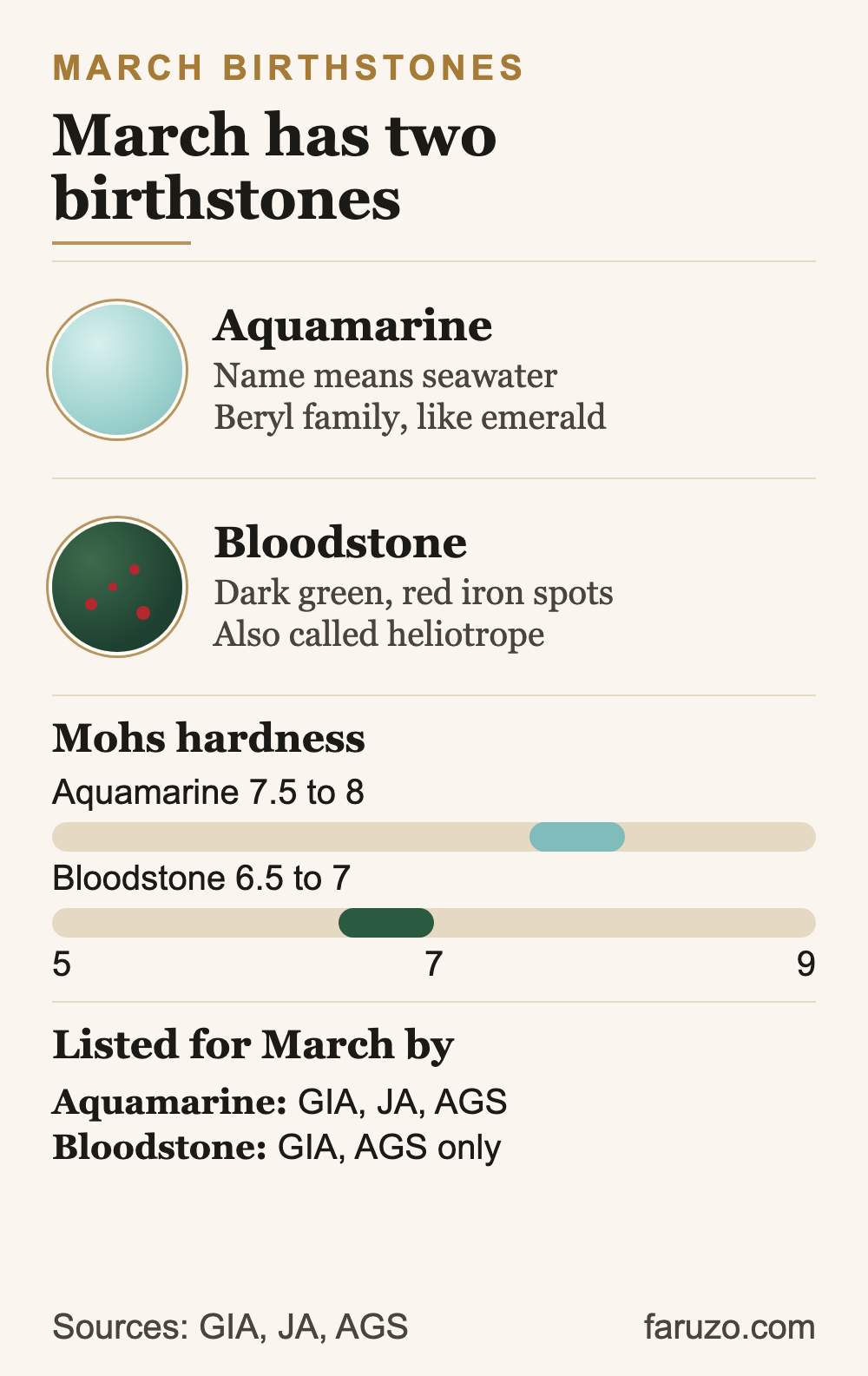
Quick answer: The commonly cited March birthstone is aquamarine. GIA, Jewelers of America and the American Gem Society all list it [1][2][3]. Bloodstone is a second March stone on GIA and the American Gem Society, but Jewelers of America does not list it [1][2][3].
At a glance
- Aquamarine: listed by GIA, Jewelers of America and the American Gem Society [1][2][3]
- Bloodstone: listed by GIA and the American Gem Society only [1][3]
- Hardness: aquamarine 7.5 to 8, bloodstone 6.5 to 7 on the Mohs scale [1]
- Name: aquamarine comes from the Latin for seawater [1]
- Meaning (tradition): calm seas for sailors, happiness in marriage; beliefs, not facts [1]
- Family: aquamarine is a variety of beryl, like emerald [4]
Which stone is the March birthstone?
It depends on which list you read. Aquamarine appears on all three: GIA, Jewelers of America and the American Gem Society [1][2][3].
Bloodstone is where they split. GIA and the American Gem Society list aquamarine and bloodstone for March [1][3]. Jewelers of America lists aquamarine only [2].
None of the three splits the two stones into "traditional" and "modern", so we do not either. If you want one answer, choose aquamarine. If you like the darker stone, bloodstone is on two of the three lists.
For the other months, see our guide to birthstones by month.
Aquamarine and the beryl family
Britannica defines beryl as a mineral, beryllium aluminum silicate, with several gem varieties [4]:
- Aquamarine: pale blue-green
- Emerald: deep green
- Heliodor: golden yellow
- Morganite: pink
So aquamarine and emerald are close relatives. Britannica says the gem varieties other than emerald are commonly found in cavities in pegmatites [4]. For the green sibling, see emerald meaning.
GIA describes aquamarine as evoking the sea, from deep green-blue to light, slightly greenish blue. Faceted stones are often free from inclusions and clear as water [1]. The American Gem Society adds that aquamarine is most often light in tone, with color usually more intense in larger stones [3].
The name and the sea
"Aquamarine" comes from the Latin for seawater [1]. The American Gem Society gives it as aqua plus marina [3].
The sea is also where the old beliefs sit. GIA says ancient mariners claimed aquamarine would calm waves and keep sailors safe [1]. The American Gem Society says it was believed to protect sailors and guarantee a safe voyage [3]. GIA adds a belief that it brings happiness in marriage [1].
These are beliefs people have held, not facts about the stone.
Famous aquamarines
- The Eleanor Roosevelt gift. In 1936, Brazil's government gave First Lady Eleanor Roosevelt a dark blue, rectangular step-cut aquamarine of 1,298 carats. It was faceted from a 2.9 lb (1.3 kg) rough and now sits in the Franklin D. Roosevelt Presidential Library and Museum in Hyde Park, New York [1].
- The Dom Pedro Aquamarine. At the Smithsonian, it weighs 10,363 carats (about 4.6 lb). GIA says it is believed to be the largest faceted aquamarine in the world. German lapidary Berndt Munsteiner cut it as a fantasy-cut obelisk about 14 inches (36 cm) tall [1].
Where aquamarine is found
Minas Gerais, Brazil, has been an important source for two centuries, with hard-rock and weathered deposits in the east of the state near Teofilo Otoni [1]. The American Gem Society names Brazil as the main source [3].
Other sources named by GIA [1]:
- Pakistan: mines in the Karakoram foothills at roughly 9,800 to over 13,000 ft (3,000 to over 4,000 m), with "water clear" stone
- Other countries: Kenya, Madagascar, Nigeria, Zambia and Mozambique
- Elsewhere: California in the United States, plus China, Myanmar, Russia and Ukraine
Hardness and care: aquamarine
Aquamarine rates 7.5 to 8 on the Mohs scale, which GIA calls durable enough for everyday wear [1].
- Clean with warm water, mild dish soap and a toothbrush [1].
- Ultrasonic and steam cleaning are usually safe, unless the stone has fractures or liquid inclusions [1].
If you are choosing between blue stones, aquamarine vs blue topaz compares them.
Bloodstone: the dark green March stone
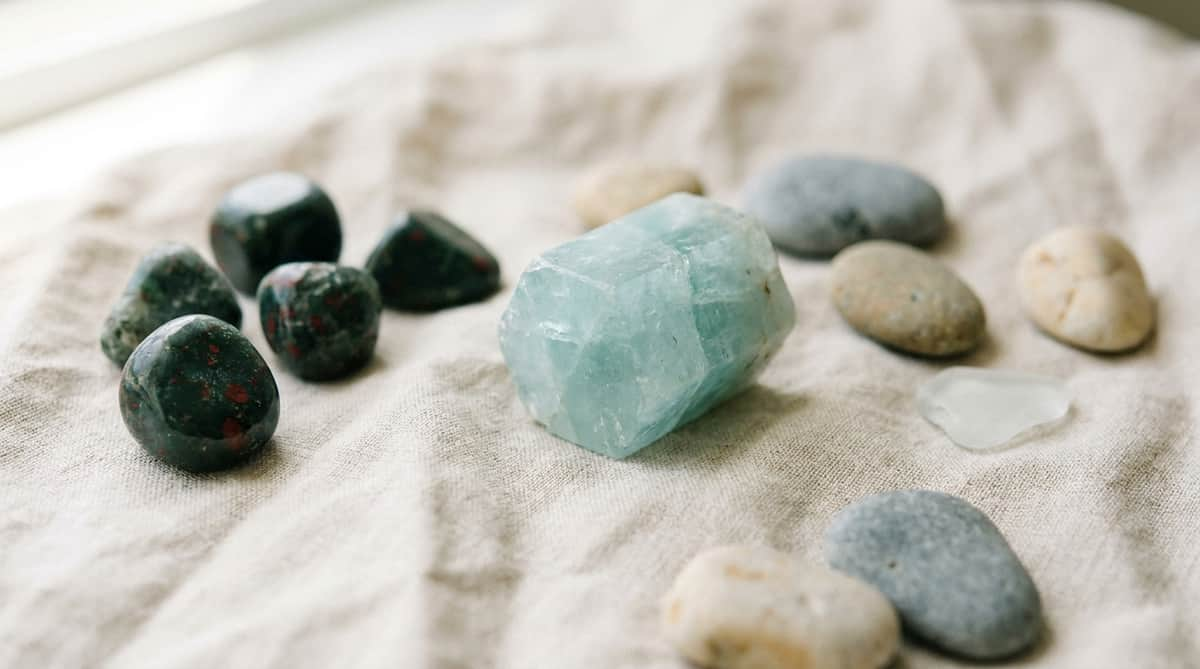
GIA says bloodstone is typically a dark-green cabochon with red spots of iron oxide [1]. It is also called heliotrope, and it is a variety of chalcedony, a cryptocrystalline quartz. Traditionally it is semi-translucent to opaque dark-green jasper with red inclusions of iron oxides, especially hematite [1].
Where the names come from. "Heliotrope" comes from the ancient Greek for "to turn the sun". In ancient times, the stone was believed to turn the sun red if placed in water [1]. "Bloodstone" comes from a belief held by some that the color pattern has religious significance, representing the blood of Christ [1].
What it is said to mean. GIA lists strength and invisibility among the properties attributed to bloodstone. It adds that some people today see it as a lucky charm prized by athletes [1]. These are beliefs, not claims we make about the stone.
Where it comes from. Most bloodstone on the market today comes from India, with other sources in Brazil, Australia, China and the United States [1].
For more, read bloodstone meaning.
Hardness and care: bloodstone
Bloodstone is softer than aquamarine, at 6.5 to 7 on the Mohs scale [1].
- Use warm soapy water and a soft brush [1].
- Keep it away from harsh chemicals and extremely hot temperatures [1].
- Dry with a soft cloth, and store it in soft fabric to avoid scratches [1].
Keep going
February's stone is amethyst. Read the February birthstone guide.
FAQ
Is aquamarine an anniversary stone?
GIA mentions aquamarine as a gift for a 19th wedding anniversary [1].
What zodiac signs go with March?
GIA's March page notes Pisces and Aries [1].
What is the biggest beryl crystal ever recorded?
Britannica reports a beryl from Malakialina, Madagascar, about 18 m long and roughly 380,000 kg, the largest crystal of any type. Britannica also records a crystal 5.8 m (19 ft) long found in the Black Hills of South Dakota [4].
Is there an American aquamarine?
GIA lists Mount Antero in Colorado, where aquamarine is the state gem, among US sources [1].
Where is bloodstone found in nature?
GIA says it is found filling fractures or cavities in other rocks, or as pebbles in riverbeds [1].
Sources
- GIA, "March Birthstones | Aquamarine & Bloodstone Meaning", https://www.gia.edu/birthstones/march-birthstones (read in a browser 2026-11-09)
- Jewelers of America, "Birthstones", https://www.jewelers.org/find-a-jeweler/buying-guides/birthstones/ (read in a browser 2026-11-09; March: Aquamarine)
- American Gem Society, "Traditional Birthstone Chart by Month", https://www.americangemsociety.org/birthstones/ (read in a browser 2026-11-09; March: Aquamarine, Bloodstone). Aquamarine details from the AGS article (2015), https://www.americangemsociety.org/march-birthstone-aquamarine/
- Encyclopaedia Britannica, "beryl", https://www.britannica.com/science/beryl (read in a browser 2026-11-09; revised Oct. 9, 2026)