
Crystal guide
Apatite Meaning, Properties and Care
Apatite is a family of calcium phosphate minerals, Ca5(PO4)3(F,Cl,OH), with a hardness of Mohs 5 and a brittle, easily scratched surface. Blue and blue-green apatite is the variety most often sold as a gem. The name comes from a Greek word for 'deceive', because the mineral was so often mistaken for other stones. In crystal tradition it is called a stone of motivation and communication.
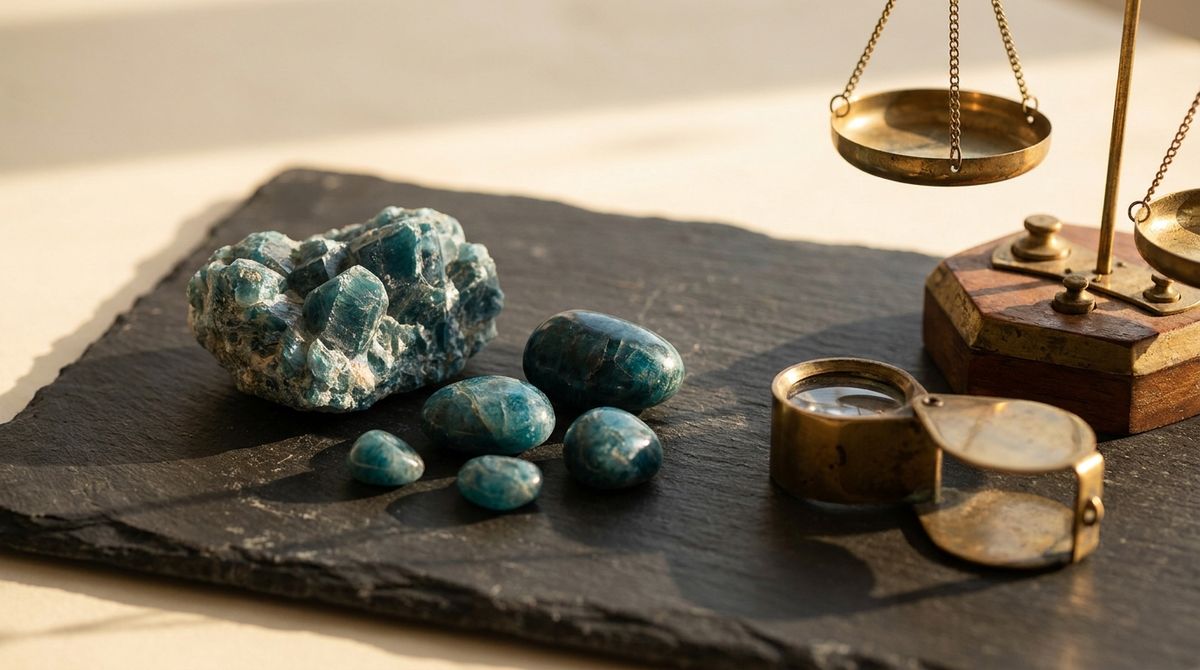
At a glance
- Formula Ca5(PO4)3(F,Cl,OH), hexagonal crystals, hardness Mohs 5.
- Brittle and soft: it scratches and chips more easily than aquamarine or tourmaline.
- Blue and blue-green is the best-known gem colour, and some pieces glow under UV light.
- Care: soft cloth, lukewarm water, mild soap. Avoid steam, machine cleaners, acids and heat.
Quick facts
| Family | Phosphate mineral group (calcium phosphate): fluorapatite, chlorapatite and hydroxylapatite |
|---|---|
| Chemical formula | Ca5(PO4)3(F,Cl,OH) |
| Crystal system | Hexagonal |
| Mohs hardness | 5 |
| Luster | Vitreous to subresinous; brittle, breaking with uneven surfaces |
| Transparency | Transparent to opaque |
| Natural colors | blue, blue-green (teal or neon), green, yellow, purple or violet, pink, brown, colourless |
| Main localities | Madagascar, Brazil, Myanmar, Mexico, Sri Lanka, Mozambique, Canada, India, Norway, Spain |
| Common treatments | usually sold untreated; because it is soft and brittle, rough handling in cutting and wear is the bigger concern |
Apatite at a glance, in pictures
Chakras (traditional)
Hardness range
Natural colors
- blue
- blue-green (teal or neon)
- green
- yellow
- purple or violet
- pink
- brown
- colourless
Common forms of Apatite
- Rough raw chunk
- Tumbled polished pebble
- Cabochon smooth dome
How hard is Apatite?
- Talc 1
- Gypsum 2
- Copper coin ~ 3
- Calcite 3
- Fluorite 4
- Apatite 5
- Glass ~ 5.5
- Steel knife ~ 5.5
- Orthoclase 6
- Quartz 7
- Topaz 8
- Corundum 9
- Diamond 10
What it is and where it comes from
The name comes from the Greek apatao, 'to deceive'. It was given in the late 1700s because the mineral had so often been mistaken for other stones such as beryl, tourmaline and olivine.
Apatite is the reference mineral for hardness 5 on the Mohs scale.
Most apatite is industrial. Phosphate rock, which is largely apatite, is a main source of the phosphorus used in fertiliser. Only a small share is gem quality.
Gem apatite occurs in many colours. Blue and blue-green is the best known, and the vivid neon blue-green stones from Madagascar and elsewhere are sometimes compared with Paraiba-style tourmaline. A yellow-green type is sometimes called asparagus stone, and rare cat's-eye apatite is also known.
Because it is soft, apatite is mostly cut as cabochons, beads and careful faceted stones for collectors rather than hard-wearing everyday gems.
In crystal tradition
What follows is belief and folklore, passed down in crystal tradition. It is not measured fact.
Traditionally associated with: motivation, communication, clarity, goal-setting.
Apatite is traditionally called a stone of motivation and communication, with manifestation added in some lists. This is a modern spiritual tradition, not a fact about the stone.
Blue apatite is traditionally linked to the Throat chakra and communication, and other colours are sometimes linked to the Third Eye. These are beliefs within crystal practice, not scientific claims.
How to care for Apatite
- Water Caution
- Sunlight Unknown
- Salt Unknown
- Heat Caution
- Ultrasonic Avoid
- Chemicals Avoid
Safe = fine as a rule · Caution = only briefly or gently · Avoid = can damage the stone · Unknown = no reliable guidance.
Clean apatite with a soft cloth, lukewarm water and mild soap, then dry it right away. Avoid ultrasonic and steam cleaners, because vibration and heat can damage a soft stone. Acids and acidic cleaners can dull or etch the surface, so keep it away from them. Do not soak it. Store it apart from harder stones that could scratch it. Effects of long sun and salt are not well documented, so avoid them as a precaution.
Real or fake? Look-alikes and treatments
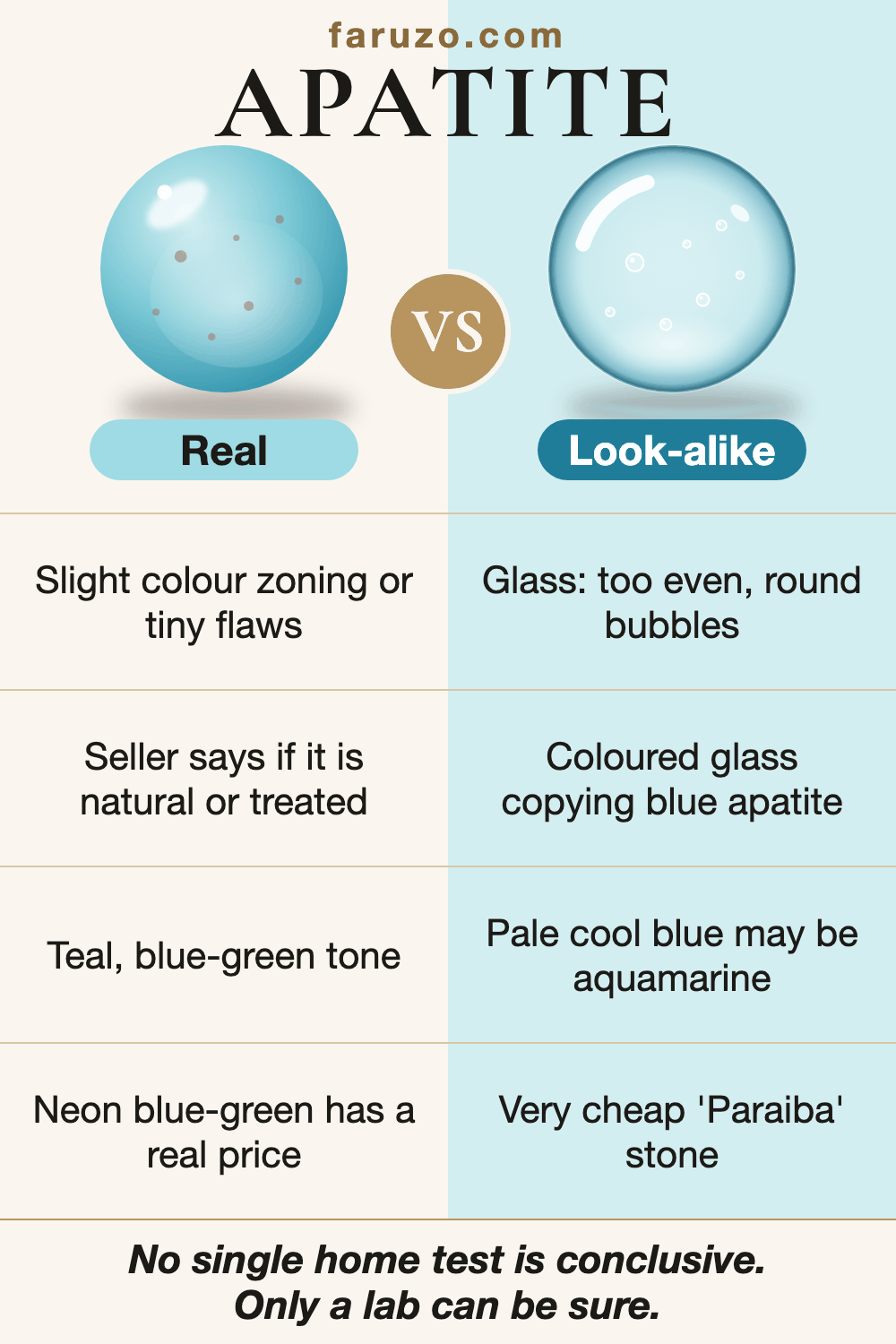
Often confused with
- Aquamarine
- Paraiba-style tourmaline
- Blue topaz
- Glass imitations
Common look-alikes
- Aquamarine. Aquamarine is a beryl at Mohs 7.5 to 8, so it resists scratches that would mark apatite. Its blue is usually a cooler, paler sea-blue, while apatite leans to a more saturated teal. A gemologist can confirm.
- Paraiba-style tourmaline. The neon blue-green of the best apatite can look like Paraiba-style tourmaline in photos. Tourmaline is much harder (about Mohs 7 to 7.5) and usually far more expensive, so a very cheap 'Paraiba' stone is most likely something else. A gemologist or lab can confirm.
- Blue topaz. Blue topaz is harder (Mohs 8) and its blue is usually produced by treatment. Apatite is softer and tends to show a more teal, greenish tone.
- Glass imitations. Coloured glass can copy the colour of blue apatite. Glass is often too even and may hold tiny round bubbles, while natural apatite usually has slight colour variation.
Safe checks you can do
- Ask the seller in writing whether the stone is natural apatite, glass, or something else, and whether it is treated.
- Compare the price. Real vivid neon blue-green apatite in a larger clean size is not bargain-priced, and a stone sold as 'Paraiba' for very little deserves questions.
- Look for natural variation. Real apatite often shows slight colour zoning or tiny inclusions, while glass is usually perfectly even.
- Expect some wear. A soft stone with scratched or chipped edges is typical for apatite, so a flawless surface on an old, much-worn piece is worth a question.
- Avoid scratch-testing a stone you plan to keep, since apatite marks and chips easily.
Wearing Apatite
Ring
Avoid
Moderate hardness, so rings can scratch or chip.
Bracelet
Careful
Bracelets take more knocks, so wear it with care.
Pendant
Careful
Keep a pendant away from hard knocks.
Earrings
Careful
Take earrings off for sport and sleep.
Guide for everyday wear, based on hardness and care notes. Safe, Careful or Avoid.
Apatite is moderately hard (Mohs 5) but brittle, so a ring worn every day is likely to scratch and chip. Pendants, earrings and occasional-wear pieces suit it better, ideally in a setting that protects the stone. A bracelet takes knocks against desks and doorframes, so wear it with care. Remove it for the gym, cleaning and anything rough, and keep it away from acids and heat.
Questions about Apatite
What does apatite mean?
In crystal tradition apatite is a stone of motivation, communication and manifestation, and blue apatite is linked to the Throat chakra. That is a belief, not a fact about the stone.
What is apatite?
Apatite is a family of calcium phosphate minerals with the formula Ca5(PO4)3(F,Cl,OH). It forms hexagonal crystals in many colours, and blue and blue-green material is the variety most often sold as a gem.
Why is apatite called the deceiver stone?
Its colours and crystal shapes overlap with several other stones, which is why it was long taken for beryl, tourmaline or olivine.
How hard is apatite?
Apatite is 5 on the Mohs scale, softer than quartz and aquamarine. A knife blade (about Mohs 5.5) can scratch it, and it is brittle enough to chip.
Can you wear apatite jewelry every day?
It suits occasional wear better than daily wear. Pendants and earrings hold up far better than a ring worn every day, which meets the most knocks.
Is apatite the same as aquamarine or Paraiba tourmaline?
No. Aquamarine is a beryl at Mohs 7.5 to 8, and Paraiba-style tourmaline is a harder, usually much more expensive mineral. The neon blue-green of the best apatite can look like tourmaline in photos, but they are different minerals.
Does apatite glow under UV light?
Some pieces glow under UV, often in yellow or blue-green tones, though the glow varies by stone and not every piece fluoresces.
Is apatite a birthstone?
No. Apatite is not on the usual traditional or modern birthstone lists for any month.
Is blue apatite rare?
As a mineral apatite is very common. Gem-quality blue apatite is scarcer, and vivid neon blue-green stones in larger clean sizes are among the rarest.
How can you tell real apatite from fake?
Real apatite often shows slight colour variation and tiny inclusions, while glass looks more even. Vivid neon blue-green stones sold cheaply as Paraiba-style deserve questions, and a gemologist can test a stone that matters.
How do you clean and care for apatite?
Use a soft cloth, lukewarm water and mild soap, then dry it right away. Avoid steam, cleaning machines, acids and heat, since a soft stone can dull, etch or crack.
Can apatite jewelry get wet?
A brief rinse in lukewarm water is fine, but do not soak it. Take it off before showers, washing up or swimming, because hot water and household cleaners can dull a soft stone.