
Crystal guide
Iolite Meaning, Properties and Care
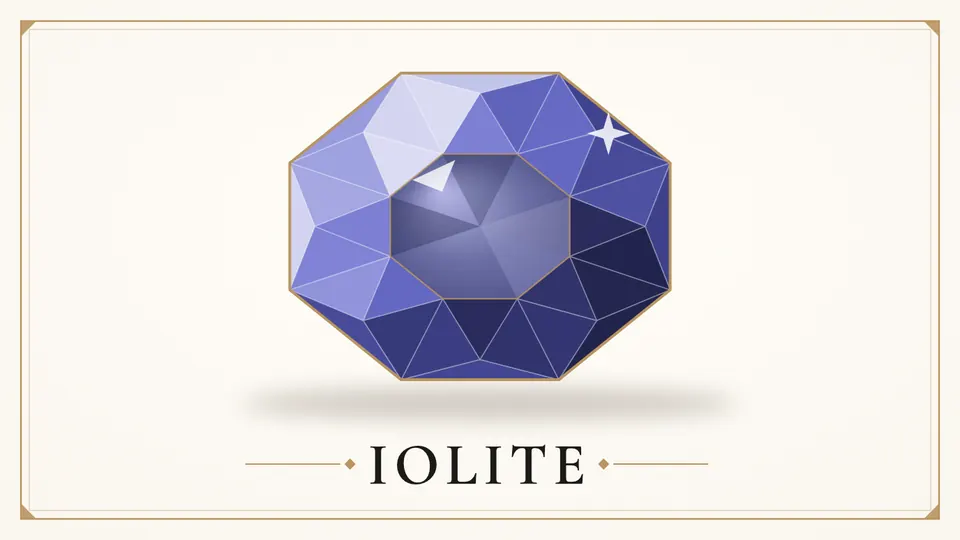
Iolite is the violet-blue gem variety of cordierite, a magnesium iron aluminium silicate. Its signature trick is strong pleochroism: tilt it and the colour moves between violet-blue and pale yellow or grey. At 7 to 7.5 on the Mohs scale it is fairly hard, but it has fair cleavage in one direction, so a hard knock can chip or split it. In crystal tradition it is a stone of intuition and direction.
At a glance
- A violet-blue gem variety of cordierite, formula (Mg,Fe)2Al4Si5O18.
- Strongly pleochroic: the colour shifts between violet-blue and pale yellow or grey as you tilt it.
- Mohs 7 to 7.5, with fair cleavage in one direction, so a hard knock can chip or split it.
- Not on the standard birthstone lists. Care: soft cloth, mild soap, no ultrasonic or steam cleaners.
Quick facts
| Family | Magnesium iron aluminium cyclosilicate, the gem variety of cordierite |
|---|---|
| Chemical formula | (Mg,Fe)2Al4Si5O18 |
| Crystal system | Orthorhombic |
| Mohs hardness | 7–7.5 |
| Luster | Fair cleavage in one direction and poor in two others |
| Transparency | Usually transparent, most often cut as a faceted stone |
| Natural colors | violet-blue, blue-violet, light blue, pale yellow to grey (from another viewing direction) |
| Main localities | Australia, Brazil, India, Madagascar, Myanmar, Namibia, Sri Lanka, Tanzania |
| Common treatments | usually sold without treatment, heat treatment is reported to produce a green variety called praseolite |
Iolite at a glance, in pictures
Chakras (traditional)
Hardness range
Natural colors
- violet-blue
- blue-violet
- light blue
- pale yellow to grey (from another viewing direction)
Common forms of Iolite
- Faceted cut gem
- Rough raw chunk
- Cabochon smooth dome
How hard is Iolite?
- Talc 1
- Gypsum 2
- Copper coin ~ 3
- Calcite 3
- Fluorite 4
- Apatite 5
- Glass ~ 5.5
- Steel knife ~ 5.5
- Orthoclase 6
- Quartz 7
- Iolite 7–7.5
- Topaz 8
- Corundum 9
- Diamond 10
What it is and where it comes from
Iolite is the gem name for cordierite. The name comes from the Greek word for violet, while cordierite itself honours the French geologist Louis Cordier.
Cordierite was reportedly first described near Nijar in southern Spain in 1813.
Iolite is strongly pleochroic, showing up to three different colours in three crystal directions. That gave the mineral its older name dichroite, meaning two-coloured. Cutters usually try to orient the rough so the best violet-blue shows through the top.
A popular story says Viking navigators held thin slices of iolite up to the sky to find the sun on cloudy days. The optics are plausible, since cordierite is strongly pleochroic, but the idea is unproven: no such stone is known from a Viking ship.
Water sapphire is an informal name sometimes given to iolite because of its colour play. Iolite is not sapphire, which is a different and much harder mineral.
Gem iolite is reportedly found in countries including India, Sri Lanka, Madagascar, Brazil, Myanmar, Tanzania and Namibia. Fine faceted stones over five carats are relatively uncommon.
Synthetic cordierite ceramic expands very little when heated, which is why it is used in catalytic converter supports. That ceramic is an industrial material and has no link to gem iolite.
In crystal tradition
What follows is belief and folklore, passed down in crystal tradition. It is not measured fact.
Traditionally associated with: intuition, inner vision, finding direction.
Iolite is traditionally associated with the Third Eye chakra and with intuition, inner vision and a sense of direction. This is a modern spiritual tradition, not a fact about the stone.
The theme of direction is often tied to the Viking sunstone story, which is itself an unproven legend. Zodiac links vary from one tradition to another, so treat them as folklore.
How to care for Iolite
- Water Caution
- Sunlight Unknown
- Salt Caution
- Heat Caution
- Ultrasonic Avoid
- Chemicals Caution
Safe = fine as a rule · Caution = only briefly or gently · Avoid = can damage the stone · Unknown = no reliable guidance.
Wipe iolite with a soft cloth, mild soap and lukewarm water, then dry it. A short rinse is fine; do not soak it. To be safe, keep it away from ultrasonic and steam cleaners, since vibration and sudden temperature swings can stress a stone with a cleavage direction. Store it apart from harder gems in a soft pouch, and take it off before sport and rough work.
Real or fake? Look-alikes and treatments
Often confused with
- Tanzanite
- Blue sapphire
- Amethyst
- Dyed or coloured quartz
- Blue-violet glass
Common look-alikes
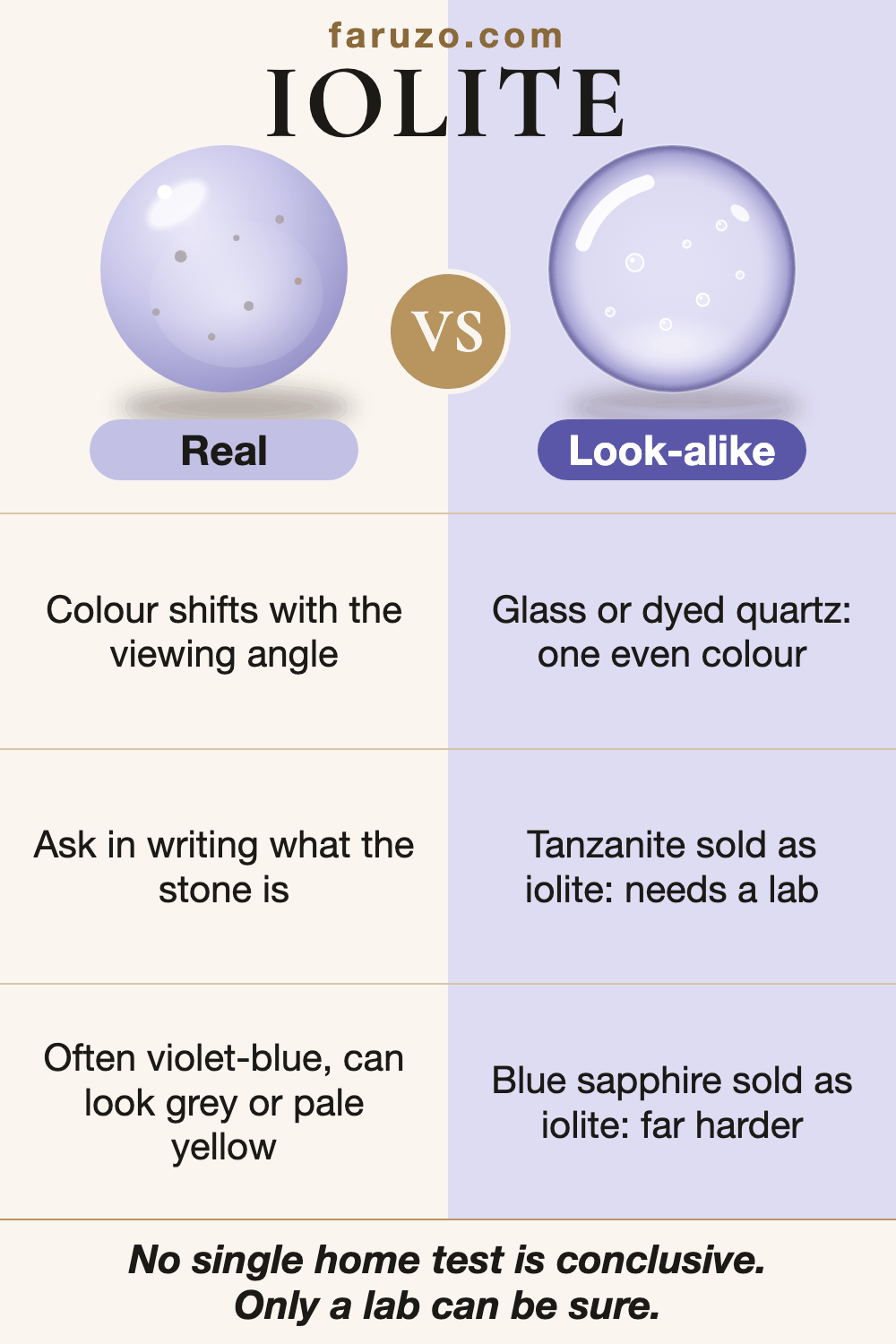
- Tanzanite. Tanzanite is a violet-blue zoisite that is also pleochroic, so a quick tilt cannot separate the two. It is a little softer (Mohs 6 to 7 against 7 to 7.5). Colour alone is not a safe guide, so a lab can confirm.
- Blue sapphire. Blue sapphire is a different mineral and much harder (Mohs 9). Iolite is the softer stone and is often much lower in price, so a bargain 'sapphire' with a violet-blue to grey colour change deserves a question.
- Amethyst. Amethyst is purple quartz. It usually looks one even purple from every side, while iolite flips between violet-blue and pale yellow or grey.
- Dyed or coloured quartz. Quartz can be coloured violet-blue to pass for iolite. It does not show iolite's strong change of colour between directions, and colour that pools in cracks points to dye.
- Blue-violet glass. Glass is a common imitation. It tends to look too even and may show round gas bubbles, and it stays the same colour however you turn it.
Safe checks you can do
- Ask the seller in writing whether the stone is iolite (cordierite), another violet-blue gem, glass or dyed quartz.
- Tilt the stone in daylight. Iolite shows violet-blue from one direction and pale yellow or grey from another, while glass looks the same all round. Tanzanite also changes colour, so this cannot rule it out.
- Be cautious with a stone sold as water sapphire. That name is informal and does not mean sapphire.
- Do not scratch-test or heat-test a stone you plan to keep. A lab is the safer route when it matters.
Wearing Iolite
Ring
Careful
It can split along a flat plane if knocked.
Bracelet
Careful
A knock on a bracelet can split it along a flat plane.
Pendant
Careful
It can split along a flat plane, so keep it protected.
Earrings
Careful
A flat-plane split is possible, so keep earrings for dressy wear.
Guide for everyday wear, based on hardness and care notes. Safe, Careful or Avoid.
Iolite is fairly hard at 7 to 7.5, but fair cleavage in one direction means a hard knock can chip or split it, so every piece needs some care. A ring or bracelet takes the most knocks and suits occasional wear, while pendants and earrings sit clear of most impacts. Take it off for the gym, gardening and rough work.
Related stones
Questions about Iolite
What does iolite mean?
In crystal tradition iolite is a stone of intuition, inner vision and finding direction, linked to the Third Eye chakra. That is a belief, not a fact about the stone. Its practical claim to fame is a violet-blue colour that shifts as you tilt it.
What is iolite?
Iolite is the gem variety of the mineral cordierite, a magnesium iron aluminium silicate with the formula (Mg,Fe)2Al4Si5O18. The name comes from the Greek word for violet.
Is iolite the same as cordierite?
Yes, in the sense that iolite is gem-quality cordierite. Cordierite is the mineral name, and iolite is the name used for the violet-blue stones cut as gems.
Why does iolite change colour?
Iolite is strongly pleochroic, so light travels through it differently in different directions. Looked at one way it is violet-blue, and from another it can be pale yellow or grey. Cutters usually orient the stone to show the best blue through the top.
How hard is iolite?
7 to 7.5 on the Mohs scale, a little harder than quartz. Hardness only measures scratching, though. It also has fair cleavage in one direction, so a sharp knock can still chip or split it.
Is iolite a birthstone?
Iolite is not on the standard modern or traditional birthstone lists, though lists vary. It is also named as a gem for a 21st wedding anniversary. Check the list you are following.
What is the Viking sunstone story?
A popular story says Viking navigators used thin slices of iolite to find the sun through cloud, because the stone changes colour with the angle of polarised sky light. It is unproven: no such stone is known from a Viking ship, so treat it as a legend.
Is iolite the same as tanzanite or water sapphire?
No. Tanzanite is a different mineral (zoisite), and sapphire is corundum. Water sapphire is only an informal nickname for iolite. Iolite and tanzanite can look alike, and a lab can tell them apart.
Is iolite a good lower-cost alternative to tanzanite or sapphire?
Iolite is generally much less costly than tanzanite or sapphire, and its best violet-blue colours can look close to tanzanite. It is softer than sapphire and has a cleavage direction, so it suits gentler wear. Ask the seller to name the stone in writing.
Can you wear an iolite ring every day?
It is not the best choice. Iolite is fairly hard, but a knock on a ring hand can chip or split it along its cleavage direction. Pendants and earrings take fewer knocks, and a ring suits occasional wear.
Can iolite get wet, and can you clean it in an ultrasonic cleaner?
A short rinse in lukewarm water is fine, but do not soak it. To be safe, skip ultrasonic and steam cleaners, since vibration and sudden temperature changes can stress a stone with a cleavage direction.
How can you tell real iolite from fake?
A home look can only hint. Real iolite shows violet-blue from one direction and pale yellow or grey from another, while glass looks even all round. Tanzanite, dyed quartz and blue sapphire can look similar, so a lab can confirm a stone that matters.
Is iolite treated or dyed?
Iolite is not typically treated, though heat treatment is reported to produce a green variety called praseolite. Ask the seller to say in writing whether a stone is natural iolite, and remember that dyed quartz is a different material.
Where does iolite come from?
Gem iolite is reportedly found in countries including India, Sri Lanka, Madagascar, Brazil, Myanmar, Tanzania and Namibia. Cordierite itself was first described near Nijar in southern Spain in 1813.