
Crystal guide
Rose Quartz Meaning, Properties and Care
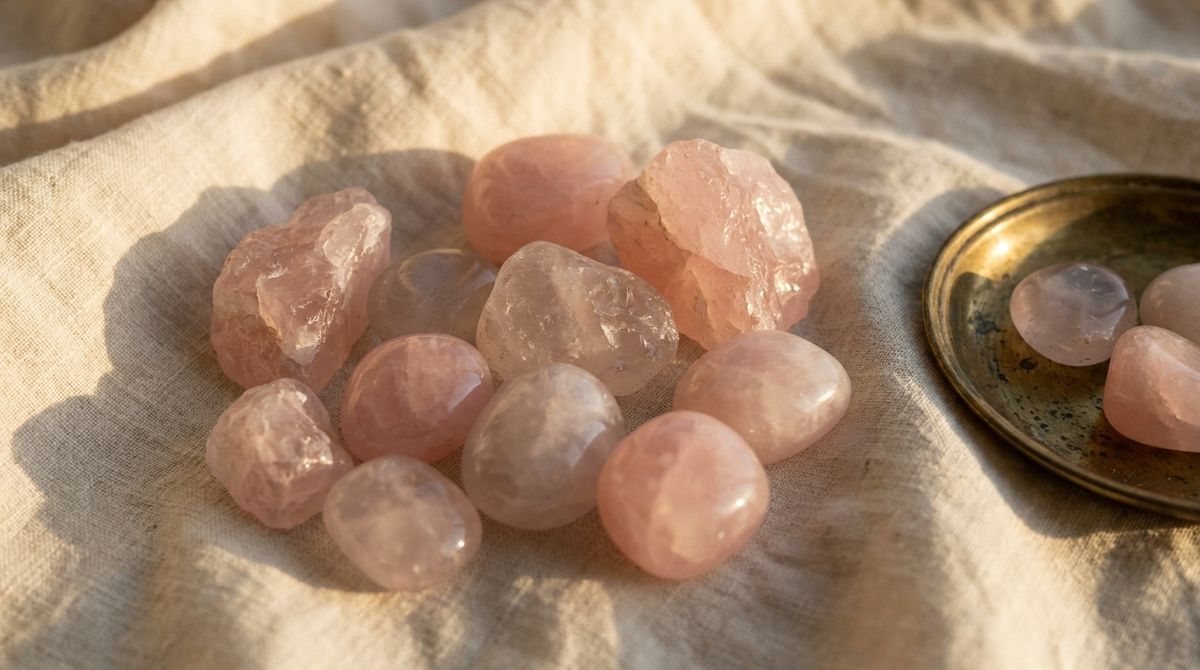
Rose quartz is the pink, usually cloudy variety of quartz (SiO2, Mohs 7). Its colour comes from microscopic pink fibres of a mineral related to dumortierite, trapped inside the quartz. It is not on the standard birthstone list, and in crystal tradition it is the stone linked to love and the heart.
At a glance
- Hardness Mohs 7 with no good cleavage: a hard knock is more of a risk than everyday wear.
- Quartz (SiO2) coloured by microscopic pink mineral fibres, not by a surface dye.
- Usually cloudy to translucent; the clearest, finest material is often faceted.
- Care: keep it out of long strong sun (it may fade) and skip steam and machine cleaners.
Quick facts
| Family | Quartz (silica group) |
|---|---|
| Chemical formula | SiO2 |
| Crystal system | Trigonal (alpha-quartz). Massive rose quartz does not form visible crystals; the crystal-forming pink variety is called pink quartz. |
| Mohs hardness | 7 |
| Luster | Vitreous (glassy) for quartz; massive material can look waxy to dull |
| Transparency | Usually translucent to cloudy because of tiny inclusions. The finest material is often transparent and is usually faceted. |
| Natural colors | very light pink (almost white), light to medium pink, medium-dark pink |
| Common treatments | occasionally treated with radiation to intensify colour; quartz in general can be dyed, and cheap beads may be dyed or heated, so check what was done |
Rose Quartz at a glance, in pictures
Chakras (traditional)
Hardness range
Natural colors
- very light pink (almost white)
- light to medium pink
- medium-dark pink
Traditionally linked to
- Planet
- Venus
- Zodiac
- TaurusLibra
- Element
- Water
Common forms of Rose Quartz
- Rough raw chunk
- Tumbled polished pebble
- Cabochon smooth dome
- Faceted cut gem
How hard is Rose Quartz?
- Talc 1
- Gypsum 2
- Copper coin ~ 3
- Calcite 3
- Fluorite 4
- Apatite 5
- Glass ~ 5.5
- Steel knife ~ 5.5
- Orthoclase 6
- Rose Quartz 7
- Topaz 8
- Corundum 9
- Diamond 10
What it is and where it comes from
Rose quartz forms in the quartz cores of pegmatites.
Rose quartz beads dating to about 7000 BC have reportedly been found in Mesopotamia (present-day Iraq), which would make it among the earliest worked ornamental stones.
More on its history
Assyrian craftsmen reportedly made rose quartz jewelry around 800 to 600 BC, and the Romans used it as a seal to mark ownership.
Some anniversary lists pair rose quartz with the fifth wedding anniversary.
For decades rutile (titanium dioxide) inclusions were assumed to cause the colour. Pink fibres 0.1 to 0.5 micrometres wide are now thought to colour massive rose quartz worldwide; the fibre mineral is related to dumortierite but not identical to it.
Rose quartz and pink quartz are treated as different varieties: rose quartz is usually massive and rarely forms well-shaped crystals, while pink quartz forms transparent crystals and is photosensitive, so it can fade.
Rose Quartz through time
-
About 800 to 600 BC
Assyrian craftsmen reportedly made rose quartz jewelry.
-
Ancient Rome
The Romans used it as a seal to mark ownership.
-
Recent decades
Rutile was long assumed to colour it; pink fibres 0.1 to 0.5 micrometres wide are now thought to.
In crystal tradition
What follows is belief and folklore, passed down in crystal tradition. It is not measured fact.
Traditionally associated with: love, self-kindness, forgiveness.
Rose quartz is traditionally associated with the Heart chakra (Anahata). This is a modern spiritual tradition, not a fact about the stone.
Rose quartz is traditionally associated with the zodiac sign Taurus (Libra is sometimes linked too), the planet Venus and the element Water. These mappings differ between lists and have no scientific basis.
Rose quartz has long been called the love stone and is traditionally associated with love, self-kindness and forgiveness. These are symbolic meanings, not effects on the body or mind.
How to care for Rose Quartz
- Water Safe
- Sunlight Caution
- Salt Unknown
- Heat Unknown
- Ultrasonic Avoid
- Chemicals Caution
Safe = fine as a rule · Caution = only briefly or gently · Avoid = can damage the stone · Unknown = no reliable guidance.
Warm, soapy water is a safe way to clean rose quartz; ultrasonic and steam cleaners should be avoided. Rose quartz may fade with long, strong sun, and crystal-forming pink quartz is more clearly photosensitive, so keep it out of strong sun. Effects of heat or salt are not well documented, so avoid torch or open-flame work near the stone. Dyed or treated pieces need extra care: many dyes can be removed by solvents such as alcohol or acetone, and some fade in sunlight, so avoid solvents and strong cleaners on them. Hardness 7 and the absence of a good cleavage plane mean it is not fragile, but rough handling is still best avoided.
Real or fake? Look-alikes and treatments
Often confused with
- Morganite
- Pink quartz (crystalline rose quartz)
- Dyed quartz
- Pink glass
- Kunzite
Common look-alikes
- Morganite. Morganite is beryl (Be3Al2Si6O18), Mohs 7.5 to 8, refractive index about 1.57 to 1.60, specific gravity 2.80 to 2.91, pink to orange-pink with distinct pleochroism. Rose quartz is Mohs 7, refractive index 1.544 to 1.553, specific gravity 2.66. The values differ, so a gemologist can separate them with a refractometer or density test; colour alone is not a reliable guide.
- Pink quartz (crystalline rose quartz). Same mineral species, but a different variety: it forms real, transparent crystals (rose quartz does not) and is photosensitive, so it can fade.
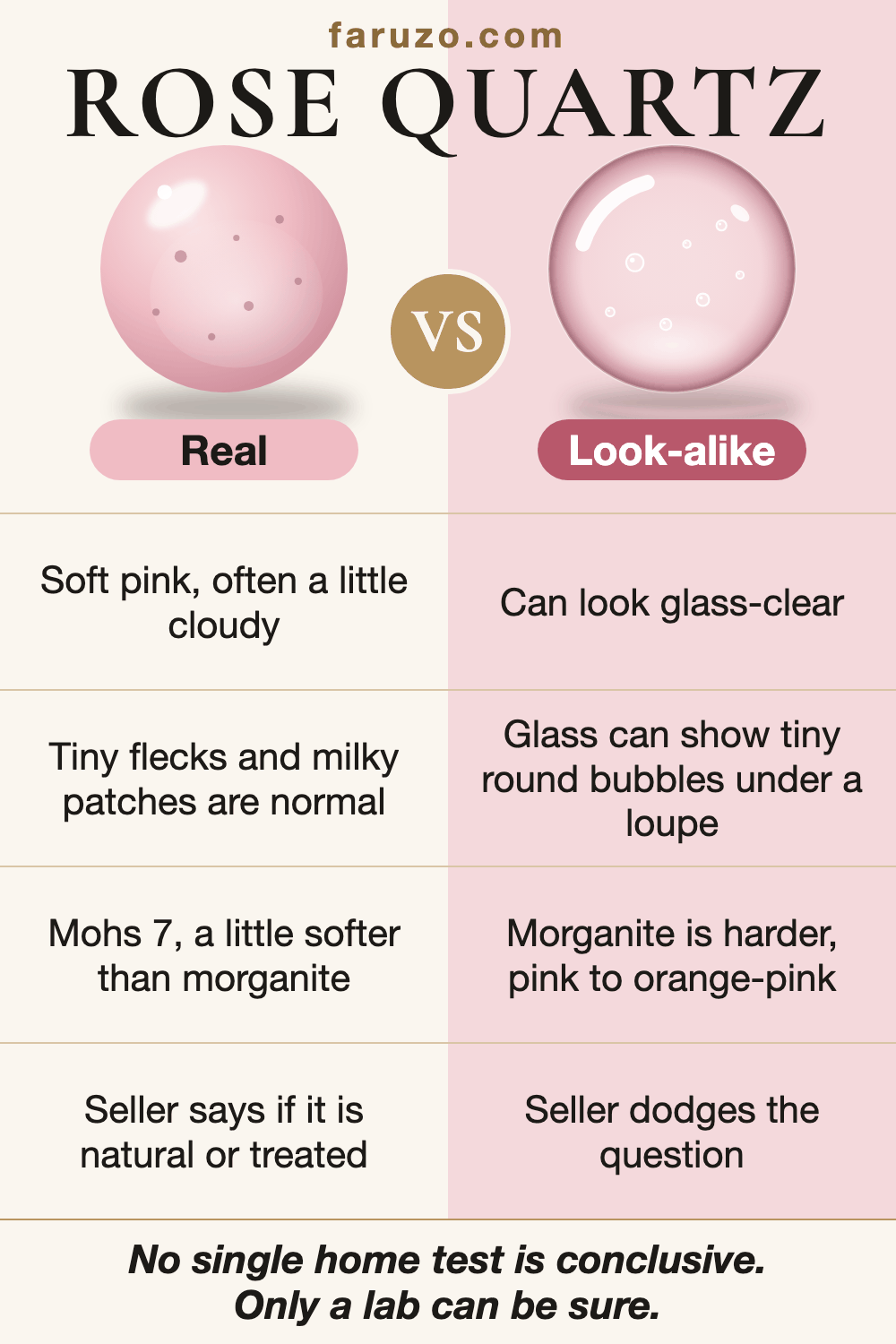
- Dyed quartz. Quartz can be dyed, and cheap pink beads in particular may be dyed or heated to look more even or deeper in colour. Dye is usually visible under magnification, and a qualified gemologist can usually detect it. Refractive index and specific gravity do not separate dyed quartz from undyed quartz, because dyed quartz is still quartz. Many dyes can also be removed by solvents.
- Pink glass. Glass is an old gem imitation that is still common. Tiny round gas bubbles seen under a loupe point to glass, and a gemologist can compare its refractive index and specific gravity with rose quartz (1.544 to 1.553 and 2.66).
- Kunzite. Kunzite is spodumene (LiAlSi2O6), Mohs 6.5 to 7, refractive index 1.660 to 1.676, pink to violetish purple, and it has two cleavage directions. Rose quartz is SiO2 with refractive index 1.544 to 1.553. The refractive index separates them.
Safe checks you can do
- Ask the seller in writing whether the stone is natural, dyed or treated.
- Look closely, ideally with a jeweller's loupe. Natural rose quartz is usually cloudy or translucent from tiny inclusions, while glass can show tiny round gas bubbles. Treat this as a sign, not proof: finest rose quartz can be clear, and a loupe cannot rule out dye.
- For a stone that matters to you, ask a gemologist or lab to measure it. Rose quartz reads refractive index 1.544 to 1.553 and specific gravity about 2.66. These readings separate quartz from morganite, kunzite and glass, but they cannot show that a quartz stone is undyed or untreated.
- To check for dye or treatment, ask for magnified inspection or lab testing. A qualified gemologist can usually detect dyed gems.
- Do not rely on a single check. Any gem can be imitated, and no single home test is conclusive proof that rose quartz is natural. Combine the seller's answer, a close look and, for a stone that matters, a gemologist's measurements.
Wearing Rose Quartz
Ring
Safe
Hard enough for daily wear; a protective setting guards knocks.
Bracelet
Safe
Beads and links hold up well to everyday knocks.
Pendant
Safe
Few knocks as a pendant.
Earrings
Safe
Light, and rarely knocked.
Guide for everyday wear, based on hardness and care notes. Safe, Careful or Avoid.
Rose quartz is durable enough for all types of jewelry, but rough handling should be avoided. At Mohs 7 it is harder than many common minerals, and its cleavage is indistinct or absent, so a pendant, bead bracelet or earring suits it well. Cloudiness comes mostly from tiny inclusions and fractures, so even fine rose quartz is often translucent rather than clear. In a ring the main risk is a hard knock rather than daily wear, and a protective setting helps. Remove it before using cleaning products or solvents, and clean it gently.
Questions about Rose Quartz
What does rose quartz mean?
In crystal tradition rose quartz is the love stone, traditionally associated with love, self-kindness and forgiveness. These are symbolic meanings from tradition, not facts about the stone or claims about your health.
Why is rose quartz pink?
Massive rose quartz is thought to be coloured by microscopic pink fibres, 0.1 to 0.5 micrometres wide, of a mineral related to dumortierite, trapped inside the quartz. Rutile was once suggested as the cause, but it is no longer thought to be. Cloudiness is usually attributed to tiny inclusions, microscopic fibrous mineral inclusions and tiny fractures.
Is rose quartz a birthstone?
Not on the standard birthstone list. Some anniversary lists do pair it with the fifth wedding anniversary. Crystal tradition also pairs it with a zodiac sign, which is separate from birthstones.
What chakra is rose quartz linked to?
Modern crystal tradition links rose quartz to the Heart chakra (Anahata). This is a spiritual tradition with no scientific basis, and the mapping varies between lists.
What zodiac sign is rose quartz for?
Crystal tradition usually pairs rose quartz with Taurus, and Libra is sometimes added. It is also paired with Venus and the element Water. These pairings come from modern crystal lore and differ between lists.
Can rose quartz go in water?
Briefly, yes: a rinse and a drop of mild soap in warm water are a safe way to clean it. For dyed or treated pieces, many dyes can be removed by solvents such as alcohol or acetone and some fade in sunlight, so avoid solvents and long sun.
Does rose quartz fade in the sun?
It may fade with long, strong sun, so keep it out of it. Opinions differ: massive rose quartz is sometimes described as not photosensitive, while crystalline pink quartz is clearly subject to fading. Some dyes are also unstable in sunlight, which matters for any dyed piece.
How do you cleanse rose quartz?
In crystal practice, cleansing is a symbolic ritual; it is not known to change the stone. To physically clean it, use a soft damp cloth. Salt is not a recommended cleaning method.
How can you tell if rose quartz is real or fake?
Home checks alone are not reliable. Ask whether the stone is natural, dyed or treated, and for a stone that matters, ask a gemologist to measure it: rose quartz reads refractive index 1.544 to 1.553 and specific gravity about 2.66. Those readings separate quartz from pink morganite, kunzite and glass, but not dyed or treated quartz from natural quartz. For dye, a qualified gemologist can usually detect dyed gems, so ask for magnified inspection or lab testing.
Is rose quartz hard? Can it scratch other stones?
Rose quartz is Mohs 7, the same as quartz. On the Mohs scale a harder material scratches a softer one, so it can scratch minerals below 7 such as apatite and orthoclase feldspar, and it can be scratched by topaz (8), corundum (9) and diamond (10). The Mohs scale is not linear, so each step is not the same size.
Can I wear rose quartz every day?
Yes for most pieces: Mohs 7 and no good cleavage make it forgiving. A pendant or earring is a lower-risk choice. A ring takes more knocks, so a protective setting is a sensible choice.
Is rose quartz treated or dyed?
Rose quartz is occasionally treated with radiation to intensify its colour. Quartz in general can be dyed, and cheap beads may be dyed or heated, so check what was done.
What is the difference between rose quartz and pink quartz?
Both are pink quartz, but they are treated as different varieties. Rose quartz is massive, cloudy and does not form crystals; its colour comes from mineral fibres. Pink quartz forms real crystals, is reported to pale in direct sunlight, and gets its colour from a different cause involving aluminium and phosphorus. Pink quartz is rarer and mostly sold to collectors.
What makes rose quartz more or less valuable?
Even, pleasing pink is the most desirable. The deepest colours often occur in larger sizes, so small pieces with deep colour tend to be scarce.
Why do some rose quartz beads look too even or too dark?
Beads that look unusually even, very dark or bright may be dyed or heated, and cheap strands are the likeliest. Natural rose quartz is usually a soft pink with a little cloudiness and some variation between beads. Dyed beads may leave colour on a damp white cloth, but this is not a reliable test, so compare strands against a natural sample.
Does rose quartz really work?
People who hold a stone often report feeling something, but this feeling is not evidence the stone is doing anything. People still find rose quartz meaningful, and that is a fair reason to wear it. See your doctor for any health concern.