
Crystal guide
Chrysoberyl Meaning, Properties and Care
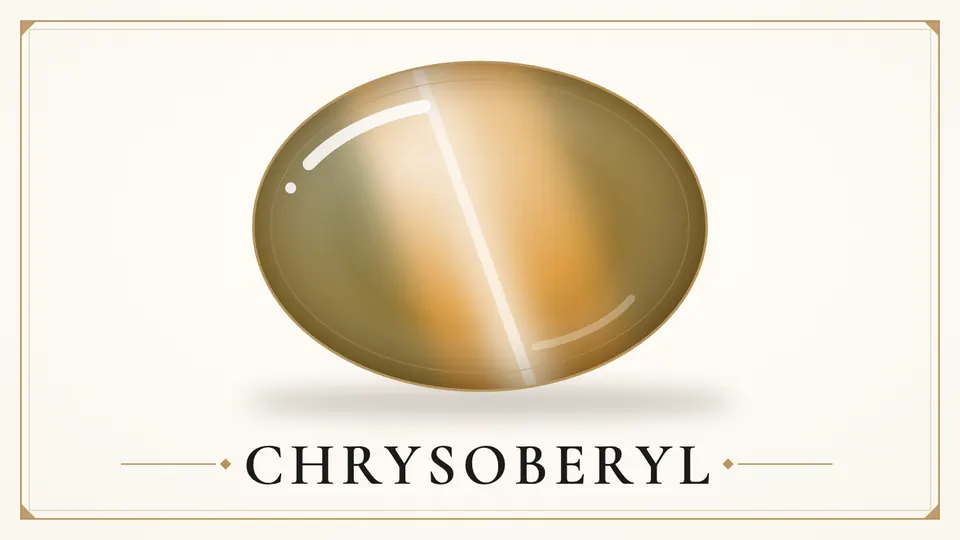
Chrysoberyl is a beryllium aluminium oxide (BeAl2O4) that is found in yellow, yellow-green, green and brownish colours. At Mohs 8.5 it is among the harder gems, and despite the name it is not a beryl. It has two famous forms: cat's eye, which shows a bright line of light across a rounded stone, and alexandrite, which changes colour with the light. In crystal tradition cat's eye is a watchful, protective stone.
At a glance
- Formula BeAl2O4, a beryllium aluminium oxide. It is not a beryl, despite the name.
- Mohs 8.5, very hard, good for bracelets, pendants and earrings. A ring is best in a protective setting.
- Cat's eye (cymophane) shows a bright line from fine needle-like inclusions, and is cut as a rounded cabochon.
- Alexandrite is the colour-change form and has its own page. Chrysoberyl itself is not on the standard birthstone lists.
Quick facts
| Family | Chrysoberyl (beryllium aluminium oxide); not a beryl, despite the similar name |
|---|---|
| Chemical formula | BeAl2O4 |
| Crystal system | Orthorhombic; it often forms twinned crystals called trillings that look six-sided |
| Mohs hardness | 8.5 |
| Luster | Vitreous |
| Transparency | Transparent when faceted; cat's-eye stones are translucent to semi-transparent and cut as cabochons |
| Natural colors | yellow to yellow-green; green; brownish yellow to brownish green, as seen in cat's-eye stones; colour-change stones are alexandrite (separate page) |
| Main localities | Brazil, Sri Lanka |
| Common treatments | ask the seller in writing whether a stone is natural, lab-created or another material; a lab-created stone is real chrysoberyl made by people rather than mined |
| Birth month | Chrysoberyl is not a standard birthstone; its colour-change form, alexandrite, is a June birthstone |
Chrysoberyl at a glance, in pictures
Hardness range
Natural colors
- yellow to yellow-green
- green
- brownish yellow to brownish green, as seen in cat's-eye stones
- colour-change stones are alexandrite (separate page)
Common forms of Chrysoberyl
- Rough raw chunk
- Faceted cut gem
- Cabochon smooth dome
How hard is Chrysoberyl?
- Talc 1
- Gypsum 2
- Copper coin ~ 3
- Calcite 3
- Fluorite 4
- Apatite 5
- Glass ~ 5.5
- Steel knife ~ 5.5
- Orthoclase 6
- Quartz 7
- Topaz 8
- Chrysoberyl 8.5
- Corundum 9
- Diamond 10
What it is and where it comes from
The name comes from the Greek words for gold and beryl, which hints at its yellow to golden colours. The two minerals are unrelated, and chrysoberyl is a different gem from beryl.
Chrysoberyl has three main forms. Plain yellow to green stones are cut with facets, cat's eye (also called cymophane) is cut as a cabochon, and alexandrite is the colour-change variety.
Cat's eye gets its glowing line from fine, needle-like inclusions packed in parallel. In chrysoberyl they are generally described as rutile, and they reflect light into a narrow band across the stone.
To show the line, a cutter shapes the stone as a rounded cabochon with its base parallel to the needles. A faceted stone does not show the effect well.
Used on its own, the words "cat's eye" usually mean chrysoberyl cat's eye. Other stones, such as quartz, tourmaline and apatite, can also show a cat's-eye effect, but they are different minerals.
Brazil and Sri Lanka are major sources of chrysoberyl, largely from alluvial deposits.
In crystal tradition
What follows is belief and folklore, passed down in crystal tradition. It is not measured fact.
Traditionally associated with: protection, focus, watchfulness.
In crystal tradition, cat's eye is linked with protection, watchfulness and a clear head, an idea drawn from its look of a narrow, watching eye. This is a belief, not a fact about the stone.
Plain yellow-green chrysoberyl has few settled traditions of its own, and its colour-change form, alexandrite, carries its own meanings on a separate page.
How to care for Chrysoberyl
- Water Safe
- Sunlight Unknown
- Salt Unknown
- Heat Caution
- Ultrasonic Caution
- Chemicals Unknown
Safe = fine as a rule · Caution = only briefly or gently · Avoid = can damage the stone · Unknown = no reliable guidance.
Warm soapy water and a soft brush are a good way to clean chrysoberyl. Ultrasonic and steam cleaners are usually safe for the colour-change form, but if you do not know how a stone was made or treated, wipe it with a damp cloth instead. Store it apart from other gems so a harder one cannot scratch it.
Real or fake? Look-alikes and treatments
Often confused with
- Quartz cat's eye
- Fibre-optic glass sold as cat's eye
- Tiger's eye
- Apatite cat's eye
- Tourmaline cat's eye
Common look-alikes
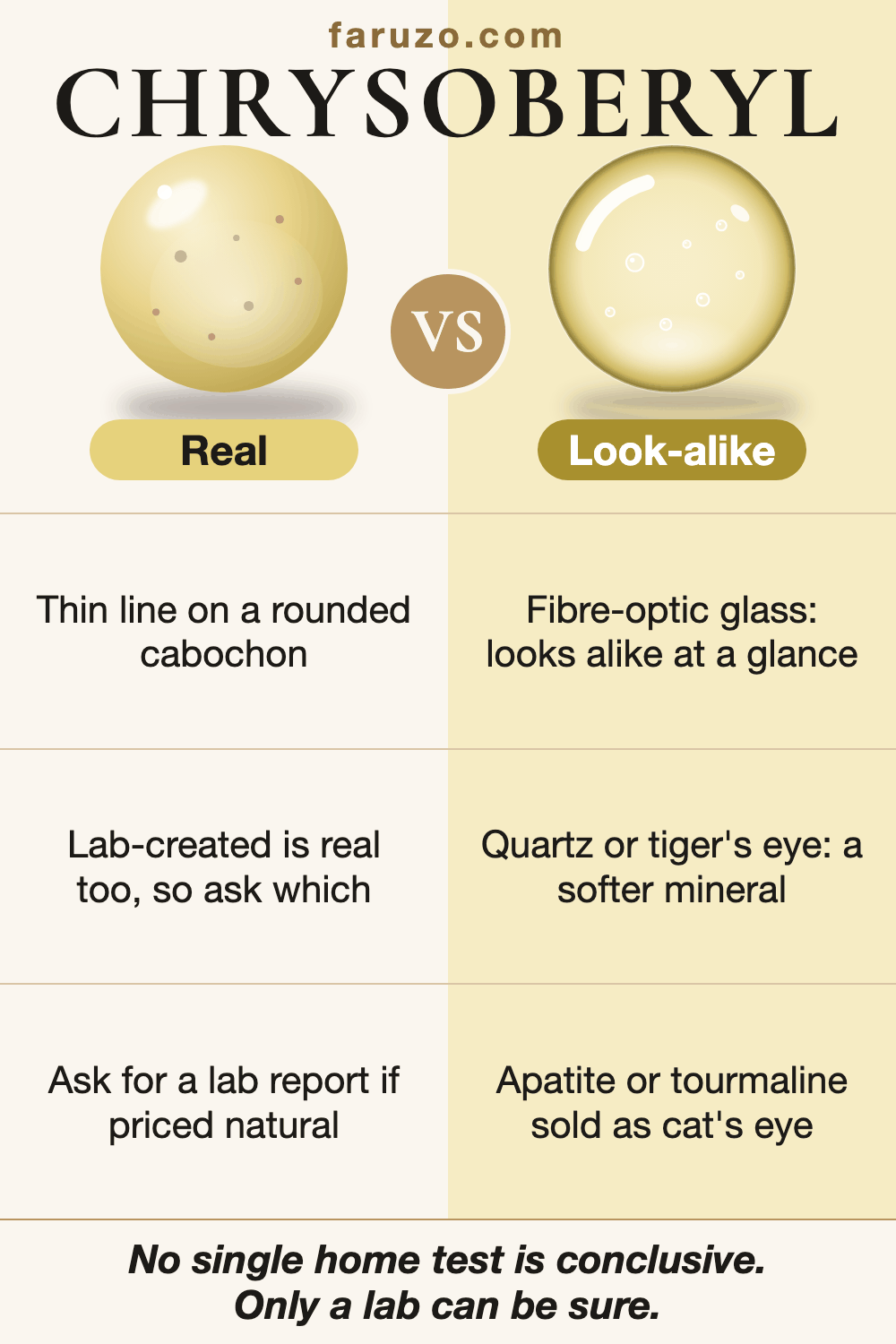
- Quartz cat's eye. Quartz can show a cat's-eye effect, but it is a different mineral and softer than chrysoberyl. The line alone cannot settle it, so a gem lab can confirm.
- Fibre-optic glass sold as cat's eye. Glass made from fused, very thin glass fibres can look like cat's-eye chrysoberyl at first glance, even set in a ring. A gem lab can tell them apart, for example by refractive index: chrysoberyl is about 1.74 to 1.75, and fibre-optic glass usually has a lower one.
- Tiger's eye. Tiger's eye is a quartz whose effect comes from parallel fibrous crystals. It is a different material from chrysoberyl and softer than it.
- Apatite cat's eye. Apatite can also show a cat's-eye effect. It is a different mineral and much softer, so it scratches and wears far more easily than chrysoberyl.
- Tourmaline cat's eye. Tourmaline can show a cat's-eye effect, so it can resemble chrysoberyl cat's eye. It is a different mineral, and a gem lab can confirm which one a stone is.
Safe checks you can do
- Ask the seller in writing whether the stone is natural chrysoberyl, lab-created chrysoberyl or another material that shows a cat's-eye line.
- Look at the cut and the effect. A real cat's-eye line needs a rounded cabochon with the base cut parallel to the needles, so a faceted stone with a line is a warning sign.
- Do not trust the line alone. Fibre-optic glass can resemble chrysoberyl cat's eye at first glance, so the look does not settle it.
- For a stone priced as natural, ask for a gem lab report. A lab can measure properties, such as refractive index, that a home look cannot.
- Do not scratch-test a stone you plan to keep. Lab-created chrysoberyl has the same hardness as natural stone, so a hardness test cannot tell them apart.
Wearing Chrysoberyl
Ring
Careful
Very hard, but a hard knock can still chip it.
Bracelet
Safe
Very hard, so fine for daily wear.
Pendant
Safe
Very hard and takes few knocks: fine for daily wear.
Earrings
Safe
Very hard and takes few knocks: fine for daily wear.
Guide for everyday wear, based on hardness and care notes. Safe, Careful or Avoid.
At Mohs 8.5, chrysoberyl is very hard, and it suits bracelets, pendants and earrings for daily wear. Some references note a cleavage direction, so a ring is best kept in a protective setting and taken off for heavy work and hard knocks. A cat's-eye cabochon stands proud of its setting, so a protective setting keeps its dome safe from knocks.
Related stones
Questions about Chrysoberyl
What does chrysoberyl mean?
In crystal tradition cat's-eye chrysoberyl is a stone of protection and watchfulness, from its look of a watching eye. That is a belief, not a fact about the stone. Its practical claim to fame is a hardness of Mohs 8.5 and the bright cat's-eye line.
What is chrysoberyl?
Chrysoberyl is a beryllium aluminium oxide with the formula BeAl2O4. It is found in yellow, yellow-green and green colours, and it is not a beryl, despite the similar name.
What is cat's eye, or cymophane?
Cat's eye, also called cymophane, is chrysoberyl that shows a bright line of light across a rounded stone. The line comes from fine, needle-like inclusions packed in parallel, which reflect light into a narrow band. The stone is cut as a cabochon to show it.
How hard is chrysoberyl?
Mohs 8.5, below sapphire and ruby (9) and diamond (10) but harder than topaz (8) and most other gems. That is very hard for everyday jewellery.
Is chrysoberyl a birthstone?
Chrysoberyl is not on the standard modern or traditional birthstone lists, though lists vary. Its colour-change form, alexandrite, is a June birthstone with pearl and moonstone.
What is the difference between chrysoberyl and alexandrite?
Alexandrite is a variety of chrysoberyl. Traces of chromium make it look green in daylight and red in lamplight. Plain chrysoberyl and cat's eye do not change colour like that. Alexandrite has its own page.
Is lab-created chrysoberyl real?
A lab-created stone is real chrysoberyl made by people instead of mined. It has the same hardness as natural stone, and it should be sold as lab-created. Origin and price are the difference, not durability.
Is the cat's eye in a shop real chrysoberyl?
Not always. Quartz, tourmaline, apatite and fibre-optic glass can all show or resemble a line of light. Ask the seller in writing what the stone is, and ask for a gem lab report for any stone priced as natural chrysoberyl cat's eye.
How can you tell real cat's-eye chrysoberyl from glass or other stones?
A home look can only hint. Fibre-optic glass can resemble chrysoberyl cat's eye at first glance, and other minerals can show a similar line. A gem lab can measure properties such as refractive index, which is how to be sure about a stone that matters.
Can you wear a chrysoberyl ring every day?
Often yes, since Mohs 8.5 is very hard, but a ring is the piece that takes the most knocks. Some references note a cleavage direction, so a hard knock could still chip it. A protective setting helps, and so does taking it off for heavy work.
How do you clean chrysoberyl?
Warm soapy water and a soft brush work well. Ultrasonic and steam cleaners are usually safe for the colour-change form, but if you do not know how a stone was made or treated, a damp cloth is the safer choice.
Where does chrysoberyl come from?
Brazil and Sri Lanka are major sources of chrysoberyl, largely from alluvial deposits.