
Crystal guide
Topaz Meaning, Properties and Care
Topaz is an aluminium silicate mineral that also holds fluorine and hydroxyl, with the formula Al2SiO4(F,OH)2. It is hard, at 8 on the Mohs scale, but it has perfect cleavage in one direction, so a sharp knock can split it cleanly. Natural colours run from colourless to yellow, orange, pink and red, and most blue topaz is colourless topaz that has been treated. In crystal tradition it is a stone of clarity and confidence.
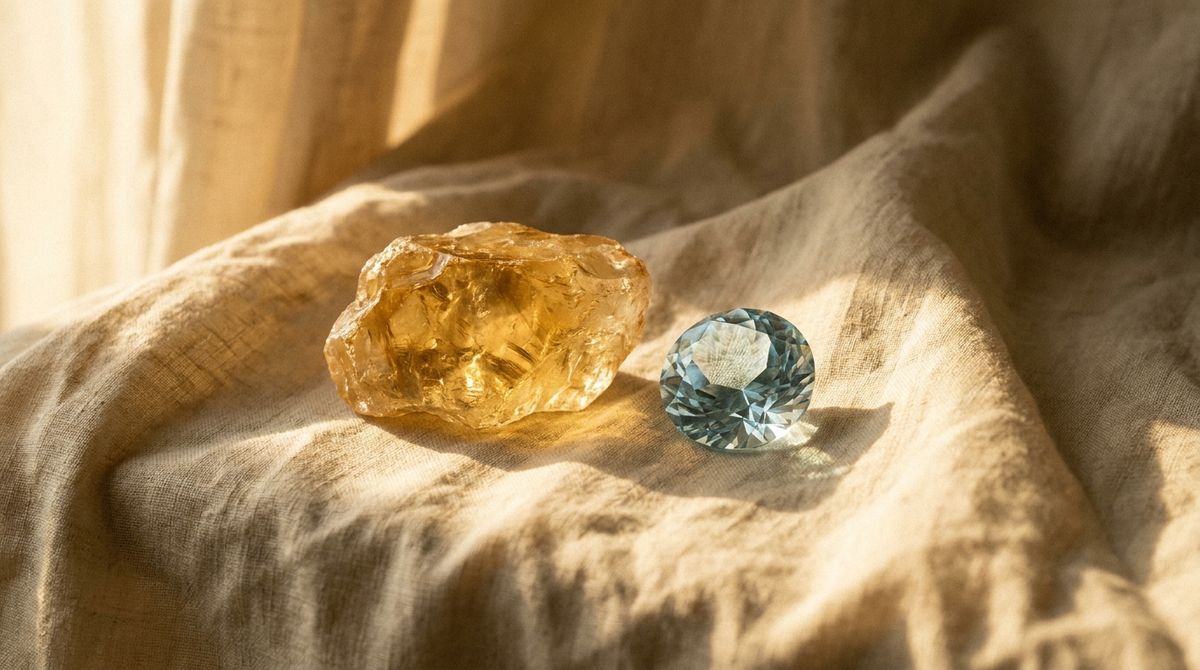
At a glance
- Formula Al2SiO4(F,OH)2, Mohs 8, but with perfect cleavage in one direction, so it can split if knocked.
- Most blue topaz is treated: colourless topaz that has been irradiated and heated. It is still real topaz.
- Mystic topaz is real topaz with a thin coating on the surface that gives a rainbow effect.
- Topaz is a November birthstone, shared with citrine, which is a different stone. Care: soft cloth, mild soap, no ultrasonic or steam.
Quick facts
| Family | Aluminium fluorosilicate mineral with hydroxyl, a nesosilicate |
|---|---|
| Chemical formula | Al2SiO4(F,OH)2 |
| Crystal system | Orthorhombic, usually as columnar prismatic crystals |
| Mohs hardness | 8 |
| Luster | Vitreous, with perfect cleavage in one direction |
| Transparency | Transparent; cut stones are typically eye clean with no visible inclusions |
| Natural colors | colourless, blue, yellow, orange, brown, pink to red, violet, light green |
| Main localities | Brazil (Minas Gerais), Russia (Ural Mountains), Pakistan, Sri Lanka, Nigeria, Mexico, Ukraine, USA (Utah and Texas) |
| Common treatments | blue colour is hardly ever natural: colourless, grey or pale material is usually irradiated and heated to make a deeper blue; many brown or pale stones are treated to look yellow, gold, pink or violet; mystic topaz is colourless topaz given a surface coating that makes a rainbow effect; ask the seller which treatments were used |
| Birth month | November (topaz, shared with citrine); blue topaz is also named for December |
Topaz at a glance, in pictures
Chakras (traditional)
Hardness range
Natural colors
- colourless
- blue
- yellow
- orange
- brown
- pink to red
- violet
- light green
Traditionally linked to
- Zodiac
- SagittariusScorpio
Common forms of Topaz
- Rough raw chunk
- Faceted cut gem
How hard is Topaz?
- Talc 1
- Gypsum 2
- Copper coin ~ 3
- Calcite 3
- Fluorite 4
- Apatite 5
- Glass ~ 5.5
- Steel knife ~ 5.5
- Orthoclase 6
- Quartz 7
- Topaz 8
- Corundum 9
- Diamond 10
What it is and where it comes from
The name is traced to Topazios, an old Greek name for a Red Sea island now called Zabargad. That island was reportedly not a source of topaz but of peridot, so the name may have first been given to the wrong stone. A Sanskrit word for fire, tapas, is another proposed origin.
Topaz can grow very large. A transparent crystal of about 596 pounds (271 kilos) has come from Minas Gerais in Brazil, and the biggest crystals are weighed in kilos, not carats.
More on its history
Pure topaz is colourless. Traces of chromium give the natural pink, red and violet colours, and the mineral also occurs in yellow, orange, brown, blue and light green. Some stones are pleochroic, showing different colours in different crystal directions.
Imperial topaz is the rare warm case, a medium reddish orange to orange-red, sometimes with a pink cast. It is among the most valued colours, and pink topaz is rare when it is natural.
Crystals are usually columnar and are often cut as ovals or pears to improve yield. Faceted topaz takes such a high polish that it can feel slightly slippery to the touch. Because of the cleavage plane, cutters have to shape and orient each stone with care.
Gem material comes from Brazil, Russia, Pakistan, Sri Lanka, Nigeria and Mexico, among other places. Topaz Mountain in Utah is a well-known locality in the USA, and colourless to pale blue topaz also occurs in Texas.
Topaz through time
-
1768
The royal court in Portugal celebrates the discovery of imperial topaz.
-
1800s
Imperial topaz gets its name in Russia, where pink stones from the Ural Mountains honour the czar and are reserved for the royal family.
-
1969
The Texas legislature adopts blue topaz as the state gem.
In crystal tradition
What follows is belief and folklore, passed down in crystal tradition. It is not measured fact.
Traditionally associated with: clarity, confidence, strength.
In tradition, topaz has long been linked with strength, protection and clarity. The ancient Greeks held that it gave strength, and in Renaissance Europe it was believed to break spells and dispel anger. These are beliefs, not effects of the stone.
In India it has long been believed that topaz worn above the heart brings long life, beauty and intelligence. Treat that as folklore.
Modern crystal tradition links golden topaz with the Solar Plexus chakra and blue topaz with the Throat chakra, and with confidence and clear speech. Zodiac links vary from one tradition to another, with Sagittarius and Scorpio both named for November. Treat all of this as folklore.
How to care for Topaz
- Water Safe
- Sunlight Caution
- Salt Unknown
- Heat Caution
- Ultrasonic Avoid
- Chemicals Caution
Safe = fine as a rule · Caution = only briefly or gently · Avoid = can damage the stone · Unknown = no reliable guidance.
Wipe topaz with a soft cloth, mild soap and lukewarm water, then dry it. Skip ultrasonic and steam cleaners and sudden temperature changes, because a stone that can split along a cleavage plane is better kept from vibration and shock. Mystic topaz carries a thin surface coating, so keep it away from abrasive cleaning and harsh chemicals. Some imperial topaz can fade after long sun exposure, so store pieces in a soft pouch away from strong light and away from harder gems, and take them off before sport and rough work.
Real or fake? Look-alikes and treatments
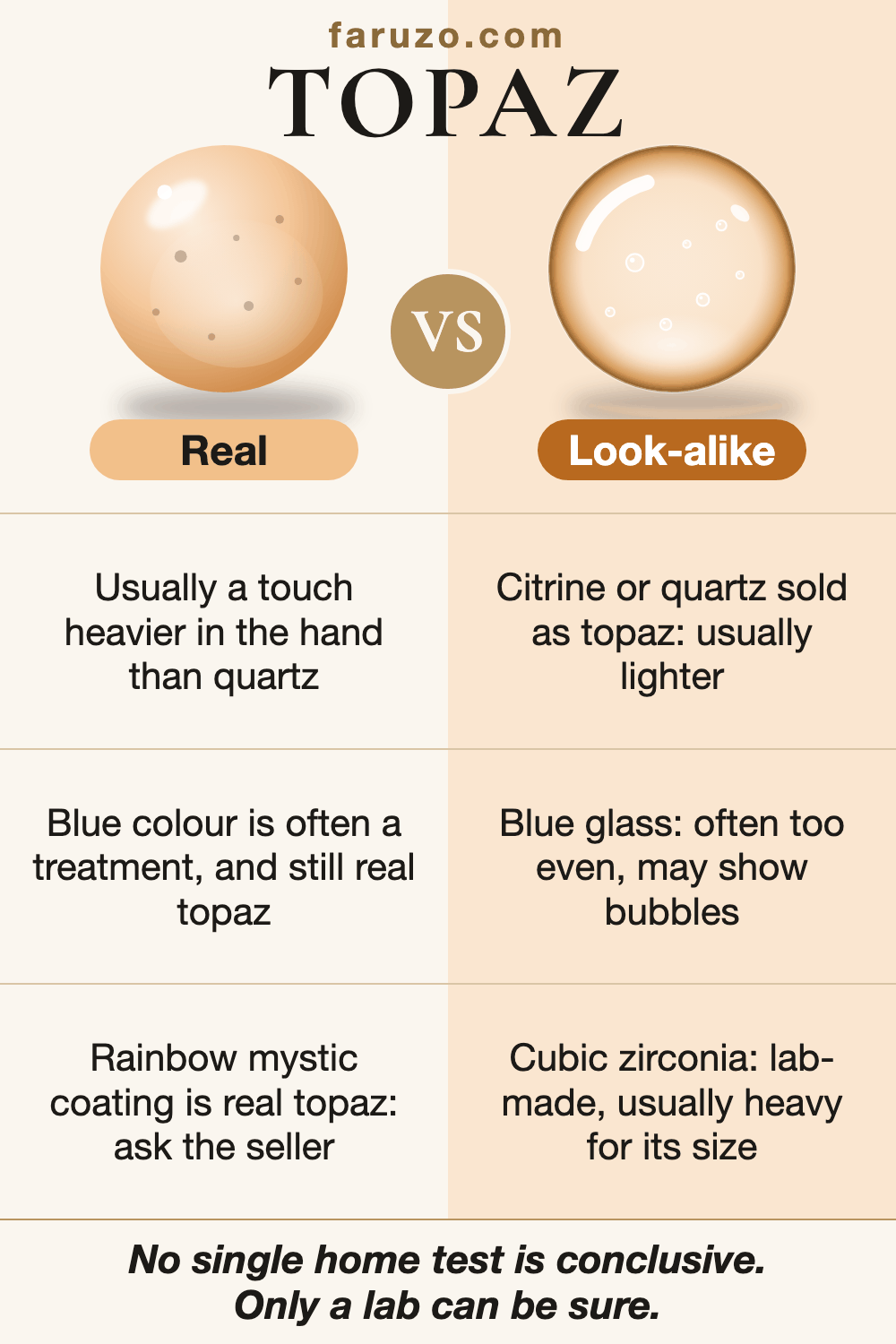
Often confused with
- Citrine (sold as topaz)
- Aquamarine
- Blue glass
- Cubic zirconia
- Quartz (colourless or pale)
Common look-alikes
- Citrine (sold as topaz). Yellow to golden quartz has been sold as topaz. Citrine is quartz, Mohs 7, with no perfect cleavage, while topaz is Mohs 8 and about 25% heavier for the same size. Colour alone cannot separate them, so a gem lab can confirm.
- Aquamarine. Aquamarine is blue beryl, a different mineral. Strong sky blue is more typical of treated topaz, while aquamarine is often a lighter, softer blue, but pale stones can look alike. A gem lab can separate them.
- Blue glass. Glass is a common imitation of blue topaz. It tends to look too even, can show round gas bubbles or swirl lines, and is softer than topaz, so it picks up scratches.
- Cubic zirconia. Cubic zirconia is a man-made stone sold in every colour. It usually feels noticeably heavy for its size and flashes more rainbow colour than topaz. A gem lab can confirm.
- Quartz (colourless or pale). Clear or pale quartz can pass for colourless topaz. Quartz is Mohs 7, lighter in the hand and has no perfect cleavage, but the two look close, so a gem lab can confirm.
Safe checks you can do
- Ask the seller in writing whether the stone is natural topaz, treated topaz, coated topaz or another gem such as citrine, glass or cubic zirconia.
- For a blue stone, ask whether the colour is treated. Almost all blue topaz is, and a treated stone is still real topaz, so the point is honest labelling and price.
- For a stone with a rainbow shimmer, ask whether it is mystic topaz. That is real topaz with a surface coating, and it needs gentler care than uncoated topaz.
- For a yellow or golden stone sold as topaz, ask whether it could be citrine. A gem lab can tell them apart by measuring density and refractive index.
- Do not scratch-test or knock-test a stone you plan to keep. Topaz can split along its cleavage plane, and a gem lab is the safer route when it matters.
Wearing Topaz
Ring
Careful
It can split along a flat plane if knocked.
Bracelet
Careful
A knock on a bracelet can split it along a flat plane.
Pendant
Careful
It can split along a flat plane, so keep it protected.
Earrings
Careful
A flat-plane split is possible, so keep earrings for dressy wear.
Guide for everyday wear, based on hardness and care notes. Safe, Careful or Avoid.
Topaz at Mohs 8 resists everyday scratching, but its perfect cleavage means a hard knock can split it cleanly. A ring needs a protective setting and care, and a bracelet takes more knocks than a pendant or earrings, which sit clear of most impacts. Take topaz off for sport and rough work, and treat mystic topaz gently because its colour sits in a thin surface coating.
Related stones
Questions about Topaz
What does topaz mean?
In crystal tradition topaz is a stone of clarity, confidence and strength, with golden topaz linked to the Solar Plexus chakra and blue topaz to the Throat chakra. Those are beliefs, not facts about the stone. Its practical claim is a hard, clear gem in many colours, with one catch: perfect cleavage.
What is topaz?
Topaz is an aluminium silicate mineral that also holds fluorine and hydroxyl, with the formula Al2SiO4(F,OH)2. It forms orthorhombic crystals, often columnar, and the biggest ones are weighed in kilos.
Is topaz a birthstone?
Yes. Topaz is a November birthstone, shared with citrine. Golden to orange topaz is the colour usually tied to November. Yellow topaz and citrine can look alike, but they are different stones: topaz is its own mineral at Mohs 8, while citrine is quartz at Mohs 7. Lists vary, so check the one you are following.
Is blue topaz the December birthstone?
Blue topaz is a December birthstone, and lists vary on the rest of the month's stones. Most blue topaz is colourless topaz that has been treated to turn blue, so it is a treated real stone, not a separate mineral.
Is yellow topaz the same as citrine?
No. They are different minerals that can look almost the same. Topaz is Mohs 8, about 25% heavier for the same size and has perfect cleavage. Citrine is quartz, Mohs 7, with no perfect cleavage. A gem lab separates them easily; colour alone does not.
How hard is topaz, and does it break easily?
Topaz is 8 on the Mohs scale, so it resists scratching from everyday dust. Hardness is not toughness, though. Perfect cleavage in one direction means a sharp blow at the wrong angle can split it cleanly.
Is blue topaz natural or treated?
Natural blue topaz exists but is rare. Most blue topaz is colourless, grey or pale material that has been irradiated and heated to make a deeper blue. It is still real topaz with a treated colour, and a seller should be able to say so.
What is mystic topaz?
Mystic topaz is colourless topaz given a thin surface coating, applied by vapour deposition, that makes a rainbow effect. The stone underneath is real topaz and the colour is a coating on it. Because the effect sits on the surface, it suits gentle care better than harsh cleaning or hard knocks.
What is imperial topaz?
Imperial topaz is a warm, medium reddish orange to orange-red, one of the most valued topaz colours. Pink topaz is rare when it is natural. Many brown or pale stones are treated to look yellow, gold or pink, so ask whether the colour is natural.
Can you wear a topaz ring every day?
It is possible with care. Topaz resists scratches, but a knock on a ring hand can still split it along its cleavage plane. A protective setting helps, and a pendant or earrings take fewer knocks than a ring.
How do you clean topaz, and can it go in an ultrasonic cleaner?
Use a soft cloth, mild soap and lukewarm water, then dry it. Skip ultrasonic and steam cleaners, since vibration and sudden temperature changes are a risk for a stone that can split along a flat plane. Mystic topaz needs only a gentle wipe because of its surface coating.
Does topaz fade in sunlight?
Some topaz can. Certain imperial topaz stones fade after a long time in strong sun. It is wise to store topaz in a pouch away from sunny windowsills, and to ask whether a coloured stone has been treated.
How can you tell real topaz from fake?
A home look can only hint. Glass tends to look too even and may show round bubbles, and citrine, aquamarine and cubic zirconia can all look close to topaz. A gem lab can confirm a stone that matters, and a treated blue or coated stone is still real topaz.
What can be mistaken for topaz?
Citrine is the classic case, and aquamarine, blue glass, cubic zirconia and clear quartz can all pass for different colours of topaz. They are different materials, so they differ in hardness, weight and how they bend light, which a gem lab measures.
What should I ask a seller before buying a topaz?
Ask in writing whether the stone is natural topaz or another gem, whether the colour is natural or treated, and whether it carries a surface coating. For a ring, ask about the setting, since perfect cleavage makes topaz less forgiving of knocks. For a stone that matters, ask for a written identification from a gem lab.
Where does topaz come from, and why is it called topaz?
Gem material comes from Brazil, Russia, Pakistan, Sri Lanka, Nigeria and Mexico, among other places. The name is traced to Topazios, an old Greek name for a Red Sea island that was reportedly not a source of topaz, though a Sanskrit word for fire is another proposed origin.