
Crystal guide
Tourmaline Meaning, Properties and Care
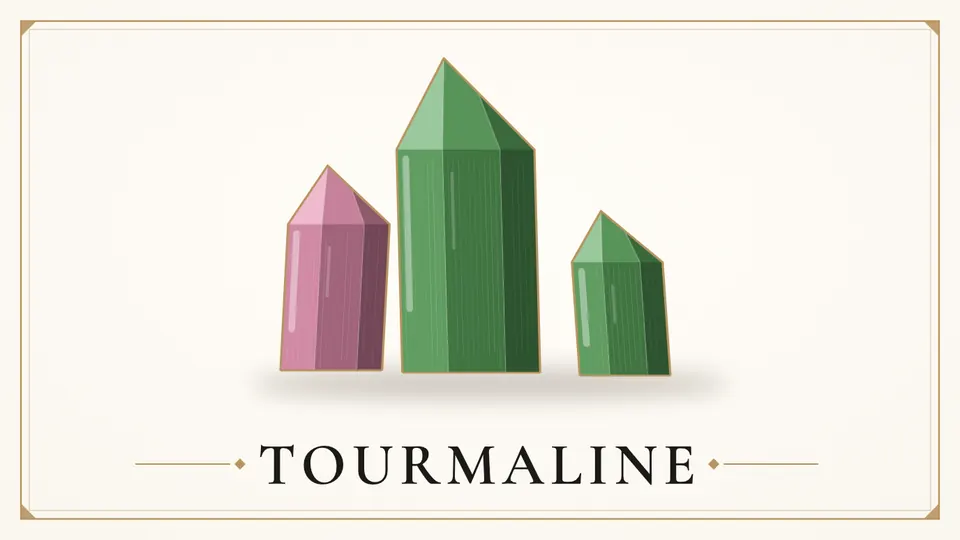
Tourmaline is a family of boron-bearing silicate minerals, not a single stone, and it comes in almost every colour. Gem tourmaline is Mohs 7 to 7.5 and brittle, with no easy cleavage, so it suits everyday jewellery with care. Pink rubellite, green verdelite, blue indicolite, two-colour watermelon and the rare copper-bearing Paraíba type are all tourmaline. In crystal tradition it is linked with creativity and openness.
At a glance
- A family of minerals, not one stone: more than 40 species exist, and elbaite is the most common gem species.
- Mohs 7 to 7.5, brittle, with no easy cleavage, so it suits everyday wear with care.
- Rubellite (pink to red), verdelite (green), indicolite (blue), watermelon and Paraíba-type stones are all tourmaline, and so is black schorl.
- An October birthstone, shared with opal. Care: warm soapy water, soft brush, no ultrasonic or steam.
Quick facts
| Family | Tourmaline supergroup, a boron-bearing silicate with more than 40 species; elbaite is the most common gem species |
|---|---|
| Chemical formula | Varies by species; elbaite is Na(Li1.5,Al1.5)Al6Si6O18(BO3)3(OH)4 |
| Crystal system | Trigonal, often as three-sided prisms |
| Mohs hardness | 7–7.5 |
| Luster | Brittle, with no easy cleavage and an uneven to small shell-like fracture |
| Transparency | Faceted gems are usually transparent; cat's-eye stones are cut as cabochons, and black schorl is opaque |
| Natural colors | pink to red (rubellite); green (verdelite, chrome tourmaline); blue (indicolite); vivid blue to green (Paraíba type); pink and green together (watermelon); yellow; brown; black (schorl); colourless (rare) |
| Main localities | Brazil (Minas Gerais, Bahia and Paraíba); Afghanistan; Pakistan; Kenya; Madagascar; Mozambique; Nigeria; Tanzania; USA (California and Maine) |
| Common treatments | pink to red stones can be heated to improve colour, and overly dark green stones can be lightened by heat; pink stones can be irradiated to deepen colour, which can be hard to detect; fractures in heavily included stones can be filled with oil, resin or glass; treatments are uncommon in tourmaline, but ask the seller to say in writing whether a stone is treated |
| Birth month | October (shared with opal); tourmaline is the newer October stone |
Looking for the month? October birthstone guide
Tourmaline at a glance, in pictures
Chakras (traditional)
Hardness range
Natural colors
- pink to red (rubellite)
- green (verdelite, chrome tourmaline)
- blue (indicolite)
- vivid blue to green (Paraíba type)
- pink and green together (watermelon)
- yellow
- brown
- black (schorl)
- colourless (rare)
Traditionally linked to
- Zodiac
- LibraScorpio
Common forms of Tourmaline
- Rough raw chunk
- Faceted cut gem
How hard is Tourmaline?
- Talc 1
- Gypsum 2
- Copper coin ~ 3
- Calcite 3
- Fluorite 4
- Apatite 5
- Glass ~ 5.5
- Steel knife ~ 5.5
- Orthoclase 6
- Quartz 7
- Tourmaline 7–7.5
- Topaz 8
- Corundum 9
- Diamond 10
What it is and where it comes from
The name is traced to toramalli, a Sinhalese word meaning mixed gems. Dutch merchants used it for the multicoloured, water-worn pebbles found in the gem gravels of Ceylon, now Sri Lanka.
Tourmaline is a mineral supergroup with more than 40 species, all with the same crystal structure but different chemistry. Elbaite is the most common gem species, and it often forms in granite pegmatites.
More on its history
Colour comes from trace elements. Iron, and possibly titanium, are thought to give green and blue, while manganese gives pinks and reds. The intense green of chrome tourmaline is mostly due to vanadium, not chromium.
Most colour names are trade names. Rubellite is pink to red, indicolite is dark violetish blue to greenish blue, verdelite is green, and Paraíba type is an intense blue to green coloured by copper.
Watermelon tourmaline is pink in the centre with a green outer zone and is often cut in slices. Parti-coloured stones show more than one colour, most often green and pink.
When tiny hollow tubes inside the crystal are dense and lined up, a cabochon can show a cat's-eye. Some stones are also dichroic, meaning the colour looks different from different directions.
Black schorl is iron-rich, and most of the tourmaline found in nature is schorl, which is rarely used as a cut gem. Gem colours come mostly from lithium-rich species such as elbaite.
Brazil is the most common source, especially Minas Gerais and Bahia. Gem material also comes from Afghanistan, Pakistan, Kenya, Madagascar, Mozambique, Nigeria and Tanzania, and Maine and California are historic US sources.
Tourmaline through time
-
1500s
A green tourmaline crystal found in Brazil is mistaken for emerald by a Spanish conquistador.
-
1800s
Tourmaline is recognised as its own mineral species. Until then, stones were often labelled ruby or sapphire by colour alone.
-
1821
The first tourmaline in the USA is found at Mount Mica in Paris, Maine.
-
1912
Pink and red tourmaline from San Diego County is shipped to China, and the trade collapses when the Chinese government falls.
-
Late 1980s
The Paraíba region of Brazil begins to yield intensely coloured copper-bearing tourmaline.
In crystal tradition
What follows is belief and folklore, passed down in crystal tradition. It is not measured fact.
Traditionally associated with: creativity, openness, grounding.
In crystal tradition tourmaline is linked with creativity, emotional openness and grounding, and each colour has its own associations. Pink and green stones are tied to the Heart chakra, blue to the Throat chakra and black to the Root chakra. These are modern spiritual associations, not effects of the stone.
Zodiac links vary from one tradition to another, with Libra and Scorpio both named. Treat them as folklore.
How to care for Tourmaline
- Water Safe
- Sunlight Safe
- Salt Unknown
- Heat Caution
- Ultrasonic Avoid
- Chemicals Caution
Safe = fine as a rule · Caution = only briefly or gently · Avoid = can damage the stone · Unknown = no reliable guidance.
Clean tourmaline with warm soapy water and a soft brush, then dry it. Skip ultrasonic and steam cleaners, since heat can damage it, and keep stones with oil or resin filling away from heat and harsh cleaners. Tourmaline is usually stable in light and most household chemicals, but it is brittle, so store it apart from harder gems such as sapphire or diamond, and take it off before sport and rough work.
Real or fake? Look-alikes and treatments
Often confused with
- Glass
- Dyed quartz
- Synthetic spinel
- Cubic zirconia
- Emerald
- Peridot
Common look-alikes
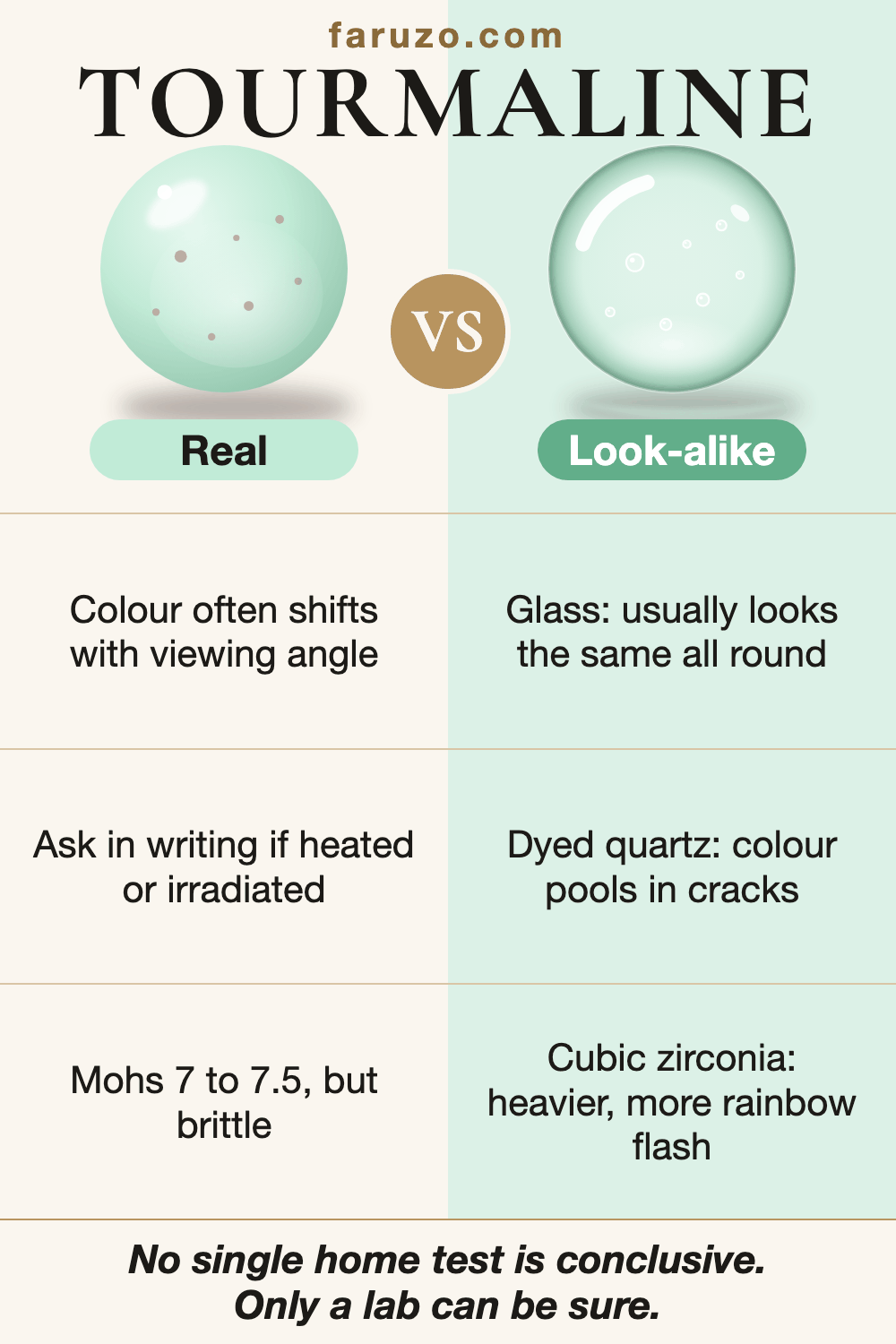
- Glass. Glass is an age-old imitation that can be made in any colour. It tends to look too even and may show round gas bubbles or swirl lines, and it will not show tourmaline's change in colour with viewing direction.
- Dyed quartz. Quartz with dye in surface cracks can pass for pink or red tourmaline. Colour that pools in cracks and looks uneven under a loupe is a warning sign, and a gem lab can confirm.
- Synthetic spinel. Synthetic spinel is widely used to imitate gems such as emerald, aquamarine and tourmaline. It is a different material, and a gem lab separates it by measuring.
- Cubic zirconia. Cubic zirconia is a man-made stone sold in every colour. It usually feels noticeably heavier than tourmaline of the same size and flashes more rainbow colour. A gem lab can confirm.
- Emerald. Emerald is green beryl, Mohs 7.5 to 8, and a green tourmaline crystal was once mistaken for emerald in Brazil. They can look close, so a gem lab can separate them.
- Peridot. Peridot is olive to yellow-green, Mohs 6.5 to 7, a different mineral from tourmaline. Yellow-green tourmaline can look similar, and a gem lab can confirm.
- Ruby and sapphire. Ruby and sapphire are corundum, Mohs 9, much harder than tourmaline. Before tourmaline was recognised as its own species, red and blue stones were often labelled ruby or sapphire by colour, so a gem lab is the safe route.
Safe checks you can do
- Ask the seller in writing which gem the stone is: tourmaline, glass, dyed quartz or another stone sold under a colour name.
- Ask whether the colour is natural or treated. Heat, irradiation and filled fractures do occur, and a treated stone is still real tourmaline, so the point is honest labelling and price.
- For a stone sold as Paraíba, ask for written identification from a gem lab. Paraíba-type stones are coloured by copper and are valued for their vivid colour and rarity, so the name should be backed up.
- Turn the stone in the light. Some tourmaline looks a different colour from different directions, while glass tends to look the same all round.
- Do not scratch-test or knock-test a stone you plan to keep. Tourmaline is brittle, and a gem lab is the safer route when it matters.
Wearing Tourmaline
Ring
Safe
Hard enough for daily wear; a hard knock can still chip it.
Bracelet
Safe
Holds up well, though a hard knock can chip a brittle stone.
Pendant
Safe
A pendant sits clear of most knocks.
Earrings
Safe
Earrings rarely take hard knocks.
Guide for everyday wear, based on hardness and care notes. Safe, Careful or Avoid.
At Mohs 7 to 7.5 tourmaline resists everyday scratches, and with no easy cleavage it suits rings, bracelets, pendants and earrings. It is brittle, though, so a hard knock can still chip it, and a ring is best set protectively and taken off for heavy work. Stones with filled fractures need gentler care, and heat can damage tourmaline, so keep it away from steam and hot water.
Related stones
Questions about Tourmaline
What does tourmaline mean?
In crystal tradition tourmaline is linked with creativity, openness and grounding, with each colour carrying its own associations. Those are beliefs, not facts about the stone. Its practical claim is one of the widest colour ranges of any gem, in a stone hard enough for everyday jewellery.
What is tourmaline?
Tourmaline is a supergroup of boron-bearing silicate minerals with more than 40 species, all sharing one crystal structure. Elbaite is the most common gem species. Crystals are trigonal and often form three-sided prisms.
Is tourmaline a birthstone?
Yes. Tourmaline is an October birthstone, shared with opal. Opal is the traditional October stone and tourmaline is the newer one. Lists vary, so check the one you are following. Some lists also give tourmaline as the gem for the eighth wedding anniversary.
What are rubellite, verdelite, indicolite and watermelon tourmaline?
They are colour names within tourmaline. Rubellite is pink to red, verdelite is green and indicolite is blue. Watermelon tourmaline is pink in the centre with a green outer zone, often cut in slices. They are all tourmaline.
What is Paraíba tourmaline?
Paraíba-type tourmaline is an intense blue to green stone coloured by copper. It was first found in the Paraíba region of Brazil, and similar stones have since come from Nigeria and Mozambique. It is rare and typically costs more than other tourmaline, so ask for written identification from a gem lab.
Is black tourmaline the same as the coloured stones?
Black tourmaline is schorl, the iron-rich black member of the family. It is real tourmaline, but it is a different species from the coloured gems, which are often elbaite. Most tourmaline found in nature is schorl.
How hard is tourmaline, and does it break easily?
Tourmaline is 7 to 7.5 on the Mohs scale, so it resists scratches from everyday dust. It is brittle, with no easy cleavage, so it does not split along flat planes, but a hard knock can still chip it.
Is tourmaline treated?
Treatments are uncommon in tourmaline, but they do occur. Pink to red stones can be heated to improve colour, pink stones can be irradiated to deepen it, and fractures in heavily included stones can be filled with oil, resin or glass. A treated stone is still real tourmaline, but a seller should say so in writing.
Is there lab-grown tourmaline?
Lab-grown gem tourmaline is not known in the jewellery trade. If a seller offers a stone as lab-grown tourmaline, ask for written identification from a gem lab. A stone grown by people with tourmaline's chemistry would be real tourmaline made in a lab, while glass and dyed quartz are look-alikes.
Can tourmaline hold an electric charge?
Yes. Tourmaline can become electrically charged when it is heated, and also when it is squeezed. That is a physical property of the mineral, and it is not a claim about any effect on people.
Can you wear a tourmaline ring every day?
It is a reasonable choice with care. At Mohs 7 to 7.5 it resists scratching, and with no easy cleavage it will not split along a plane. It is brittle, so a hard knock can still chip it. A protective setting helps, and it is best taken off for heavy work.
How do you clean tourmaline, and can it go in an ultrasonic cleaner?
Use warm soapy water and a soft brush, then dry it. Skip ultrasonic and steam cleaners, since heat can damage tourmaline and stones with filled fractures are more fragile.
Does tourmaline fade in sunlight?
Tourmaline is usually stable in light, though heat can damage it. It is still sensible to store it in a pouch rather than on a hot windowsill, and to ask whether a coloured stone has been treated.
How can you tell real tourmaline from fake?
A home look can only hint. Glass tends to look too even and may show round bubbles, and dyed quartz can show colour pooling in cracks. Some tourmaline looks a different colour from different directions, while glass looks the same all round. A gem lab can confirm a stone that matters.
What can be mistaken for tourmaline?
Glass, dyed quartz, synthetic spinel and cubic zirconia are common look-alikes. Emerald, peridot, ruby and sapphire are real gems that can look similar in some colours. They differ in hardness, weight and how they bend light, which a gem lab measures.
What should I ask a seller before buying a tourmaline?
Ask in writing whether the stone is tourmaline or another gem, whether the colour is natural or treated, and whether any fractures are filled. For a ring, ask about the setting. For a stone sold as Paraíba or any high-value colour, ask for written identification from a gem lab.
Where does tourmaline come from, and why is it called tourmaline?
Brazil is the most common source, and gem material also comes from Afghanistan, Pakistan, Kenya, Madagascar, Mozambique, Nigeria and Tanzania. The name is traced to toramalli, a Sinhalese word meaning mixed gems, used by Dutch merchants for the colourful pebbles of Sri Lanka.