
Crystal guide
Black tourmaline Meaning, Properties and Care
Black tourmaline is schorl, the iron-rich and most common member of the tourmaline group (Mohs about 7 to 7.5). It is both piezoelectric and pyroelectric, meaning it can build up a small electric charge when squeezed or heated. In crystal tradition it is the classic protection stone, linked to grounding and warding off negativity.

At a glance
- Hardness Mohs about 7 to 7.5: durable for daily wear, though a hard knock can still chip it.
- The most common tourmaline in nature, often said to make up 95% or more.
- A real physical quirk: it is piezoelectric and pyroelectric, so squeezing or heating can create a small electric charge.
- Care: a soft cloth and gentle hand-washing. Avoid hard knocks and sudden temperature swings.
Quick facts
| Family | Tourmaline group (borosilicate); black variety schorl |
|---|---|
| Chemical formula | NaFe3Al6(BO3)3Si6O18(OH)4 (schorl end member; real stones are a mix) |
| Crystal system | Trigonal, growing as striated prisms with a rounded three-sided cross-section |
| Mohs hardness | 7–7.5 |
| Luster | Vitreous to slightly resinous; opaque black; no easy cleavage and brittle |
| Transparency | Opaque for black material |
| Natural colors | black, brownish black, bluish black |
| Main localities | Brazil, Namibia, Pakistan, Madagascar, Tanzania, Nigeria, United States (including California and Maine) |
| Common treatments | usually sold untreated; some black beads sold as tourmaline turn out to be dyed onyx or glass, so ask what a bead really is |
| Birth month | Tourmaline in general is an October birthstone (with opal); black tourmaline is not usually singled out |
Black tourmaline at a glance, in pictures
Chakras (traditional)
Hardness range
Natural colors
- black
- brownish black
- bluish black
Traditionally linked to
- Planet
- Saturn
- Zodiac
- CapricornScorpio
- Element
- Earth
Common forms of Black tourmaline
- Rough raw chunk
- Tumbled polished pebble
- Cabochon smooth dome
- Bead drilled bead
How hard is Black tourmaline?
- Talc 1
- Gypsum 2
- Copper coin ~ 3
- Calcite 3
- Fluorite 4
- Apatite 5
- Glass ~ 5.5
- Steel knife ~ 5.5
- Orthoclase 6
- Quartz 7
- Black tourmaline 7–7.5
- Topaz 8
- Corundum 9
- Diamond 10
What it is and where it comes from
The word tourmaline is said to come from the Sinhalese tōramalli, a general name for carnelian and other coloured stones from Sri Lanka.
Schorl is the most common tourmaline species, and is often said to make up 95% or more of all tourmaline in nature.
Tourmaline crystals are piezoelectric (they become charged when squeezed) and pyroelectric (they become charged when heated). This is a measurable property of the mineral, not a claim about energy.
Because of this property, tourmaline was reportedly used in the early to mid 20th century to build pressure gauges for measuring underwater blasts.
Black tourmaline is not on the birthstone lists by itself. Tourmaline as a group is an October birthstone alongside opal.
Tourmalinated quartz is a different material: clear quartz with needle-like black tourmaline crystals growing inside it.
In crystal tradition
What follows is belief and folklore, passed down in crystal tradition. It is not measured fact.
Traditionally associated with: protection, grounding, boundaries, clearing a space.
Black tourmaline is traditionally associated with the Root chakra (Muladhara). This is a modern spiritual tradition, not a fact about the stone.
Black tourmaline is traditionally linked with Capricorn and Scorpio, the planet Saturn and the element Earth. These mappings vary from list to list and have no scientific basis.
Black tourmaline is traditionally called the ultimate protection stone, kept in doorways, on desks and in jewelry to ward off negativity and to feel grounded. These are symbolic meanings, not effects on the body or mind.
How to care for Black tourmaline
- Water Safe
- Sunlight Caution
- Salt Caution
- Heat Caution
- Ultrasonic Caution
- Chemicals Caution
Safe = fine as a rule · Caution = only briefly or gently · Avoid = can damage the stone · Unknown = no reliable guidance.
Warm soapy water and a soft cloth are the usual way to clean black tourmaline, then dry it. A quick rinse is fine, but avoid long soaking in salt water and harsh cleaners. Sudden temperature swings and hard knocks are best avoided, because the stone is brittle. Ultrasonic and steam cleaners are best skipped as a precaution, especially for stones with surface fractures or coatings. Black tourmaline is generally thought to hold its colour well in everyday light, though long strong sun is best avoided as a precaution.
Real or fake? Look-alikes and treatments
Often confused with
- Black onyx
- Obsidian
- Hematite
- Black glass
Common look-alikes
- Black onyx. Black onyx is usually dyed chalcedony (a quartz), Mohs about 6.5 to 7. It is often very evenly black, with a glassy or waxy shine and no visible crystal structure. Raw black tourmaline grows in striated, straight-sided prisms and has a more matte look. Polished beads of the two can look alike, so confirm what the stone is.
- Obsidian. Obsidian is volcanic glass, Mohs about 5 to 6, so it is softer. It breaks in smooth curved shell-like chips and does not form flat-sided striated crystals. Black tourmaline grows in long striated prisms and is harder.
- Hematite. Hematite is a heavy iron oxide with a metallic grey shine, often cut into beads. It feels noticeably heavier than tourmaline of the same size and looks silvery rather than matte black. Its streak is reddish brown, while black tourmaline's streak is white to pale.
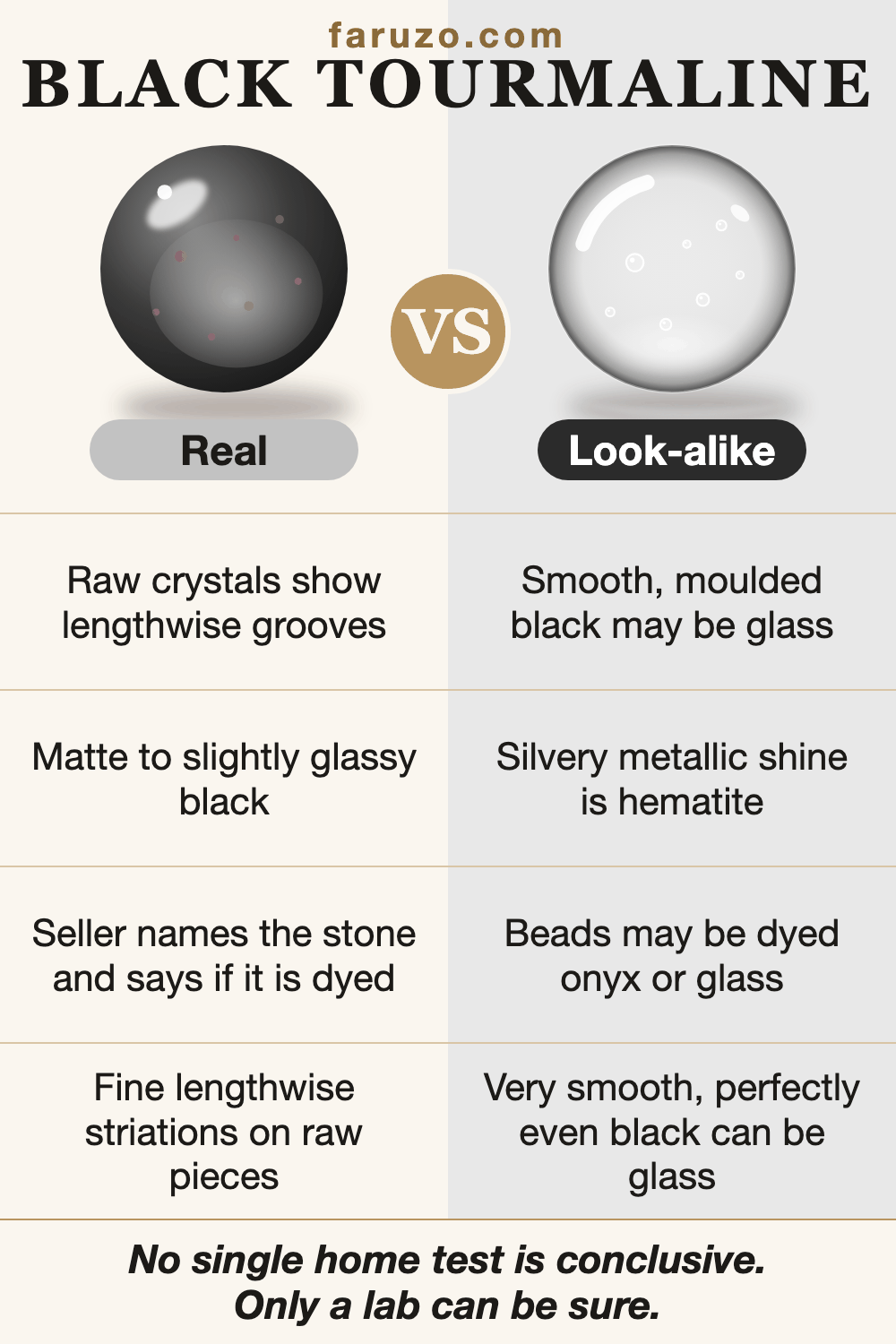
- Black glass. Cheap black glass can be very smooth and perfectly even, may show round bubbles or a curved break, and tends to feel warm to the touch sooner than stone. Natural black tourmaline usually shows fine lengthwise striations on raw crystals.
Safe checks you can do
- Look at raw crystals for lengthwise striations and a rounded three-sided cross-section. Real black tourmaline usually has them, while smooth glass or a moulded piece does not.
- Compare the shine. Black tourmaline is usually a matte to slightly glassy black, while hematite looks silvery and metallic and glass often looks too perfect.
- Ask the seller in writing what the stone is and whether it is dyed or coated. Beads sold as black tourmaline are sometimes dyed onyx or glass.
- A hardness test is only a hint: tourmaline (about 7 to 7.5) is harder than obsidian, hematite and steel blades, but onyx is close. For a stone that matters, ask a gemologist or lab to test it.
Wearing Black tourmaline
Ring
Safe
Hard enough for daily wear; a protective setting guards knocks.
Bracelet
Safe
Beads and links hold up well to everyday knocks.
Pendant
Safe
Few knocks as a pendant.
Earrings
Safe
Light, and rarely knocked.
Guide for everyday wear, based on hardness and care notes. Safe, Careful or Avoid.
At Mohs about 7 to 7.5 black tourmaline suits pendants, earrings and bead bracelets well. It has no strong cleavage, and as with any gem a hard knock can still chip it, so a ring is fine for everyday wear but best taken off for heavy work. Storing it apart from harder stones such as sapphire or diamond avoids scratches, since a harder gem can mark a softer one.
Related stones
Questions about Black tourmaline
What does black tourmaline mean?
In crystal tradition black tourmaline is the ultimate protection stone, traditionally associated with grounding, boundaries and warding off negativity. These are symbolic meanings from tradition, not facts about the stone or claims about your health.
What is black tourmaline made of?
Chemically it is a sodium iron aluminium borosilicate (NaFe3Al6(BO3)3Si6O18(OH)4 for the end member), and the iron gives it the opaque black colour.
How hard is black tourmaline?
Mohs about 7 to 7.5, hard enough for everyday jewelry. It is still brittle, so a sharp knock can chip it, and it is better kept away from harder gems.
Is black tourmaline a birthstone?
Not on its own. Tourmaline in general is an October birthstone alongside opal, but the black variety is not usually singled out for a month.
Is black tourmaline piezoelectric?
Yes. Tourmaline crystals can build up an electric charge when squeezed (piezoelectric) or heated (pyroelectric). It is a real physical property of the mineral, and it was reportedly used in blast-pressure gauges in the 20th century.
Is black tourmaline magnetic?
Not in the way a magnet is. Schorl contains iron, and a few specimens may show a very faint pull to a strong magnet, but this is not a reliable test. A strongly magnetic black bead is more likely hematite.
Does black tourmaline block EMF or negativity?
In crystal tradition it is said to shield against negativity and electronic 'energy'. That is belief only: there is no measured evidence that a stone blocks electromagnetic fields, and it is not a substitute for anything practical.
How can you tell black tourmaline from onyx, obsidian or hematite?
Raw black tourmaline grows in striated, straight-sided prisms. Onyx is evenly dyed and glassy, obsidian is softer volcanic glass with curved breaks, and hematite is heavy and silvery. Beads are harder to judge, so a lab can settle it.
Is black tourmaline the same as tourmalinated quartz?
No. Tourmalinated quartz is clear quartz with needle-like black tourmaline crystals inside it, two minerals in one piece.
Is black tourmaline rare?
No. It is found on most continents. Its lower price compared with coloured tourmaline reflects that.
How do you clean black tourmaline?
Use a soft cloth and a drop of mild soap in lukewarm water, then dry it. Avoid long soaking, salt water, harsh chemicals and sudden temperature changes, and skip steam and machine cleaners as a precaution.
Does black tourmaline fade in sunlight?
Black tourmaline is generally thought to hold its colour well, since the black comes from iron inside the crystal. Some other tourmaline colours can shift with strong light, so it is still sensible to avoid long strong sun as a precaution.
Can black tourmaline get wet?
Yes, a quick rinse in water is fine. Avoid prolonged soaking and salt water.
Can I wear black tourmaline in a ring?
Yes, at Mohs about 7 to 7.5 it is hard enough. A hard knock can still chip it, so take it off for heavy work.