
Crystal guide
Rutilated Quartz Meaning, Properties and Care
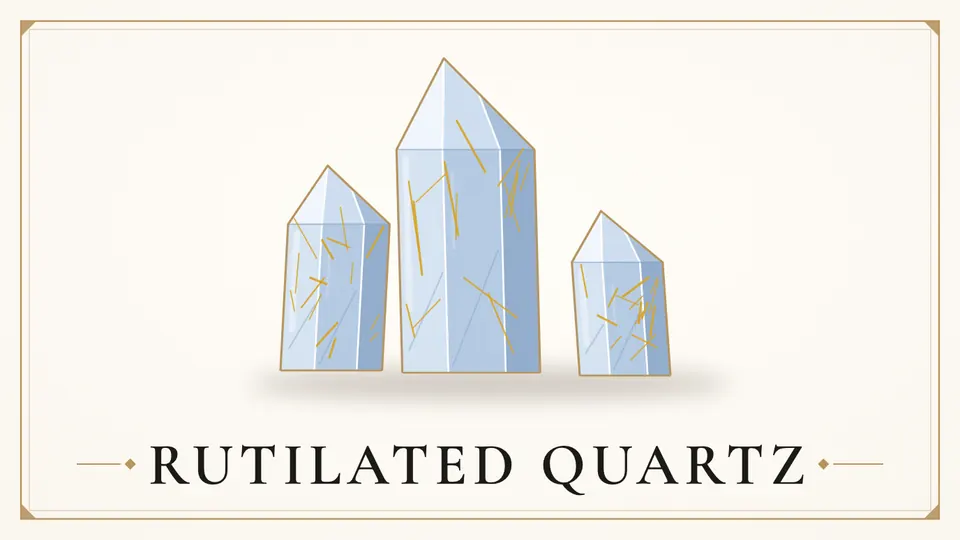
Rutilated quartz is clear quartz (SiO2, Mohs 7) that holds fine needles of rutile, a titanium oxide mineral (TiO2). The needles mostly look golden, but they can also be silver, copper-red or black, and they may lie scattered or in star-like bundles. It is also sold as angel hair quartz or Venus' hair stone. In crystal tradition it is a stone of brightness and drive.
At a glance
- Clear quartz (SiO2, Mohs 7) with needle-like rutile (TiO2) inside, most often golden, sometimes silver, copper-red or black.
- Also sold as angel hair quartz or Venus' hair stone. Tourmalinated quartz is a different stone, with black needles.
- Look-alikes are glass, plastic or resin, and doublets. Lab-grown quartz is real quartz made by people, so ask which one a piece is.
- Not a birthstone. Care: warm water, mild soap, soft cloth, no steam or sudden heat.
Quick facts
| Family | Quartz (silicon dioxide, a silicate) containing needle-like inclusions of rutile (titanium dioxide) |
|---|---|
| Chemical formula | SiO2 for the quartz; the needles are rutile, TiO2 |
| Crystal system | Trigonal quartz host; the rutile needles are tetragonal |
| Mohs hardness | 7 |
| Luster | Vitreous (glassy) quartz, breaking with a shell-like fracture and no cleavage; the needles can look metallic |
| Transparency | Transparent to translucent; sparse needles leave the quartz clear, while dense needles can make it nearly opaque |
| Natural colors | clear or lightly tinted quartz with golden needles; silver, copper-red or black needles; orange, brown or gray needles are also seen |
| Main localities | Australia, Brazil, India, Madagascar, Pakistan, Russia, Spain, United States |
| Common treatments | usually sold with no enhancement beyond cutting and polishing; heat may spoil the needle effect, so strong heat is best avoided; dyed or heat-treated quartz exists in the trade, so ask whether a piece is natural and untreated |
| Birth month | Not a birthstone. April's stone is diamond, a different mineral; rock crystal (clear quartz) appears on one April list |
Rutilated Quartz at a glance, in pictures
Hardness range
Natural colors
- clear or lightly tinted quartz with golden needles
- silver, copper-red or black needles
- orange, brown or gray needles are also seen
Common forms of Rutilated Quartz
- Cabochon smooth dome
- Faceted cut gem
- Tumbled polished pebble
How hard is Rutilated Quartz?
- Talc 1
- Gypsum 2
- Copper coin ~ 3
- Calcite 3
- Fluorite 4
- Apatite 5
- Glass ~ 5.5
- Steel knife ~ 5.5
- Orthoclase 6
- Rutilated Quartz 7
- Topaz 8
- Corundum 9
- Diamond 10
What it is and where it comes from
Rutilated quartz is a variety of quartz that contains needle-like (acicular) inclusions of rutile. It is also known as Venus' hair stone, and is sold as angel hair quartz and Cupid's darts.
Rutile is titanium dioxide (TiO2), a mineral that ranges from brown and red to yellow. Its name comes from the Latin word for red, from the deep red seen in some pieces in transmitted light, and it was first described in 1803 from specimens found near Madrid, Spain.
One example of rutile growing through quartz is the material called fléches d'amour from Graubünden, Switzerland. Tiny rutile needles also cause the star effect in star sapphire and star ruby.
Rutilated quartz is thought to form in quartz veins, where quartz crystals grow inward and enclose rutile crystals that cross the vein. The needles are usually between about 0.1 and 1 mm wide.
The needles may be scattered at random or grouped in bundles, and the bundles are sometimes arranged in a star-like pattern. They can be sparse or dense enough to make the quartz nearly opaque.
Inclusions usually lower the value of a quartz crystal, but rutilated quartz is prized for the quality of its needles. Golden yellow and copper-red needles are often the most sought after.
Gem material is reportedly found in Australia, Brazil, India, Madagascar, Pakistan, Russia, Spain and the United States.
Tourmalinated quartz is a different stone, often confused with this one. It is clear quartz grown together with black tourmaline, whose dark strands run through the quartz and give the stone its name. The type of needle is the difference: gold or silver rutile here, black tourmaline there.
Strawberry quartz is also a different material. It is clear quartz with flecks of iron oxide, most often hematite and less often goethite or lepidocrocite, which give it a pink to orange tint. The flecks are iron oxide, not rutile.
Cherry quartz is a trade name that is often glass, one of the fruit-named materials sold as quartz. Glass has also been sold under the name strawberry quartz, so a pretty red-flecked piece is worth a question to the seller.
In crystal tradition
What follows is belief and folklore, passed down in crystal tradition. It is not measured fact.
Traditionally associated with: clarity, motivation, brightness.
In crystal tradition rutilated quartz is called a stone of illumination, said to take the amplifying idea attached to clear quartz and add drive and brightness. This is a belief, not a measured effect of the stone.
Names such as angel hair and Cupid's darts come from how the needles look. Chakra, zodiac and planet links differ from one tradition to another and have no scientific basis.
How to care for Rutilated Quartz
- Water Safe
- Sunlight Unknown
- Salt Unknown
- Heat Caution
- Ultrasonic Caution
- Chemicals Caution
Safe = fine as a rule · Caution = only briefly or gently · Avoid = can damage the stone · Unknown = no reliable guidance.
Clean rutilated quartz with warm water, mild soap and a soft cloth, then dry it. Keep it away from steam, torch work and sudden temperature changes, because heat may spoil the needles and can crack quartz that has internal fractures. Be careful with ultrasonic cleaners if a piece shows cracks or dense inclusions. The quartz is hard, but a sharp knock can still chip an edge, so store it apart from harder stones such as ruby, sapphire or beryl. Take jewelry off before household chemicals.
Real or fake? Look-alikes and treatments
Often confused with
- Glass with threads or flecks inside
- Plastic or resin
- Doublets and coated stones
Common look-alikes
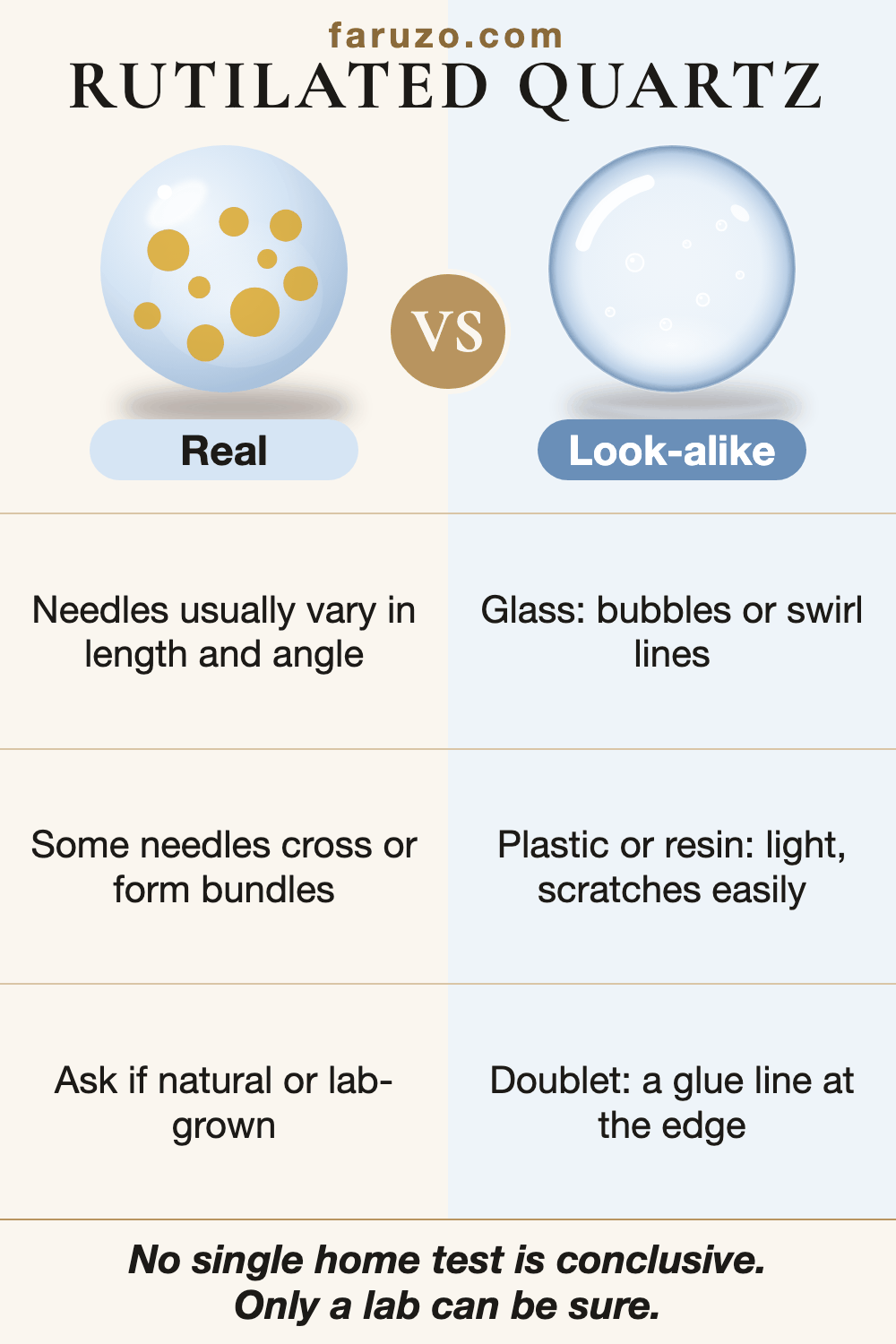
- Glass with threads or flecks inside. Glass can be made in nearly any colour, and a piece with golden or silver threads inside may be sold as rutilated quartz. Glass is softer than quartz, can show round bubbles or swirl lines, and tends to look too even. Natural needles vary in length, thickness and angle, and some cross or sit in bundles.
- Plastic or resin. Plastic is a cheap imitation used in fashion jewelry and is not durable. It is much softer than quartz at Mohs 7, so it scratches easily, and it tends to feel light and warm in the hand. A moulded piece can look too regular, with needles that repeat in the same pattern.
- Doublets and coated stones. A doublet joins two pieces with colorless glue, and a triplet adds a layer between them. A join or a glue layer may show at the edge of the stone under magnification, and a coating can wear off or look too bright or too uniform.
Safe checks you can do
- Ask the seller in writing whether the piece is natural rutilated quartz, lab-grown quartz, glass, resin or a doublet. Lab-grown quartz is real quartz made by people, and a home check cannot separate it from natural quartz.
- Look closely at the needles. Natural needles usually vary in length, thickness and direction, and some cross or form bundles. A perfectly even, repeating pattern is a reason to ask questions, not proof of anything.
- Look for bubbles and swirl lines, which point to glass, and for a glue line at the edge, which points to a doublet.
- Check the price against the size. An unusually low price can signal a fake. Faking the needle effect in full is thought to be uncommon, so a plain question to the seller often settles it.
- Other products sold nearby are real quartz, not copies. Tourmalinated quartz has black tourmaline strands instead of gold or silver rutile needles. Strawberry quartz is clear quartz with red to orange iron oxide flecks, while cherry quartz is a trade name that is often glass, so ask the seller what a piece is.
- Treat no single home test as conclusive. Do not scratch-test or heat-test a piece you plan to keep. For a stone that matters, have a gem lab test the stone.
Wearing Rutilated Quartz
Ring
Safe
Hard enough for daily wear.
Bracelet
Safe
Tough enough for everyday bracelets.
Pendant
Safe
A pendant sits clear of most knocks.
Earrings
Safe
Earrings rarely take hard knocks.
Guide for everyday wear, based on hardness and care notes. Safe, Careful or Avoid.
At Mohs 7, rutilated quartz resists everyday scratching and has no flat cleavage plane, so it suits rings, bracelets, pendants and earrings. The needles are softer than the quartz around them, but they sit inside it and are protected. A sharp knock can still chip an edge, and strong heat may spoil the needles, so keep it away from steam and sudden temperature changes. Store it apart from harder stones such as ruby, sapphire or beryl.
Related stones
Questions about Rutilated Quartz
What does rutilated quartz mean?
In crystal tradition rutilated quartz is a stone of illumination, linked with clarity, motivation and brightness. Those are beliefs, not effects of the stone. Its plain facts are simpler: clear quartz with needles of rutile inside.
What is rutilated quartz?
It is a variety of quartz (SiO2, Mohs 7) that contains needle-like inclusions of rutile, which is titanium dioxide (TiO2). The needles mostly look golden, but can also be silver, copper-red or black.
Is rutilated quartz the same as rutile?
No. Rutile is a separate mineral, titanium dioxide, that forms the needles. Rutilated quartz is quartz with those needles inside it. Rutile is softer than quartz, at about Mohs 6 to 6.5.
Why is it called angel hair quartz?
Angel hair and Venus' hair are names for the fine, hair-like needles. They are sales and folk names for rutilated quartz, not separate minerals.
Is rutilated quartz a birthstone?
No, it is not on the main birthstone lists. April's stone is diamond, a different mineral, though rock crystal (clear quartz) appears on one April list. Lists vary, so check the list you are following.
How hard is rutilated quartz, and can you wear it daily?
The quartz is Mohs 7, so it resists everyday scratching, and it has no flat cleavage plane. A sharp knock can still chip an edge. It suits everyday rings, bracelets, pendants and earrings with ordinary care.
How can you tell real rutilated quartz from fake?
A home look can only hint. Natural needles vary in length, thickness and direction, while glass or resin may look too even or show bubbles. Doublets can show a glue line at the edge. For a piece that matters, have a gem lab test it.
What can pass for rutilated quartz?
Glass with threads or flecks, plastic or resin, and doublets or coated stones. Tourmalinated quartz is a real but different stone with black tourmaline needles, and strawberry quartz is clear quartz with red iron oxide flecks.
What is tourmalinated quartz?
It is clear quartz grown together with black tourmaline, so dark strands run through it. It is often confused with rutilated quartz, which has gold or silver rutile needles. Both are quartz at Mohs 7.
Is strawberry quartz or cherry quartz real?
Natural strawberry quartz exists. It is clear quartz with flecks of iron oxide, mostly hematite, and it is not rutilated. Cherry quartz is a trade name that is often glass, and glass has also been sold as strawberry quartz, so ask the seller what a piece is.
Is lab-grown rutilated quartz real quartz?
Yes. Lab-grown quartz is real quartz made by people, grown in a lab. It is the same material as natural quartz, so a home check cannot separate the two. The seller should say which one a piece is.
Is rutilated quartz treated or dyed?
It is usually sold with no enhancement beyond cutting and polishing. Dyed or heat-treated quartz exists in the trade, though. Ask the seller to say in writing whether a piece is natural and untreated, and remember a treated stone is still real quartz.
Where does rutilated quartz come from?
Gem material is reportedly found in Australia, Brazil, India, Madagascar, Pakistan, Russia, Spain and the United States. Rutilated quartz is thought to form in quartz veins, where quartz grows around rutile crystals.
How do you clean rutilated quartz?
Use warm water, mild soap and a soft cloth, then dry it. Avoid steam and sudden temperature changes, and be careful with ultrasonic cleaners if a piece shows cracks or dense inclusions. Take jewelry off before household chemicals.
Is rutilated quartz the same as clear quartz?
It is the same mineral, silicon dioxide at Mohs 7. The difference is the inclusions: rutilated quartz carries needles of rutile, while clear quartz is not defined by them.