
Crystal guide
Herkimer Diamond Meaning, Properties and Care
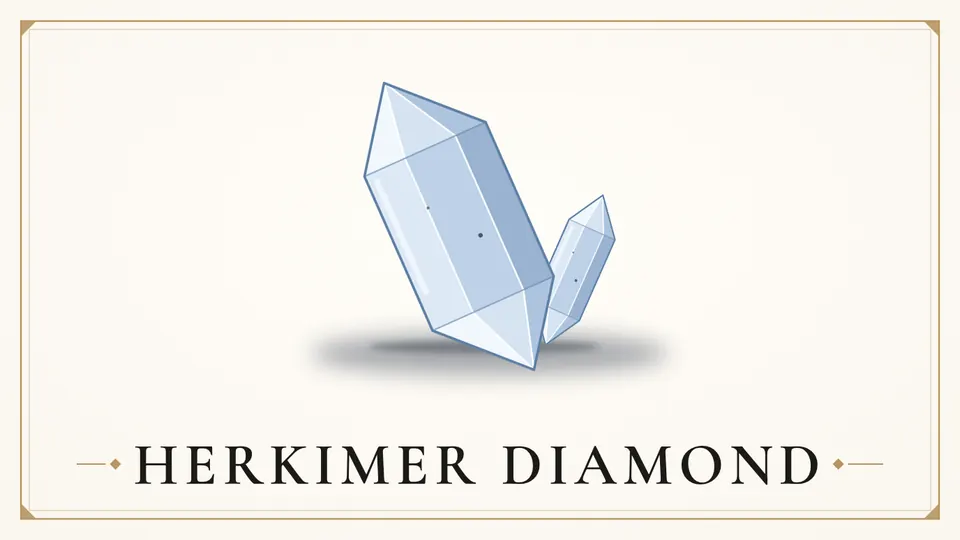
Herkimer diamond is quartz, not diamond. It is clear silicon dioxide (SiO2) at 7 on the Mohs scale, usually found as natural double-terminated crystals with a point at each end and many facets. The best-known source is Herkimer County, New York, and the area around it, but similar crystals are also sold from other places, so the origin is hard to confirm. In crystal tradition it is called the stone of attunement.
At a glance
- Herkimer diamond is quartz, not diamond: SiO2, Mohs 7, with a natural point at both ends.
- Best known from Herkimer County, New York and nearby. Similar crystals are also sold from other places, so the origin is hard to confirm.
- Look-alikes are glass, clear cubic zirconia and plastic. Lab-grown quartz is real quartz made by people, so ask which one a piece is.
- Not a birthstone. April is diamond, a different mineral. Care: warm water, mild soap, soft cloth, no steam.
Quick facts
| Family | Quartz (silicon dioxide, a silicate), sold under the trade name Herkimer diamond |
|---|---|
| Chemical formula | SiO2 |
| Crystal system | Trigonal, as natural crystals with a point at both ends (double-terminated) |
| Mohs hardness | 7 |
| Luster | Vitreous (glassy), breaking with a shell-like fracture |
| Transparency | Transparent and often very clear, sometimes with tiny black specks or pockets of liquid or gas inside |
| Natural colors | colorless, clear |
| Main localities | United States (Herkimer County and the Mohawk River Valley, New York, including Middleville and Little Falls); double-terminated quartz also occurs in other places and is often sold under the same name |
| Common treatments | usually sold as natural quartz crystals, but the origin is hard to confirm; dyed or crackled quartz exists, so ask whether a piece is natural and untreated |
| Birth month | Not a birthstone. April's stone is diamond, a different mineral; some lists add rock crystal, which is clear quartz |
Herkimer Diamond at a glance, in pictures
Chakras (traditional)
Hardness range
Natural colors
- colorless
- clear
Common forms of Herkimer Diamond
- Rough raw chunk
- Point crystal tip
How hard is Herkimer Diamond?
- Talc 1
- Gypsum 2
- Copper coin ~ 3
- Calcite 3
- Fluorite 4
- Apatite 5
- Glass ~ 5.5
- Steel knife ~ 5.5
- Orthoclase 6
- Herkimer Diamond 7
- Topaz 8
- Corundum 9
- Diamond 10
What it is and where it comes from
Herkimer diamonds are double-terminated quartz crystals found in dolomite rock in and around Herkimer County, New York, and the Mohawk River Valley. They are not diamonds. The name points to their clarity and well-formed faces.
The first finds were around the village of Middleville and the city of Little Falls, so the crystals are also called Middleville or Little Falls diamonds. Workmen cutting into the dolomite of the Mohawk Valley turned up large numbers of them in the late 18th century.
The host rock is the Little Falls Formation, a Cambrian dolostone that began as sediment in a shallow sea about 500 million years ago. Acidic water later opened small cavities in the buried rock, and the quartz is thought to have grown slowly inside them, which is why the crystals can be exceptionally clear.
Quartz ends up with a point at both ends when it grows freely, without being attached to a surface. Most well-formed quartz crystals are attached at one end, which is why a natural double-terminated crystal stands out.
Some Herkimer diamonds hold tiny inclusions: solids, liquids such as salt water or petroleum, and gases, most often carbon dioxide. A black hydrocarbon is the most common solid inclusion, seen as dark specks.
Double-terminated quartz occurs in other parts of the world, and it is often sold as Herkimer diamond whatever its origin. That is why the origin of a single piece is hard to confirm.
In crystal tradition
What follows is belief and folklore, passed down in crystal tradition. It is not measured fact.
Traditionally associated with: clarity, attunement, focus.
In crystal tradition, Herkimer diamond is known as the stone of attunement, said to help a person feel in tune with others or with a chosen intention. This is a belief, not a measured effect of the stone.
Crystal tradition traditionally links it with the Crown and Third Eye chakras and with clarity of mind. These mappings vary from one tradition to another and have no scientific basis.
How to care for Herkimer Diamond
- Water Safe
- Sunlight Safe
- Salt Unknown
- Heat Caution
- Ultrasonic Caution
- Chemicals Caution
Safe = fine as a rule · Caution = only briefly or gently · Avoid = can damage the stone · Unknown = no reliable guidance.
Wash with warm water and mild soap, use a soft brush, then dry with a soft cloth. Some crystals hold tiny pockets of liquid or gas, so avoid steam, torch work and sudden temperature changes, and be careful with ultrasonic cleaners if a piece shows cracks or inclusions. The points are sharp and a hard knock can chip them, so store each piece apart from harder stones such as sapphire and diamond. Take jewelry off before household chemicals.
Real or fake? Look-alikes and treatments
Often confused with
- Glass or crystal glass
- Clear cubic zirconia
- Acrylic or plastic
Common look-alikes
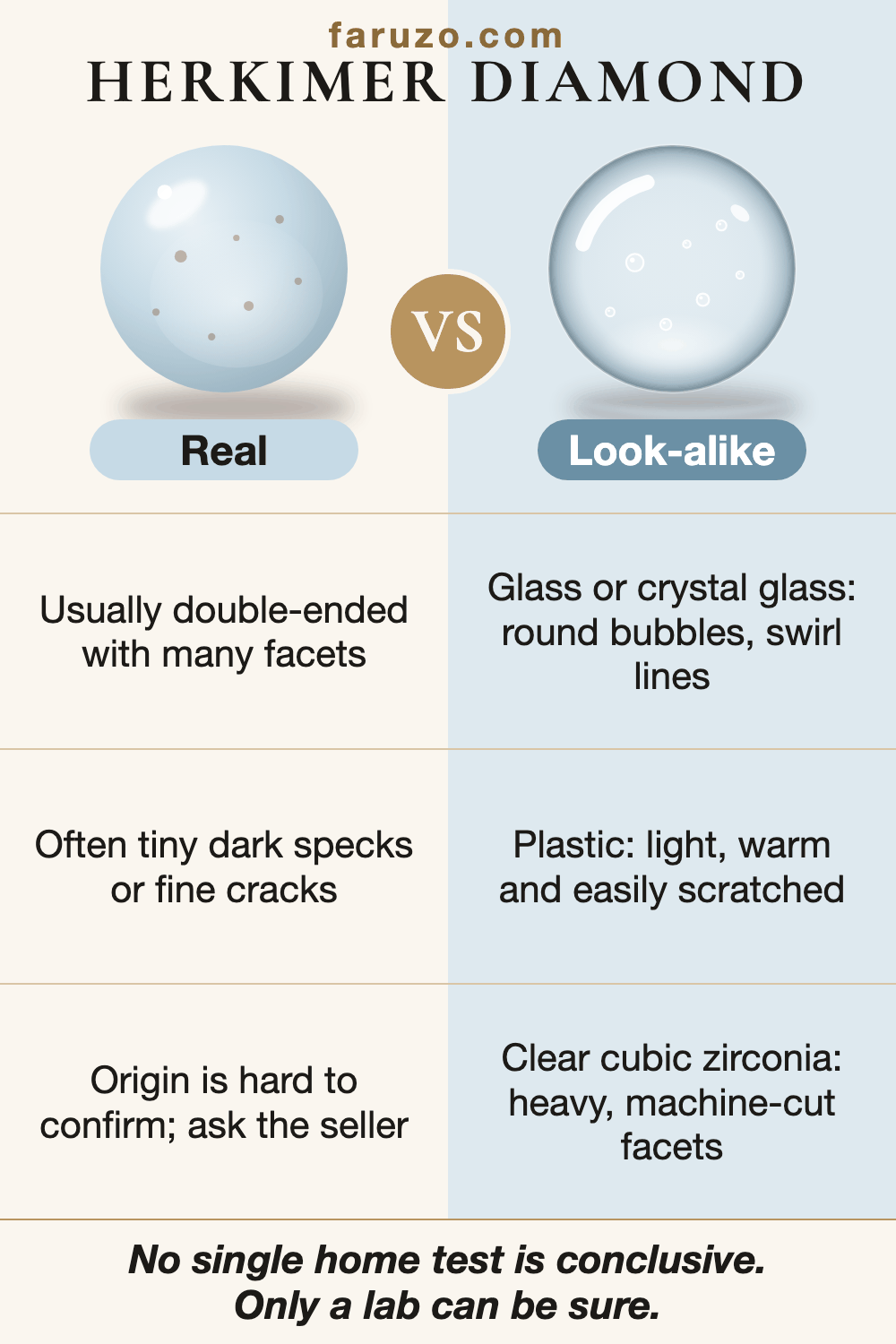
- Glass or crystal glass. Glass is softer, about 5.5 on the Mohs scale for window glass, and can show round bubbles or swirl lines. Natural quartz tends to show small dark specks or tiny cracks instead. Crystal glass is glass, not the mineral. A flawless piece at a low price is a reason to ask what it is.
- Clear cubic zirconia. Cubic zirconia is a man-made stone, Mohs 8 to 8.5, and more than twice as dense as quartz, so it feels heavy for its size. It also flashes more rainbow colour. It is usually cut with machine-made facets, while a Herkimer-type crystal has natural faces and a point at each end.
- Acrylic or plastic. Plastic is much softer than quartz at Mohs 7, so it scratches easily, and it tends to feel light and warm in the hand. A moulded piece can look too even, with no natural specks or growth lines.
Safe checks you can do
- Ask the seller in writing whether the piece is a natural quartz crystal, lab-grown quartz, glass or something else. Lab-grown quartz is real quartz made by people, and a home check cannot separate it from natural quartz.
- Do not take the name as proof of origin. Double-terminated quartz is found in other places and is often sold as Herkimer diamond whatever its origin, so where a crystal grew is hard to confirm. A seller who names the locality and the mine gives you something to weigh.
- Look closely for natural features such as tiny black specks, fine cracks or growth lines. Many natural crystals show them. A perfectly even, flawless piece at a low price is a reason to ask questions, not proof of anything.
- Check the shape. A natural crystal usually has a point at each end and flat faces that meet at natural angles. A piece with identical, machine-cut facets may be a cut stone or glass.
- Treat no single home test as conclusive. For a stone that matters, ask a gem lab to confirm what it is, and remember that a lab can identify the material far more easily than the place it came from.
Wearing Herkimer Diamond
Ring
Safe
Hard enough for daily wear.
Bracelet
Safe
Tough enough for everyday bracelets.
Pendant
Safe
A pendant sits clear of most knocks.
Earrings
Safe
Earrings rarely take hard knocks.
Guide for everyday wear, based on hardness and care notes. Safe, Careful or Avoid.
At Mohs 7, Herkimer diamond resists everyday scratching and breaks with a shell-like fracture rather than along a flat plane, so it suits rings, bracelets, pendants and earrings. A hard knock can still chip a sharp point, and some crystals hold tiny pockets of liquid or gas, so keep them away from sudden heat. Store each piece apart from harder stones such as sapphire and diamond.
Related stones
Questions about Herkimer Diamond
What does Herkimer diamond mean?
In crystal tradition it is called the stone of attunement, linked with clarity and with the Crown and Third Eye chakras. Those are beliefs, not effects of the stone. Its plain facts are simpler: a very clear quartz crystal with a point at each end.
Is a Herkimer diamond a real diamond?
No. It is quartz, silicon dioxide (SiO2) at Mohs 7. Diamond is carbon at Mohs 10, much harder and far more costly. Herkimer diamond is a trade name, and the word diamond describes how clear it looks, not what it is.
Why is it called a diamond?
The name points to its clarity and well-formed faces. Natural crystals can look sharp and bright, with many small facets, which is where the comparison comes from.
Where do Herkimer diamonds come from?
The best-known source is Herkimer County, New York, and the Mohawk River Valley around it, where the crystals grow in cavities in a Cambrian dolostone. Similar double-terminated quartz is also sold from other places, so the origin of a single piece is hard to confirm.
Is Herkimer diamond a birthstone?
No. It is not a birthstone on the main lists. April's stone is diamond, a completely different mineral, and the shared word is the main link. Some lists add rock crystal for April, which is clear quartz, but Herkimer diamond does not appear on the main lists.
Is every Herkimer diamond from New York?
Not necessarily. Double-terminated quartz occurs in other places and is often sold as Herkimer diamond whatever its origin. A seller who names the locality and the mine gives a better clue than the name alone, but origin is hard to confirm from the crystal.
How can you tell a real Herkimer diamond from glass?
A home look can only hint. Glass is softer, about 5.5 on the Mohs scale for window glass, and may show round bubbles or swirl lines, while natural quartz tends to show tiny black specks or fine cracks. A flawless piece at a low price is a reason to ask the seller what it is.
Can cubic zirconia or plastic pass for a Herkimer diamond?
They can look similar at a glance. Cubic zirconia is Mohs 8 to 8.5 and more than twice as dense as quartz, so it feels heavy, and it flashes more rainbow colour. Plastic is far softer and scratches easily. A natural crystal has a point at each end and natural faces.
Can lab-grown quartz be sold as Herkimer diamond?
It can be sold under the name, and it is real quartz made by people. It is the same material as natural quartz, so a home check cannot separate the two. The seller should say which one a piece is.
What are the dark specks inside Herkimer diamonds?
Many are tiny inclusions. A black hydrocarbon is the most common solid inclusion, and some crystals also hold liquid, such as salt water or petroleum, or gas, most often carbon dioxide. They are natural features, not flaws in the sense of damage.
Why does a Herkimer diamond have a point at both ends?
Quartz ends in a point at both ends when it grows freely, without being attached to a surface. Most well-formed quartz crystals are attached at one end, which is why a natural double-terminated crystal stands out.
How hard is Herkimer diamond, and can you wear it daily?
It is Mohs 7, so it resists everyday scratching, and it does not split along a flat plane. A hard knock can still chip a sharp point, and some crystals hold tiny pockets of liquid or gas. It suits everyday rings, bracelets, pendants and earrings with ordinary care.
How do you clean a Herkimer diamond?
Wash it in warm water with mild soap and a soft brush, then dry it with a soft cloth. Avoid steam and sudden temperature changes, and be careful with ultrasonic cleaners if a piece shows cracks or inclusions. Take jewelry off before household chemicals.
Is Herkimer diamond the same as clear quartz?
It is the same mineral, silicon dioxide at Mohs 7. The difference is the form: Herkimer diamonds are naturally double-terminated crystals with many facets, while most clear quartz points are attached at one end.
What should I ask a seller before buying a Herkimer diamond?
Ask in writing whether it is a natural quartz crystal, lab-grown quartz or glass, where it was found, and whether it is natural and untreated. For a piece that matters, ask for written identification from a gem lab.