
Crystal guide
Diamond Meaning, Properties and Care
Diamond is pure carbon in a cubic crystal, and at Mohs 10 it tops the hardness scale. Hard is not unbreakable, though: it has perfect cleavage in four directions, so a sharp knock can still chip or split it. Lab-grown diamond is the same material as mined diamond, made by people instead of formed in the Earth. In tradition, diamond stands for clarity, strength and endurance.
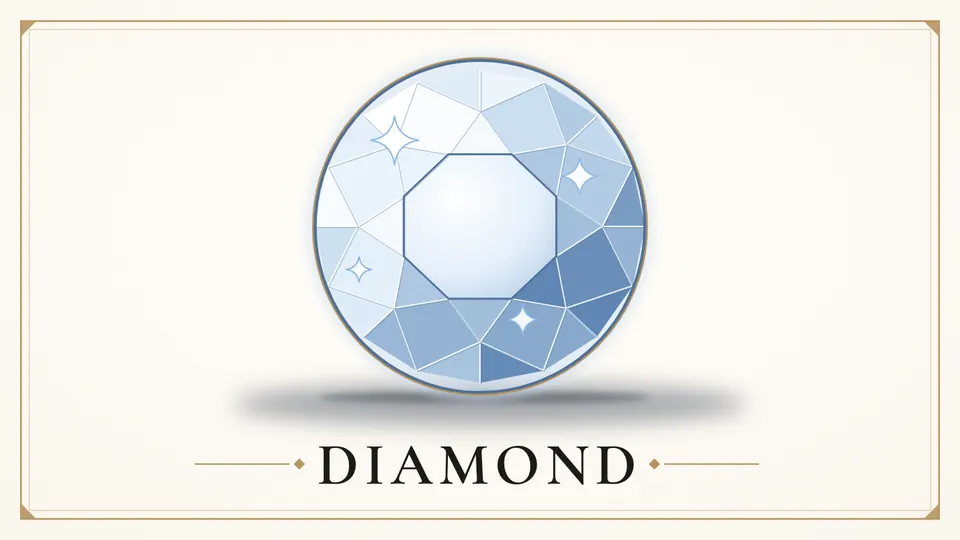
At a glance
- Pure carbon, formula C, in a cubic crystal; graphite is also carbon, with a different structure.
- Mohs 10, scratched only by another diamond, yet perfect cleavage in four directions means a hard knock can chip or split it.
- The April birthstone on almost all modern lists, and the traditional gem for the 60th and 75th wedding anniversaries.
- Lab-grown diamond is real diamond: ask for a grading report, because no home test tells lab-grown from mined.
Quick facts
| Family | Native element: pure carbon (gem diamond is typically about 99.95 percent carbon) |
|---|---|
| Chemical formula | C |
| Crystal system | Cubic (isometric); rough gem diamond most often forms as octahedra |
| Mohs hardness | 10 |
| Luster | Adamantine, with perfect cleavage in four directions |
| Transparency | Transparent in gem quality; opaque or cloudy stones are mostly used in industry |
| Natural colors | colourless (the standard for gem grading); yellow and brown (nitrogen); blue (boron); pink and red (distortion of the crystal lattice, rare) |
| Main localities | Botswana, Russia, Democratic Republic of the Congo, South Africa, Australia (Argyle), Canada, India (the historic source), Brazil (a major source from the early 1700s) |
| Common treatments | colour can be changed by high-pressure high-temperature (HPHT) treatment or irradiation; dark inclusions can be removed by laser drilling; small cracks can be filled with glass-like filler to look clearer; ask the seller in writing which treatments, if any, were used |
| Birth month | April (on almost all modern birthstone lists) |
Looking for the month? April birthstone guide
Diamond at a glance, in pictures
Chakras (traditional)
Hardness range
Natural colors
- colourless (the standard for gem grading)
- yellow and brown (nitrogen)
- blue (boron)
- pink and red (distortion of the crystal lattice, rare)
Traditionally linked to
- Zodiac
- Aries
Common forms of Diamond
- Rough raw chunk
- Faceted cut gem
How hard is Diamond?
- Talc 1
- Gypsum 2
- Copper coin ~ 3
- Calcite 3
- Fluorite 4
- Apatite 5
- Glass ~ 5.5
- Steel knife ~ 5.5
- Orthoclase 6
- Quartz 7
- Topaz 8
- Corundum 9
- Diamond 10
What it is and where it comes from
Diamond is made of one element, carbon. Graphite is also pure carbon, but its structure and the way it forms are different, which is why the two behave so differently.
Most gem diamonds formed in the Earth's mantle, roughly 150 to 250 km down, and mostly more than a billion years ago. They reached the surface in volcanic rocks such as kimberlite.
More on its history
The name comes from the Greek adamas, meaning unbreakable or invincible, a word that suits its resistance to scratching.
Gem diamonds are graded on four things: cut, colour, clarity and carat weight. For colourless stones the less colour, the higher the grade. Cut means how well the proportions and polish handle light, not just the shape.
Boron gives blue diamond, and nitrogen gives yellow and brown. Pink and red come from distortion of the crystal lattice, and fancy colours of this kind are far rarer than colourless stones.
Gem-quality lab-grown diamond is the same material as mined diamond. It is grown either under high pressure and heat (HPHT) or from a carbon-rich gas (CVD).
Diamond's hardness and its ability to carry heat also make it useful outside jewellery, in saws, drill bits, abrasive grit and heat sinks for electronics.
Diamond through time
-
4th century BC
Trade in diamonds gathered from Indian rivers is thought to have begun as early as this century; India was the first known source.
-
1477
The first recorded diamond engagement ring is given by Archduke Maximilian of Austria to Mary of Burgundy.
-
Early 1700s
Brazil becomes a key source as Indian supplies decline, and it dominates the market for more than 150 years.
-
1772
Antoine Lavoisier shows that burning diamond leaves only carbon dioxide, proving diamond is carbon.
-
Late 1860s
Diamonds are found near Kimberley, South Africa, the start of the modern diamond market.
-
1905
A 3,106-carat rough diamond from South Africa's Premier mine yields the 530-carat Cullinan I, now in the Royal Sceptre.
In crystal tradition
What follows is belief and folklore, passed down in crystal tradition. It is not measured fact.
Traditionally associated with: clarity, strength, endurance.
Because its name means unbreakable, diamond has long been linked with strength and invincibility. In old belief it was said to ward off the evil eye and to bring strength and happiness. These are beliefs, not effects of the stone.
In modern crystal tradition diamond is associated with clarity and with amplifying intention, a metaphor drawn from how clear and bright the stone is. It is linked with the Crown chakra, and Aries is the zodiac sign most often named for it. These links vary from one tradition to another.
How to care for Diamond
- Water Safe
- Sunlight Unknown
- Salt Unknown
- Heat Caution
- Ultrasonic Caution
- Chemicals Unknown
Safe = fine as a rule · Caution = only briefly or gently · Avoid = can damage the stone · Unknown = no reliable guidance.
Warm water, mild soap and a soft brush clean most diamonds. Ultrasonic cleaners are usually fine, but a stone with many inclusions, or one that has been treated, is safer cleaned with a lint-free cloth or the soft brush. A crack-filled diamond can be damaged by a jeweller's torch, so mention any filling before a repair. Have the setting checked from time to time.
Real or fake? Look-alikes and treatments
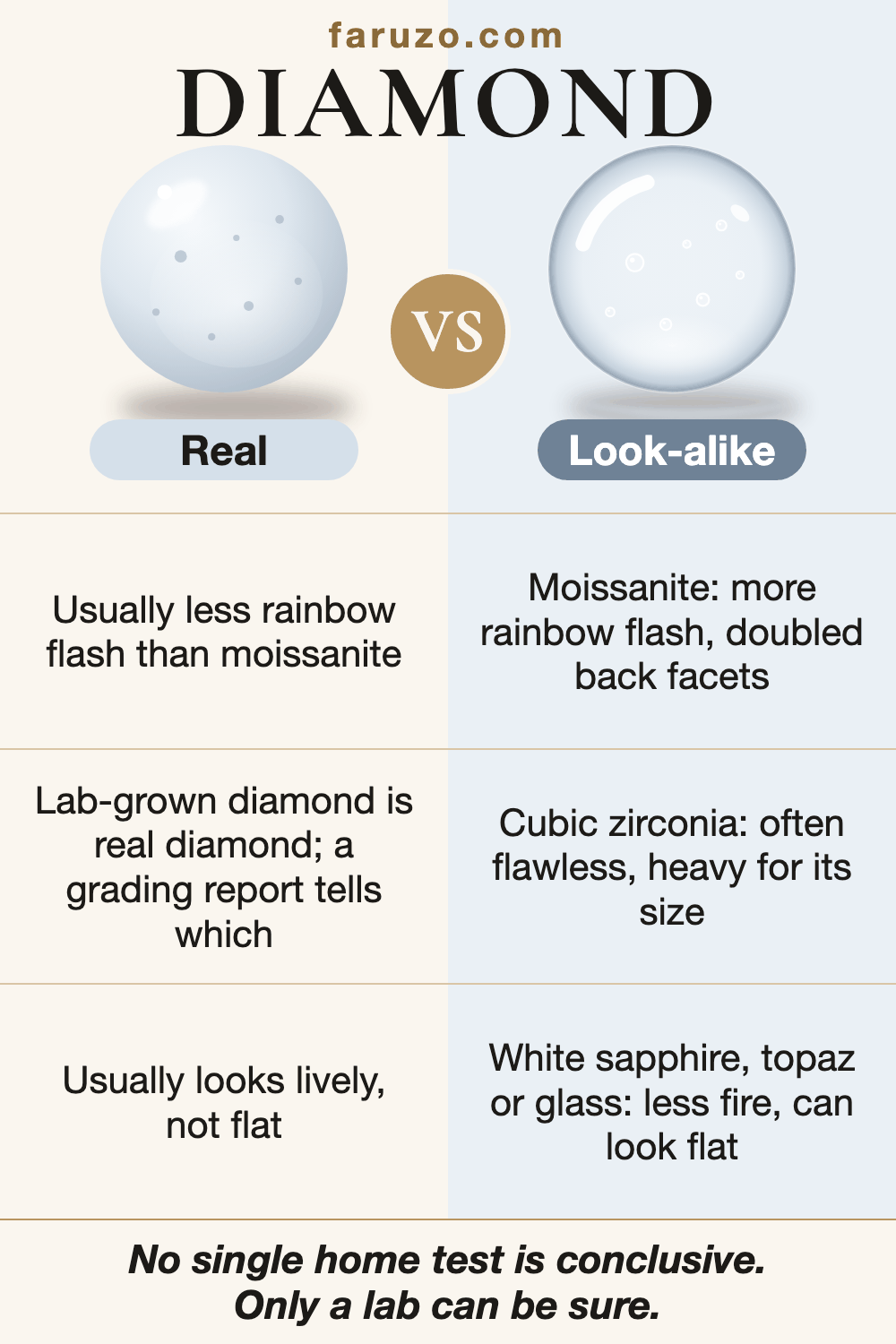
Often confused with
- Moissanite
- Cubic zirconia
- White sapphire
- White topaz
- Glass
- YAG and GGG
Common look-alikes
- Moissanite. Moissanite is silicon carbide, a different material (Mohs 8.5 to 9.25) with more rainbow fire than diamond. It is doubly refractive, so the back facets can look doubled under magnification, and it can pass a heat-conduction tester that clears most other look-alikes. A lab or a jeweller with the right tools can confirm.
- Cubic zirconia. Cubic zirconia is a common, inexpensive man-made look-alike (Mohs 8 to 8.5). It is usually flawless and colourless, feels heavy for its size, and is described as slightly more fire but less brilliance than diamond. It can yellow over time, and a heat-conduction tester separates it from diamond.
- White sapphire. White (colourless) sapphire is a different material, corundum, at Mohs 9. It has a lower refractive index and less fire, so a cut stone can look flat and lifeless next to diamond, and it is doubly refractive.
- White topaz. Colourless topaz is a natural gem at Mohs 8, and its density is close to diamond's, so weight alone does not settle it. It has far less fire than diamond, which is often the easiest thing to notice.
- Glass. Glass is the classic imitation and is less brilliant than diamond. It is soft, so facet edges round over and scratch, and it can show air bubbles, flow lines or mould seams under a loupe.
- YAG and GGG. YAG (about Mohs 8.25) and GGG (about Mohs 7) are man-made crystals that have been cut as look-alikes. Both show less fire than diamond. GGG is very dense, so it feels heavy for its size, and it can turn brown under ultraviolet light.
Safe checks you can do
- Ask the seller in writing whether the stone is a mined diamond, a lab-grown diamond, or another material, and whether it has been treated.
- For a diamond that matters, ask for a grading report from an independent gem lab. The major labs laser-inscribe the girdle of each lab-grown diamond they grade with the report number and a lab-grown note, visible at 10x magnification.
- A jeweller's tester that measures heat conduction separates diamond from most look-alikes, but moissanite can pass it. Treat a pass as a first screen, not proof.
- Do not try to scratch a stone to test it. Moissanite and white sapphire are also very hard, and a knock can chip a diamond along its cleavage.
- Lab-grown and mined diamond share the same hardness and chemistry, so no home test, scratch test or sparkle test can separate them.
Wearing Diamond
Ring
Careful
It can split along a flat plane if knocked.
Bracelet
Careful
A knock on a bracelet can split it along a flat plane.
Pendant
Careful
It can split along a flat plane, so keep it protected.
Earrings
Careful
A flat-plane split is possible, so keep earrings for dressy wear.
Guide for everyday wear, based on hardness and care notes. Safe, Careful or Avoid.
At Mohs 10, diamond resists scratching better than any other gem, so it keeps its polish for years of daily wear. Hard is not unbreakable, though: perfect cleavage in four directions means a sharp knock at the wrong angle can still chip or split it. Rings and bracelets meet the most knocks, so a setting that protects the stone's edge is worth having. Pendants and earrings take fewer hits, but the same care applies. Store a diamond apart from softer gems, which it can scratch.
Related stones
Questions about Diamond
What does diamond mean?
The name comes from the Greek adamas, meaning unbreakable or invincible. In tradition diamond stands for clarity, strength and endurance, and in old belief it was said to ward off the evil eye. Those are beliefs, not facts about the stone.
What is diamond made of?
Pure carbon, formula C, arranged in a cubic crystal. Graphite is also pure carbon, but it forms and is structured differently.
Is diamond the April birthstone?
Yes. Diamond is the April birthstone on almost all modern lists. It is also the traditional gem for the 60th and 75th wedding anniversaries.
How hard is diamond, and can it break?
Diamond is Mohs 10, the top of the scale, and only another diamond can scratch it. It can still chip or split: it has perfect cleavage in four directions, so a sharp knock at the wrong angle can break it. Hard does not mean unbreakable.
Is lab-grown diamond real diamond?
Yes. Lab-grown diamond is made of the same material as mined diamond, pure carbon in the same cubic crystal, with the same chemical, physical and optical properties. The difference is how it was made: grown by people with high pressure and heat (HPHT) or from a carbon-rich gas (CVD), instead of formed in the Earth. It should be described as lab-grown when sold. In the US, the FTC's jewellery guides have counted lab-grown diamond as diamond since 2018.
Lab-grown or natural diamond: how can you tell?
Not by eye and not with a home test, because the material is the same. Labs use instruments such as spectroscopy and ultraviolet fluorescence. The practical route is paperwork: ask the seller to state in writing whether the stone is mined or lab-grown, and ask for a grading report from an independent gem lab. The major labs inscribe each lab-grown diamond's girdle with the report number and a lab-grown note, readable at 10x magnification.
What looks like diamond but is not?
Moissanite, cubic zirconia, white sapphire, white topaz, glass, and man-made crystals such as YAG and GGG have all been used as look-alikes. They are different materials from diamond. Moissanite and cubic zirconia are the most common today. A lab or a jeweller with the right tools can tell them apart.
Does a diamond tester prove a stone is a diamond?
Not on its own. Many testers measure how quickly heat moves through a stone. Diamond conducts heat quickly, so a tester separates it from cubic zirconia and glass, but moissanite can pass. For a stone that matters, ask for a grading report from an independent gem lab.
Are diamonds treated?
Some are. Colour can be changed by high-pressure high-temperature (HPHT) treatment or irradiation, dark inclusions can be removed by laser drilling, and small cracks can be filled to look clearer. A treated diamond is still a real diamond, but it can need gentler cleaning and care. Ask in writing whether a stone has been treated; treatments are expected to be disclosed at sale.
What should I ask a seller before buying a diamond?
Ask four things in writing: is it mined or lab-grown, has it been treated (HPHT, irradiation, laser drilling or crack filling), what are its cut, colour, clarity and carat weight, and can you see a grading report from an independent gem lab. Some buyers also ask where a stone was mined; the Kimberley Process, introduced in 2002, was set up to address conflict diamonds.
What are the 4 Cs?
Cut, colour, clarity and carat weight. Cut is how well the proportions and polish handle light, colour is how close the stone is to colourless, clarity is the relative absence of inclusions and blemishes, and carat weight is the stone's size. For colourless stones, the less colour, the higher the grade.
How do you clean a diamond?
Use warm water, mild soap and a soft brush. Ultrasonic cleaners are usually fine, but a stone with many inclusions or a treated one is safer cleaned with a lint-free cloth. Have the setting checked from time to time.
Can you wear a diamond ring every day?
Usually yes, since diamond resists scratching better than any other gem. Because it can chip along its cleavage, take it off for heavy work and choose a setting that protects the stone's edge.
Where do diamonds come from?
Most gem diamonds formed in the Earth's mantle, roughly 150 to 250 km down, mostly more than a billion years ago, and were carried up in volcanic rocks such as kimberlite. India was the first known source, and today major producers include Botswana, Russia, the Democratic Republic of the Congo, South Africa, Australia and Canada.