
Crystal guide
Bloodstone Meaning, Properties and Care
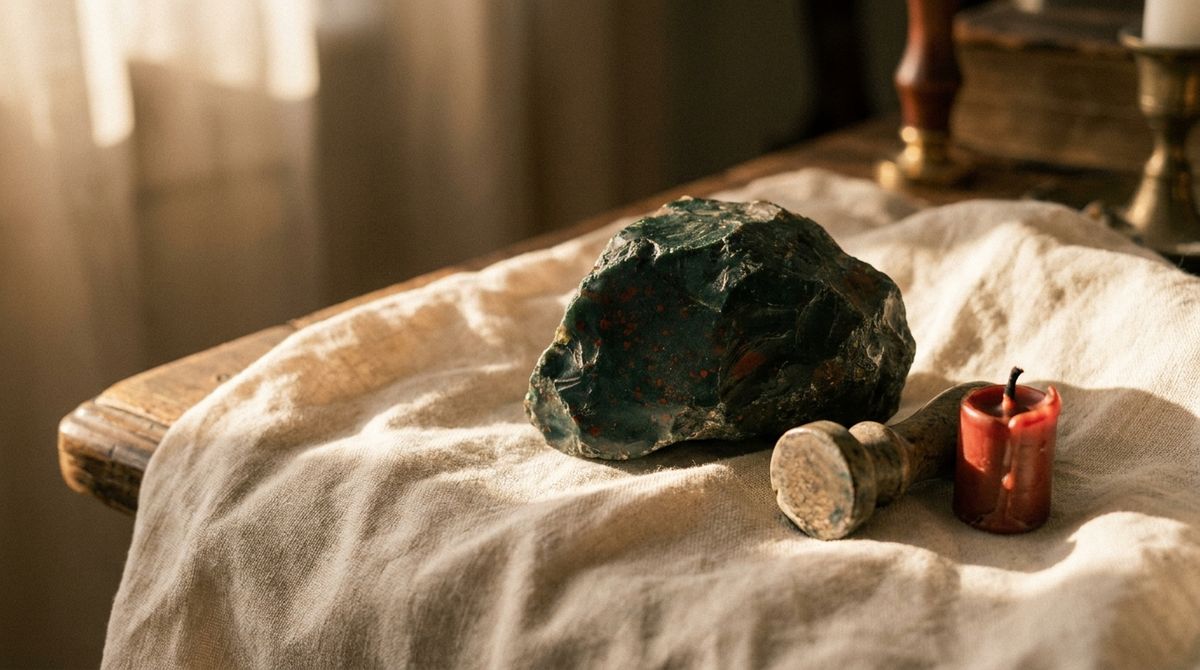
Bloodstone, also called heliotrope, is a dark green chalcedony (a fine-grained quartz, SiO2) dotted with red flecks of iron oxide, often described as hematite or red jasper. It sits at about 6.5 to 7 on the Mohs scale and is a March birthstone in some lists. Old tradition ties it to blood and battle, which is where the name and most of its lore come from.
At a glance
- Formula SiO2: green chalcedony with red iron-oxide spots, so the red is part of the stone, not paint.
- Hardness about 6.5 to 7, with no flat splitting plane, so it takes ordinary wear well.
- A March birthstone in some lists, usually shown beside aquamarine.
- Look-alikes include green jasper and glass; ask whether any red has been added.
Quick facts
| Family | Quartz (cryptocrystalline silica): green chalcedony with red jasper or hematite inclusions |
|---|---|
| Chemical formula | SiO2 |
| Crystal system | Trigonal (quartz group), as a fine-grained aggregate |
| Mohs hardness | 6.5–7 |
| Luster | Vitreous to waxy; breaks with curved, shell-like surfaces |
| Transparency | Opaque to slightly translucent at thin edges |
| Natural colors | dark green with red flecks (the classic look), red or yellow spots on a green base |
| Main localities | India (the Deccan Traps, the main source); Brazil; Australia; South Africa; Bulgaria; Czech Republic; Italy; Scotland (Isle of Rum); USA |
| Common treatments | usually sold untreated, some cheap pieces are painted or dyed to add red |
| Birth month | March (in some lists, alongside aquamarine) |
Looking for the month? March birthstone guide
Bloodstone at a glance, in pictures
Chakras (traditional)
Hardness range
Natural colors
- dark green with red flecks (the classic look)
- red or yellow spots on a green base
Traditionally linked to
- Planet
- Mars
- Zodiac
- AriesPisces
Common forms of Bloodstone
- Rough raw chunk
- Tumbled polished pebble
- Cabochon smooth dome
How hard is Bloodstone?
- Talc 1
- Gypsum 2
- Copper coin ~ 3
- Calcite 3
- Fluorite 4
- Apatite 5
- Glass ~ 5.5
- Steel knife ~ 5.5
- Orthoclase 6
- Bloodstone 6.5–7
- Quartz 7
- Topaz 8
- Corundum 9
- Diamond 10
What it is and where it comes from
The name heliotrope comes from Greek words meaning sun and to turn, linked to old ideas about how the stone reflects light.
Bloodstone forms when silica-rich fluids deposit green chalcedony with iron oxide flecks, usually in old volcanic rock. The Deccan Traps of India are a well-known source.
Old tales credited it with odd powers, such as invisibility and rain-making, and Roman soldiers reportedly wore it in battle.
A medieval Christian tale says the red spots came from drops of Christ's blood falling on green jasper at the cross. That tale gave the stone the nickname Martyr's Stone, and carvers used it for crucifixion scenes and images of martyrs. It is a legend, not documented history.
Hardness, fine grain and a dark colour made it a long-running choice for seals and signet rings, where a design is carved into the surface and pressed into wax.
In crystal tradition
What follows is belief and folklore, passed down in crystal tradition. It is not measured fact.
Traditionally associated with: courage, resilience, grounding.
Bloodstone is traditionally seen as a stone of courage and staying steady under pressure, and is linked to the Root and Heart chakras and to Aries and Pisces. This is a spiritual tradition, not a fact about the stone.
The old blood-and-battle lore comes from folk belief and legend, and has no physical basis.
How to care for Bloodstone
- Water Caution
- Sunlight Safe
- Salt Unknown
- Heat Caution
- Ultrasonic Avoid
- Chemicals Caution
Safe = fine as a rule · Caution = only briefly or gently · Avoid = can damage the stone · Unknown = no reliable guidance.
Wipe bloodstone with a soft cloth and a little mild soap in lukewarm water, then rinse and dry. Brief contact with water is fine. Skip ultrasonic and steam cleaners, since heat and vibration can stress hidden fractures, and avoid bleach and strong cleaners that can dull the polish. Salt effects are not well documented, so rinse it after sea swims. Store it apart from diamond, sapphire and other harder stones. Dyed pieces are best kept away from heat and long soaking.
Real or fake? Look-alikes and treatments
Often confused with
- Green jasper
- Green aventurine
- Glass or painted stone
Common look-alikes
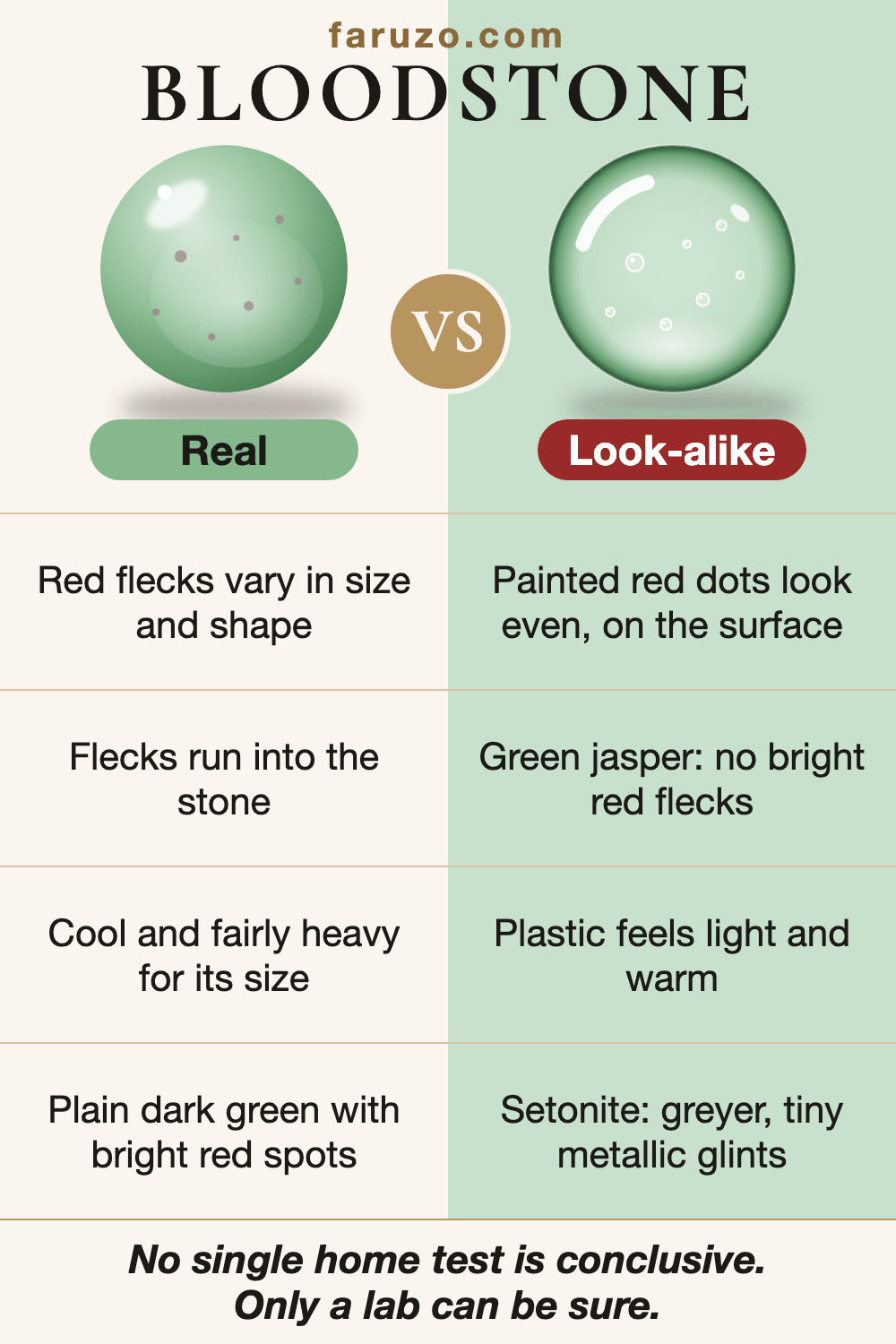
- Green jasper. Plain green jasper looks similar but lacks the bright red flecks running through it. Bloodstone is defined by those red spots on green.
- Green aventurine. Green aventurine is a quartz with a glittery shimmer and no red flecks. Bloodstone is darker, waxy and spotted with red.
- Glass or painted stone. Glass can look too even and may hold tiny round bubbles. Painted red dots tend to look uniform and sit on the surface, while natural flecks look irregular and run into the stone.
Safe checks you can do
- Look at the red flecks. Natural ones vary in size and shape, while printed or painted spots look suspiciously even.
- Check whether the spots sit only on the surface or seem to run into the stone, since painted dots can rub off.
- Real bloodstone feels cool and fairly heavy for its size, noticeably more than plastic.
- Be wary of a very low price on something sold as rare, and ask the seller what the stone is. A lab can sometimes tell a treated stone, or a look-alike material, if it matters.
Wearing Bloodstone
Ring
Careful
Fine with care, but knocks can mark it.
Bracelet
Safe
Fairly hard, so fine for normal bracelet wear.
Pendant
Safe
Fairly hard, and a pendant sits clear of knocks.
Earrings
Safe
Fairly hard, and earrings rarely take knocks.
Guide for everyday wear, based on hardness and care notes. Safe, Careful or Avoid.
Bloodstone is fairly hard and has no flat splitting plane, so pendants and earrings suit it well. A ring is fine with care, since knocks can still mark a stone at this hardness, and a bracelet takes normal wear. Take it off for heavy work and the gym, and keep it away from diamond and sapphire.
Questions about Bloodstone
What does bloodstone mean?
Traditionally bloodstone stands for courage and steadiness, and old lore ties it to blood and battle. That is a belief from folk and crystal tradition, not a fact about the stone.
What is bloodstone made of?
Bloodstone is dark green chalcedony, a fine-grained form of quartz (SiO2), with red flecks of iron oxide such as hematite or red jasper. Another name for it is heliotrope.
Is bloodstone a birthstone?
Yes, for March in some lists, usually shown next to aquamarine. Lists vary, so it is not on every birthstone chart.
What causes the red spots?
Iron oxide, often described as hematite or red jasper, trapped in the green chalcedony as it formed. In natural bloodstone the red is part of the stone.
How hard is bloodstone?
About 6.5 to 7 on the Mohs scale, close to quartz. It has no flat splitting plane, but a hard knock can still chip or scratch it.
Is the Martyr's Stone story true?
It is a medieval legend that the red spots came from drops of Christ's blood on green jasper. It cannot be checked as history, which is why it is told as a story.
Can you wear bloodstone in water or in a ring?
Water itself does not harm natural bloodstone, but heat can stress it and dyed pieces may fade with long soaking. A ring is fine with care, so remove it for heavy work.
Can bloodstone fade or be dyed?
Natural bloodstone keeps its colour well. Cheap pieces are sometimes dyed or painted to add red, and those can fade or rub off, so keep them away from heat and strong cleaners.
How can you tell real bloodstone from fake?
Real flecks vary in size and shape and run into the stone. Even, printed-looking red dots or tiny round bubbles point to paint or glass, and a lab can confirm a stone that matters.
Where does bloodstone come from?
The main source is the Deccan Traps of India. It also occurs in Brazil, Australia, South Africa, Bulgaria, the Czech Republic, Italy, Scotland and the USA.
Is bloodstone the same as green jasper?
No. Green jasper is a plain green quartz rock, while bloodstone is green chalcedony with distinct red iron-oxide flecks. The two can look close when the red is sparse.