
Crystal guide
Tanzanite Meaning, Properties and Care
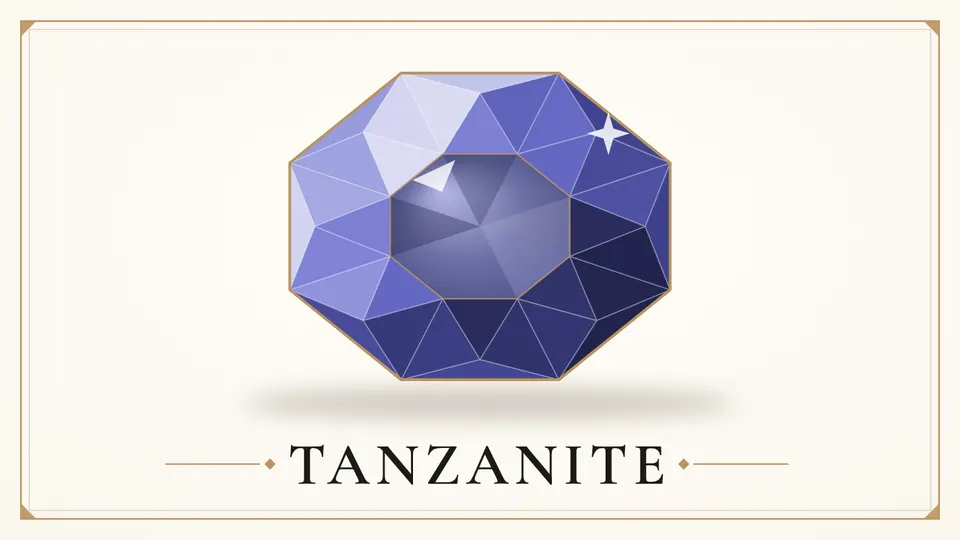
Tanzanite is the blue to violet gem variety of zoisite, a calcium aluminium silicate coloured by traces of vanadium. It rates about 6 to 7 on the Mohs scale but has perfect cleavage, so a sharp knock can split it. Most tanzanite is heat treated to bring out its colour, and it is mined commercially mainly in one area, the Merelani Hills of Tanzania. In tradition it is a stone of insight and change.
At a glance
- Formula Ca2Al3(SiO4)3(OH): tanzanite is the blue to violet variety of zoisite, coloured by traces of vanadium.
- Mohs about 6 to 7, with perfect cleavage, so a knock can split it. Pendants and earrings suit it better than an everyday ring.
- Most is heat treated: brownish rough turns blue and violet, and the colour is permanent. Ask the seller to confirm in writing.
- Mined commercially in one area only, the Merelani Hills in northern Tanzania, near Mount Kilimanjaro.
Quick facts
| Family | Calcium aluminium silicate (epidote group), the blue to violet gem variety of zoisite |
|---|---|
| Chemical formula | Ca2Al3(SiO4)3(OH), with small amounts of vanadium giving the blue and violet |
| Crystal system | Orthorhombic |
| Mohs hardness | 6–7 |
| Luster | Vitreous, pearly on cleavage surfaces, with perfect cleavage in one direction |
| Natural colors | violet blue, blue violet, violet purple, burgundy or reddish flashes from some directions |
| Main localities | Tanzania (Merelani Hills, near Mount Kilimanjaro) |
| Common treatments | most tanzanite is heat treated, usually at roughly 370 to 390 degrees C for about 30 minutes, to remove brownish tints and bring out blue and violet; the colour from heating is permanent and raises no extra durability concern; a thin coating is sometimes put on lower grades and can wear off, so ask whether a stone is coated; ask the seller to say in writing whether a stone is heated or coated |
| Birth month | December (one of the stones on the modern list) |
Tanzanite at a glance, in pictures
Chakras (traditional)
Hardness range
Natural colors
- violet blue
- blue violet
- violet purple
- burgundy or reddish flashes from some directions
Traditionally linked to
- Zodiac
- Sagittarius
Common forms of Tanzanite
- Rough raw chunk
- Faceted cut gem
How hard is Tanzanite?
- Talc 1
- Gypsum 2
- Copper coin ~ 3
- Calcite 3
- Fluorite 4
- Apatite 5
- Glass ~ 5.5
- Steel knife ~ 5.5
- Orthoclase 6
- Tanzanite 6–7
- Quartz 7
- Topaz 8
- Corundum 9
- Diamond 10
What it is and where it comes from
Tanzanite is the blue to violet gem variety of the mineral zoisite, coloured by small amounts of vanadium. The name is a trade name for the stone, taken from the country where it is mined.
Rough tanzanite is usually brownish. Gentle heating removes the brown tint and leaves the blue and violet, which is why heating is the usual treatment for the stone.
More on its history
Tanzanite is strongly pleochroic: tilt a stone and it flashes blue, violet and a burgundy or reddish tone. Cutters choose the direction of the rough so the face-up colour leans blue and violet, and the size of the stone changes how deep that colour looks.
The light changes the colour too. Cool, daylight-type light tends to bring out the blue, while warm, incandescent-type light can shift the same stone toward violet or purple.
Gem tanzanite is mined commercially in one area only, the Merelani Hills in northern Tanzania, near Mount Kilimanjaro. The mining area is small, roughly 7 km long and 2 km wide.
Because its colour is popular, tanzanite has been imitated. Lab-made forsterite, corundum and YAG, coloured glass and cubic zirconia have all been sold as tanzanite, and standard gem-lab tests can tell them apart.
Tanzanite through time
-
1967
Blue-violet crystals are first found in the Merelani Hills of Tanzania and later shown to be a gem variety of zoisite.
-
1968
Tiffany & Co. introduces the stone as tanzanite, because the name blue zoisite was not thought marketable.
-
2002
Tanzanite is added to the modern December birthstone list.
-
2010
Tanzania reportedly bans the export of rough stones over one gram.
-
June 2020
A miner reportedly sells two rough stones weighing 11.14 kg together to the Tanzanian government for about US$3.35 million.
In crystal tradition
What follows is belief and folklore, passed down in crystal tradition. It is not measured fact.
Traditionally associated with: insight, intuition, change.
Tanzanite is traditionally linked with insight, intuition and change, and with the Third Eye and Throat chakras. It has been known to the wider world only since the late 1960s, so this is a modern tradition with no long folk history. It is a belief, not a fact about the stone.
Its colour shift between blue, violet and burgundy is often tied in modern tradition to the idea of transformation. Zodiac links vary from one tradition to another, with Sagittarius sometimes named because of its December link. Treat all of this as folklore.
How to care for Tanzanite
- Water Safe
- Sunlight Unknown
- Salt Unknown
- Heat Caution
- Ultrasonic Avoid
- Chemicals Caution
Safe = fine as a rule · Caution = only briefly or gently · Avoid = can damage the stone · Unknown = no reliable guidance.
Clean tanzanite with warm soapy water and a soft cloth, then dry it. Skip ultrasonic and steam cleaners, because high heat and sudden temperature changes can crack it. Keep it away from acids and harsh cleaners, and store it apart from harder stones, which can scratch it. Take it off before sport and rough work.
Real or fake? Look-alikes and treatments
Often confused with
- Iolite
- Blue sapphire
- Lab-made forsterite and corundum
- Glass and cubic zirconia
- Amethyst and other purple stones
Common look-alikes
- Iolite. Iolite is a violet-blue stone that is also pleochroic, so a quick tilt does not settle it. It shows blue to violet in one direction and pale yellow to colourless in another, where tanzanite flashes burgundy. Iolite is harder (Mohs 7 to 7.5) and usually much cheaper, so a lab can confirm which is which.
- Blue sapphire. Top tanzanite can look like a fine violetish-blue sapphire, but sapphire is a different mineral and far harder (Mohs 9). Tanzanite is much softer and has cleavage, so it chips and splits where sapphire would not. Colour alone is not a safe guide, so a lab can confirm.
- Lab-made forsterite and corundum. Synthetic forsterite and blue-violet synthetic corundum have both been sold as tanzanite. They are real materials made by people, but they are different from tanzanite. Their optical character differs, and standard gem-lab tests such as a refractometer or a Hanneman filter separate them.
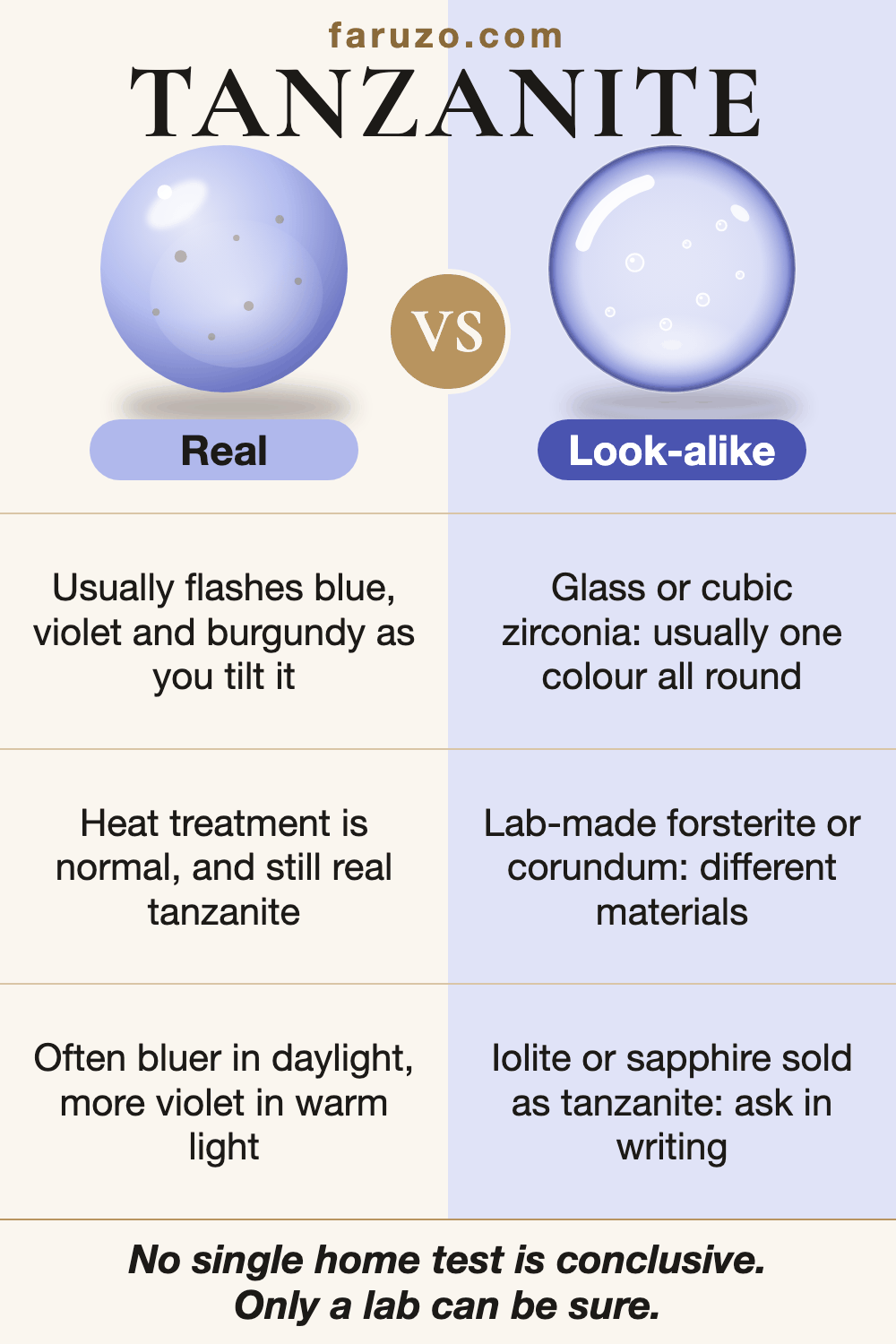
- Glass and cubic zirconia. Coloured glass and cubic zirconia are common imitations. Both are singly refractive, so they show one colour from every direction, where tanzanite flashes blue, violet and burgundy. Glass can also show round gas bubbles. A dichroscope separates them from tanzanite.
- Amethyst and other purple stones. Amethyst is purple quartz, Mohs 7, and its best colour is a strong reddish purple, not tanzanite's blue-violet. It shows much less of tanzanite's blue, violet and burgundy shift. Any violet stone sold as tanzanite deserves a question about what it is.
Safe checks you can do
- Ask the seller in writing whether the stone is natural tanzanite, heated, coated, lab-made or another violet-blue gem.
- Tilt the stone in good light. Tanzanite flashes blue, violet and a burgundy or reddish tone as you turn it, while glass and cubic zirconia stay one colour all round.
- Look at it in daylight and in warm indoor light. Tanzanite looks bluer in cool daylight and more violet in warm light, which a plain imitation does not do in the same way.
- For a stone that matters, ask for a report from an independent gem lab. Standard lab tests separate natural tanzanite from the usual substitutes.
- Do not scratch-test or heat-test a stone you plan to keep. Tanzanite abrades easily and can crack with sudden temperature changes.
Wearing Tanzanite
Ring
Careful
Dressy, occasional wear only: a poor choice every day.
Bracelet
Careful
Wrists take knocks that can split it: wear with care.
Pendant
Careful
Takes fewer knocks than a ring: wear with care.
Earrings
Careful
Takes fewer knocks than a ring: wear with care.
Guide for everyday wear, based on hardness and care notes. Safe, Careful or Avoid.
Tanzanite is about 6 to 7 on the Mohs scale and has perfect cleavage, so a hard knock can split it. Pendants and earrings take fewer knocks and suit it best. A ring is possible for dressy or occasional wear in a protective setting, but it is a poor choice for every day or for manual work. Take it off for sport and cleaning.
Related stones
Questions about Tanzanite
What does tanzanite mean?
In crystal tradition tanzanite stands for insight, intuition and change, and it is linked with the Third Eye and Throat chakras. Those are beliefs, not facts about the stone. Its practical claim to fame is a shifting blue-violet colour and a single mining area.
What is tanzanite?
Tanzanite is the blue to violet gem variety of the mineral zoisite, a calcium aluminium silicate with the formula Ca2Al3(SiO4)3(OH). Its colour comes from small amounts of vanadium, and the name is a trade name taken from Tanzania.
Is tanzanite a birthstone?
Yes. Tanzanite is one of the December birthstones, alongside turquoise, zircon and blue topaz, and it is often said to have joined the list in 2002. It is also the traditional gem for the 24th wedding anniversary.
How hard is tanzanite, and does it chip?
About 6 to 7 on the Mohs scale, softer than quartz or sapphire. It also has perfect cleavage in one direction, so a sharp knock can chip or split it. Hardness measures scratching only, so tanzanite needs more care than its number suggests.
Is tanzanite heat treated, and is it still real?
Most tanzanite is heat treated, and it is still real tanzanite. Rough is usually brownish, and gentle heating removes the brown tint and brings out blue and violet. The colour is permanent. Ask the seller to say in writing whether a stone was heated.
Where does tanzanite come from?
Gem tanzanite is mined commercially in one area only, the Merelani Hills in northern Tanzania, near Mount Kilimanjaro. The mining area is small, roughly 7 km long and 2 km wide, so supply is tied to that one place.
Why does tanzanite change colour?
It is pleochroic, so it shows different colours in different crystal directions: blue, violet and a burgundy or reddish tone. The light matters too, with cool daylight bringing out blue and warm indoor light shifting it toward violet or purple.
Can you wear a tanzanite ring every day?
It is not the best choice. Because tanzanite has perfect cleavage and sits near 6 to 7 on the Mohs scale, a knock on a ring hand can chip or split it. Pendants and earrings take fewer knocks, and a ring suits occasional wear in a protective setting.
How do you clean tanzanite?
Use warm soapy water and a soft cloth, then dry it. Do not use ultrasonic or steam cleaners, since high heat and sudden temperature changes can crack it, and keep it away from acids and harsh cleaners.
How can you tell real tanzanite from fake?
A home look can only hint. Real tanzanite flashes blue, violet and burgundy as you tilt it, while glass and cubic zirconia stay one colour. Iolite and some lab-made substitutes can look close, so a report from an independent gem lab is the safe way to confirm a stone that matters.
Is tanzanite the same as sapphire or iolite?
No. Tanzanite is zoisite, sapphire is corundum and iolite is cordierite, so all three are different minerals. Sapphire is much harder (Mohs 9), and iolite is harder and usually cheaper, though its best colours can look close to tanzanite.
What should I ask before buying tanzanite?
Ask four things in writing: is it natural tanzanite or a substitute, has it been heated, is it coated, and can you see a report from an independent gem lab. Also ask about the setting, since a ring needs more protection than a pendant.
Is lab-made tanzanite real?
Stones sold as lab-made tanzanite are usually other materials, such as forsterite or corundum, made by people to look like it. They are real materials, but they are not tanzanite, and a seller should name the material plainly.
Why is it called tanzanite?
The name comes from Tanzania, the country where it is mined. Tiffany & Co. introduced the stone under that name in 1968, because the mineral name blue zoisite was not thought marketable.