
Crystal guide
Turquoise Meaning, Properties and Care
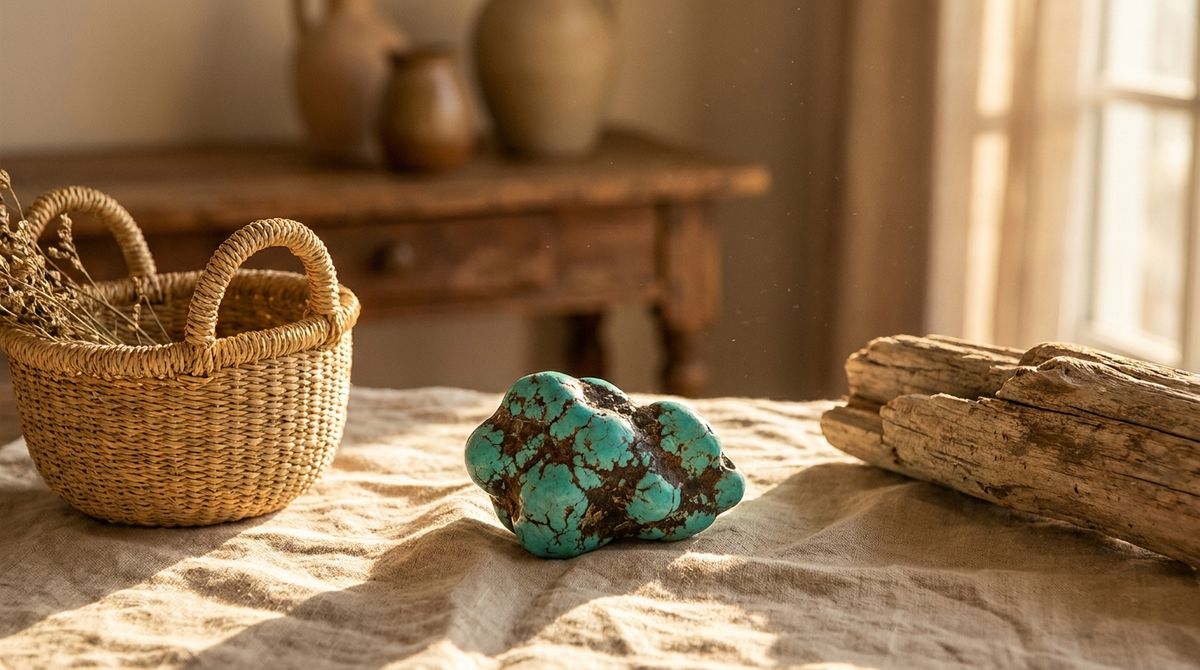
Turquoise is a blue to green hydrated copper aluminium phosphate, CuAl6(PO4)4(OH)8·4H2O. It is soft, at about 5 to 6 on the Mohs scale, and porous, so it can pick up oils and cosmetics and slowly change colour. Much of what is sold is treated, so it pays to ask. In crystal tradition it is a stone of protection and clear speech.
At a glance
- Formula CuAl6(PO4)4(OH)8·4H2O, a hydrated copper aluminium phosphate.
- Mohs 5 to 6 and porous, so it scratches and can absorb oils, perfume and lotion.
- Real turquoise is often stabilised or dyed, and dyed howlite is a common look-alike. Ask the seller in writing.
- Traditionally the December birthstone, though lists vary. Care: soft dry cloth, no soaking, no ultrasonic or chemical cleaners.
Quick facts
| Family | Hydrated copper aluminium phosphate, forming a series with chalcosiderite (where iron replaces aluminium) |
|---|---|
| Chemical formula | CuAl6(PO4)4(OH)8·4H2O |
| Crystal system | Triclinic, but cryptocrystalline: it is almost always a dense mass of tiny grains, not single crystals |
| Mohs hardness | 5–6 |
| Luster | Waxy to subvitreous, usually porous |
| Transparency | Opaque, at most semitranslucent in thin pieces, so usually cut as cabochons or beads |
| Natural colors | sky blue to robin's-egg blue, blue-green, green, often with brown to black matrix veining |
| Main localities | Iran (Nishapur); Egypt (Sinai); USA (Arizona, Nevada, New Mexico); China |
| Common treatments | waxing or oiling is an old, widely accepted enhancement; stabilisation with resin or similar fillers is common, to firm up soft, porous stone; dyeing and bonding powdered stone into a block (reconstituted) also occur; ask whether a stone is natural, stabilised, dyed or reconstituted |
| Birth month | December (traditional; modern lists vary) |
Turquoise at a glance, in pictures
Chakras (traditional)
Hardness range
Natural colors
- sky blue to robin's-egg blue
- blue-green
- green
- often with brown to black matrix veining
Common forms of Turquoise
- Cabochon smooth dome
- Rough raw chunk
- Bead drilled bead
How hard is Turquoise?
- Talc 1
- Gypsum 2
- Copper coin ~ 3
- Calcite 3
- Fluorite 4
- Apatite 5
- Glass ~ 5.5
- Steel knife ~ 5.5
- Turquoise 5–6
- Orthoclase 6
- Quartz 7
- Topaz 8
- Corundum 9
- Diamond 10
What it is and where it comes from
Turquoise is usually a secondary mineral. Copper-rich water meets aluminium- and phosphorus-bearing rock, most often in dry regions, and the stone fills veins and cracks. Copper gives the blue, and iron is usually behind the green shades.
The English name comes from an Old French word meaning Turkish, because the stone reached Europe by way of Turkish trade routes. It was not mined in Turkey, so the name is a misnomer.
More on its history
Ancient Egyptians mined it in the Sinai, and it is inlaid in Tutankhamun's burial mask alongside lapis lazuli and carnelian.
Nishapur in Iran is the classic historic source, and Persian craftsmen used turquoise widely in architecture and decoration. The Aztecs set it into mosaic masks and shields.
In the American Southwest, Arizona is now the most valuable source, Nevada has many mines, and New Mexico's Cerrillos area was once the largest producer. The stone is sacred to the Zuni and Pueblo peoples and is central to Southwestern silver jewelry.
Matrix is the dark webbing of host rock left in the stone. Spiderweb matrix is prized in the Southwest and Far East, while it is less liked in the Near East.
Softer turquoise is generally more porous, and the finest material is just under 6 on the Mohs scale. Untreated stone usually fetches higher prices than bonded or reconstituted material.
Turquoise through time
-
Around 3000 BCE
Turquoise is in use in Egypt, and the Sinai becomes known as the Country of Turquoise.
-
14th century
Europe begins to adopt turquoise as an ornamental stone.
-
1519
Montezuma is said to have given Cortés turquoise, valued as the favourite gem of the god Quetzalcoatl.
-
1912
Tiny single crystals, very rare in turquoise, turn up at Lynch Station, Virginia.
-
1950s
Epoxy stabilisation appears, a way to firm up soft, porous stone that is now common.
In crystal tradition
What follows is belief and folklore, passed down in crystal tradition. It is not measured fact.
Traditionally associated with: protection, clear speech, calm.
Turquoise is traditionally associated with protection and with calm, honest speech. Several unconnected cultures, among them ancient Egypt, Persia and Native American peoples of the Southwest, have long treated it as a protective stone. This is a belief and cultural tradition, not a fact about the stone.
Egyptian tradition links it with the goddess Hathor, called the Lady of Turquoise. Modern crystal tradition often pairs it with the Throat chakra, and zodiac links vary from one tradition to another.
How to care for Turquoise
- Water Caution
- Sunlight Caution
- Salt Caution
- Heat Avoid
- Ultrasonic Avoid
- Chemicals Avoid
Safe = fine as a rule · Caution = only briefly or gently · Avoid = can damage the stone · Unknown = no reliable guidance.
Wipe turquoise with a soft, dry or barely damp cloth, then dry it. Do not soak it, and keep it away from perfume, hairspray, sunscreen, cosmetics and jewellery cleaners, which can dull the surface or change the colour. Skip ultrasonic and steam cleaners, since heat and vibration can harm resin-treated and porous stone. Prolonged strong sun can fade or dry it out. Store it in a soft pouch, apart from harder stones that can scratch it, and not in an airtight container.
Real or fake? Look-alikes and treatments
Often confused with
- Dyed howlite ("turquenite")
- Dyed magnesite
- Glass, plastic or resin
- Variscite
- Chrysocolla
Common look-alikes
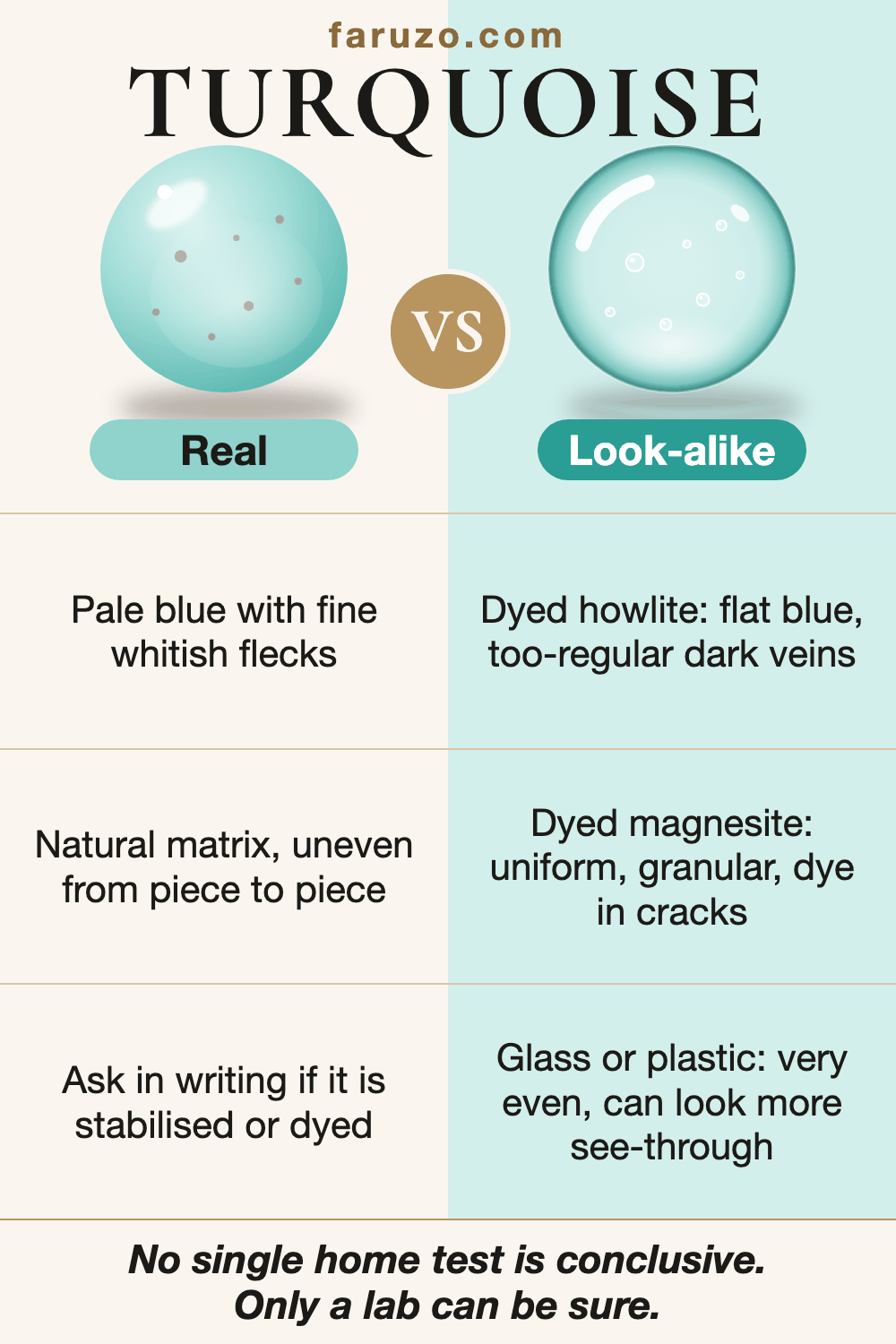
- Dyed howlite ("turquenite"). Howlite is naturally white with fine grey or black veins, and at about Mohs 3.5 it is softer than turquoise. Its porous texture takes dye easily, so dyed howlite can show a flat, even blue with dark web-like veins that look too regular, and colour can pool in cracks and drill holes.
- Dyed magnesite. Magnesite is a white carbonate (Mohs about 3.5 to 4.5), and beads of it are often dyed light blue. Dyed stone can look uniform and granular, with colour gathered in cracks. A lab can tell it apart from turquoise, since it reacts to acid.
- Glass, plastic or resin. Glass, enamel and plastics have imitated turquoise for centuries. They often look a very even blue, and glass or plastic can seem more translucent than real turquoise. Real stone usually has a pale background with fine whitish flecks under magnification.
- Variscite. Variscite is a hydrated aluminium phosphate (Mohs about 4.5) that is usually greener than turquoise, though Nevada material can show black spiderweb matrix and pass for green turquoise. Some stones are sold as "variquoise". Colour alone is not a safe guide.
- Chrysocolla. Chrysocolla is a copper silicate in similar blue to blue-green shades, and it is sometimes used in place of turquoise. Soft, dark blue material is much softer than turquoise, but silica-rich chrysocolla can come close in hardness, so hardness alone does not settle it.
Safe checks you can do
- Ask the seller in writing whether the stone is natural untreated turquoise, stabilised, dyed or reconstituted (block) turquoise, or another material. All four can be sold as turquoise, and the price should reflect which one it is.
- Look for natural variation. Real turquoise tends to show a pale blue background with fine whitish flecks under magnification, while imitations are often a uniform dark blue with a granular look.
- Check cracks, edges and drill holes on a bead or cabochon. Dye can gather in them as dark blue lines, and it may rub off on a damp cloth.
- Treat a bargain price on a large, even, "untreated" stone with caution. Untreated turquoise is worth more than bonded or reconstituted material.
- Do not scratch-test, acid-test or hot-probe a stone you plan to keep. Those tests can mark it, and a lab is the safer route when it matters.
Wearing Turquoise
Ring
Avoid
Moderate hardness, so rings can scratch or chip.
Bracelet
Careful
Bracelets take more knocks, so wear it with care.
Pendant
Careful
Heat can harm it, so keep it away from steam.
Earrings
Careful
Heat can harm it, so keep earrings away from steam.
Guide for everyday wear, based on hardness and care notes. Safe, Careful or Avoid.
At about 5 to 6, turquoise is soft and porous, so a ring is best avoided: hands meet soap, lotion and knocks all day, which can scratch the stone and stain it. A bracelet takes fewer hits but still meets sweat and washing up, so wear it with care. Pendants and earrings sit clear of most knocks and suit occasional wear. Put turquoise on last, after perfume and sunscreen, and take it off first.
Related stones
Questions about Turquoise
What does turquoise mean?
In crystal tradition turquoise is a stone of protection, calm and clear speech, and is linked to the Throat chakra. That is a belief, not a fact about the stone. Its practical claim to fame is a sky-blue to green colour that people have worn for thousands of years.
What is turquoise?
Turquoise is a hydrated copper aluminium phosphate, CuAl6(PO4)4(OH)8·4H2O. Copper gives the blue and iron is usually behind the green shades. It forms in veins and cracks, usually in dry regions.
Is turquoise a birthstone?
Turquoise is traditionally the December birthstone. Modern lists vary, and some use blue topaz or zircon for December, so check the list you are following.
How hard is turquoise?
About 5 to 6 on the Mohs scale, with the finest material just under 6. That is softer than quartz and close to window glass, and softer turquoise is generally more porous.
Does turquoise change colour?
It can. Turquoise is porous, so skin oils, lotion, perfume and sweat can slowly shift its colour, and strong sun or heat can fade or dry it out. That is a normal trait of the stone, and treated stone can behave differently.
What does stabilised turquoise mean?
Stabilised turquoise is real turquoise that has been filled with resin or a similar material to firm up soft, porous stone. It is a common, accepted treatment, but the seller should say so. It is not the same as reconstituted turquoise, which is powdered stone bonded into a block.
What is matrix in turquoise?
Matrix is the dark brown or black webbing of host rock left in the stone. It is a natural feature, not a flaw, and spiderweb patterns are prized by many Southwestern jewelers and collectors.
Is turquoise jewelry always real turquoise?
No. Turquoise-coloured pieces are often made from dyed howlite or magnesite, glass or plastic, and some stones sold as turquoise are other minerals such as variscite. Check the listing for the actual material and ask the seller to state it.
How can you tell real turquoise from fake?
A home look can only hint. Real turquoise tends to show natural variation, often with matrix, while dyed look-alikes can look flat and even with colour in the cracks. Stabilised and reconstituted stone can pass as natural, so ask the seller and use a lab for a stone that matters.
Can you wear a turquoise ring every day?
It is not the best choice. At about 5 to 6 turquoise scratches easily, and hands meet soap, lotion and knocks all day. Pendants and earrings take fewer knocks and suit occasional wear.
Can turquoise get wet, and can you clean it in an ultrasonic cleaner?
Keep it dry where you can and do not soak it, because the stone is porous. Wipe it with a soft, dry or barely damp cloth. Skip ultrasonic and steam cleaners and chemical jewellery cleaners, since heat, vibration and chemicals can harm resin-treated and porous stone.
Why is it called turquoise?
The name comes from an Old French word meaning Turkish, because the stone reached Europe through Turkish trade routes. It was not mined in Turkey, so the name is a misnomer.
Where does turquoise come from?
Historic sources include Nishapur in Iran and the Sinai in Egypt. Today much comes from the American Southwest, mainly Arizona, Nevada and New Mexico, and from China.
What is the difference between turquoise and larimar?
Turquoise is a copper aluminium phosphate with a waxy shine, usually opaque and often with dark matrix. Larimar is the sky-blue form of pectolite, a silicate found almost only in the Dominican Republic, with silky white and blue swirls.