
Crystal guide
Larimar Meaning, Properties and Care
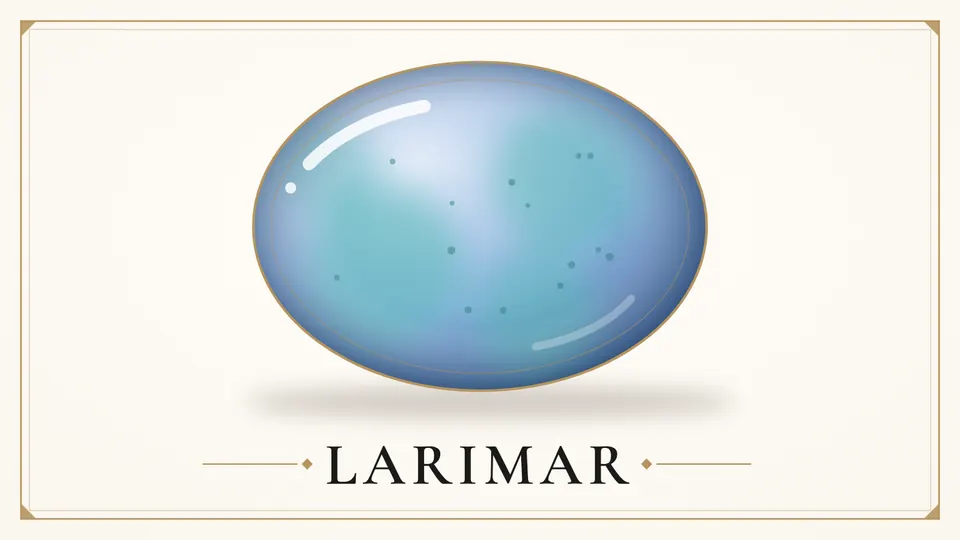
Larimar is the sky-blue to turquoise form of pectolite, a sodium calcium silicate (NaCa2Si3O8(OH)). It is found almost only in one place, the Dominican Republic. It is fairly soft, at about 4.5 to 5 on the Mohs scale, and its blue can pale in strong light and heat. In crystal tradition it is a stone of calm and the sea.
At a glance
- Formula NaCa2Si3O8(OH), the blue variety of pectolite.
- Mohs 4.5 to 5, so it scratches more easily than quartz and can split if knocked.
- Found almost only in the Dominican Republic, near Barahona.
- Blue can fade in strong light and heat. Care: soft cloth, mild soap, no soaking or ultrasonic cleaners.
Quick facts
| Family | Sodium calcium silicate (inosilicate), the blue variety of pectolite |
|---|---|
| Chemical formula | NaCa2Si3O8(OH) |
| Crystal system | Triclinic, usually as fibrous masses rather than single clear crystals |
| Mohs hardness | 4.5–5 |
| Luster | Silky to subvitreous, with perfect cleavage in two directions |
| Transparency | Translucent to opaque, usually cut as cabochons |
| Natural colors | light sky blue, turquoise blue, deep blue, blue-green, bluish white |
| Main localities | Dominican Republic (near Barahona) |
| Common treatments | usually sold as natural stone, but ask whether it is natural, treated or a look-alike material; strong light and heat can pale the blue over time |
Larimar at a glance, in pictures
Chakras (traditional)
Hardness range
Natural colors
- light sky blue
- turquoise blue
- deep blue
- blue-green
- bluish white
Traditionally linked to
- Element
- Water
Common forms of Larimar
- Cabochon smooth dome
- Rough raw chunk
- Tumbled polished pebble
How hard is Larimar?
- Talc 1
- Gypsum 2
- Copper coin ~ 3
- Calcite 3
- Fluorite 4
- Larimar 4.5–5
- Apatite 5
- Glass ~ 5.5
- Steel knife ~ 5.5
- Orthoclase 6
- Quartz 7
- Topaz 8
- Corundum 9
- Diamond 10
What it is and where it comes from
Larimar is a trade name for the rare blue variety of pectolite. Pectolite itself is usually white to grey and was first described in 1828 in Italy. The blue comes from copper taking the place of some calcium in the structure.
The blue stone is usually dated to 1974, when Miguel Méndez and Peace Corps volunteer Norman Rilling found it on a beach in the south-west of the Dominican Republic. Before that, locals called it simply the blue stone.
The name joins Méndez's daughter's name, Larissa, with the Spanish word for sea, mar. It also suits the stone's Caribbean colours.
The first pieces were loose stones washed down to the coast by a river. Searching upstream led to the main source, the Los Chupaderos area, about 10 km south-west of Barahona.
The hillside is now reportedly pierced by around 2,000 narrow vertical shafts, which is one reason fine material stays scarce and prices for top blue pieces can be high.
In crystal tradition
What follows is belief and folklore, passed down in crystal tradition. It is not measured fact.
Traditionally associated with: calm, serenity, self-expression.
Larimar is traditionally associated with the sea, with calm and with easy, open speech. Its water-like colour is the usual reason given. This is a modern spiritual tradition, not a fact about the stone.
Crystal tradition often links it to the Throat and Heart chakras. These pairings vary from one tradition to another and have no scientific basis.
How to care for Larimar
- Water Caution
- Sunlight Avoid
- Salt Caution
- Heat Avoid
- Ultrasonic Avoid
- Chemicals Caution
Safe = fine as a rule · Caution = only briefly or gently · Avoid = can damage the stone · Unknown = no reliable guidance.
Wipe larimar with a soft, slightly damp cloth and a drop of mild soap, then dry it right away. Brief contact with water is fine, but do not soak it or wear it in the shower, pool or sea. At about 4.5 to 5 it is soft and has perfect cleavage, so skip ultrasonic and steam cleaners, and keep it away from heat, hot cars and strong sun, which can pale the blue. Store it apart from harder stones so it is not scratched.
Real or fake? Look-alikes and treatments
Often confused with
- Dyed howlite
- Blue glass
- Pectolite from other places
- Amazonite
Common look-alikes
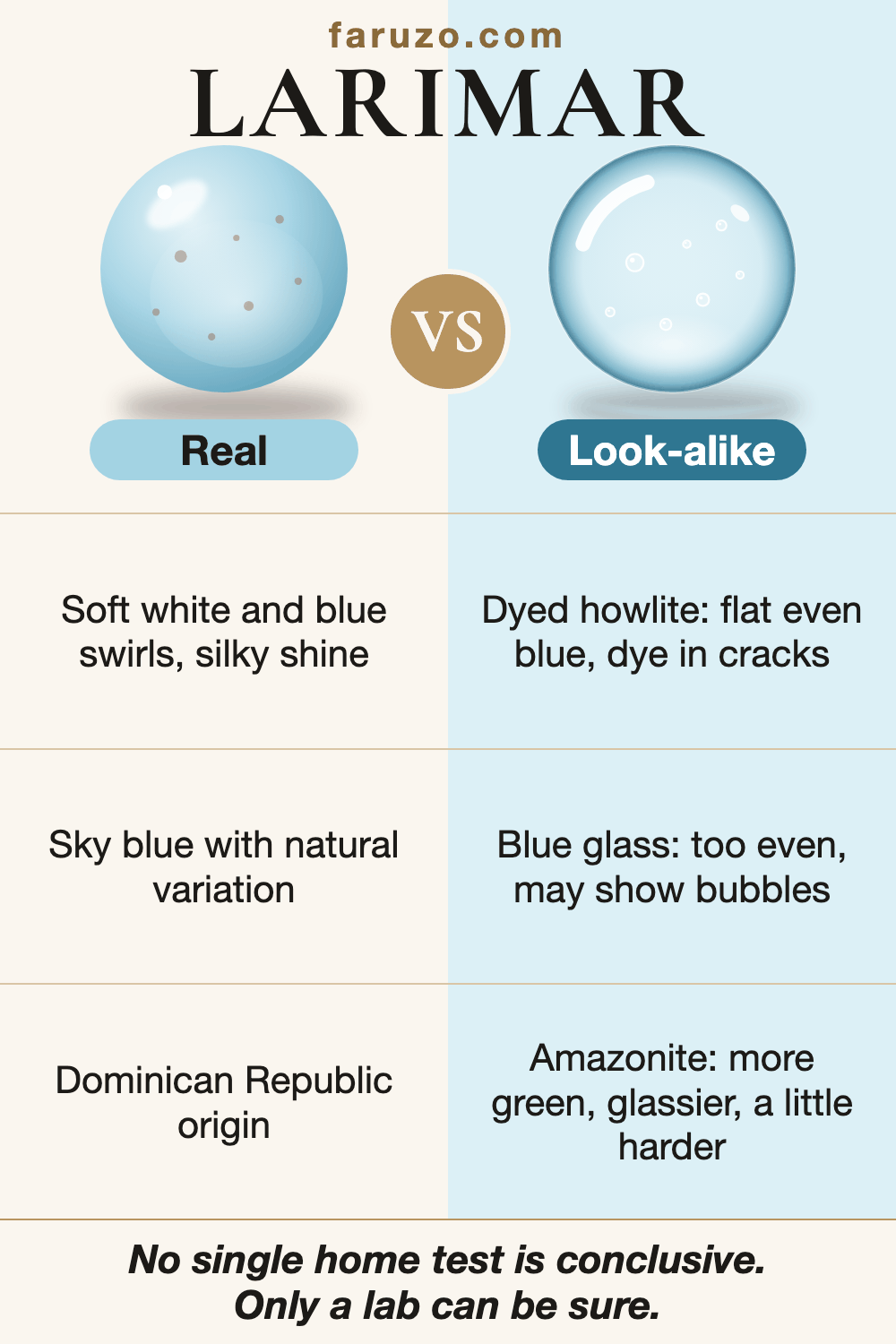
- Dyed howlite. Howlite is a soft white stone (Mohs about 3.5) whose porous texture takes dye well, so it is often coloured blue. Look for a flat, even blue, dark grey veining and colour pooling in cracks. Larimar usually shows softer white or deeper blue swirls instead.
- Blue glass. Glass is a common imitation. It tends to look too even and clear, may show round gas bubbles, and feels cool and glassy rather than silky. Larimar is usually translucent to opaque with a soft, silky shine.
- Pectolite from other places. Most pectolite is white to grey, sometimes sold as Alaska jade. It is the same mineral but without the sky-blue colour. A stone with no blue and no Dominican origin is not larimar.
- Amazonite. Amazonite is a blue-green feldspar (Mohs 6 to 6.5) with a glassy shine, usually a little harder and greener than larimar's sky blue. Colour alone is not a safe guide, so confirm what the stone actually is.
Safe checks you can do
- Ask the seller in writing whether the stone is natural larimar from the Dominican Republic, treated, or another blue stone.
- Look for natural variation. Real larimar often shows soft white, pale or deeper blue patterns, while dyed stone and glass can look flat and even.
- Check the cracks and edges of a bead or cabochon. Dye can pool in fine cracks and leave dark blue lines.
- Do not scratch-test or heat-test a stone you plan to keep. Heat can pale larimar, and a lab is the safer route when it matters.
Wearing Larimar
Ring
Avoid
Splits easily along a flat plane, so a ring is best avoided.
Bracelet
Avoid
One knock on the wrist can split it along a flat plane.
Pendant
Careful
It can split along a flat plane, so keep it protected.
Earrings
Careful
A flat-plane split is possible, so keep earrings for dressy wear.
Guide for everyday wear, based on hardness and care notes. Safe, Careful or Avoid.
At about 4.5 to 5, larimar scratches easily and can split along flat planes if knocked, so a ring or bracelet takes too many bumps for everyday wear. Pendants and earrings sit clear of most knocks and suit dressy, occasional wear. Take it off for the gym, showers and washing up, and keep it out of strong sun and heat between wearings.
Related stones
Questions about Larimar
What does larimar mean?
In crystal tradition larimar is a stone of calm, the sea and easy speech, and is linked to the Throat and Heart chakras. That is a belief, not a fact about the stone. Its practical claim to fame is a sky-blue colour found almost only in one place.
What is larimar?
Larimar is the sky-blue to turquoise variety of pectolite, a sodium calcium silicate with the formula NaCa2Si3O8(OH). Its blue comes from copper in the structure, and the name is a trade name rather than a separate mineral.
Where does larimar come from?
Larimar is found almost only in the Dominican Republic, near Barahona in the south-west. The main source is the Los Chupaderos area, about 10 km south-west of the town.
How hard is larimar?
About 4.5 to 5 on the Mohs scale, softer than glass and quartz. Perfect cleavage in two directions also means a sharp knock can split it.
Is larimar a birthstone?
Larimar is not on the standard modern or traditional birthstone lists, though lists vary and some alternative lists may include it. Check the list you are following.
Who named larimar?
Miguel Méndez is usually credited with the name. It joins his daughter's name, Larissa, with mar, the Spanish word for sea.
Does larimar fade in sunlight?
It can. Strong light and heat over a long time may pale the blue, so avoid leaving larimar on a sunny windowsill or in a hot car. Between wearings, keep it in a closed box or pouch.
Can you wear a larimar ring every day?
It is not the best choice. At about 4.5 to 5 it scratches easily, and a knock on a ring hand can split it. Pendants and earrings take fewer knocks and suit occasional wear.
Can larimar get wet, and can you clean it in an ultrasonic cleaner?
A short wipe or rinse in lukewarm water is fine, but do not soak it or wear it in the shower or sea. Skip ultrasonic and steam cleaners, since strong ultrasonic cleaners or heat can mark soft stone, and the colour may fade in strong light.
How can you tell real larimar from fake?
A home look can only hint. Real larimar usually shows soft white or deeper blue patterns, while dyed howlite and glass can look flat and even. A seller who cannot say where the stone came from is a warning sign, and a lab can confirm a stone that matters.
Is larimar treated or dyed?
Larimar is usually sold as a natural stone, but dyed howlite is sometimes passed off as it. Ask the seller to say in writing what the stone is and where it came from.
Is larimar rare?
It is found almost only in one area of the Dominican Republic, so fine blue material is limited. Rare does not mean every stone sold as larimar is genuine, so ask about origin.