
Crystal guide
Angelite Meaning, Properties and Care
Angelite is the trade name for pale blue to blue-violet anhydrite, a calcium sulfate mineral (CaSO4). It is soft (Mohs about 3.5), splits along flat planes and can slowly take up water, so it is best kept dry. In crystal tradition it is the gentle stone of awareness, linked to angels and quiet reflection.
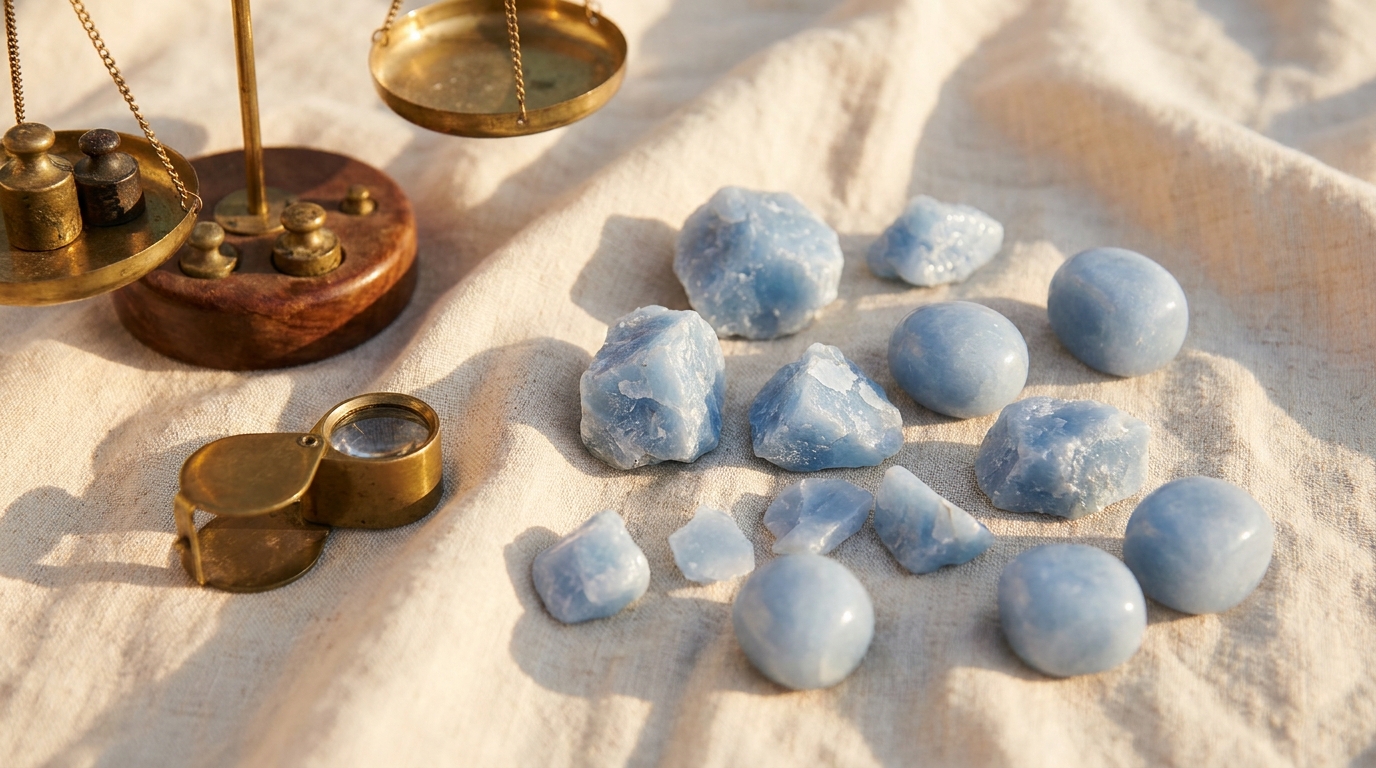
At a glance
- Formula CaSO4, orthorhombic. "Angelite" is a trade name, not a separate mineral.
- Hardness is about 3.5 on the Mohs scale, with perfect cleavage in more than one direction.
- Natural colour is pale blue to blue-violet, usually opaque to semi-transparent.
- Care: keep it dry, wipe with a soft dry cloth, and store it apart from harder stones.
Quick facts
| Family | Calcium sulfate (sulfate mineral), the anhydrous relative of gypsum |
|---|---|
| Chemical formula | CaSO4 |
| Crystal system | Orthorhombic; angelite is usually the massive, compact form |
| Mohs hardness | 3.5 |
| Luster | Glassy to pearly (pearly on the best cleavage surface); three directions of cleavage |
| Transparency | Opaque to semi-transparent |
| Natural colors | pale sky blue, blue-violet or lavender-blue, blue-grey, white or grey (plain anhydrite) |
| Main localities | Peru (the main source of blue angelite), anhydrite itself occurs widely in evaporite deposits |
| Common treatments | usually sold natural and polished; a vivid, even blue may have been dyed |
Angelite at a glance, in pictures
Chakras (traditional)
Hardness range
Natural colors
- pale sky blue
- blue-violet or lavender-blue
- blue-grey
- white or grey (plain anhydrite)
Common forms of Angelite
- Tumbled polished pebble
- Rough raw chunk
How hard is Angelite?
- Talc 1
- Gypsum 2
- Copper coin ~ 3
- Calcite 3
- Angelite 3.5
- Fluorite 4
- Apatite 5
- Glass ~ 5.5
- Steel knife ~ 5.5
- Orthoclase 6
- Quartz 7
- Topaz 8
- Corundum 9
- Diamond 10
What it is and where it comes from
Anhydrite is the older, plain mineral name. It means without water, because it lacks the water that gypsum holds in its crystals. Angelite is a modern trade name for the blue-grey to blue variety, and it is not a name with a long history behind it.
The blue material sold today comes mostly from Peru. Anhydrite forms in evaporite deposits, where mineral-rich water dries out in stages and leaves sulfate minerals behind, often alongside gypsum.
Anhydrite can take up water and slowly turn into gypsum. That is why it is treated as a more moisture-sensitive stone than most others in a jewellery box.
Being soft and mostly opaque, angelite is usually cut as cabochons, beads or tumbled stones rather than faceted.
In crystal tradition
What follows is belief and folklore, passed down in crystal tradition. It is not measured fact.
Traditionally associated with: awareness, calm, meditation.
Angelite is nicknamed the Stone of Awareness. Its sky-like colour and name have led crystal tradition to link it with angels, spirit guides and quiet communication, and it is traditionally kept at the bedside or held during meditation.
These associations belong to modern spiritual tradition and are a matter of belief, not a measured property of the stone.
How to care for Angelite
- Water Avoid
- Sunlight Caution
- Salt Caution
- Heat Caution
- Ultrasonic Avoid
- Chemicals Caution
Safe = fine as a rule · Caution = only briefly or gently · Avoid = can damage the stone · Unknown = no reliable guidance.
Do not soak it, and keep it clear of showers, pools and washing up, because anhydrite can slowly take up water and turn dull. Wipe with a soft dry cloth. Steam and ultrasonic cleaners are best avoided, as vibration can split a stone along its cleavage. Long direct sun may fade the pale colour, so keep it out of a bright window. Store it wrapped in soft cloth, apart from harder stones that could scratch it.
Real or fake? Look-alikes and treatments
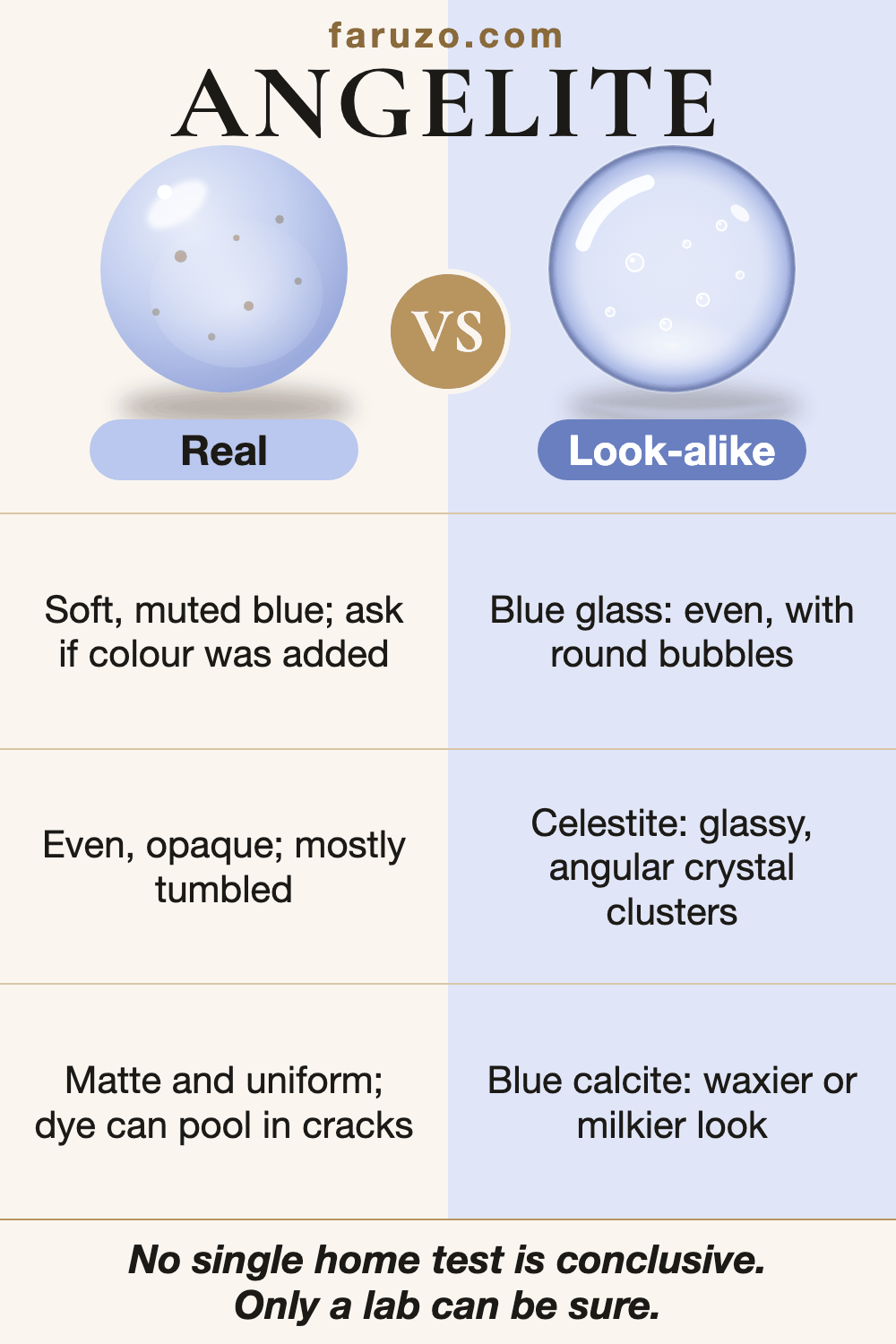
Often confused with
- Celestite
- Blue calcite
Common look-alikes
- Celestite. Celestite is strontium sulfate, a separate stone. It usually grows as glassy, angular crystal clusters or geode pieces, while angelite is more even and opaque with a matte finish, and mostly sold tumbled. A lab can sometimes tell them apart.
- Blue calcite. Blue calcite is calcium carbonate with a similar soft pale blue look. It tends to look waxier or milkier, while angelite looks more matte and uniform. The two are close in hardness, so touch alone will not separate them.
Safe checks you can do
- Natural angelite is a soft, slightly muted blue. A very bright, saturated blue at a bargain price deserves a closer look, since colour can be added.
- Look for colour pooled in cracks or at drill holes, a sign of dye added after the fact.
- A uniform, glassy blue with round bubbles points to glass rather than a mineral.
- Do not scratch-test a piece you want to keep. It is soft and marks easily, so a lab can test it more safely.
Wearing Angelite
Ring
Avoid
Splits easily along a flat plane, so a ring is best avoided.
Bracelet
Avoid
One knock on the wrist can split it along a flat plane.
Pendant
Careful
Water can harm it, so keep a pendant dry.
Earrings
Careful
Water can harm it, so take earrings off before showering.
Guide for everyday wear, based on hardness and care notes. Safe, Careful or Avoid.
Angelite is soft, splits along flat planes and dislikes water, so a ring is best avoided, and a bracelet is best avoided too. A pendant or earrings suit it better, as long as they stay dry and are worn with care. Take it off before showers, swimming and anything rough, and keep it for occasional wear rather than every day.
Related stones
Questions about Angelite
What does angelite mean?
In crystal tradition angelite is the Stone of Awareness, linked to angels, calm and quiet reflection, partly because of its sky-like colour. That is a belief, not a measured property of the mineral.
What is angelite made of?
Angelite is blue anhydrite, a calcium sulfate mineral (CaSO4). The name is a trade name for the compact blue form, so it is a real mineral and not glass or a synthetic.
Is angelite the same as celestite?
No. Celestite is strontium sulfate and usually forms glassy, angular crystal clusters, while angelite is calcium sulfate and looks more uniform and opaque. They are often sold side by side because both are soft and pale blue.
Is angelite a birthstone?
No. Angelite is not on the usual modern or traditional birthstone lists, and its link to angels comes from crystal tradition.
How hard is angelite?
About 3.5 on the Mohs scale, softer than most stones used for jewellery. It also splits along flat planes, so it chips more easily than its number alone suggests.
Can angelite get wet or be worn in a ring?
Do not soak it, and keep it dry, because it can slowly take up water and turn dull. A ring is best avoided, since it is soft and splits along flat planes. Pendants and earrings that stay dry are a better fit.
Can angelite fade in the sun?
Long direct sun may fade the pale colour over time, so display it away from a bright window.
Is angelite a real mineral?
Yes, but under another name. Angelite is a trade name for blue anhydrite, a genuine sulfate mineral.
Is angelite dyed?
It is usually sold natural, but colour can be added to some stones. A very bright, even blue deserves a closer look, and dye pooled in cracks is a sign.
What is the difference between angelite and blue calcite?
They are different minerals. Angelite is calcium sulfate, while blue calcite is calcium carbonate and often looks waxier or milkier. Both are soft and pale blue.
Where does angelite come from?
Most blue angelite comes from Peru. Plain anhydrite occurs in evaporite deposits in many other countries.