
Crystal guide
Chrysocolla Meaning, Properties and Care
Chrysocolla is a blue to blue-green hydrous copper silicate with a soft Mohs hardness of about 2.5 to 3.5 as a pure mineral. Its name comes from Greek words for gold and glue. In crystal tradition it is a stone of calm, clear speech.
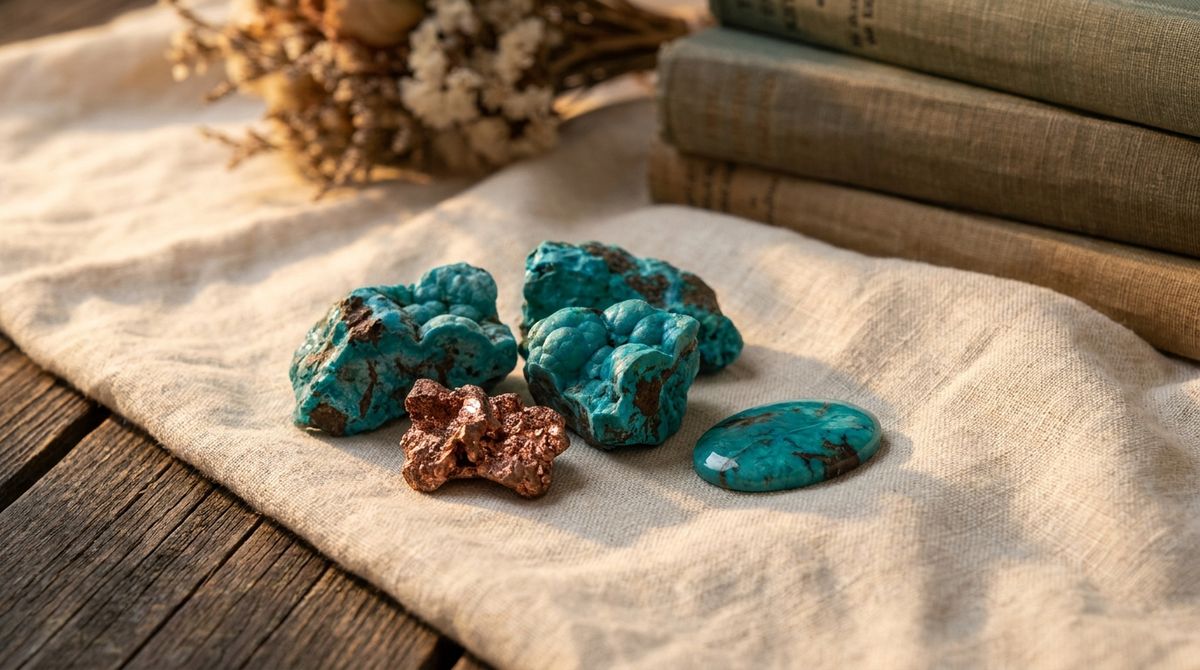
At a glance
- A hydrous copper silicate, blue to blue-green, with a colour that comes from copper.
- Pure chrysocolla is soft, about 2.5 to 3.5 on the Mohs scale, and brittle.
- Gem silica is quartz-rich chalcedony coloured by chrysocolla, and it can be much harder.
- Care: keep it dry, away from heat and chemicals; no ultrasonic or steam cleaners. Often treated or dyed, so the label matters.
Quick facts
| Family | Hydrous copper silicate (a silicate mineral, or mineraloid) |
|---|---|
| Chemical formula | (Cu,Al)2H2Si2O5(OH)4·nH2O |
| Crystal system | Usually forms as botryoidal crusts, veins and masses, rarely as visible crystals |
| Mohs hardness | 2.5–3.5 |
| Luster | Vitreous to earthy; no cleavage, with an irregular to sub-conchoidal fracture |
| Transparency | Translucent to opaque |
| Natural colors | blue; cyan; blue-green; green; dark blue to black; brown, rarely |
| Main localities | Ray mine and Bisbee, Arizona (USA); Kennecott mine, Utah (USA); San Simon mine (Chile); Rokana mine, Copperbelt (Zambia) |
| Common treatments | soft, crumbly material is often stabilised with resin or wax so it can be cut and polished; pale or patchy stones are sometimes dyed a stronger blue |
Chrysocolla at a glance, in pictures
Chakras (traditional)
Hardness range
Natural colors
- blue
- cyan
- blue-green
- green
- dark blue to black
- brown, rarely
Traditionally linked to
- Zodiac
- GeminiVirgoTaurus
Common forms of Chrysocolla
- Rough raw chunk
- Cabochon smooth dome
- Bead drilled bead
How hard is Chrysocolla?
- Talc 1
- Gypsum 2
- Copper coin ~ 3
- Calcite 3
- Chrysocolla 2.5–3.5
- Fluorite 4
- Apatite 5
- Glass ~ 5.5
- Steel knife ~ 5.5
- Orthoclase 6
- Quartz 7
- Topaz 8
- Corundum 9
- Diamond 10
What it is and where it comes from
The name joins the Greek words for gold and glue. It is tied to a material used to solder gold, and it appears in writing from about 315 BC.
Ancient names grouped blue and green copper minerals together by colour, so an old mention of chrysocolla may describe malachite or another copper stone.
Chrysocolla forms in the weathered upper zone of copper deposits, often beside malachite, azurite and quartz.
It has been carved and used as an ornamental stone since antiquity, and it is a minor copper ore.
Jewellers have reportedly used it as an easy-to-work stand-in for turquoise, since both are blue-green copper stones from similar ground.
Well-known sources include Arizona, Utah, Chile and Zambia, all copper-mining districts.
In crystal tradition
What follows is belief and folklore, passed down in crystal tradition. It is not measured fact.
Traditionally associated with: calm, clear communication, balance.
Chrysocolla is traditionally linked to calm and clear communication, a stone to reach for before a hard conversation. This is a modern spiritual tradition, not a fact about the stone.
Crystal tradition pairs it with the Throat and Heart chakras, reading its blue-green shade as a bridge between the two. Some traditions call it a goddess stone, tied to feminine and ancestral themes.
Zodiac pairings vary, with Gemini, Virgo and Taurus all appearing. It is not on any standard birthstone list.
How to care for Chrysocolla
- Water Caution
- Sunlight Caution
- Salt Caution
- Heat Caution
- Ultrasonic Avoid
- Chemicals Avoid
Safe = fine as a rule · Caution = only briefly or gently · Avoid = can damage the stone · Unknown = no reliable guidance.
Wipe chrysocolla with a soft, dry or barely damp cloth, and never soak it, since water can seep into soft or porous material and dull treated stones. Keep it away from perfume, lotion, acids and cleaners. Steam and ultrasonic cleaners can crack it. Store it in its own soft pouch, away from harder stones, out of long direct sun and heat.
Real or fake? Look-alikes and treatments
Often confused with
- Turquoise
- Malachite
- Amazonite
- Blue-dyed howlite or magnesite
Common look-alikes
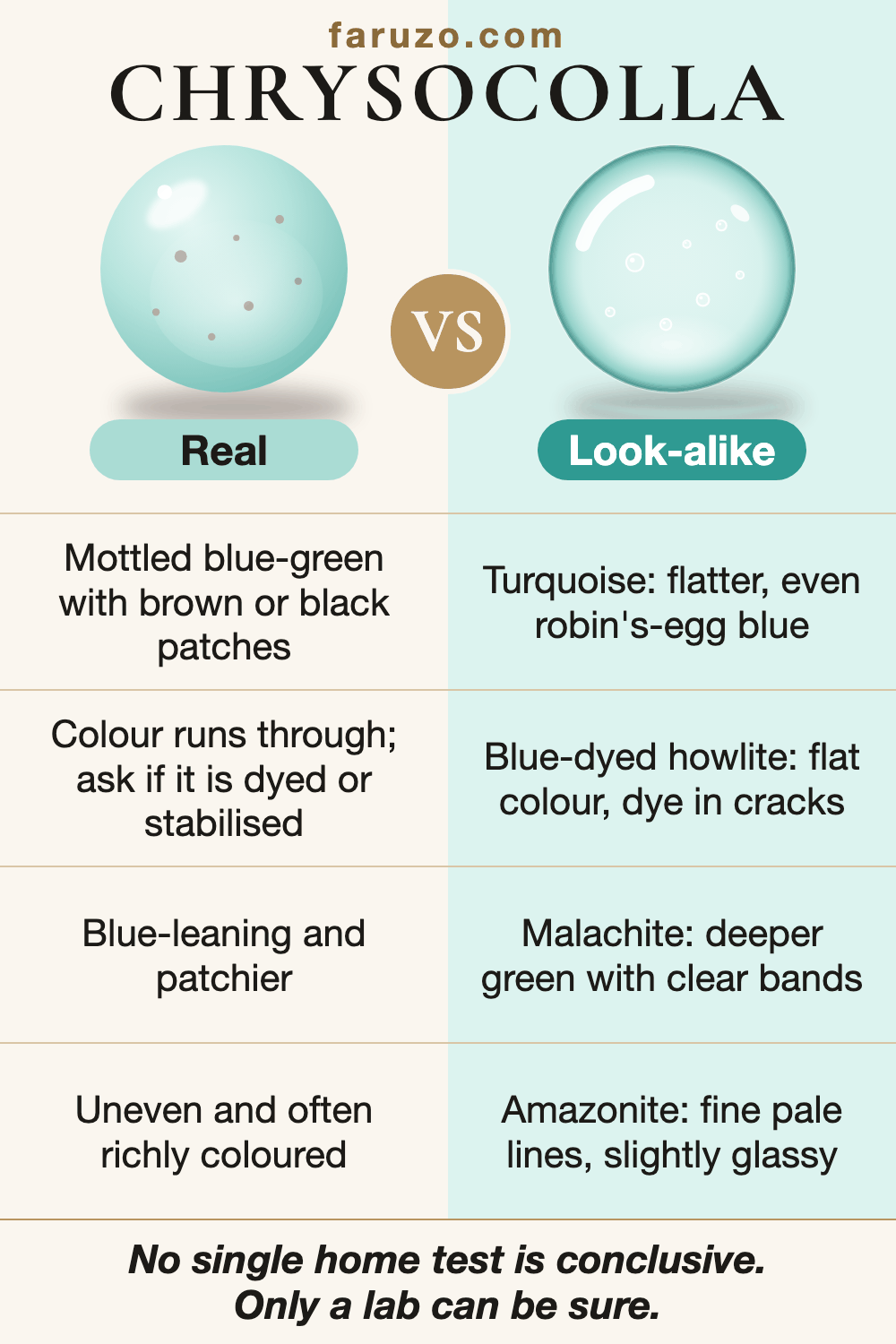
- Turquoise. Turquoise is a copper aluminium phosphate. It more often shows a flatter, even robin's-egg blue against a matrix, while chrysocolla tends to look mottled in blue and green with brown or black patches. Turquoise is somewhat harder.
- Malachite. Malachite is a green copper carbonate with clear banded rings, and it is usually a deeper, more solid green. Chrysocolla leans blue and looks patchier.
- Amazonite. Amazonite is a blue-green feldspar that is much harder, and it often shows fine pale lines or a slightly glassy look. Chrysocolla looks more uneven and often more saturated.
- Blue-dyed howlite or magnesite. These are white stones coloured to imitate turquoise, and they are sometimes sold as chrysocolla. The colour tends to look flat and even, and dye can pool in cracks and pits.
Safe checks you can do
- Ask whether the stone is pure chrysocolla, gem silica, stabilised or dyed, and get the answer in writing.
- Look at the colour. Natural chrysocolla is mottled, with blue-green shifts and brown or black patches, while a very even, bright colour deserves questions.
- Check cracks and pits under a loupe. Dye tends to collect there, while natural colour runs through the stone.
- Be wary of a hard, glassy, very uniform stone sold cheaply as chrysocolla. A lab can sometimes tell what it really is.
- Do not scratch or acid-test a stone you plan to keep. Use a lab instead.
Wearing Chrysocolla
Ring
Avoid
Softer than most everyday dust, so it scratches easily.
Bracelet
Avoid
Softer than most everyday dust, so a bracelet scratches easily.
Pendant
Avoid
Very soft, so a pendant is best avoided.
Earrings
Avoid
Very soft, so earrings are best avoided.
Guide for everyday wear, based on hardness and care notes. Safe, Careful or Avoid.
Pure chrysocolla is soft and brittle, so every kind of jewelry is best avoided: a ring or bracelet takes the most knocks, and even a pendant or earrings scratch or chip easily. Stones that are mostly quartz-rich chalcedony, often sold as gem silica, can be much harder, but the label and the stone itself should agree. Take chrysocolla off for the gym, showers, cleaning and anything rough. Cutting or polishing the rough makes dust, which matters in a workshop.
Questions about Chrysocolla
What does chrysocolla mean?
In crystal tradition chrysocolla is a stone of calm and clear communication, linked to the Throat and Heart chakras. That is a belief, not a fact about the stone. Its measurable story is its copper-blue colour and its soft, variable nature.
What is chrysocolla?
Chrysocolla is a hydrous copper silicate that forms in the weathered upper zone of copper deposits. It usually appears as rounded crusts, veins and masses, and its blue-green colour comes from copper.
How hard is chrysocolla?
Pure chrysocolla is about 2.5 to 3.5 on the Mohs scale, so it scratches easily. Quartz-rich varieties are far harder, which is why one name covers very different stones.
What is gem silica?
Gem silica is the trade name for chalcedony, a fine-grained quartz, coloured blue-green by chrysocolla. Strictly it is not pure chrysocolla, and it can be hard enough to resist scratches far better.
Is chrysocolla a birthstone?
No. Chrysocolla is not on the standard modern or traditional birthstone lists. Crystal tradition links it to Gemini, Virgo or Taurus, but that is a belief rather than an official designation.
Is chrysocolla the same as turquoise?
No. Chrysocolla is a copper silicate and turquoise is a copper aluminium phosphate. They form in similar copper-rich ground and share blue-green shades, so they are often mixed up.
Where does the name chrysocolla come from?
It joins the Greek words for gold and glue, and is tied to a material used to solder gold. It does not describe the stone's colour, and older uses of the name were not always for this exact mineral.
Can chrysocolla go in water, and will it fade?
Keep it dry. Never soak it, since water can seep into soft or treated material and dull it. Strong light and heat can change dyed or stabilised stones, and a dyed stone may lose colour sooner than a natural one.
Can you wear a chrysocolla ring?
A ring is best avoided for pure chrysocolla, which is soft and brittle, and a pendant or earrings are best avoided too. Quartz-rich gem silica is far tougher.
Is dyed or stabilised chrysocolla still real?
Yes, the stone underneath is real, just treated. Stabilising with resin makes soft material easier to cut and wear, and dye can deepen the colour. It is worth knowing which treatment a stone has had.
How can you tell chrysocolla from a fake?
A home look can only hint. Natural chrysocolla is mottled blue-green, often with brown or black patches, while dyed howlite looks flat and even, with colour pooling in cracks. A lab is the way to be sure.
Is chrysocolla rare?
The mineral is common around copper mines. Clean, sound material that is hard enough to cut well is scarcer, and gem silica is among the rarest of the group.