
Crystal guide
Amazonite Meaning, Properties and Care
Amazonite is the green to blue-green variety of microcline feldspar (KAlSi3O8, Mohs 6 to 6.5). It is most often confused with turquoise, but it is a different mineral: harder, glassier, and usually streaked with pale white. Its name comes from the Amazon River, though that link is uncertain. In crystal tradition it is called a stone of truth and communication.
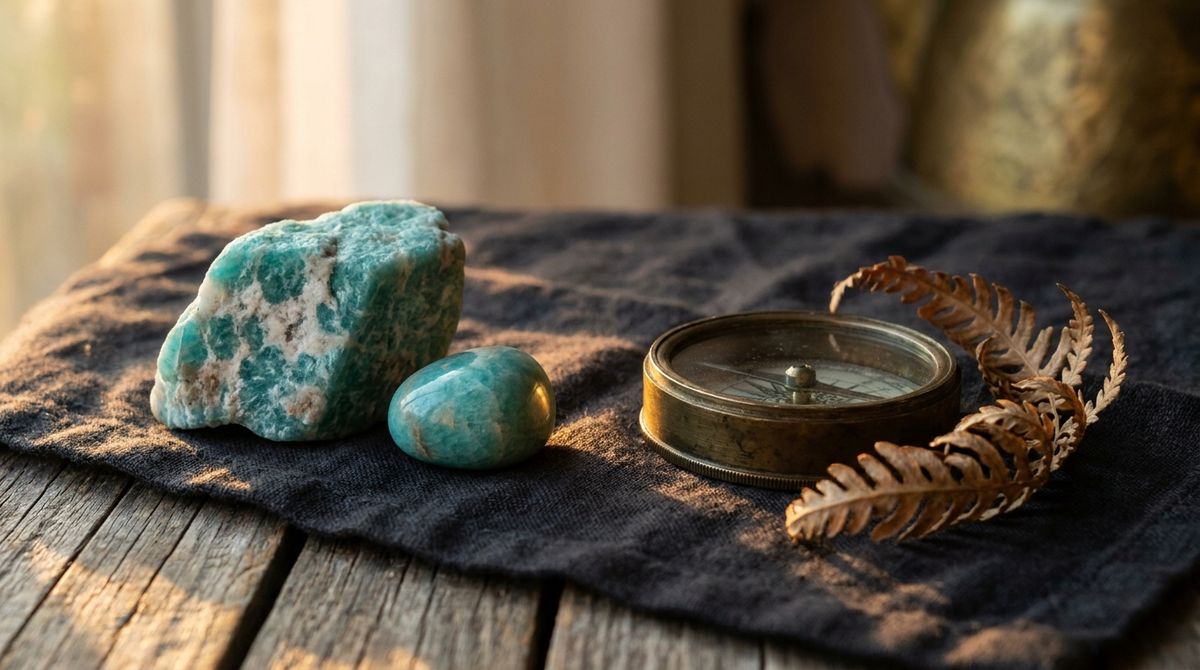
At a glance
- Hardness Mohs 6 to 6.5, with perfect cleavage: a hard knock can chip or split it.
- Potassium feldspar (KAlSi3O8) in green to blue-green, often with pale white streaks or mottling.
- Turquoise is a different mineral (copper aluminum phosphate, Mohs 5 to 6); dyed howlite and magnesite are common stand-ins.
- Care: soft damp cloth. Avoid machine cleaners and hard knocks.
Quick facts
| Family | Feldspar (microcline, a potassium feldspar) |
|---|---|
| Chemical formula | KAlSi3O8 |
| Crystal system | Triclinic |
| Mohs hardness | 6–6.5 |
| Luster | Vitreous (glassy) to slightly waxy; perfect cleavage |
| Transparency | Mostly opaque to translucent, often with pale mottling or streaks |
| Natural colors | green, blue-green, bluish green with white streaks |
| Main localities | Russia (Miass area); United States (Colorado, Virginia, Pennsylvania); Australia; China; Mongolia; Ethiopia; South Africa; Sweden; Brazil |
| Common treatments | usually sold untreated; dyed imitations of similar-looking stones are common in the trade |
Amazonite at a glance, in pictures
Chakras (traditional)
Hardness range
Natural colors
- green
- blue-green
- bluish green with white streaks
Common forms of Amazonite
- Rough raw chunk
- Tumbled polished pebble
- Cabochon smooth dome
How hard is Amazonite?
- Talc 1
- Gypsum 2
- Copper coin ~ 3
- Calcite 3
- Fluorite 4
- Apatite 5
- Glass ~ 5.5
- Steel knife ~ 5.5
- Orthoclase 6
- Amazonite 6–6.5
- Quartz 7
- Topaz 8
- Corundum 9
- Diamond 10
What it is and where it comes from
Amazonite is jewelry-grade green to blue-green microcline. Its colour is often linked to lead and water in the crystal, but the cause is not fully settled and may involve several factors together.
The name comes from the Amazon River, but it is uncertain whether the green stones once believed to come from there were amazonite at all. The link may be a mistake.
Green feldspar beads are found in some ancient jewelry from Egypt and Mesopotamia, though old pieces are hard to identify with certainty.
In early modern times much of the supply came from the Miass area of Russia.
Today it comes from many places, including Colorado, Virginia and Pennsylvania in the United States, as well as Australia, China, Mongolia, Ethiopia, South Africa and Sweden.
Amazonite is not a traditional or modern birthstone for any month.
In crystal tradition
What follows is belief and folklore, passed down in crystal tradition. It is not measured fact.
Traditionally associated with: truth, communication, calm, self-expression.
Amazonite is traditionally called a stone of truth and communication, something people hold before a difficult conversation to encourage honest, calm speech. This is a modern spiritual tradition, not a fact about the stone or an effect on the mind.
Crystal tradition traditionally pairs amazonite with the Heart and Throat chakras, linking its blue-green tone to balance and self-expression. These mappings differ between lists and have no scientific basis.
How to care for Amazonite
- Water Caution
- Sunlight Caution
- Salt Caution
- Heat Caution
- Ultrasonic Avoid
- Chemicals Caution
Safe = fine as a rule · Caution = only briefly or gently · Avoid = can damage the stone · Unknown = no reliable guidance.
Clean amazonite with a soft, slightly damp cloth and dry it. Perfect cleavage means vibration or a hard knock can split it, so ultrasonic cleaners are best avoided as a precaution, and steam and sudden heat are a caution for the same reason. Long strong sun can reportedly fade some feldspar colour, so keep pieces out of it as a precaution. Salt is best avoided; brief contact with water is fine, but skip soaking, chlorine and long showers.
Real or fake? Look-alikes and treatments
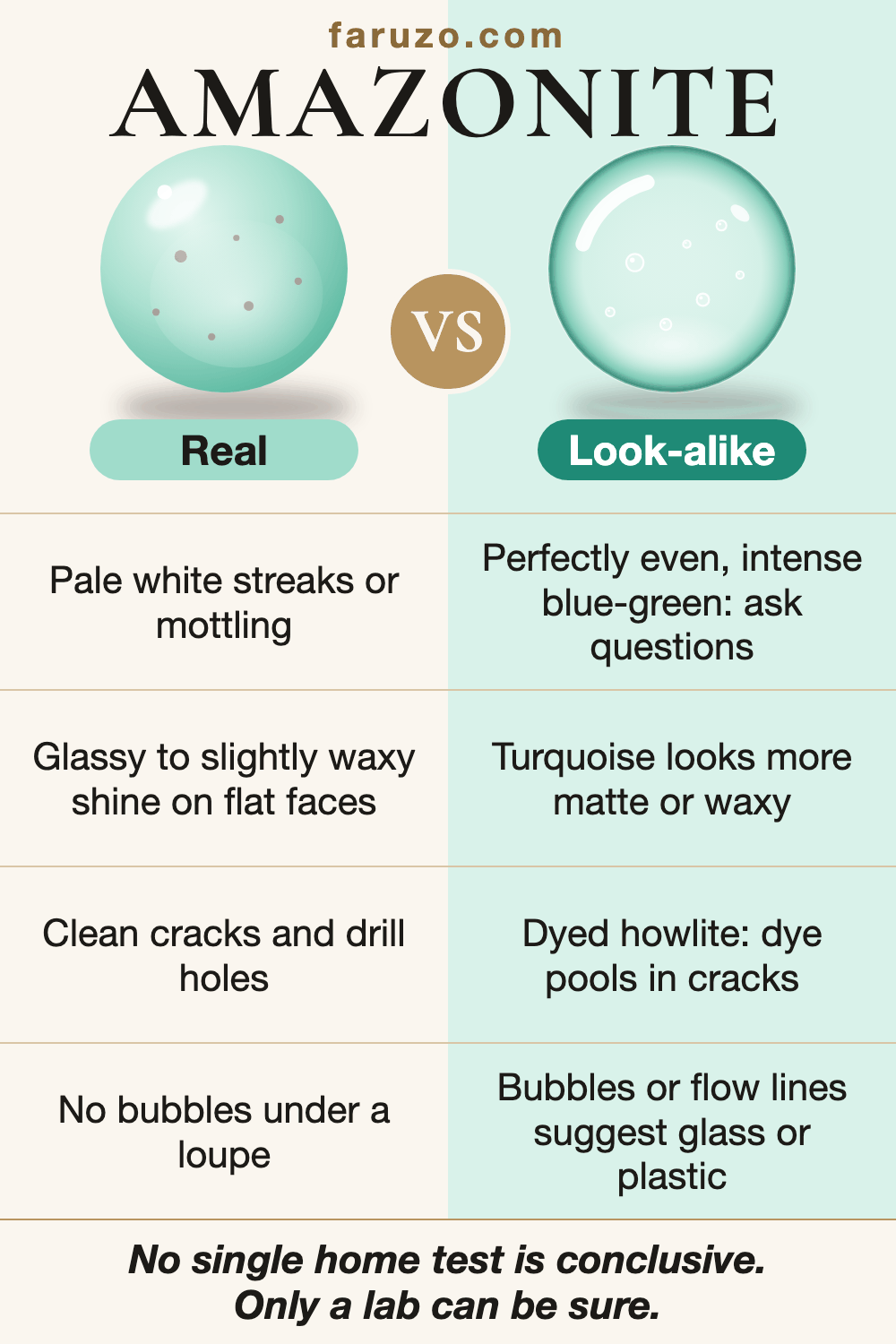
Often confused with
- Turquoise
- Dyed howlite or dyed magnesite
- Glass or plastic imitations
- Green aventurine
Common look-alikes
- Turquoise. Turquoise is a copper aluminum phosphate (Mohs 5 to 6), usually more evenly coloured and matte to waxy, often with a brown or black web-like matrix. Amazonite is a feldspar (Mohs 6 to 6.5) that usually shows pale white streaks or mottling and a glassier shine. Colour alone is not reliable, so confirm what the stone actually is.
- Dyed howlite or dyed magnesite. These are naturally white stones commonly dyed blue-green to imitate turquoise, and they can be sold as amazonite too. Dyed stones often look uniformly and strongly coloured, and dye may collect in cracks or between grains. Ask whether the stone is natural or dyed.
- Glass or plastic imitations. Glass and plastic are often more translucent and may show tiny bubbles or flow lines under a loupe. Natural amazonite usually has no bubbles and typically shows the pale streaking of feldspar.
- Green aventurine. Green aventurine is a quartz (Mohs about 7) with a sparkly glitter from tiny flakes inside, a shine amazonite does not have. Amazonite is softer and bluer, and shows pale streaks rather than glitter.
Safe checks you can do
- Ask the seller in writing whether the stone is natural amazonite, and whether it is dyed. Dyed howlite and magnesite are widely sold as blue-green stones.
- Look for pale white streaks or mottling through the green-blue body. This is normal for amazonite; a perfectly even, intense blue-green can be a prompt to ask questions. It is a sign, not proof.
- Look closely at cracks and drill holes. Dye pooling in cracks, or colour that rubs off on a damp white cloth, points to a dyed stone. Bubbles or flow lines under a loupe point to glass or plastic.
- Check the shine. Amazonite has a glassy to slightly waxy shine on its flat cleavage faces, where turquoise tends to look more matte or waxy.
- For a stone that matters, ask a gemologist or lab to test it.
Wearing Amazonite
Ring
Careful
Fine with care, but knocks can mark it.
Bracelet
Careful
A knock on a bracelet can split it along a flat plane.
Pendant
Careful
It can split along a flat plane, so keep it protected.
Earrings
Careful
A flat-plane split is possible, so keep earrings for dressy wear.
Guide for everyday wear, based on hardness and care notes. Safe, Careful or Avoid.
At Mohs 6 to 6.5 with perfect cleavage, amazonite scratches more easily than quartz-family stones and can chip or split from a sharp knock. It tends to suit earrings, pendants and occasional rings better than a ring worn every day. Store it apart from harder stones so it is not scratched in a jewelry box.
Questions about Amazonite
What does amazonite mean?
In crystal tradition amazonite is called a stone of truth and communication, traditionally linked to calm, honest speech and to the Heart and Throat chakras. These are symbolic meanings from tradition, not facts about the stone or claims about your health.
Is amazonite a real gemstone?
Yes. Amazonite is a real mineral, the green to blue-green variety of microcline feldspar (KAlSi3O8), not glass or plastic. Dyed howlite, magnesite or glass can be sold under the name, so check what yours is.
What is the difference between amazonite and turquoise?
They are different minerals. Turquoise is a copper aluminum phosphate (Mohs 5 to 6), usually more evenly coloured with a matte or waxy finish and often a web-like matrix. Amazonite is a feldspar (Mohs 6 to 6.5) that usually shows pale white streaks and a glassier shine.
How can you tell real amazonite from fake?
Look for a glassy shine on flat faces, and no dye pooling in cracks or bubbles under a loupe. Dyed howlite or magnesite can stand in for it, so check that the listing names the mineral and says whether it is dyed.
Is amazonite named after the Amazon River?
Probably not in a direct way. The stone is not known to come from the Amazon, so the name may rest on an old mix-up.
Does amazonite scratch or chip easily?
More easily than quartz stones. Amazonite is Mohs 6 to 6.5 and has perfect cleavage, so a hard, direct knock can chip or split it. It suits earrings and pendants better than a ring worn every day.
How do you clean amazonite?
Wipe it with a soft, slightly damp cloth and dry it. Avoid steam and machine cleaners, and sudden heat, as a precaution because of its cleavage. Skip soaking, chlorine and long strong sun.
Can amazonite jewelry get wet?
Brief contact is usually not the worry, but soaking, chlorine and hot showers are best avoided as a precaution. Take it off before swimming and dry it afterwards.
Is amazonite a birthstone?
No. It is not a traditional or modern birthstone for any month.
Where does amazonite come from?
Russia's Miass area was an early source, and the Pikes Peak area of Colorado is a classic collector locality. Other supplies come from Brazil, Australia, China, Mongolia, Ethiopia and South Africa, among others.
Does amazonite fade in sunlight?
Some feldspar colour is reported to fade in long strong sun, though it is not well documented. As a precaution, keep amazonite out of a sunny window and away from heat.