
Crystal guide
Magnesite Meaning, Properties and Care
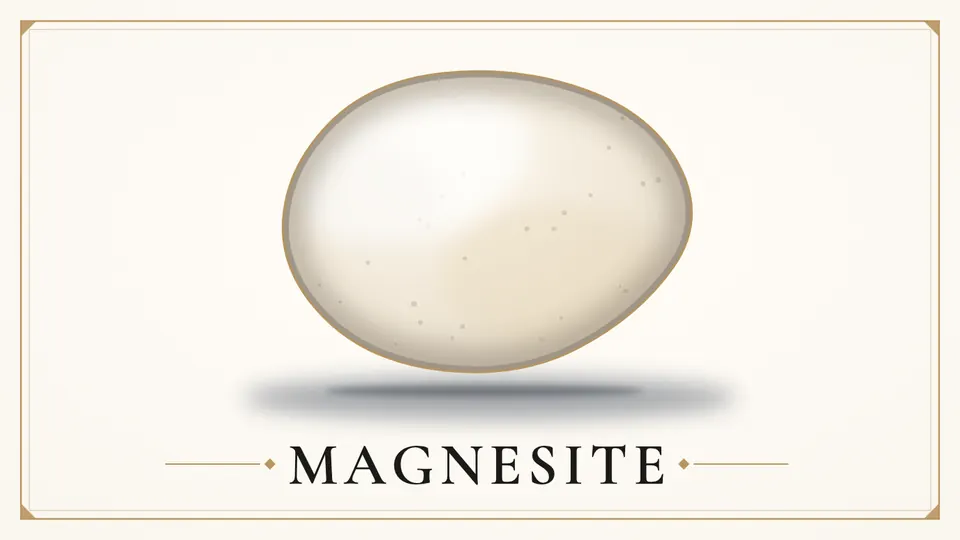
Magnesite is a magnesium carbonate (MgCO3), usually white to cream or grey, and soft at about 3.5 to 4.5 on the Mohs scale. It can be dyed, and light blue dyed magnesite beads are often sold as turquoise. In crystal tradition it is a stone of patience and quiet reflection.
At a glance
- A magnesium carbonate, formula MgCO3, usually white to cream or grey.
- Soft at Mohs about 3.5 to 4.5 and brittle, so it scratches easily and can chip.
- Often dyed light blue and sold as turquoise. Dyed magnesite is still real magnesite, just coloured, and calling it turquoise is a mislabel.
- Not on the standard birthstone lists. Care: soft cloth, no soaking, no acid, heat or ultrasonic cleaners.
Quick facts
| Family | Magnesium carbonate, a carbonate mineral of the calcite group |
|---|---|
| Chemical formula | MgCO3, with small amounts of iron, manganese, cobalt or nickel sometimes present |
| Crystal system | Trigonal, found as crystals and also as veins and masses of stone |
| Mohs hardness | 3.5–4.5 |
| Luster | Vitreous to dull; perfect rhombohedral cleavage in crystals |
| Natural colors | white; cream to grey; pale yellow or brown, sometimes faintly pink; dyed light blue or other colours |
| Main localities | Brazil (Bahia), Austria (Styria), Spain, Canada (British Columbia), China |
| Common treatments | often dyed, most commonly light blue to imitate turquoise; dyed magnesite is still magnesite; sometimes sold under trade names that hint at turquoise, so ask what a name means |
Magnesite at a glance, in pictures
Chakras (traditional)
Hardness range
Natural colors
- white
- cream to grey
- pale yellow or brown, sometimes faintly pink
- dyed light blue or other colours
Common forms of Magnesite
- Bead drilled bead
- Tumbled polished pebble
- Rough raw chunk
How hard is Magnesite?
- Talc 1
- Gypsum 2
- Copper coin ~ 3
- Calcite 3
- Fluorite 4
- Magnesite 3.5–4.5
- Apatite 5
- Glass ~ 5.5
- Steel knife ~ 5.5
- Orthoclase 6
- Quartz 7
- Topaz 8
- Corundum 9
- Diamond 10
What it is and where it comes from
Magnesite forms as veins in, and as an alteration product of, magnesium-rich ultramafic rock such as serpentinite. It also forms as a secondary carbonate in the soil above such rock.
Its name comes from its chemical makeup, magnesium carbonate.
Industry is its main use. Burned magnesite becomes magnesium oxide, a heat-resistant lining for blast furnaces and kilns.
White magnesite is also polished into beads and spheres and carved into figures. The sculptor Isamu Noguchi used it as a material for some of his artworks.
Magnesium carbonates have also been detected on Mars, near Jezero Crater.
Dyed howlite and magnesite are the most common turquoise imitations today. Beads dyed a light blue mimic turquoise, and staining between the grains may be visible.
In crystal tradition
What follows is belief and folklore, passed down in crystal tradition. It is not measured fact.
Traditionally associated with: patience, reflection.
Magnesite is traditionally associated with the Crown chakra and with patience and quiet reflection. This is a modern spiritual tradition, not a fact about the stone.
How to care for Magnesite
- Water Caution
- Sunlight Caution
- Salt Caution
- Heat Caution
- Ultrasonic Avoid
- Chemicals Avoid
Safe = fine as a rule · Caution = only briefly or gently · Avoid = can damage the stone · Unknown = no reliable guidance.
Wipe magnesite with a soft, slightly damp cloth, then dry it straight away. Do not soak it: a dyed stone can lose or smear its colour, and water, soap and sweat may soak in. Keep it away from acid, vinegar, lemon, solvents, perfume, hot water and steam, since acid can harm a carbonate and solvents can lift dye. Never use an ultrasonic cleaner. Strong sun can fade dye, so store it in a soft pouch, apart from harder stones that would scratch it.
Real or fake? Look-alikes and treatments
Often confused with
- Howlite
- White marble or calcite
- Porcelain
- White glass
- Plastic or resin
- Bone
Common look-alikes
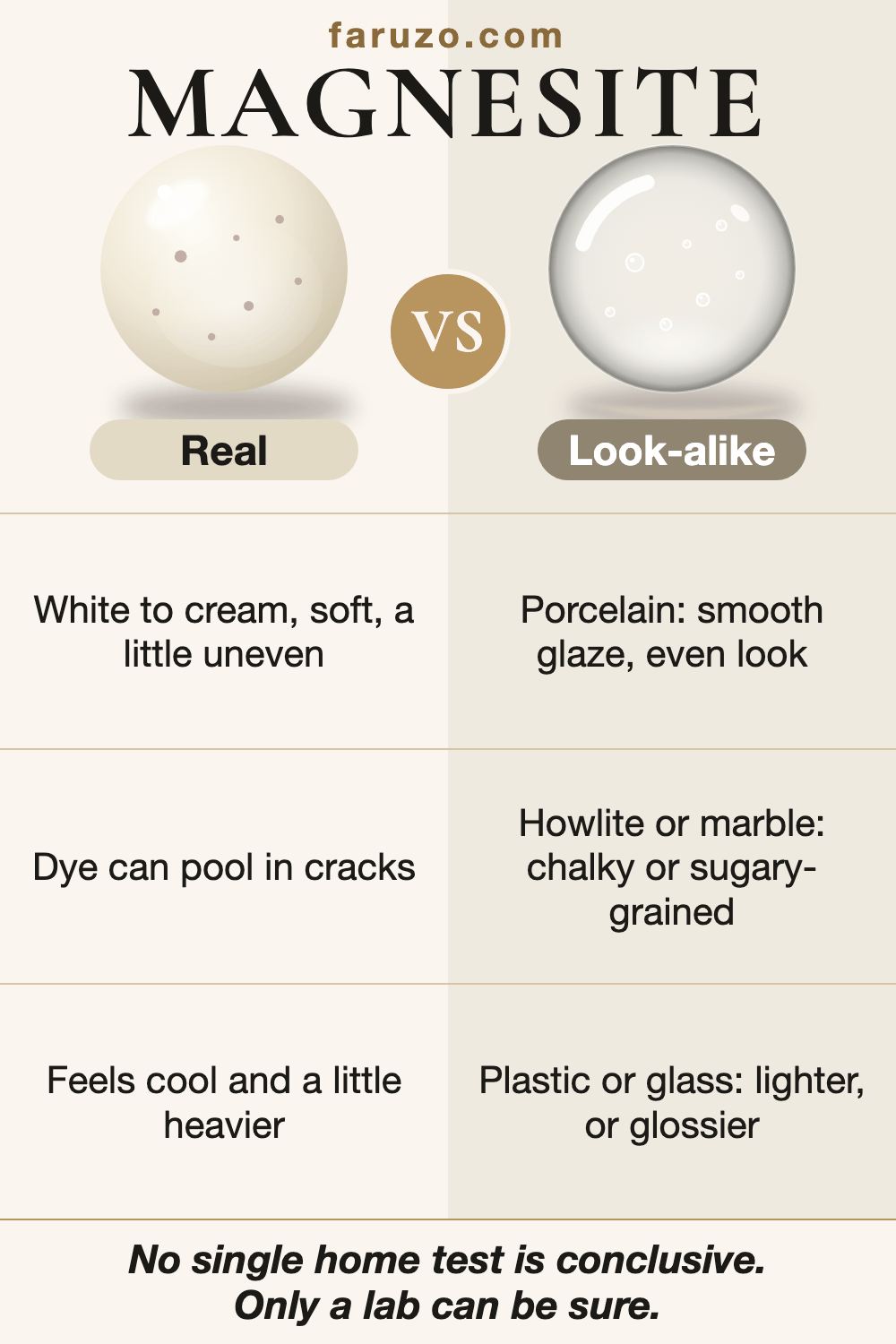
- Howlite. Howlite is another soft white stone that is often dyed blue to imitate turquoise, and the two can look very alike. Howlite is a borate, not a carbonate, and its hardness is close to magnesite's, so scratching will not separate them. Howlite is often a chalky white with fine grey or black veins, but a lab is the sure way to tell.
- White marble or calcite. Marble and calcite are white carbonates too, and can show grey veining. They are often more crystalline and sugary-grained, and sparkle more in good light. Colour alone is not a safe guide.
- Porcelain. Porcelain beads often have a smooth, glassy glaze and an even look with no real veins or grain, while magnesite is usually matt to softly glossy and a little uneven.
- White glass. Glass often looks glossier, cooler and more even, and may show tiny round bubbles. Magnesite usually has a softer, dull to waxy finish.
- Plastic or resin. Plastic beads often feel light and warm in the hand and may have a uniform, printed-looking pattern. Magnesite tends to feel cooler and a little heavier.
- Bone. Bone may show fine parallel lines or tiny pores along its length, while magnesite often has an irregular, mineral look with occasional darker veins.
Safe checks you can do
- Ask the seller in writing whether the stone is natural magnesite, dyed magnesite, howlite or something else, and whether any blue is dye. A stone sold as turquoise should be turquoise.
- Look closely at a blue stone sold as turquoise. Dye often pools darker in cracks, pits and between the grains, and the colour can look flat, even and too bright from edge to edge.
- Check the price. A large blue stone or a long strand offered far below the price of real turquoise is a warning sign that it may be dyed magnesite or howlite.
- Real turquoise is noticeably harder, just under 6 at its best, but do not scratch-test a stone you plan to keep. No single home test is conclusive, and a lab is the safer route when it matters.
Wearing Magnesite
Ring
Avoid
Soft and brittle, so a ring will scratch and chip.
Bracelet
Avoid
Knocks, soap and water would soon mark a soft bracelet.
Pendant
Careful
Sits clear of most knocks, but it still scratches.
Earrings
Careful
Light wear only, kept away from rain and perfume.
Guide for everyday wear, based on hardness and care notes. Safe, Careful or Avoid.
Magnesite is soft and brittle, at about 3.5 to 4.5, so a ring is best avoided, and a bracelet is best avoided too, since both meet knocks, soap and water every day. A pendant or earrings suit it better for occasional wear, kept away from showers, perfume and acid. Take it off before swimming, exercise and cleaning.
Related stones
Questions about Magnesite
What does magnesite mean?
In crystal tradition magnesite is linked with patience, quiet reflection and the Crown chakra. That is a belief, not a fact about the stone. Its practical claim to fame is a soft white mineral that is very often dyed blue.
What is magnesite?
Magnesite is a magnesium carbonate with the formula MgCO3. It is usually white to cream or grey, and it forms in veins and as an alteration product of magnesium-rich rock. Most of it is mined for industry.
How hard is magnesite?
About 3.5 to 4.5 on the Mohs scale, so it is soft and brittle. A steel blade or a harder stone can mark it, and it is not suited to hard daily wear.
Where is magnesite found?
Magnesite is found in Brazil (Bahia), Austria (Styria), Spain, Canada (British Columbia) and China, among other places. It forms as veins in, and as an alteration product of, magnesium-rich rock such as serpentinite.
What does magnesite look like, and what is it used for?
Magnesite is usually white, cream or grey, sometimes pale yellow or brown, with a matt to softly glossy look. Industry is its main use, as burned magnesite becomes a heat-resistant lining for furnaces. White stone is also polished into beads and spheres and carved into figures.
Is magnesite a birthstone?
Magnesite is not on the standard modern or traditional birthstone lists, though lists vary. Turquoise, the stone dyed magnesite is often sold as, is a traditional December birthstone.
Is the blue stone sold as turquoise really turquoise?
Often it is not. A bright, even blue stone sold cheaply as turquoise is frequently dyed magnesite or dyed howlite. Ask the seller to say in writing what the stone is and whether the colour is dye.
How can you tell dyed magnesite from real turquoise?
A home look can only hint. Dye tends to pool darker in cracks and pits, the colour can look too even and too bright, and some dyed stones leave a trace of colour on a damp cloth. Real turquoise is harder, but no single home test is conclusive, and a lab can settle a stone that matters.
Is dyed magnesite still real magnesite?
The stone itself is real magnesite, only coloured. The problem comes when it is sold as turquoise, which is a mislabel. Sold honestly as dyed magnesite, it is a fair, low-cost stone.
Will dyed magnesite lose its colour?
It can. Soaking, solvents, sweat, perfume, strong sun and rubbing can fade or smear dye over time. Keep it dry, store it in a pouch and avoid harsh cleaners.
Can you wear a magnesite ring every day?
It is not the best choice. At about 3.5 to 4.5 it scratches and chips easily, and a ring meets knocks and water constantly. A pendant or earrings take fewer knocks and suit occasional wear.
Can magnesite get wet, and does acid harm it?
Avoid soaking it, since water can soak into a dyed stone and lift colour. Magnesite is a carbonate, so acid can harm it, and a fizz test can damage the stone, so it is not a safe home check. Wipe it with a soft, slightly damp cloth, dry it, and skip ultrasonic and steam cleaners.
Is magnesite the same as howlite?
No. Magnesite is a magnesium carbonate and howlite is a calcium borosilicate. Both are white, soft and often dyed blue to imitate turquoise, which is why they are easy to confuse.