Sardonyx is a stone with a name that announces exactly what it's made of: sard, a reddish-brown chalcedony, fused in bands with onyx, the white-to-black banded chalcedony most people already know by name. That combination gave the ancient world a stone hard enough to carve, cheap enough to carry, and — for one very specific, well-documented reason — perfect for stamping a signature into wax. Here's what sardonyx actually is, why Roman seal-ring owners relied on it, the meaning later attached to it, and why it was August's birthstone for centuries before peridot took over the job.
What Sardonyx Actually Is
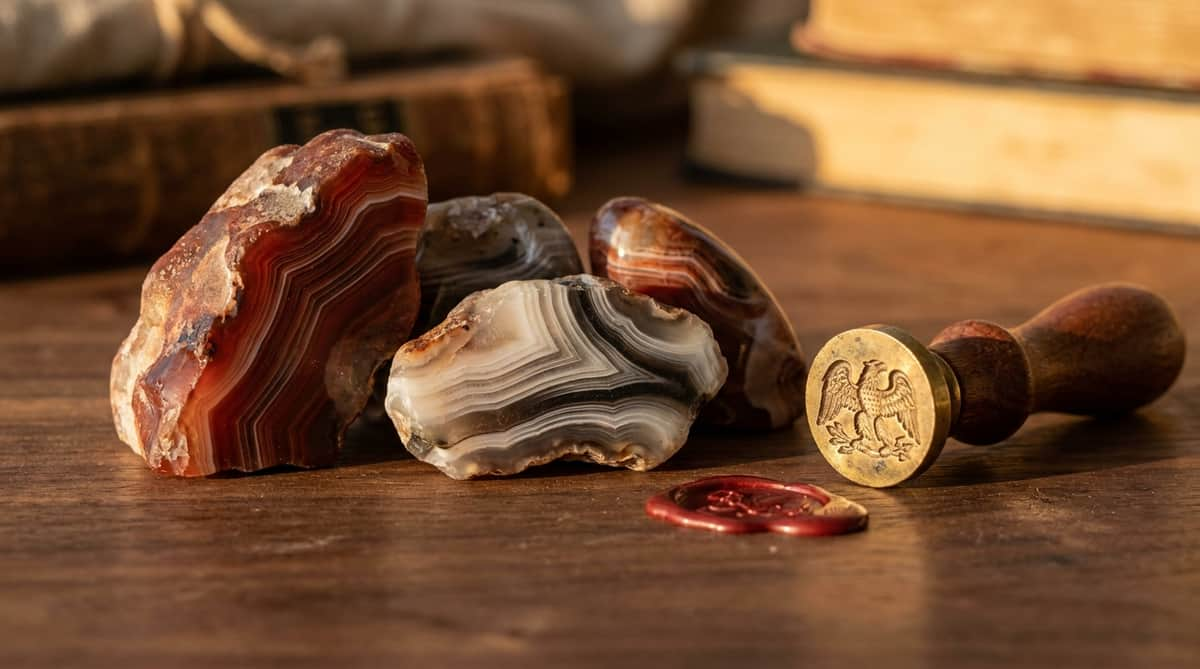
Sardonyx isn't a single mineral — it's a banded variety of chalcedony, the same microcrystalline quartz family behind agate, onyx, and carnelian (see our chalcedony meaning guide for the full family tree). Specifically, it's chalcedony that shows alternating layers of sard — a reddish-brown band colored by iron oxide — and onyx, the parallel white, black, or grey bands that give plain onyx its name. Where the line between "sard" and its close cousin carnelian actually falls is genuinely disputed among gem sources; most treat sard as the darker, more brownish end of the same reddish-chalcedony range carnelian occupies. On the Mohs hardness scale, the American Gem Society lists sardonyx at 6.5, while other sources place chalcedony generally at 6.5 to 7 — durable enough for daily-wear jewelry and, historically, durable enough to carve fine detail into without the stone chipping or crumbling.
Why Romans Carved Their Signatures Into It
Sardonyx's defining historical use wasn't decorative — it was functional. The American Gem Society and other gem-trade sources agree on the specific reason Roman signet rings were so often cut from sardonyx: melted sealing wax doesn't stick to its surface, which meant a ring carved with an intaglio design (an image cut into the stone rather than raised from it) could stamp a clean, repeatable impression into wax without the wax dragging or tearing the design. That made sardonyx the practical choice for anyone who needed to seal letters, documents, or property with a personal mark — a function closer to a modern signature than to pure adornment. Roman soldiers reportedly carried sardonyx carved with the image of Mars for protection, and women reportedly wore cameos of Venus cut from it, though gem-trade sources themselves describe these as tradition rather than documented fact. Centuries later, Renaissance orators linked sardonyx to eloquence and persuasive speech, a belief traced back to the writings of the Roman naturalist Pliny the Elder — a symbolic association with no physical basis, worth noting as folklore rather than a property of the stone itself.
Sardonyx Was August's Birthstone First
Before most modern shoppers ever hear the word "sardonyx," they've already heard of its replacement: peridot, the lime-green stone that dominates today's August birthstone lists. But sardonyx held that spot on its own for centuries before peridot entered the picture. When the United States' modern birthstone list was standardized in 1912 (most sources credit the National Association of Jewelers), sardonyx was still listed as August's primary stone, with peridot added as an alternate rather than a replacement. Peridot gradually became the dominant choice in the decades since, to the point that most birthstone charts — including our own birthstone-by-month guide — now list peridot alone for August. Spinel joined as a third official August birthstone only in 2016, when the jewelry trade's own standard-setting bodies added it.
The Meaning Attached to Sardonyx
In crystal-healing and metaphysical circles, sardonyx is commonly described as a stone of courage, strength, and confidence — language that traces directly back to its Roman soldier-talisman reputation rather than to any tested property of the mineral. It's also associated in some modern sources with integrity and clear communication, echoing the old "stone of eloquence" claim from Pliny's writing. None of this is scientifically established; it's belief passed down from a genuinely old tradition, which is a different thing from a documented fact, and worth treating as such rather than as a marketed health claim.
Sardonyx vs. Onyx vs. Carnelian
Because sardonyx is literally built from two other chalcedony varieties, it's easy to confuse with either one on its own — or with carnelian, sard's lighter-colored cousin:
- Sardonyx: alternating bands of reddish-brown sard and white-to-black onyx in the same stone; always banded, never a single flat color; Mohs 6.5–7.
- Onyx: solid bands of black and white (or occasionally other colors) with no reddish-brown sard layer present; often cut and dyed to a uniform solid black for modern jewelry, which can make true banded onyx harder to spot at a glance. See our onyx meaning guide.
- Carnelian: a single, unbanded reddish-orange to brownish-red chalcedony — essentially what sard would look like without the onyx layers running through it, and the stone most often mistaken for sard specifically. See our carnelian meaning guide.
The simplest field check: if the reddish color appears in distinct parallel bands alongside white or black layers, it's sardonyx; if the reddish color is the entire stone with no banding, it's carnelian; if there's banding but no reddish-brown layer at all, it's plain onyx.
How to Care for Sardonyx Jewelry
At Mohs 6.5 to 7, sardonyx holds up well to daily wear — harder than bronzite or moonstone, in the same durability range as quartz and most of its chalcedony relatives. A soft cloth with mild soap and water is enough for routine cleaning; ultrasonic and steam cleaners are best avoided, since repeated heat and vibration can stress banded stones along their natural layer lines over time. Because many commercial sardonyx and onyx pieces are dyed to deepen or even out their color, it's worth asking a jeweler whether a given piece is natural or treated before assuming the banding is entirely untouched.
For a ring or pendant built around a single banded stone like sardonyx, FARUZO's personalized rings collection is a reasonable starting point for a custom piece, and the personalized bracelets collection can pair a gemstone bead with an engraved nameplate.
Frequently Asked Questions
Is sardonyx a real gemstone or just dyed onyx?
It's a genuine, naturally banded chalcedony combining sard and onyx layers — not simply dyed onyx, though commercial pieces (like plenty of onyx jewelry) are sometimes color-enhanced, so it's worth asking a jeweler whether a specific piece is natural.
What's the difference between sardonyx and onyx?
Onyx is solid black-and-white (or other colored) banding with no reddish layer. Sardonyx specifically includes bands of reddish-brown sard alongside the white-to-black onyx bands — it's a combination stone, not a separate mineral from onyx.
Was sardonyx really the original August birthstone?
Yes. It was the traditional sole August birthstone for centuries and remained the primary stone on the 1912 U.S. birthstone list, with peridot added only as an alternate at that point. Peridot became the dominant modern choice in the decades after.
Why did Romans use sardonyx for signet rings?
Because melted sealing wax doesn't stick to its surface, letting a carved intaglio design stamp a clean impression into wax — a practical reason tied to its physical properties, not just decoration.
Is sardonyx durable enough for an everyday ring?
Yes. At roughly Mohs 6.5 to 7, it's in the same durability range as quartz and most other chalcedony varieties, suitable for daily wear with ordinary care.