Carnelian is the stone that made ancient Egypt's amulet-makers and the Indus Valley's bead-cutters reach for the same orange-red material thousands of miles apart — and much of what's sold as carnelian today has been color-enhanced from a plainer stone. Here's what it actually is, where it really comes from, and how to tell a well-treated stone from a dyed one.
What Carnelian Actually Is
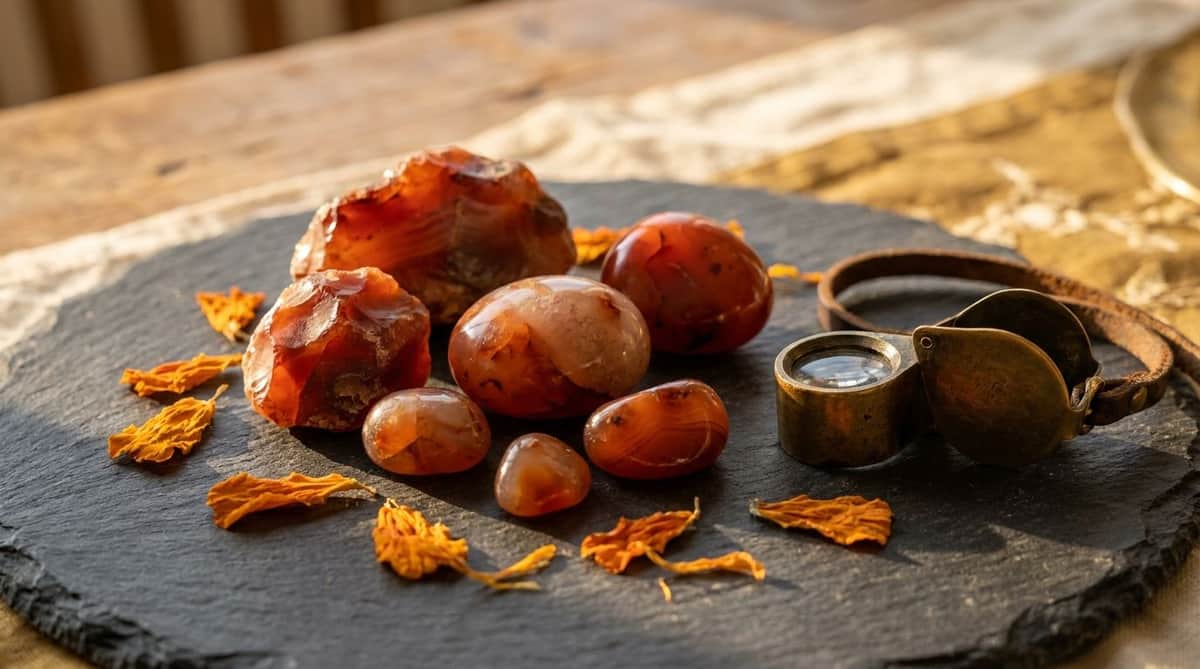
Carnelian is a variety of chalcedony, the microcrystalline form of quartz (silicon dioxide, SiO₂) made of crystals too small to see without magnification. Its orange-to-red color comes from iron oxide impurities distributed through the stone; the more concentrated the iron, the deeper and redder the color. Unlike agate, its banded chalcedony cousin, carnelian is prized for being a single, even color rather than a pattern.
On the Mohs hardness scale, carnelian sits at 6.5 to 7 — the same range as quartz-family stones like amethyst and citrine, and hard enough for daily-wear jewelry with normal care.
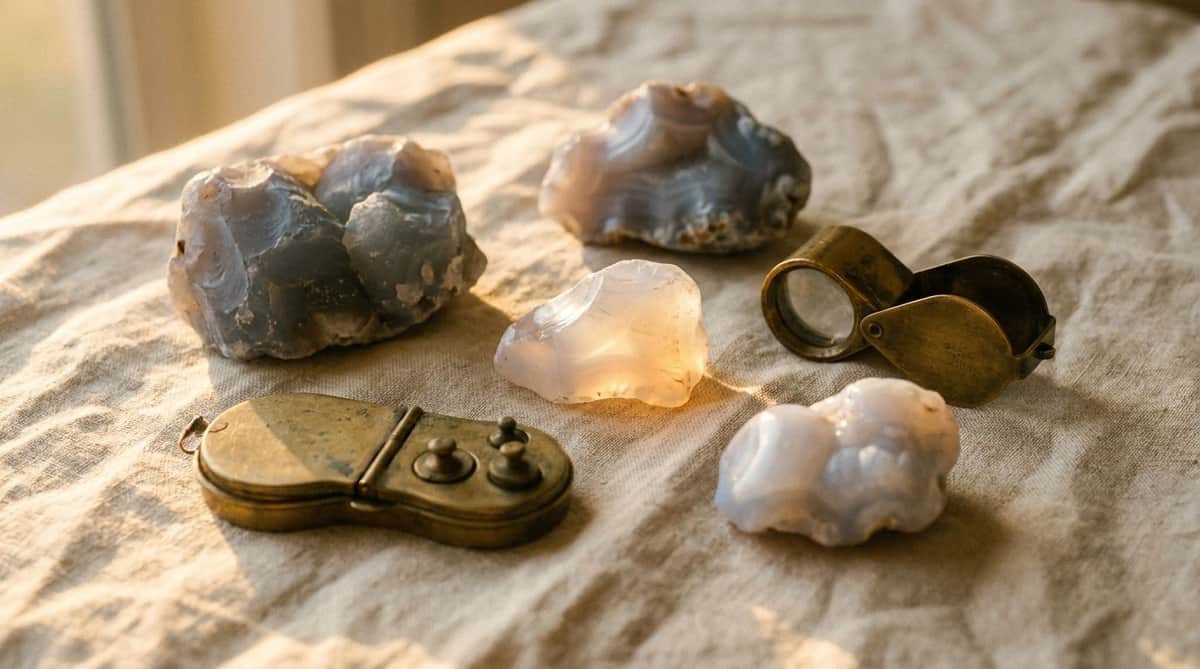
A large share of the carnelian sold commercially today isn't naturally that color: geology.com notes that much of the material marketed as carnelian is actually a plainer, less colorful agate that has been heat treated (or occasionally stained) to develop its bright orange-to-red tone, since heating causes the iron impurities already in the stone to intensify. This is a long-standing, industry-normal practice — not a sign of a fake — provided it's disclosed.
Carnelian also has a close sibling, sard, and the line between them is more about naming convention than hard science: both are chalcedony colored by iron oxide, and the distinction is essentially shade — sard runs browner and darker, carnelian runs more toward true red-orange — without an official boundary separating the two.
Carnelian is one entry in a much bigger family of colored stones — see our full guide to gemstone meanings for how other stones get their names, colors, and folklore. Its opaque, patterned cousin jasper belongs to the same iron-colored chalcedony family, just wearing a different face.
Physical, Mental, and Metaphysical Properties
Physical
Carnelian is almost always cut as cabochons, beads, or flat inlay rather than faceted, since its translucent-to-opaque structure doesn't bend light the way a transparent gem does. It takes a smooth, glassy polish and, with no cleavage planes to worry about, holds up well to everyday wear in rings, pendants, and bracelets.
Mental
In wellness and crystal-healing circles, carnelian is described as a stone of motivation and creative confidence — associated with pushing past hesitation and taking action. This is a belief tradition, not a scientific claim, but it's a consistent theme across crystal-meaning sources.
Metaphysical
Ancient Egyptians called carnelian "the setting sun" and associated it with vitality, courage, and protection into the afterlife — linked in myth to the sun god Horus and the fertility goddess Isis, who was said to use the stone to protect the dead on their journey onward. Passages from the Book of the Dead were inscribed on carnelian amulets specifically for this protective purpose.
Where Carnelian Comes From
India's Gujarat region has been the world's premier source of carnelian for more than 4,500 years, and remains a major source today. The stone forms in cavities within the Deccan basalt — ancient volcanic rock — where silica-rich groundwater slowly deposited chalcedony inside gas bubbles left in the cooling lava; iron impurities in that solution gave the nodules their color as they crystallized. Weathering and erosion eventually freed the nodules into looser sediment beds, which is why the traditional mining method around Ratanpur and the Rajpipla hills is closer to digging and sifting than hard-rock mining. The finished nodules were historically cut and polished at Khambhat (Cambay), one of the subcontinent's oldest lapidary centers and still active today.
Beyond India, much of the plainer agate that gets heat-treated into commercial "carnelian" comes from Brazil, the world's largest agate producer, concentrated in the southern state of Rio Grande do Sul — a supply chain shaped as much by that material's responsiveness to color treatment as by its natural abundance.
That color logic — why iron produces orange-red here and green or purple in other stones — is the subject of our gemstone color meanings guide.
A History Written in Fire
The name's origin is debated between two Latin roots: carneus, meaning "flesh-colored," and cornum, the cornel cherry, whose translucent red fruit was said to resemble the stone's tone. Both explanations appear across gemology sources without a clear, settled answer.
Carnelian's documented use goes back further than almost any other ornamental stone. The clearest, best-evidenced chapter is the Indus Valley bead trade of the 3rd millennium BCE: Harappan craftspeople in Gujarat developed an alkaline-etching technique to burn white patterns into carnelian's surface, and these etched beads traveled as far as Mesopotamia. Archaeologists recovered etched carnelian beads among the elaborate gold and lapis lazuli jewelry in the tomb of Queen Puabi at the Royal Cemetery of Ur (roughly 2600–2500 BCE), almost certainly imported from the Indus region — tangible evidence of a trade network stretching thousands of miles.
In Egypt, carnelian was cut into beads, amulets, and later rings and earrings from the Predynastic period through the end of Dynastic history, prized as much for its color symbolism as its workability.
Carnelian and the Zodiac
Carnelian doesn't have one settled zodiac assignment — different gemstone-astrology sources list it for Virgo, Leo, or Taurus, usually tied to its fire-toned color rather than any single agreed system. Treat any zodiac pairing you see for carnelian as belief-tradition context, not a fixed rule.
How to Identify Real Carnelian
Because heat-treated agate is so common in the market, "real carnelian" mostly comes down to whether you're comfortable with a disclosed, industry-standard treatment rather than expecting untreated stone. A few things to check when buying:
Color evenness: natural, untreated carnelian tends to show soft, cloud-like variation in tone; heat-treated material is often more uniformly saturated. Neither is automatically "better," but a seller should be able to tell you which you're getting.
Banding: if you see distinct parallel bands rather than one even color, you're likely looking at agate — carnelian's banded, un-uniform cousin — rather than true carnelian.
Translucency: hold the stone to a light source — genuine carnelian typically shows some translucency at thin edges, while heavily dyed or glass imitations often look flat and opaque throughout.
Wearing and Caring for Carnelian Jewelry
At 6.5–7 on the Mohs scale, carnelian handles everyday wear reasonably well, including in rings, though it's still softer than sapphire or diamond and can scratch against harder surfaces over time. Store carnelian pieces separately from harder gems so they don't rub against each other in a jewelry box.
For the full do's and don'ts — cloths, solutions, and what to avoid — see how to clean a gemstone ring, which applies to carnelian's hardness range as well.
If you're shopping for a piece to wear it in, our personalized necklaces can be customized with a birthstone-style accent stone.
Frequently Asked Questions
Is carnelian a rare stone?
No — carnelian is widely available and affordably priced compared to precious gems like ruby or sapphire, which is part of why it's been used in jewelry continuously for thousands of years rather than reserved for royalty alone.
Is most carnelian jewelry treated?
Much of it, yes. A significant share of commercial carnelian is heat-treated (or occasionally dyed) agate rather than naturally red-orange stone straight from the ground. This is a long-accepted, industry-standard practice when disclosed, not a mark of a fake.
What's the difference between carnelian and sard?
They're the same mineral — iron-colored chalcedony — distinguished mainly by shade: sard is darker and browner, carnelian is a brighter red-orange. There's no strict scientific line between them.
Can carnelian go in water or the shower?
Brief contact, like handwashing, won't hurt it, but avoid soaking it or wearing it in a pool, hot tub, or shower long-term — especially if the stone has been treated, since prolonged moisture and chemical exposure can affect treated material more than untreated stone.
What's the difference between carnelian and agate?
Both are chalcedony, but agate shows visible parallel banding of different colors, while carnelian is prized for being one even orange-red tone throughout. Much commercial carnelian actually starts as plain, weakly-colored agate before heat treatment intensifies it into carnelian's signature shade.