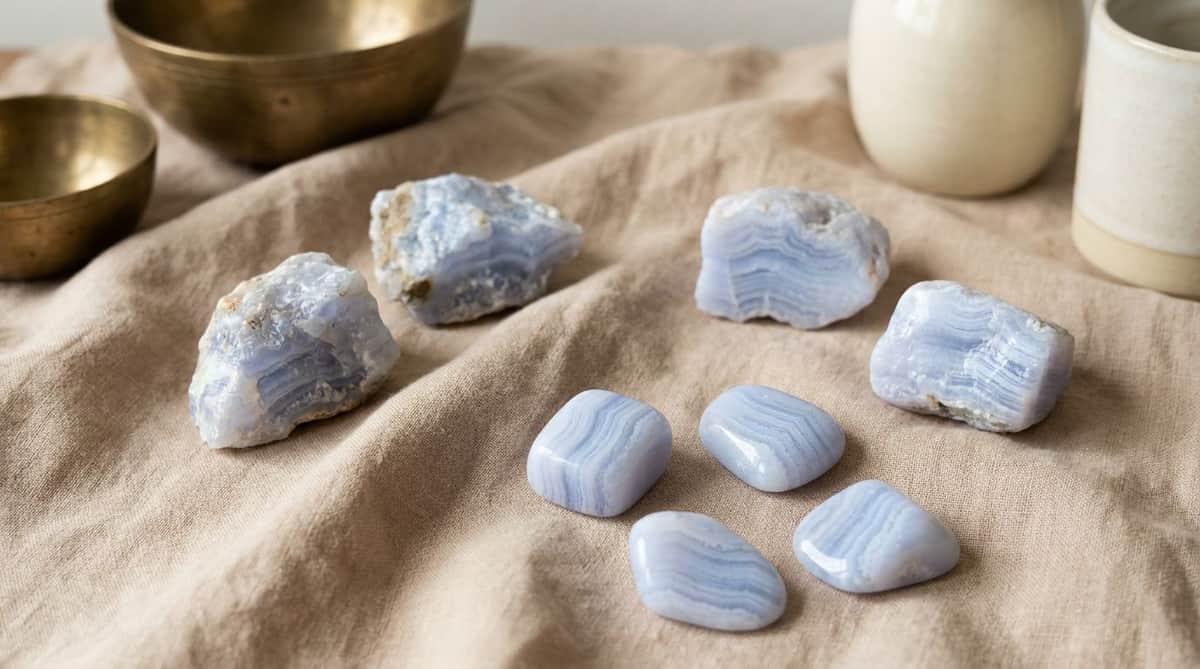
Walk into any crystal shop and "blue lace agate" is almost always the palest, most delicate-looking stone on the shelf — thin ribbons of sky blue, white, and sometimes grey-brown, banded like a piece of lace frozen in stone. Sellers call it the "Stone of the Diplomat" for its calming reputation, but the geology underneath that name is just as interesting: it isn't its own mineral at all, but a banded variety of a much more common material.
What Blue Lace Agate Actually Is
Blue lace agate is a variety of chalcedony — a fine-grained, fibrous form of quartz, the same silica mineral family that includes clear quartz, amethyst, and citrine. What separates agate from plain chalcedony is the banding: distinct, often curved layers that form as silica-rich groundwater deposits mineral in thin stages inside a cavity, usually in volcanic rock. In blue lace agate specifically, those bands run pale powder-blue to white, sometimes with a faint grey or brown line marking an older layer. Like other quartz-family stones, it sits around 6.5–7 on the Mohs hardness scale — hard enough for everyday jewelry, but soft enough that it can still be scratched by harder gems like sapphire or diamond if stored carelessly alongside them.
The "lace" in the name describes the visual effect of those bands at a small scale: thin, wavy, often concentric lines that can look almost woven when the stone is cut and polished into a cabochon or bead. Agate forms when silica-rich groundwater seeps into a gas pocket or cavity in cooling volcanic rock and deposits mineral in successive thin layers over a very long period — each layer a slightly different shade depending on trace minerals and impurities present at the time it formed. The result, once the rock is cut open, is that banded pattern rather than a single solid color, which is also why no two pieces of blue lace agate band in quite the same way.
Where It Comes From
Most blue lace agate on the market today traces back to Namibia, where it was first commercially mined in significant quantities — the stone's soft, uniform blue banding is closely associated with Namibian deposits specifically, which is part of why supply has tightened and prices have crept up as those sources have aged. Agate in general forms in volcanic regions worldwide, but the particular pale-blue coloring that made this variety popular in jewelry and crystal shops is a Namibian signature more than a global one.
Blue Lace Agate vs. Blue Chalcedony vs. Angelite
All three are soft, pale blue stones sold in the same crystal-shop aisle, and shoppers regularly ask how to tell them apart. Here's the real difference:
- Blue Lace Agate: banded chalcedony (quartz family); you can usually see distinct lighter and darker stripes under good light. Hardness ~6.5–7 — durable enough for daily jewelry.
- Blue Chalcedony: the same mineral family as blue lace agate, but without the visible banding — it's a smooth, even, milky blue all the way through. Same hardness, same quartz-family origin; the banding is the only real giveaway between the two.
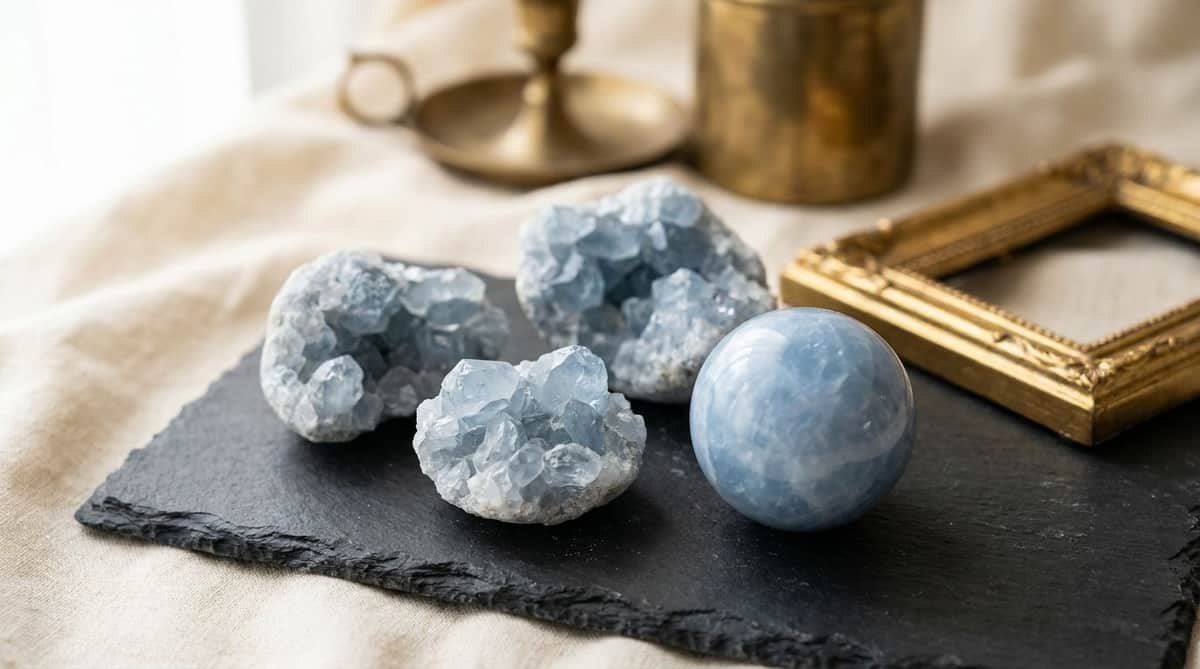
- Angelite: a completely different mineral — compressed celestite, chemically a calcium sulfate, not a silica stone at all. It's noticeably softer, around 3.5 on the Mohs scale, scratches far more easily, and is not safe to wear in water the way blue lace agate generally is. Our Angelite meaning guide covers it in full.
The Meaning and Lore Behind It
In crystal lore — belief systems with no scientific backing, but widely repeated across the trade — blue lace agate is associated with calm and clear communication, earning it nicknames like the "Stone of the Diplomat" and the "Stone of Articulation." Practitioners link it to the throat chakra, treating it as a stone meant to support honest, gentle expression rather than conflict. Within the broader agate family — covered in our agate meaning guide — lighter, cooler-toned banded stones like this one are generally read as calming, while darker, warmer bands (red or brown agate) are read as grounding or protective instead.
Blue Lace Agate in Jewelry
Its pale, even coloring makes blue lace agate a popular bead stone — it shows up most often as polished round beads strung into bracelets and necklaces, or cut into cabochons for pendants and earrings, rather than faceted the way a transparent gem would be. Because agate is opaque, cutters lean into the banding itself as the main visual interest: a cabochon is usually oriented so the bands run across it in a way that shows the pattern clearly, rather than hiding it. Larger tumbled or polished specimens are also sold as standalone display pieces outside of jewelry entirely, which is part of why it shows up as often in crystal shops as it does in jewelry cases.
How to Wear and Care for It
Because it's a quartz-family stone, blue lace agate is more water-tolerant than softer crystal-shop stones like angelite or selenite — a quick rinse won't damage it the way it would damage either of those. That said, sustained soaking, harsh chemicals, and ultrasonic cleaners are still worth avoiding on any banded agate, since repeated exposure can dull the surface polish over time. Its pale color is also more sensitive to fading from prolonged, direct sunlight than deeper-colored gemstones — a windowsill display for months at a time isn't the best place for it, even though normal jewelry wear is fine. Set in a bracelet or pendant, it pairs well with both silver and gold tones; our personalized bracelets collection can be made with a gemstone bead alongside an engraved nameplate for exactly that kind of pairing.
Frequently Asked Questions
Is blue lace agate rare?
Not rare in the sense of being hard to find, but supply has genuinely tightened as the original Namibian deposits most associated with the pale, evenly banded material have aged. It's still widely available, just less of a bargain stone than it was a decade ago.
Can blue lace agate go in water?
Yes, briefly — as a quartz-family stone it's more water-tolerant than many crystal-shop stones. It's not meant for prolonged soaking or saltwater exposure, though, since that can dull the polished surface over time.
What's the difference between blue lace agate and regular agate?
They're the same mineral — banded chalcedony — just different color varieties. "Regular" agate covers a huge range of banded colors (reds, browns, greys, blacks); blue lace agate is specifically the pale powder-blue and white banded variety most associated with Namibian deposits.
Does blue lace agate fade in sunlight?
Its pale coloring is more susceptible to fading under prolonged, direct sunlight than deeper-colored gemstones, so long-term display in a sunny window isn't ideal. Normal jewelry wear — worn outdoors occasionally, stored away from direct sun the rest of the time — isn't a meaningful risk.
Is blue lace agate expensive?
No — it's one of the more affordable banded stones, typically priced well under gems like moonstone or labradorite for a comparable size. Pricing has drifted up somewhat as the Namibian material most associated with the classic pale-blue banding has become harder to source, but it remains an entry-level stone compared to most of the crystal-shop case.