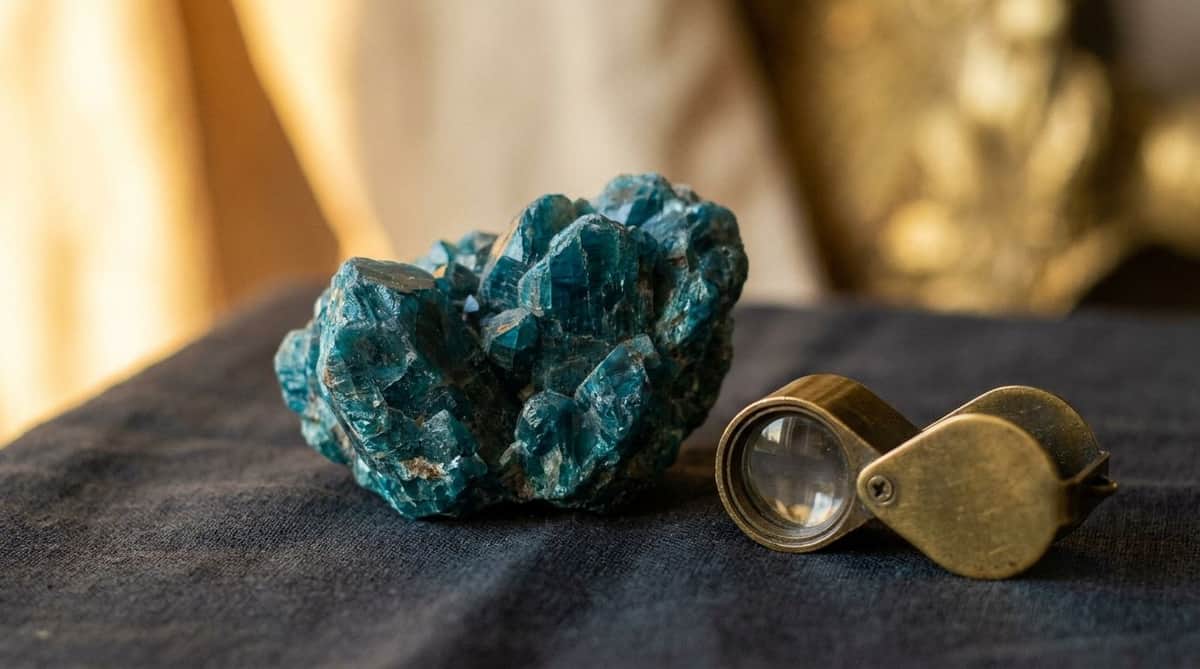
“Apatite” comes from the Greek word apatao — to deceive. German geologist Abraham Gottlob Werner coined the name in 1786 for exactly that reason: the mineral had been repeatedly misidentified as other, better-known stones. Blue apatite inherited that reputation more than any other color in the apatite family, because its clearest, most saturated blue is routinely mistaken for aquamarine, Paraiba tourmaline, or even sapphire at a glance.
Where the name actually comes from
Before apatite had its own name, pieces of it had been catalogued as beryl, tourmaline, and olivine (the mineral peridot belongs to) by mineralogists who had no reason to think they were looking at something new. Werner's 1786 name was a deliberate dig at that history — he called it “the deceiver” because collectors kept being fooled by it. The irony is that apatite turned out to be far more common and geologically important than any of the minerals it was mistaken for: it's the main source of phosphorus in the Earth's crust and the primary mineral in tooth enamel and bone.
What blue apatite actually is
Apatite is a group name for a family of calcium phosphate minerals sharing the general formula Ca₅(PO₄)₃(F,Cl,OH), crystallizing in the hexagonal system. Most apatite is unremarkable and industrial — ground up for fertilizer, mostly. Gem-quality material is the exception, and blue is the color most associated with gem-grade apatite. According to GIA's gemological research, the blue color in apatite has been linked to manganese: older research GIA cites attributes it to phosphate (PO₄) sites in the crystal being partly substituted by manganate (MnO₄), rather than the iron or copper that colors many other blue minerals.
Mohs hardness for apatite sits at 5 — soft enough that GIA's own gemology materials use it as one of the reference points on the Mohs hardness scale itself. That softness is also why gem-quality rough is cut carefully and why finished stones need gentler handling than a quartz-family gem rated 7.
The rarest material is a vivid, almost electric blue-green variety from Madagascar, sometimes sold as “neon” or “Paraiba-like” apatite because its color overlaps with the far more expensive Paraiba tourmaline. GIA's gem-news coverage separately notes that deep blue apatite showing a cat's-eye effect (chatoyancy) is especially rare, turning up only occasionally in material from Sri Lanka and Myanmar.
Blue apatite vs. the stones it gets mistaken for
Four stones account for most of the “what am I actually looking at” confusion around blue apatite. None of these pairings are officially codified — they're the comparisons gem buyers and sellers actually run into — but the practical differences are consistent:
- Blue apatite vs. aquamarine — aquamarine is a beryl with Mohs hardness 7.5–8, roughly a day-to-day jewelry stone; apatite at Mohs 5 is softer and scratches more easily. Aquamarine also tends toward a cooler, paler sea-blue, while apatite's best material leans toward a more saturated teal-blue.
- Blue apatite vs. Paraiba tourmaline — the neon blue-green varieties of each can look nearly identical in photos, but Paraiba tourmaline (colored by copper) sells for thousands of dollars per carat at the high end, while even fine apatite stays in the tens-to-low-hundreds range. Price, more than color, is the real tell.
- Blue apatite vs. blue topaz — blue topaz (Mohs 8) is harder, more common, and almost always treated to reach its blue color; apatite's blue is natural but softer and rarer in large, clean sizes.
- Blue apatite vs. sapphire — royal-blue apatite can read as a pale sapphire at a glance, but sapphire's hardness (9) and price per carat are both in an entirely different category.
Blue is one color among several
Apatite isn't exclusively blue — the same mineral group also occurs in green, yellow, purple, and colorless varieties, and gem dealers sometimes use “asparagus stone” for a yellow-green type. Blue is simply the color that reaches gem quality most often and commands the most attention in jewelry, which is part of why “apatite” in casual conversation usually means the blue material by default even though the name itself covers the whole mineral family.
Where blue apatite comes from
Crystal and gem-trade sources most often cite Brazil, Madagascar, and Mexico as primary sources for gem-quality blue apatite, with Madagascar specifically associated with the most saturated neon material. Sri Lanka, Myanmar, and Russia also produce apatite, though less of it reaches gem quality. These are trade-source attributions rather than a single peer-reviewed geological survey, which is worth noting plainly rather than presenting as more settled than it is.
Caring for blue apatite jewelry
Mohs 5 puts apatite below most of the stones it's compared to, which has two practical consequences. First, it scratches more easily than a ring stone worn daily against other jewelry, keys, and countertops — pendants, earrings, and occasional-wear rings suit it better than an everyday band. Second, acidic cleaners and ultrasonic cleaners can dull or etch the surface; a soft cloth and mild soap and water, dried promptly rather than left to air-dry with mineral deposits, is the safer routine.
The metaphysical meaning (belief, not science)
Crystal sellers and metaphysical writers most commonly associate blue apatite with communication, clarity, and motivation, tying it to the throat chakra specifically. It's described in that literature as a “stone of manifestation,” believed to support goal-setting and self-expression. None of this is a scientific claim about the mineral — it's a belief system some buyers find meaningful and others don't, and it's worth being direct about the distinction rather than presenting folklore as established fact.
If you like blue apatite, also see
Blue apatite sits alongside a small group of blue and blue-green stones in our gemstone series that get confused with each other or with better-known gems. Our kyanite guide covers another blue mineral that, unusually, can have two different hardnesses in the same crystal. Our amazonite guide covers a blue-green stone with its own case of mistaken identity. If you'd rather wear an engraved, nickel-safe piece than a soft display-grade gemstone, FARUZO's personalized necklaces are plated over 316L stainless steel — durable enough for daily wear in a way that Mohs-5 stones like apatite generally aren't.
Frequently Asked Questions
What does blue apatite mean?
“Apatite” itself comes from the Greek word for “deceive,” a name given in 1786 because the mineral had repeatedly been mistaken for other gems. Beyond that naming history, crystal sellers separately associate blue apatite with communication and clarity — a belief-based meaning rather than a scientific one.
Is blue apatite a rare gemstone?
Most apatite is common, industrial-grade material used in fertilizer. Gem-quality blue apatite, especially the vivid neon material from Madagascar, is considerably rarer and is the variety most often sold in jewelry.
What chakra is blue apatite associated with?
The throat chakra, according to crystal-healing sources, which tie that association to the stone's claimed role in communication and self-expression. This is a metaphysical belief rather than a documented physical effect.
Can you wear blue apatite jewelry every day?
It's not the best choice for daily wear. At Mohs 5, it scratches more easily than harder everyday stones, so pendants, earrings, or occasional-wear pieces hold up better than a ring worn constantly against other surfaces.
Is blue apatite the same as aquamarine?
No. They're different minerals that happen to overlap in color. Aquamarine is a beryl at Mohs 7.5–8; apatite is a phosphate mineral at Mohs 5, generally softer and, in its finest neon-blue form, rarer than aquamarine of comparable size and clarity.