
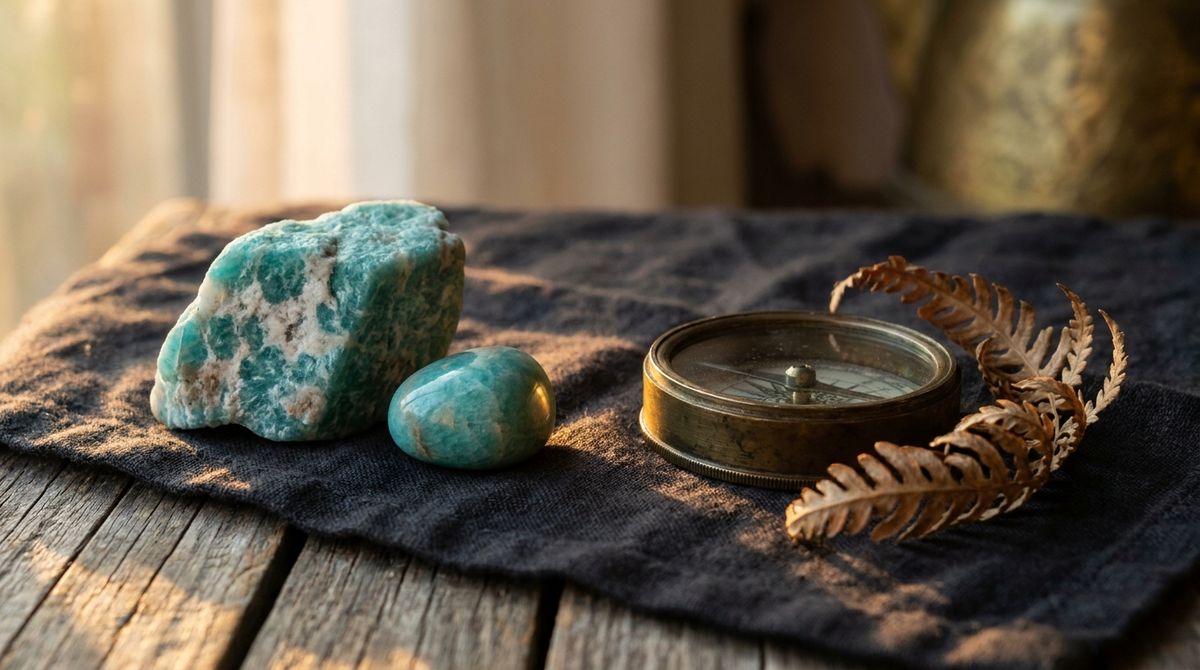
Amazonite is one of the few gemstones whose name is more mysterious than the stone itself: it is named for the Amazon River, yet mineralogists have never confirmed that true amazonite ever actually came from anywhere near it. Here is the real geology behind its blue-green color, where it is actually mined, how it compares to turquoise and other look-alikes, and how to keep a piece wearing well once it is set in jewelry.
What Amazonite Actually Is
Amazonite is the green-to-blue-green variety of microcline, a potassium feldspar with the chemical formula KAlSi3O8 — part of the same broad feldspar family that makes up much of the Earth's crust, rather than a rare exotic mineral. On the Mohs hardness scale it measures 6 to 6.5, noticeably softer than the quartz-family stones — citrine, amethyst, rose quartz — that dominate the rest of this series; for how that compares across other gems, see our Mohs hardness scale guide.
Its color is generally attributed to trace amounts of lead (with water also implicated) sitting inside the crystal structure, and pieces very often show pale white mottling or streaking running through the green-blue body — a normal feature of the stone, not a flaw. Like other feldspars, amazonite has two directions of perfect cleavage, meaning it can split cleanly along a flat plane if it takes a hard, direct knock — a structural fact worth knowing before wearing a piece somewhere it might collide with a desk edge or a car door.
Physical, Mental, and Metaphysical Properties
Physical
At 6 to 6.5 Mohs, amazonite scratches more easily in daily wear than a quartz or sapphire piece, and its perfect cleavage means a sharp knock is more likely to chip or split it than to simply scuff the surface. It takes a good polish and reads with a soft, slightly waxy-to-vitreous luster rather than the higher-shine brilliance of harder, more refractive stones. For general upkeep once it is set, our gemstone ring cleaning guide applies here too — gentle, dry-leaning care rather than an ultrasonic cleaner.
Mental
In today's wellness and crystal market, amazonite is marketed as a 'stone of truth and communication' — something to hold before a difficult conversation, said to soothe anxiety and encourage honest, calm speech. That is a belief carried forward by the modern crystal community rather than a measured, tested effect, and it is worth reading in exactly that spirit — the same way we frame every stone's folklore in our gemstone color meanings guide.
Metaphysical
Crystal-healing traditions typically pair amazonite with the heart and throat chakras, tying its blue-green tone to emotional balance and self-expression. As with every metaphysical claim on this stone, there is no scientific mechanism behind it — it is folklore, not a documented physical property, and we present it here as exactly that.
A Name Borrowed From a River It May Never Have Touched
Amazonite gets its name from the Amazon River, but the connection is genuinely uncertain: historical sources describe green stones once believed to have come from the Amazon, and it is not actually confirmed those stones were amazonite at all. The mineral was not formally described and named as a distinct feldspar variety until the 18th century — centuries after people were already wearing it.
That is because amazonite's use in jewelry goes back much further than its name. Archaeological evidence shows it was worn ornamentally for more than 3,000 years, appearing in Middle and New Kingdom Egypt and in Mesopotamia — but ancient and medieval writers never referred to it by any name we would recognize today. The material came first; the (possibly mistaken) river name came much, much later.
Where Amazonite Actually Comes From
Historically, one of the earliest well-documented sources was Russia's Ilmensky Mountains near Miass, and archaeological mining evidence has also been found at Gebel Migif in Egypt's southern Eastern Desert, dating to the Bronze Age. The material people picture most often today, though, is American: Pikes Peak and Crystal Peak in Colorado are classic, widely collected sources (Colorado's official state gemstone is actually aquamarine, and its state mineral is rhodochrosite — amazonite has no official designation there, despite how strongly it is associated with the region).
Beyond Colorado, amazonite is also found in Virginia, Wyoming, and Pennsylvania in the U.S., and internationally in Brazil, Ethiopia, Mongolia, South Africa, Sweden, and Australia — a genuinely global distribution for a stone most people associate with one river it may never have actually touched.
Amazonite vs. Turquoise and Other Blue-Green Look-Alikes
Amazonite's blue-green color gets it confused with turquoise more than any other stone. The two are chemically unrelated: turquoise is a copper-aluminum phosphate, typically more uniformly opaque with a matte finish and its own webbed matrix veining, while amazonite is a feldspar that usually shows the pale mottling described above and a glassier surface luster. Turquoise is also generally softer at 5 to 6 Mohs, versus amazonite's 6 to 6.5.
It also gets grouped loosely with green stones like green aventurine simply because both are inexpensive, opaque-leaning green-toned crystals popular in the wellness market — but aventurine is a quartz variety with a distinctive sparkly 'aventurescence' from mineral inclusions, a visual effect amazonite does not share.
Wearing and Caring for Amazonite
Because of its moderate hardness and perfect cleavage, amazonite tends to hold up better in earrings and pendants — pieces that rarely take a direct knock — than in a ring worn every day. Clean it with a soft, slightly damp cloth rather than an ultrasonic or steam cleaner: gemstone-care guides consistently warn that the vibration and heat from ultrasonic cleaning can stress the internal inclusions responsible for its color, and that prolonged direct sunlight can fade some material over time. Store pieces separately from harder stones so they are not scratched in a jewelry box, and remove amazonite jewelry before swimming or showering.
Frequently Asked Questions
Is amazonite a real gemstone, or just dyed glass?
It is a real mineral — a color variety of microcline feldspar (KAlSi3O8) — not a manufactured glass or plastic imitation. As with any popular, moderately priced stone, dyed howlite or glass imitations do circulate, so buying from a source that states the material plainly is worth doing.
What's the real difference between amazonite and turquoise?
Different chemistry entirely: turquoise is a copper-aluminum phosphate and amazonite is a potassium feldspar. Turquoise is usually more uniformly opaque with its own matrix veining and is slightly softer (5–6 Mohs) than amazonite (6–6.5 Mohs), which more often shows pale mottled streaking through the green-blue body.
Does amazonite scratch or chip easily?
It is softer than quartz-family stones like citrine and amethyst, and its feldspar cleavage means a hard, direct knock is more likely to chip it than a harder gem would. It is durable enough for regular wear in earrings or a pendant, just not the toughest choice for a ring worn daily.
Can amazonite jewelry get wet?
Brief contact isn't the concern — extended soaking, chlorine, and especially ultrasonic or steam cleaning are. Wipe it clean with a soft, slightly damp cloth instead, and take it off before swimming or a long shower.
Is amazonite a birthstone?
No — it is not one of the traditional or modern birthstones for any month. If you want a stone with an official birth-month meaning set into a personalized piece, our birthstone name necklace lets you choose from the full birthstone necklace collection instead.


