Green aventurine is the original, most common form of aventurine — the classic quartz variety that gave the whole family of stones its name, before blue, red, and peach versions were also grouped under the same word. Its color and signature sparkle come from the same source as every other aventurine variety: microscopic mineral inclusions scattered through translucent quartz. This guide covers what makes green aventurine specifically green, how it differs from the aventurine post's broader color range, the meanings attached to it in modern crystal-healing traditions, and how to buy and care for it.
What Makes Green Aventurine Green
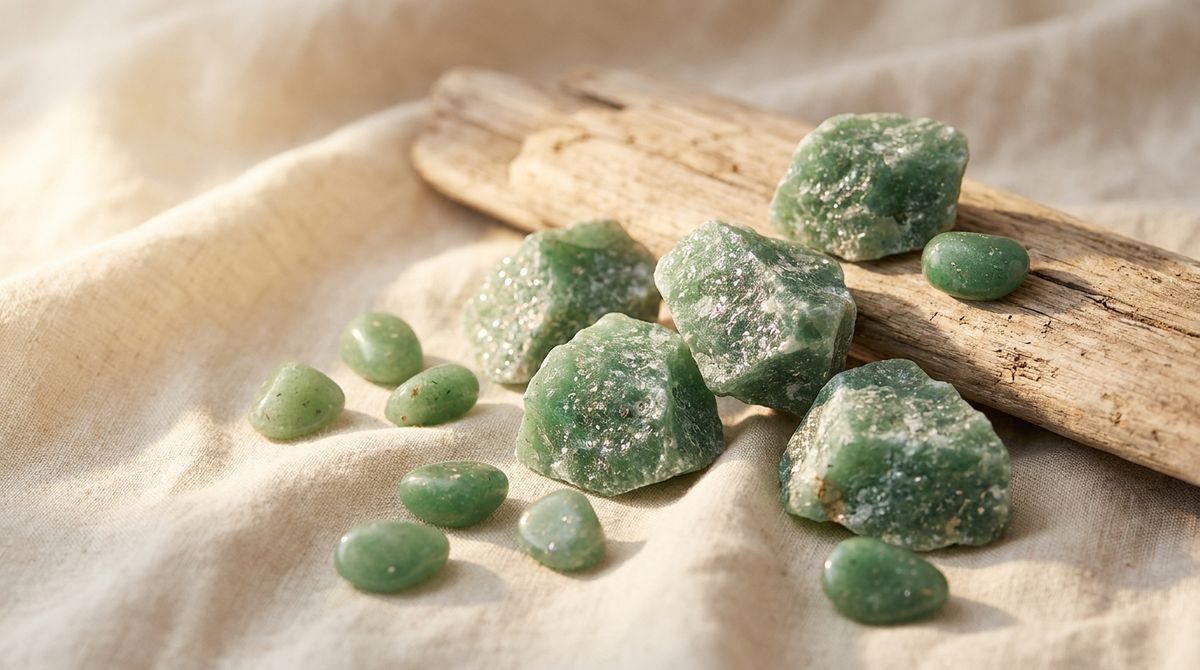
Aventurine is a translucent variety of quartz containing small, flat, platy mineral inclusions that catch and scatter light — an effect called aventurescence. In green aventurine specifically, that color comes from fuchsite, a chromium-bearing form of muscovite mica, embedded throughout the quartz in fine flecks. The same base mineral, quartz, produces different aventurine colors depending on which inclusion is present: dumortierite or crocidolite for blue aventurine, hematite or goethite for red and orange varieties. Green is by far the most common and best documented of the group, which is why the word 'aventurine' defaults to green in casual use even though it technically covers the whole color family.
Our broader aventurine guide covers the full color range and the stone's history as a category. This piece focuses specifically on the green variety — its identification, its meanings in crystal-healing traditions, and buying it as jewelry.
On the Mohs hardness scale, green aventurine measures 6.5 to 7, the same as other quartz varieties — durable enough for regular jewelry wear, on par with amethyst or citrine, though softer than sapphire or ruby and still capable of scratching if stored loose against harder stones.
Physical, Mental, and Metaphysical Properties
Physical
As a quartz variety, green aventurine holds up well to daily wear — resistant to scratching from most everyday contact, though it can chip on a hard impact like any brittle mineral. It takes a smooth polish and is commonly cut as cabochons, beads, and tumbled stones rather than faceted, since its inclusions make it opaque to translucent rather than transparent.
Mental
In the modern wellness market, green aventurine is described as a calming, steadying stone — associated with easing stress and encouraging emotional balance. These are wellness-market claims rather than clinically studied effects, and should be read as belief, not medical fact.
Metaphysical
Green aventurine's best-known reputation is as the 'Stone of Opportunity' — linked to luck, prosperity, and fresh chances in crystal-healing traditions, and closely associated with the heart chakra, where practitioners describe it as clearing blockages and supporting emotional openness. As with all crystal-healing claims, these are traditional and spiritual beliefs, not scientifically verified properties.
Where the 'Luck Stone' Reputation Comes From
Green aventurine's reputation as a luck stone is tied up with its own name. Aventurine takes its name from aventurine glass, a sparkly Murano glass developed by Italian glassmakers in the 18th century — the mineral was named after the glass it resembled, not the other way around, and 'a ventura' is Italian for 'by chance,' a reference to the accidental discovery of the glassmaking technique. The gemstone's use in beads and carvings, particularly across South Asia, predates that naming, though the historical record here is thinner and less consistently dated than the glass origin story.
Green aventurine's association with luck and prosperity built on top of that name over the following centuries, cemented by its widespread modern use in crystal-healing and feng shui practice as a stone for attracting opportunity and financial growth — claims rooted in tradition rather than evidence.
Green Aventurine vs. Jade: How to Tell Them Apart
Green aventurine is sometimes sold as 'Indian jade' or 'new jade' — a trade name, not an accurate one, and worth watching for when buying. True jade is either jadeite or nephrite, both distinct mineral species from quartz, and genuinely rarer and typically more valuable, especially in the fine, saturated 'imperial' green associated with top-grade jadeite.
The clearest tell is the sparkle: green aventurine's fuchsite inclusions catch light in tiny glittery flecks across the surface, an effect jade does not have — jade's surface reads as a smoother, more uniform, waxy-to-glassy sheen. Aventurine is also generally less dense and less expensive than comparable jade, which is why the substitution happens in the first place. If a listing calls a piece 'jade' at an aventurine-typical price, or shows visible sparkle in the photos, it's very likely aventurine.
Where Green Aventurine Comes From
India is the largest commercial producer of green aventurine, with the leading deposits concentrated in Karnataka, Tamil Nadu, and Madhya Pradesh. Brazil is the second major source, particularly the Minas Gerais region, and smaller quantities come from Russia's Ural Mountains, along with Spain, Austria, and Tanzania. Material from different sources can vary in the size and density of the fuchsite inclusions — coarser flecks generally read as a more visible, glittery sparkle, while finer inclusions give a softer, more uniform shimmer.
Because the mineral is abundant and the deposits are large, green aventurine has never carried the scarcity premium of gemstones like emerald or sapphire, which is part of why it's a common, affordable choice for beaded jewelry, cabochons, and carved objects rather than a stone reserved for fine faceted pieces.
Buying and Caring for Green Aventurine Jewelry
At 6.5 to 7 on the Mohs scale, green aventurine is durable enough for rings, bracelets, and everyday wear, though — like any gemstone — it should come off before activities with hard impact risk, such as heavy manual work or contact sports. Clean it with warm water and mild soap and a soft cloth; avoid ultrasonic cleaners, which can stress natural inclusions and fractures over time.
When buying, look for even color distribution and a visible, consistent sparkle across the surface rather than a flat, dull green, which can indicate dyed or lower-grade material. Natural green aventurine's color runs from pale, minty green to a deeper forest green depending on how much fuchsite the specimen contains — both are genuine, and neither is inherently better than the other, just a difference in mica concentration.
Frequently Asked Questions
Is green aventurine a real gemstone?
Yes. Green aventurine is a genuine variety of quartz colored by natural fuchsite mica inclusions — not colored glass or a synthetic imitation, though its name is borrowed from an unrelated glassmaking technique.
Is green aventurine the same as regular aventurine?
'Aventurine' is the umbrella term for the quartz variety in any color — green, blue, red, or peach. Green aventurine specifically refers to the most common and widely available variety, colored by chromium-rich fuchsite mica, and is what most people mean by 'aventurine' in casual use.
Is green aventurine the same stone as jade?
No. They're unrelated minerals that happen to share a green color in some forms — aventurine is a quartz variety, jade is either jadeite or nephrite, a different mineral species entirely. Aventurine's tiny sparkly inclusions are the easiest way to tell them apart.
What zodiac sign is green aventurine associated with?
Green aventurine is most commonly paired with Virgo in modern crystal traditions, tied to its association with practicality, growth, and Virgo's earth element.
Is green aventurine durable enough for everyday jewelry?
Yes. At 6.5 to 7 on the Mohs scale it's on par with quartz generally and holds up well to daily wear, making it a practical, affordable choice for rings, bracelets, and beaded jewelry.