Charoite's swirling lilac-and-violet pattern looks dyed even when it's completely natural, which is exactly what the geologists who first handled it assumed too. It's one of the few gemstones on the market with a genuinely single, verifiable point of origin — not "mostly from" one region, but found nowhere else on Earth in commercial quantity. Here's what charoite actually is, where that swirl pattern comes from, and why its scarcity makes it an unusually easy stone to fake.
What Charoite Actually Is
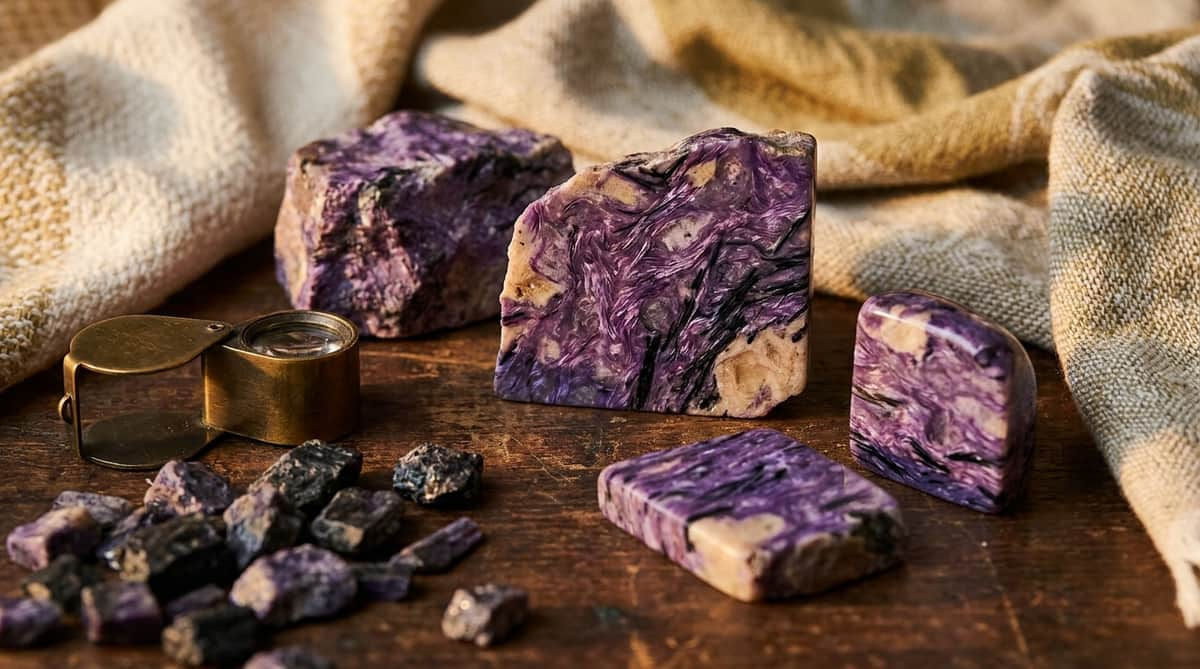
Charoite isn't a single mineral the way quartz or calcite is — like lapis lazuli, the material sold as "charoite" is technically a rock, an intergrowth of several minerals rather than one chemical compound. The purple-violet base is a fibrous silicate mineral (also called charoite), tangled into interlocking sprays that create the swirling, almost woven-looking pattern. Running through that violet matrix are black, needle-like crystals of aegirine and pale cream-to-white patches of microcline feldspar, and the contrast between all three is what gives a polished piece its distinctive look — no two pieces swirl the same way, since the pattern comes from how the fibrous crystals happened to grow and interlock. Sources differ on the exact cause of the purple color itself (manganese is the most commonly cited culprit) and even on charoite's precise chemical formula, which is still being refined by mineralogists — treat both as reasonably informed but not fully settled. On the Mohs hardness scale it sits at 5 to 6, with a stated specific gravity of roughly 2.54–2.68 depending on source — moderate hardness, well below quartz-family gems but harder than many other display-only crystals.
Where the Name Comes From
Charoite is named for the Chara River in Siberia, even though the deposit itself sits roughly 70 km away from the river — a gap that's led some sources to call the naming a geographic approximation rather than a literal description of where it formed. The river's name, from the local Evenki language, is usually translated along the lines of "to melt" or "melting," though the exact etymology is disputed. Either way, the river gave its name to a mineral it doesn't actually run past.
A Gemstone From Exactly One Place
This is the part of charoite's story that genuinely sets it apart: it's documented as occurring in commercial quantity at a single deposit worldwide, the Murunskii Massif (also written Murun Massif), an alkaline intrusive complex in the Aldan Shield region of Siberia, Russia. "Rare gemstone" gets thrown around loosely in jewelry marketing, but most stones marketed that way still come from a handful of mines across two or three countries. Charoite is a useful contrast against stones that get the same "rare" label for different reasons:
- Charoite — one documented deposit worldwide (Murunskii Massif, Siberia); all material in the trade traces back to this single source.
- Tanzanite — found in one small geographic area, the foothills of Mount Kilimanjaro near Merelani, Tanzania, but mined across multiple active claims within that single district.
- Larimar — mined almost exclusively from the Dominican Republic, with one primary mining area (Barahona province), similar in spirit to charoite's single-source status but a larger overall mining district.
- Labradorite — by contrast, genuinely widespread: significant deposits exist in Canada, Madagascar, Finland, and several other countries, so "rare" doesn't really apply to it as a species.
For other single-region stones with a similar "you can name the one place it comes from" story, see our guides to tanzanite and lapis lazuli, which shares charoite's status as a multi-mineral rock rather than a single compound.
Discovery, and Why It Was Nearly Dismissed as Fake
Accounts of charoite's discovery don't fully agree. Some sources date the first find to the 1940s, during construction work in the region; a more detailed account from the mineralogical database Mindat credits geologist Vladimir Ditmar, who spent three years from 1956 surveying and studying the Murunskii Massif. What's consistent across accounts is what happened next: early samples were reportedly dismissed by some who saw them as a dyed fake, since a natural stone swirling that vividly purple seemed implausible. It took until 1978 for charoite to be formally described and recognized, decades after whichever initial discovery date is accurate — a long gap for a stone that, once accepted, became one of the more recognizable "exotic" gemstones in the trade.
The Meaning People Give Charoite
In crystal-healing circles, charoite is most often described as a "stone of transformation," tied to courage, change, and letting go of old patterns — a reading that owes something to the stone's dramatic, almost chaotic swirl pattern, which lends itself easily to language about turbulence resolving into something beautiful. It's also commonly associated with the third eye and crown chakras in that framework, linked to intuition and spiritual insight. None of this is a scientifically established property of the mineral; it's folklore and wellness-market language built on the stone's visual drama, worth knowing as context rather than treating as fact.
Charoite in Jewelry: Durability and Spotting a Fake
At Mohs 5 to 6, charoite is harder than crystal-shop staples like calcite or selenite but softer than quartz-family stones such as amethyst — durable enough for a pendant or occasional-wear ring, less ideal for a ring worn daily against constant friction, since it can still be scratched by harder dust particles and grit over time. Because genuine supply is limited to one deposit, charoite is a frequent target for dyeing and imitation: sellers have been known to dye lower-grade lavender stone or even plastic to mimic the swirl pattern. A few things to check before buying — natural charoite shows genuine depth to its pattern, with the black aegirine inclusions appearing as true needle-like crystals rather than flat printed or painted streaks, and the surface should have a silky, slightly chatoyant luster rather than a uniform plastic-like shine. If a "charoite" piece is suspiciously cheap or the pattern looks too perfectly repeated, treat that as a red flag.
If you want the color and drama of charoite's swirl in something built to last daily wear, FARUZO's personalized rings are plated over 316L stainless steel — nickel-safe and considerably more scratch- and tarnish-resistant for everyday use than a soft, single-sourced natural stone.
Frequently Asked Questions
Is charoite a real mineral or a rock?
Technically a rock, not a single mineral — like lapis lazuli, "charoite" in the trade refers to an intergrowth of several minerals (fibrous charoite itself, black aegirine, white microcline feldspar, and others) rather than one pure chemical compound.
Where does charoite come from?
Documented sources place commercial charoite at a single deposit worldwide: the Murunskii Massif in the Aldan Shield region of Siberia, Russia. It's named after the nearby Chara River, though the deposit itself sits about 70 km from the river.
Is charoite a durable stone for jewelry?
It's moderate — Mohs 5 to 6, harder than soft display crystals like calcite but softer than quartz-family gems like amethyst. It holds up to occasional wear in a pendant or ring but isn't as scratch-resistant as harder gemstones for daily use.
How can you tell if charoite is real or dyed?
Genuine charoite shows true depth and texture to its swirl, with the black aegirine inclusions reading as actual needle-like crystals rather than a flat printed pattern, and a silky rather than plastic-looking shine. Unusually cheap pricing or a too-perfectly-repeated pattern are signs of a dyed or imitation piece.
Why was charoite almost dismissed as fake when it was discovered?
Because its vivid, swirling purple color looked implausible for a natural stone. It took until 1978 for charoite to be formally described and accepted by mineralogists, well after its initial discovery.