Lapis lazuli is not a mineral — it's a rock, an aggregate of several minerals fused together, which is part of why no two pieces look quite alike. Its deep, saturated blue has been dug from the same mountains in northeastern Afghanistan for roughly 6,000 years, making it one of the oldest continuously mined gem materials on earth, prized by pharaohs, ground into the most expensive paint pigment in Renaissance Europe, and still worn today as a stone of truth and insight. This guide covers what lapis actually is, where it comes from, how to spot a fake, and what to know before wearing or caring for it.
What Lapis Lazuli Actually Is
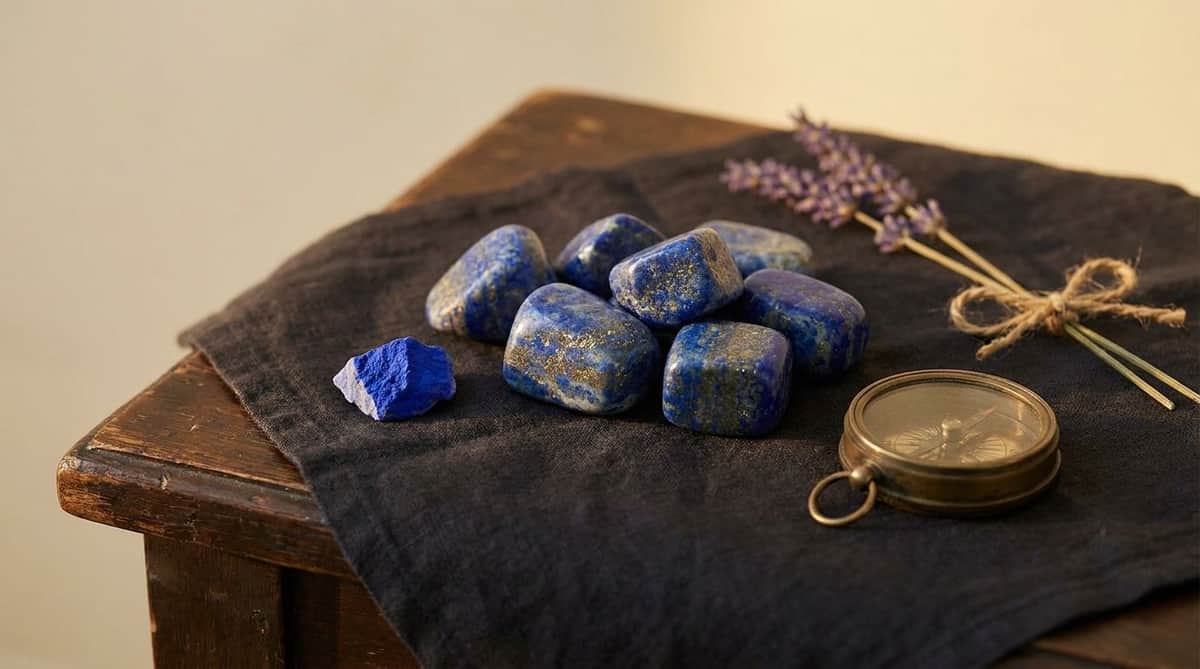
Lapis lazuli is a metamorphic rock, not a single crystal — it's made mostly of lazurite (typically 25–40% of the stone), the mineral that gives it its intense blue color, mixed with white calcite and metallic gold pyrite. The finest material shows a rich, even blue with little visible calcite; a scatter of small pyrite flecks is normal and often desirable, while heavy calcite streaking or excess pyrite lowers the quality and can dull the color toward grey or green.
On the Mohs hardness scale, lapis lazuli sits at 5 to 6 — noticeably softer than quartz-family stones like amethyst or citrine, and softer than sapphire or diamond. That makes it a moderately durable choice for jewelry that isn't knocked around daily, but one that scratches more easily than harder gems and needs a gentler care routine.
Lapis is prized specifically for its color rather than for the range of colors it comes in — unlike stones that shift across a palette, lapis is valued almost entirely by how deep and even its blue is. For how gemstone color generally ties to meaning across different stones, see our gemstone color meanings guide.
Physical, Mental, and Metaphysical Properties
Physical
Lapis is typically cut as cabochons, beads, or inlay rather than faceted — its opaque-to-semitranslucent structure doesn't refract light the way transparent gems do, so a smooth polished dome shows off the color and pyrite flecks best. Because of its moderate hardness and fair toughness, lapis is more prone to chipping at edges and corners than harder stones, which is why it's more commonly set in pendants, earrings, and cabochon rings than in settings that take daily knocks, like everyday-wear engagement rings.
Mental
In wellness and crystal circles, lapis lazuli is described as a stone of clarity and honest self-expression — associated with cutting through confusion and speaking the truth plainly. As with any stone's metaphysical reputation, that's a belief carried by the modern crystal community rather than a measured effect, worth reading the same way we frame the meaning behind any stone in our different gemstones guide.
Metaphysical
Ancient Mesopotamian and Egyptian cultures associated lapis with royalty, the heavens, and the divine — its color was read as a piece of the night sky itself. That symbolic weight is the actual, well-documented root of lapis's reputation as a stone of wisdom and protection; the more specific "third eye" and chakra associations attached to it are a modern layer added by 20th-century crystal healing writers, not an ancient claim.
Where Lapis Lazuli Comes From
Afghanistan is, and always has been, the world's premier source of lapis lazuli. The mines of Sar-e-Sang in the remote Badakhshan province have been worked for roughly 6,000 years — among the oldest known mining sites on the planet — and still produce the deepest, most saturated blue material available. Smaller deposits exist in Chile and around Lake Baikal in Russia, with minor production from Pakistan, Angola, Canada, and Colorado, but Afghan material remains the benchmark the trade grades against.
A History Written in Blue
Lapis lazuli's name comes from the Persian lazhuward, meaning blue, combined with the Latin lapis, meaning stone. For over 5,000 years it has been carved into amulets, beads, and inlay across Mesopotamia and Egypt, where its deep blue was read as a fragment of the night sky and the realm of the gods. Tutankhamun's funeral mask, one of the most famous artifacts in the world, is inlaid with lapis lazuli in the striped headdress, eyebrows, and eyeliner.
Its most consequential use came centuries later: ground into powder, lapis produces natural ultramarine, the deepest and most stable blue pigment available to Renaissance painters. Because every gram had to be shipped overland and by sea from Afghanistan — hence "ultramarine," from the Latin for "beyond the sea" — it was, gram for gram, often more expensive than gold. Painters reserved it for their most important subjects, most famously the robes of the Virgin Mary in devotional paintings.
How to Tell Real Lapis Lazuli from Fake
The most common fake on the market is dyed howlite or dyed magnesite — a naturally white, porous stone dyed deep blue to imitate lapis. A few checks can tell them apart:
- The acetone test: dab a cotton swab with a little acetone (nail polish remover) and press it gently to an inconspicuous spot. Dyed howlite will transfer blue color to the swab; genuine lapis will not.
- Look for real pyrite: genuine lapis shows irregular metallic-gold flecks that catch the light at odd angles. A perfectly uniform blue with no gold at all, or gold that looks like flat glitter or paint sitting on the surface, is a red flag.
- Weight and feel: lapis feels cool and reasonably heavy for its size, consistent with its rock density; lightweight dyed imitations often feel slightly "off" once you've handled a few real pieces.
Lapis Lazuli and the Zodiac
In modern astrology-linked gemstone traditions, lapis lazuli is most commonly associated with Sagittarius, tied to that sign's ruling planet Jupiter and its reputation for seeking truth and knowledge; some sources also list it as a secondary stone for Virgo or Pisces. As with all zodiac gemstone pairings, this is a belief-system convention with no scientific basis — useful as a gifting angle, not a factual claim.
Wearing and Caring for Lapis Lazuli Jewelry
Because lapis sits at only 5–6 on the Mohs scale, treat it more gently than harder everyday gems. Clean it with a soft, slightly damp cloth rather than an ultrasonic or steam cleaner, which can crack the stone or loosen the pyrite and calcite bound inside it. Avoid ammonia-based jewelry cleaners and prolonged soaking — lapis is porous enough that some treated stones can lose color over time if left wet. Store lapis pieces separately from harder stones like diamond, sapphire, or quartz-family gems, which can scratch its softer surface if they knock together in a jewelry box. For step-by-step cleaning technique, see our full gemstone cleaning guide.
Because of its softness, lapis suits pendants and earrings better than rings worn daily, where knocks are harder to avoid. If you're drawn to the stone but want it set in a piece built for regular wear, browse our personalized necklace collection for pendant styles where the stone sits protected rather than exposed at the edges.
Frequently Asked Questions
Is lapis lazuli a real gemstone or a rock?
It's a rock, technically — an aggregate of lazurite, calcite, and pyrite rather than a single mineral crystal. That's normal for ornamental gem materials (turquoise and jade work the same way) and doesn't make it any less genuine or valuable in jewelry.
What's the difference between lapis lazuli and sodalite?
Sodalite is a related but distinct blue mineral, sometimes sold as a budget substitute for lapis. Sodalite is usually a more uniform violet-blue with white calcite veining but little to no gold pyrite, while genuine lapis almost always shows at least a few metallic pyrite flecks. Sodalite is also slightly softer, at 5.5–6 on the Mohs scale.
Can lapis lazuli get wet?
Brief contact with water — like washing your hands while wearing a lapis ring — won't damage it, but it shouldn't be soaked or worn in a pool, shower, or hot tub regularly. Chlorine and prolonged moisture can affect the calcite content and, on dyed or treated stones, cause color loss over time.
What zodiac sign is lapis lazuli associated with?
Most modern gemstone-astrology sources list Sagittarius as lapis lazuli's primary zodiac sign, with some also naming it a secondary stone for Virgo or Pisces. This is a belief-based tradition, not an established fact.
Is lapis lazuli rare or expensive?
Lapis lazuli is not considered a rare gem in the way sapphire or emerald are — it's mined in meaningful quantity and priced accessibly compared to precious colored stones. The finest deep-blue, low-calcite Afghan material commands a real premium over lower grades, but lapis overall remains one of the more affordable ways to wear a stone with genuine ancient pedigree.