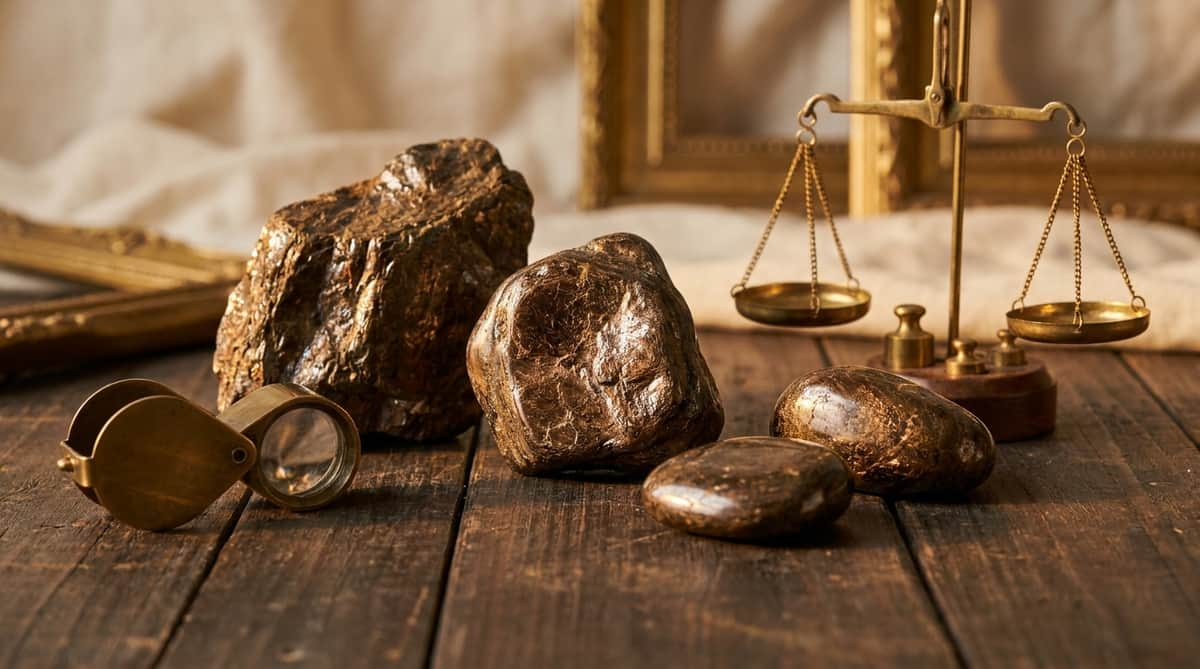
Bronzite is a stone that announces exactly what it is in its name: polish it and it throws back a genuine bronze-colored, metallic sheen, close enough to actual metal that it's easy to assume it's been treated or coated. It hasn't been — the sheen is a real optical property of the mineral itself. Here's what bronzite actually is, why it catches the light that way, the meaning crystal sellers attach to it, and how it compares to the other chatoyant, sheen-throwing stones it's most often mistaken for.
What Bronzite Actually Is
Bronzite is a variety of enstatite, a magnesium-iron silicate in the pyroxene mineral group, with a crystal structure classed as orthorhombic. Mineralogically, it sits between two closely related pyroxenes, enstatite and hypersthene, with "bronzite" historically used for the iron-rich end of that range. Its hardness measures roughly 5.5 to 6 on the Mohs scale — durable enough for occasional jewelry wear, though softer than quartz-family stones like tiger's eye. The name itself is straightforward: "bronze" plus the mineralogical suffix "-ite," a reference to its sheen rather than any actual bronze content, first recorded in English in the 1810s-1820s. It forms in igneous rock and has also turned up in meteorites, which is a more unusual origin story than most jewelry-counter stones can claim.
Why It Has a Metallic Bronze Sheen
The sheen comes from a genuine optical effect called schiller, caused by microscopic plate-like mineral inclusions aligned within the stone's crystal structure. Light bounces off those internal plates and back toward the viewer, producing the metallic, almost oily-looking luster that gives bronzite its name — a different mechanism from the fibrous chatoyancy that makes tiger's eye glow in a single moving band of light, even though both get described with similar language. The effect is strongest on a well-polished, properly oriented cabochon cut; a rough or poorly cut piece can look like a dull brown rock with none of the sheen that makes bronzite recognizable.
The Meaning Crystal Sellers Attach to It
In crystal-healing circles, bronzite is commonly called a "stone of courtesy," associated with grounding, calm confidence, and protection from negativity — claims that are traditional belief rather than anything scientifically established, and worth noting plainly as such. Some sources also repeat a historical claim that Romans carried powdered bronzite as a protective talisman, believed to ward off confusion; this detail shows up often enough in crystal literature to be worth mentioning, but it's a repeated historical anecdote rather than a documented, sourced fact, so it's best treated as folklore alongside the stone's other claimed properties. Lithotherapy sites also attribute various physical benefits to bronzite, including improved circulation — these have no clinical evidence behind them and shouldn't be treated as health advice.
Bronzite vs. Other Sheen-and-Chatoyancy Stones
Bronzite gets grouped with — and sometimes mistaken for — several other stones known for throwing light in distinctive ways, even though the underlying minerals and optical mechanisms are different:
- Bronzite: a pyroxene (enstatite variety); schiller effect from aligned plate-like inclusions; metallic bronze-brown color; Mohs 5.5–6.
- Tiger's Eye: a quartz-family stone (chalcedony with fibrous inclusions); true chatoyancy — a single moving band of light — rather than schiller; golden-brown to reddish-brown; Mohs 7, noticeably harder than bronzite. See our full tiger's eye meaning guide.
- Labradorite: a feldspar; labradorescence, a flash of blue, green, or gold across the surface caused by light interference in layered internal structures, distinct from both schiller and chatoyancy; grey-green base color. See our labradorite meaning guide.
- Hypersthene: bronzite's closest mineralogical relative on the iron-rich end of the enstatite series — the two are sometimes sold interchangeably, and the dividing line between them is a matter of exact chemical composition rather than anything visibly different to a buyer.
How to Care For Bronzite Jewelry
At Mohs 5.5 to 6, bronzite is soft enough to scratch from everyday contact with harder stones or grit, so it's best suited to pendants, earrings, or occasional-wear rings rather than something knocked against surfaces daily. A soft cloth and mild soap and water are enough for routine cleaning; skip ultrasonic cleaners and steam, both of which can stress the internal inclusions responsible for its signature sheen. Direct, prolonged sunlight isn't a major risk the way it is for some lighter-colored stones, but storing it separately from harder gems in a jewelry box prevents surface scratching over time.
For a ring or pendant built around a single polished stone like bronzite, FARUZO's personalized rings collection is a reasonable starting point for a custom piece, and the personalized bracelets collection can pair a gemstone bead with an engraved nameplate.
Frequently Asked Questions
Is bronzite a real gemstone or just a colored rock?
It's a genuine mineral — a variety of enstatite in the pyroxene group — with a real, documented optical property (schiller) behind its bronze sheen, not a dyed or artificially treated stone.
Is bronzite the same as tiger's eye?
No. They're different minerals from different mineral families — bronzite is a pyroxene, tiger's eye is a quartz variety — and they produce their sheen through different optical mechanisms, schiller versus true chatoyancy, even though both are brown and both catch the light.
Is bronzite durable enough for everyday jewelry?
It's moderately durable at Mohs 5.5 to 6, softer than quartz-family stones like tiger's eye or amethyst. It holds up fine for occasional wear but isn't the best choice for a ring worn daily without some risk of surface scratching.
What does bronzite meaning refer to in crystal healing?
Crystal sellers describe it as a "stone of courtesy" tied to grounding, calm confidence, and protection from negativity. These are traditional beliefs with no scientific backing, not documented properties of the mineral itself.
Where does bronzite come from?
It forms in igneous rock in several locations worldwide and has also been identified in meteorites — an unusual origin shared by very few stones sold in jewelry.