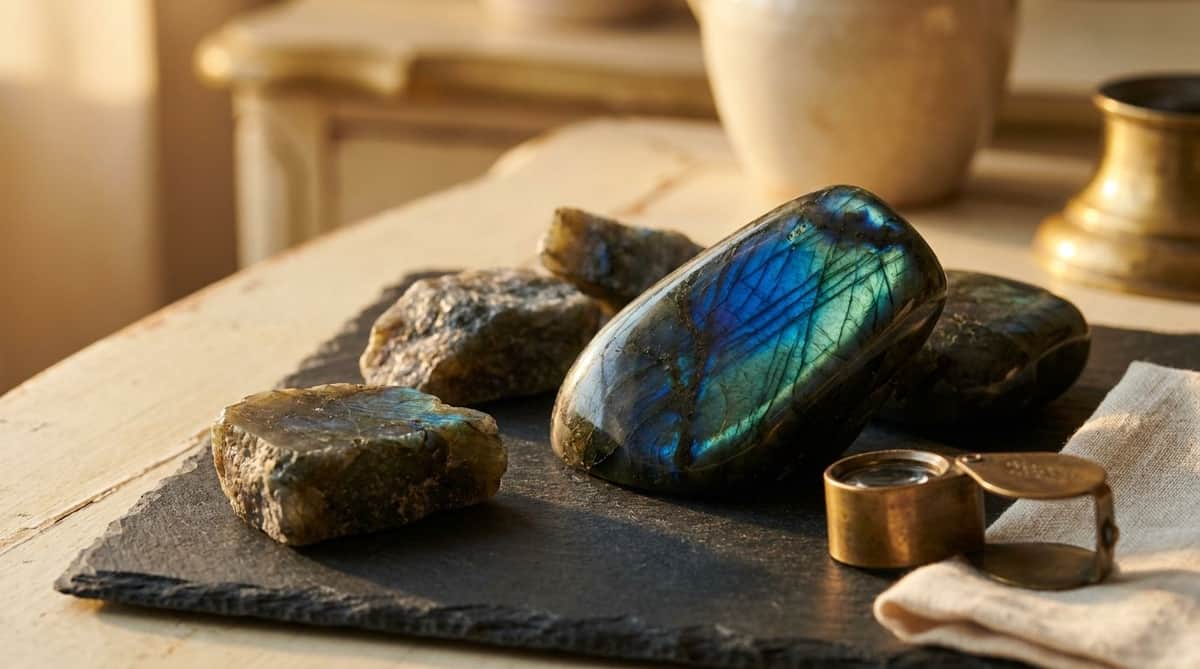
Labradorite is a feldspar, not a quartz or a beryl, which puts it in a different mineral family from most of the popular ‘crystal shop’ stones. Its signature effect — a flash of blue, green, gold, or purple that seems to switch on and off as the stone turns in the light — is called labradorescence, and unlike the glittery sparkle in aventurine or opal's color-play, it comes from a specific kind of internal twinning inside the crystal itself. This guide covers what labradorite actually is, where the name and the material called spectrolite come from, how it differs from moonstone — the feldspar it's most often confused with — and what to know before wearing or caring for it.
What Labradorite Actually Is
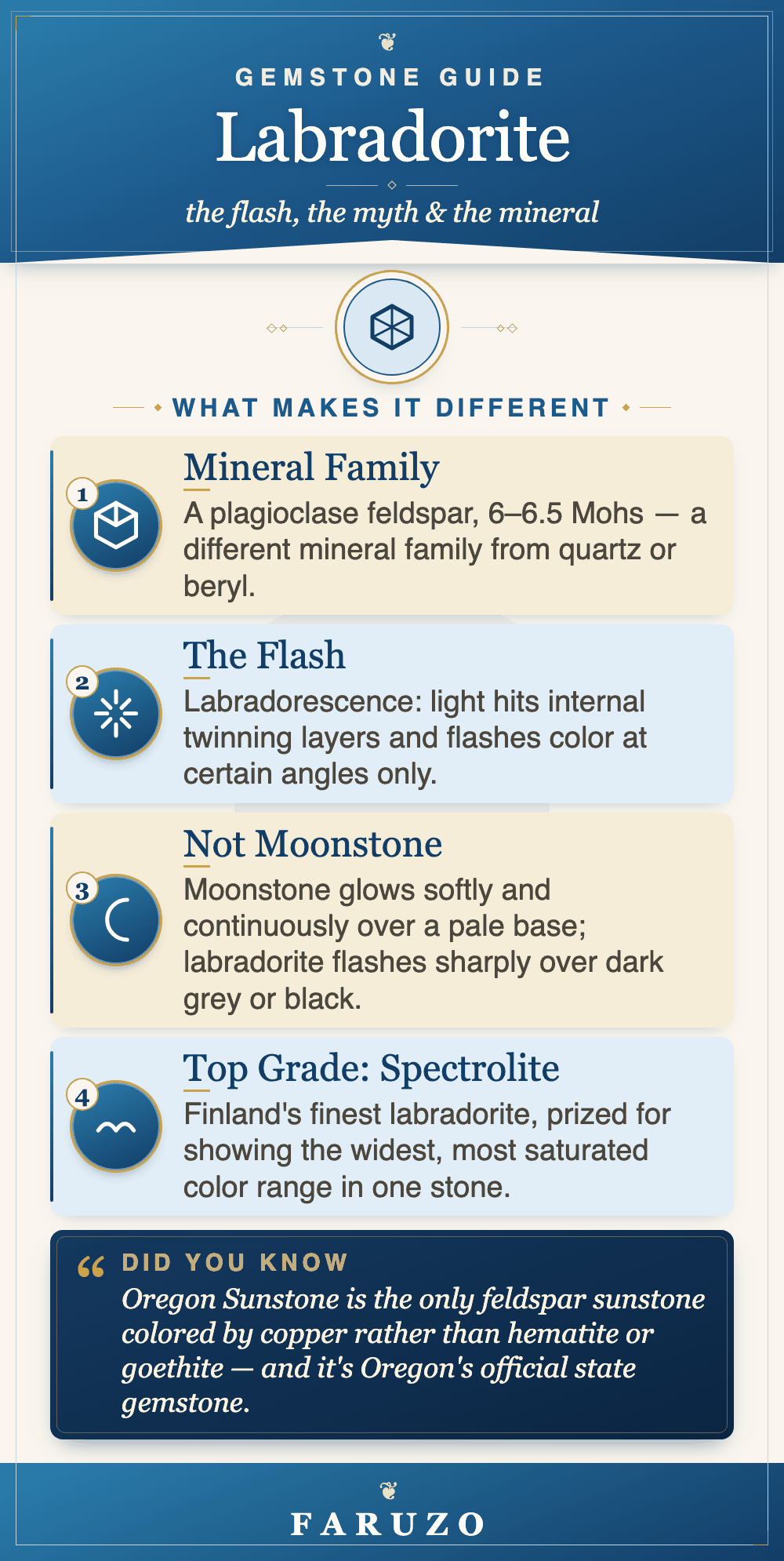
Labradorite is a plagioclase feldspar, a mineral series defined by a solid-solution mix of calcium and sodium aluminosilicate — roughly (Ca,Na)(Al,Si)4O8, with labradorite sitting in the calcium-rich 50–70% range of that series. It typically forms as a translucent-to-opaque grey, grey-green, or black base stone. What sets it apart isn't its base color but labradorescence: light entering the stone strikes internal twinning planes — thin, repeating layers formed as the crystal cooled — and reflects back out as a flash of color. The exact hue depends on the spacing of those layers, which is why one labradorite can flash blue while another cut from the same rough flashes gold or green. On the Mohs hardness scale it measures 6 to 6.5, and it has two directions of perfect cleavage meeting at close to a right angle, meaning it can split cleanly along an internal plane if struck — worth knowing before choosing it for a ring you'll knock around.
Physical, Mental, and Metaphysical Properties
Physical
Labradorite's Mohs hardness of 6 to 6.5 puts it roughly on par with moonstone and other feldspars — hard enough to resist everyday scratching, but its perfect cleavage in two directions means a sharp, direct knock can cause it to split rather than just chip. That combination makes it better suited to earrings, pendants, and occasional-wear rings than a ring worn daily through manual work.
Mental
In the modern wellness market, labradorite is described as a stone of clarity and calm — said to help quiet mental noise and support intuition during periods of change. As with any stone's mental-health claims, this is a belief carried by today's crystal community rather than a measured effect, worth reading the same way we'd frame the meaning behind any stone in our different gemstones guide.
Metaphysical
Labradorite's best-known nickname is the ‘stone of transformation’ — associated in new-age and modern witchcraft circles with protecting the aura during change and revealing hidden truth. What labradorite symbolizes in that tradition tracks the stone itself: a grey, unremarkable surface that only reveals its color when it catches the light at the right angle, which crystal practitioners read as a metaphor for personal change — qualities staying hidden until the right moment or perspective brings them out. It's also associated with intuition and protection during periods of transition, which is why it shows up often in jewelry meant to mark a life change rather than as an everyday piece. The name is often tied to an Inuit legend that the Northern Lights were once trapped inside rock near Labrador until an ancestor struck them free with a spear; that story is folklore carried by the crystal trade, not a documented historical account, and it postdates the mineral's 1770 scientific discovery by generations. As with all of labradorite's symbolic associations, this is belief carried by the wellness and crystal community rather than a documented or measured property of the stone.
Where the Name and the Northern Lights Story Come From
Labradorite was first described in 1770 by a Moravian missionary on the Isle of Paul near Nain on the Labrador Peninsula, in what's now Canada — which is where the mineral gets its name. Grey rock containing flashes of blue and green was unusual enough at the time that it quickly became a mineralogical curiosity in Europe. The finest material, however, doesn't come from Labrador at all: deposits in Finland, catalogued by the Geological Survey of Finland, produce labradorite with an exceptionally wide and saturated color range, and that top-grade material is sold under its own trade name, spectrolite, rather than as labradorite.
Labradorite Colors, Spectrolite, and Oregon Sunstone
Labradorescence can flash blue, green, gold, yellow, purple, or red depending on the exact spacing of a stone's internal twinning layers, and the same piece of rough can yield stones that flash different colors depending on how it's cut and oriented. Finnish spectrolite is prized specifically for showing the full range of that spectrum in one stone rather than a single dominant color. A related but distinct material is Oregon sunstone: a transparent, copper-bearing variety of labradorite found only in central Oregon, where trace copper platelets — not the twinning that causes classic labradorescence — create its schiller and, in some stones, a visible reddish or greenish glow. It's the only feldspar sunstone in the world colored primarily by copper rather than by hematite or goethite inclusions, and it's recognized as Oregon's official state gemstone.
Labradorite vs. Moonstone: How to Tell Them Apart
Labradorite and moonstone are both plagioclase feldspars, and both owe their optical effects to internal twinning, which is why the two get confused so often. Moonstone's effect, adularescence, is a soft, milky, billowing glow that seems to float just under the surface, typically white or blue over a pale, near-transparent base. Labradorite's labradorescence is sharper and more saturated — a flash of distinct color, usually blue, green, or gold, over a darker grey or black base, and it only appears at certain angles rather than glowing continuously. Base color is usually the fastest tell side by side: moonstone reads pale and translucent, labradorite reads dark until it catches the light. For more on moonstone specifically, see our moonstone guide, and for a closer side-by-side on identifying each by eye and which suits a ring versus an everyday necklace, see our labradorite vs. moonstone comparison.
Wearing and Caring for Labradorite Jewelry
Because of its perfect two-direction cleavage, labradorite is more prone to cracking from a sharp knock than stones like the quartz varieties, so it suits pendants, earrings, and occasional-wear rings better than a ring worn daily through manual work. Clean it by hand with a soft cloth and mild soap and water, and skip ultrasonic and steam cleaners, which can exploit existing cleavage planes and stress fractures. Store it away from harder stones that could scratch its surface, ideally in its own padded compartment. If you want the labradorescence to read clearly in a finished piece, look for a cabochon cut — oriented and polished specifically to catch the flash — since a poorly oriented cut can leave a stone looking flat and grey with little visible color.
If you like the idea of wearing a meaningful stone as part of your everyday jewelry, our birthstone necklaces collection uses traditional gemstones the same way labradorite is worn in crystal jewelry, and pieces like our black agate bracelet show how we set similar tumbled, banded stones for daily wear. For more stones with their own real geology and lore, our gemstone & crystal guides cover dozens more, including our selenite guide to another crystal linked to moonlight and clarity.
Frequently Asked Questions
Is labradorite a real gemstone?
Yes. It's a plagioclase feldspar mineral used in jewelry since its 1770 discovery in Canada. It's classified as a semi-precious gemstone — the term “precious” is reserved for diamond, ruby, sapphire, and emerald — but that classification is about market tradition, not durability or authenticity.
What causes labradorite's color-flashing effect?
Labradorescence happens when light enters the stone and reflects off internal twinning planes — thin, repeating layers formed as the crystal cooled. The spacing between those layers determines which color reflects back, which is why the effect only appears at certain viewing angles rather than glowing continuously.
What's the difference between labradorite and spectrolite?
They're the same mineral. Spectrolite is a trade name used specifically for the finest labradorite mined in Finland, prized for showing an unusually wide, saturated range of labradorescent color in a single stone rather than just one dominant flash.
Is labradorite the same as moonstone?
No, though they're closely related. Both are plagioclase feldspars with optical effects caused by internal twinning, but moonstone shows a soft, continuous glow called adularescence over a pale base, while labradorite shows sharper, angle-dependent color flashes over a darker base.
Is labradorite durable enough for everyday jewelry?
It's borderline. At 6 to 6.5 on the Mohs scale it resists routine scratching about as well as moonstone, but its perfect cleavage in two directions makes it more likely than harder, non-cleaving stones to crack from a hard direct knock — better suited to earrings and pendants than a ring worn through daily manual work.
What does labradorite symbolize?
In crystal and new-age tradition, labradorite is called the ‘stone of transformation’ — symbolizing change, intuition, and hidden potential revealed at the right moment, drawn from the way its labradorescence stays hidden until the stone catches light at the right angle. This is a belief carried by the wellness and crystal community, not a documented or scientifically measured property of the mineral.
What is pink labradorite?
Pink labradorite (sometimes sold as fuchsia labradorite) isn't a separate mineral — it's ordinary labradorite in which the internal twinning layers happen to reflect a dominant pink or purple flash instead of the more common blue, green, or gold. That flash orientation shows up in only a small share of mined rough, which is why pink-flashing pieces are rarer and usually priced higher than standard labradorite. As with the rest of labradorite's ‘stone of transformation’ reputation, any heart-chakra or emotional-healing claims tied to the pink variety are wellness-market belief, not a measured property of the stone.