Labradorite and moonstone sit in the same mineral family, show a similar "shimmer when tilted" effect, and get mixed up constantly — not helped by the jewelry-trade habit of selling labradorite as "rainbow moonstone." They're genuinely different stones with different optical effects, different typical appearances, and different best uses in jewelry. Here's how to actually tell them apart.
Same Family, Different Minerals
Both stones are feldspar, the most common mineral group in the Earth's crust, but they're different species within it. Moonstone is an alkali feldspar — usually orthoclase — with the approximate formula KAlSi3O8. Labradorite is a plagioclase feldspar, a calcium-sodium feldspar on a different branch of the same broader family. That shared ancestry is exactly why the two behave similarly in some ways — comparable hardness, a related crystal structure — and quite differently in others, namely color range and optical effect.
The Real Tell: Adularescence vs. Labradorescence
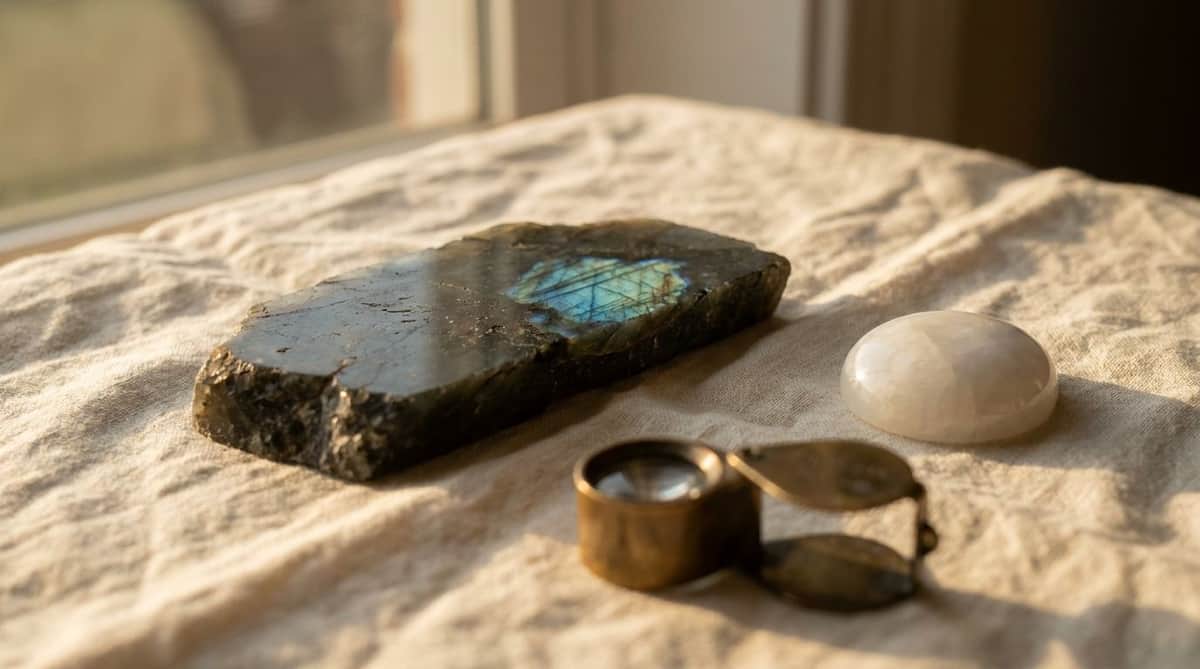
The two stones' signature shimmer effects look related but are optically distinct phenomena, and this is the single most reliable way to identify a loose or set stone. Moonstone shows adularescence: a soft, billowy, almost-liquid glow that seems to float just beneath the surface, visible across a fairly wide range of viewing angles, and limited to blue or white tones. Labradorite shows labradorescence: a bold, saturated flash of color — typically blue, green, or gold, or the full spectrum in fine material known as spectrolite — that appears only within a narrow viewing angle and can otherwise look like a plain gray or black stone.
In practice: tilt the piece under a single light source. A soft, wide, pale glow is moonstone. A sudden, vivid, angle-dependent flash that vanishes when you tilt it back is labradorite.
Labradorite vs. Moonstone at a Glance
Put side by side, the practical differences come down to a handful of things:
- Optical effect — Moonstone: adularescence, a soft, wide glow. Labradorite: labradorescence, a bold, narrow flash.
- Base color — Moonstone: typically pale, often near-colorless to light gray or peach. Labradorite: typically medium-to-dark gray or black.
- Color of the shimmer — Moonstone: blue or white only. Labradorite: blue, green, gold, or multicolor in fine spectrolite material.
- Hardness — Both sit around 6 to 6.5 on the Mohs scale; neither has a durability edge over the other.
- What drives price — For both stones, clarity, body color, and the strength of the optical effect matter more than which of the two species it is — fine examples of either can be a premium stone, and commercial-grade examples of either are comparatively affordable.
Why Sellers Mix Up the Names
The mislabeling isn't usually malicious — it's a trade shorthand that stuck. When labradorite showing a strong blue or green flash is cut into pale, thin slices, the resulting look can genuinely resemble classic moonstone's glow at a glance, especially in a product photo. "Rainbow moonstone" became the catch-all marketing name for that look decades ago and never went away, even though gemologists have long pointed out that the material is usually labradorite rather than true moonstone. If a listing uses the word "rainbow" in front of "moonstone," treat it as a cue to look more closely at the optical effect rather than assume the seller is describing true orthoclase moonstone.
A quick buyer check: ask for (or take) a photo or video of the stone being tilted in hand. A static studio photo under even lighting can make either stone look similar; movement is what separates a soft, wide moonstone glow from a sharp, narrow labradorite flash.
Where Each One Comes From
True moonstone's best-known sources are Sri Lanka, historically prized for pale, blue-sheen material, and India, a major source of the broader commercial moonstone supply, including warmer body-color stones; Myanmar is also a recognized, if smaller, source. Labradorite takes its name from Canada's Labrador Peninsula, where it was first documented by Moravian missionaries in 1770. A particularly vivid labradorite variety called spectrolite, known for an especially intense color flash, comes from a single deposit near Ylämaa, Finland, discovered in the 1940s, and Madagascar is today one of the largest commercial sources of labradorite overall, including much of the material cut thin and sold internationally as "rainbow moonstone."
Which One Suits Which Piece of Jewelry
Moonstone's soft, all-over glow reads well in pieces meant to be seen up close and often — a pendant resting at the collarbone, a ring viewed across a table — since its shimmer doesn't depend on catching a specific angle. Labradorite's flash is more dramatic but angle-dependent, so it rewards movement: a piece worn on the wrist or a drop earring that shifts position as you move shows off the color flash more than a stationary pendant would.
Because both sit at a moderate 6–6.5 hardness, neither is ideal for a daily-wear ring that takes heavy impact — both suit an occasional-wear or accent piece more than an everyday stacking band. If you want a gemstone set into something built for daily wear instead, FARUZO's personalized rings are plated over 316L stainless steel rather than set with soft feldspar-family stones, which is worth knowing if durability matters more to you day-to-day than the shimmer itself.
Meaning and Symbolism
In crystal-healing tradition, both stones are associated with intuition and the feminine or lunar — moonstone for the obvious lunar-glow association, and labradorite for its lore around transformation and protecting one's own energy. As with all crystal-lore associations, these are traditional and modern-wellness framings, not documented properties of the mineral itself. For the full lore and history behind each stone individually, our moonstone meaning guide and labradorite meaning guide both go deeper on the symbolism side.
Frequently Asked Questions
What is "rainbow moonstone" really?
In the jewelry trade, "rainbow moonstone" is very often labradorite, not true moonstone. The name describes a multicolor flash, which is labradorescence — a labradorite trait — not the soft, all-over glow (adularescence) that defines true moonstone. If a "rainbow moonstone" piece shows a bold, angle-dependent color flash rather than a soft, wide glow, it's labradorite wearing a moonstone name.
Can a hardness test tell them apart?
No. Both sit around 6 to 6.5 on the Mohs scale, close enough that a hardness test won't reliably separate them. The optical effect — adularescence versus labradorescence — is the reliable tell.
Is one more valuable than the other?
It depends on quality, not species. Fine blue-sheen moonstone and high-flash spectrolite labradorite can both command premium prices, while commercial-grade material of either stone is comparatively affordable. Clarity, body color, and the strength of the optical effect matter more than which of the two it is.
Are labradorite and moonstone the same mineral?
No. Both are feldspar, but moonstone is typically an alkali feldspar (orthoclase) and labradorite is a plagioclase (calcium-sodium) feldspar — related branches of the same broader mineral family, not the same species.
Which one is a birthstone?
Moonstone is a recognized alternate birthstone for June. Labradorite doesn't hold an official birthstone designation in the standard modern list.
How do I clean either stone?
Use a soft, dry cloth for routine cleaning and avoid ultrasonic cleaners for both — feldspar's internal cleavage planes can be stressed by the vibration, regardless of which of the two stones you own.