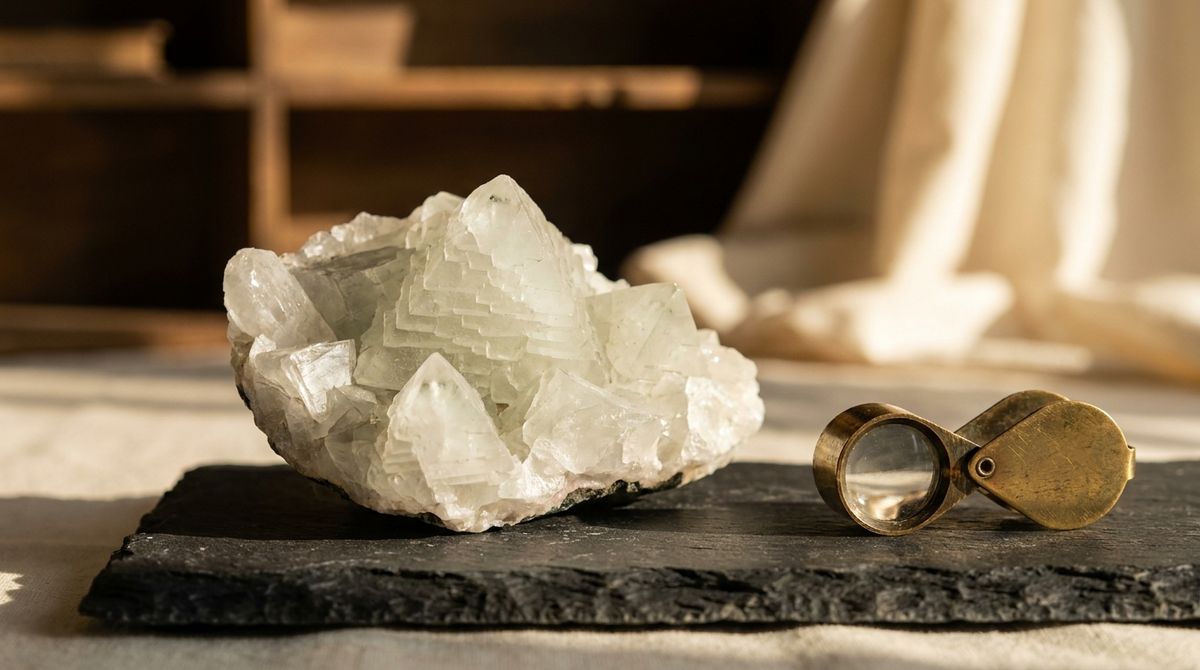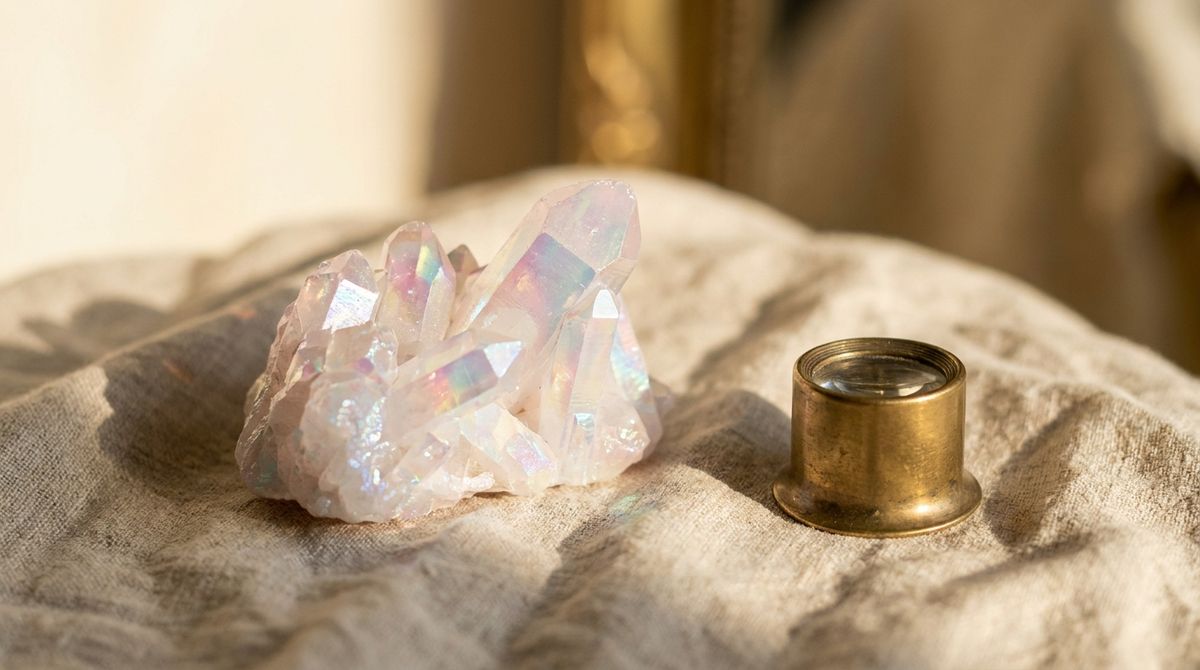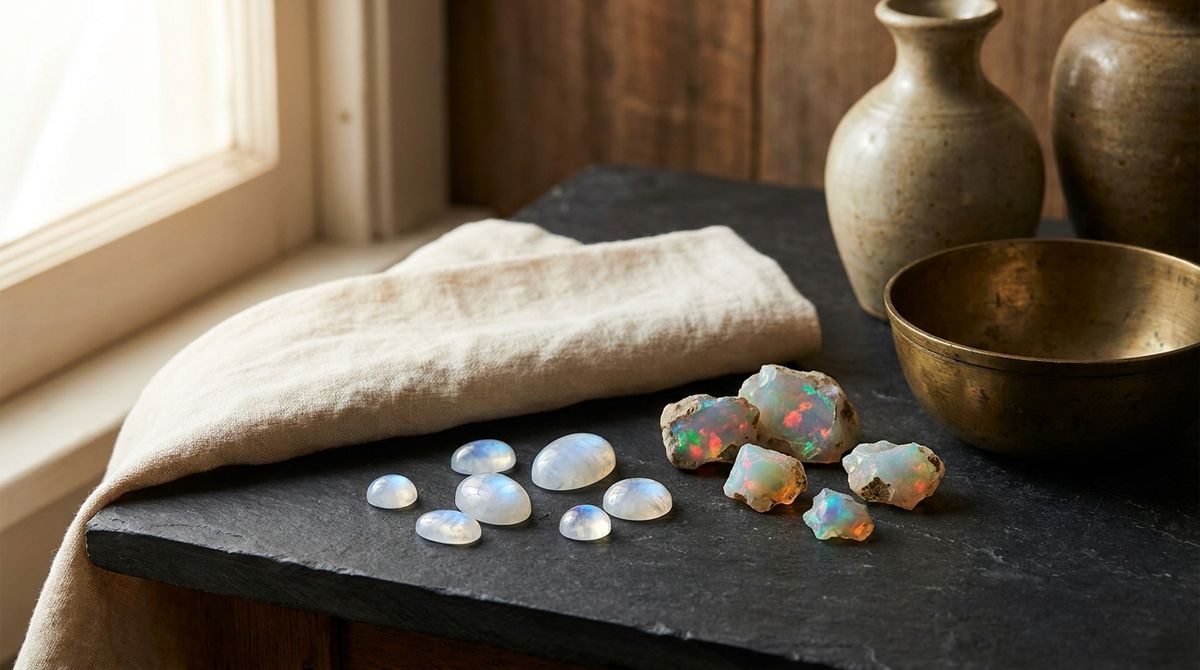
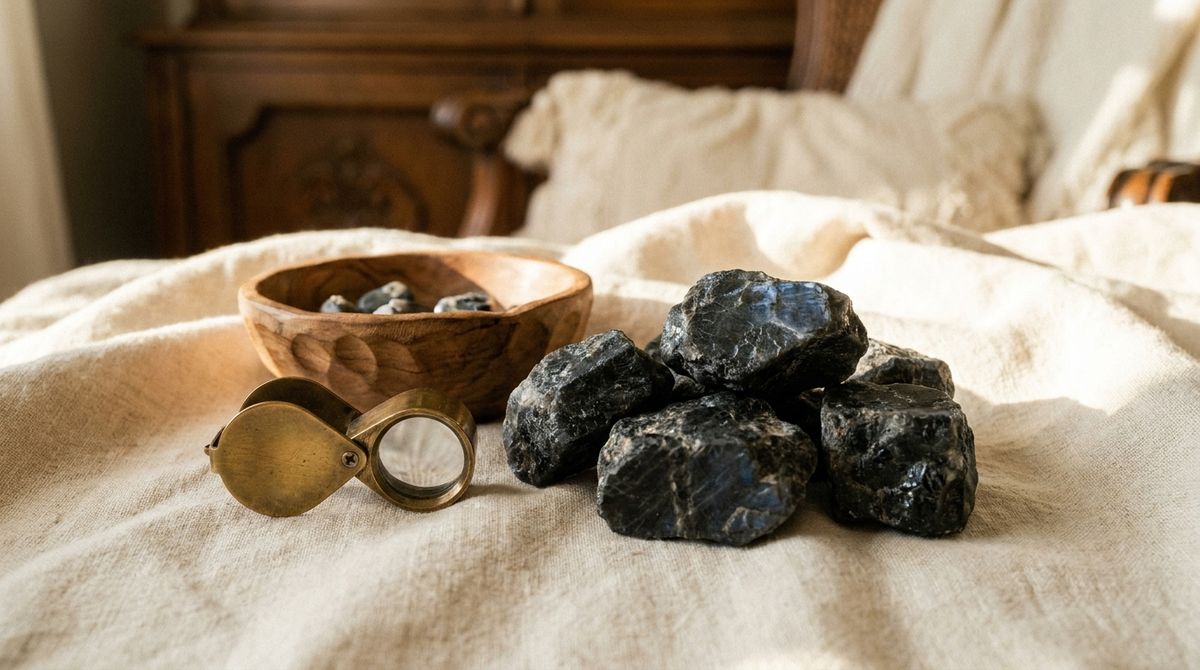
Walk past a crystal shop's "moonstone" bin and you'll usually find two very different things sitting side by side: pale, glowing stones that shift light across their surface, and dark, almost-black ones with the same label. The second kind — black moonstone — isn't always what the name implies, and the real mineralogy behind it is more interesting than the marketing name suggests.
What "Moonstone" Actually Means, Mineralogically
True moonstone is a feldspar — specifically an alkali feldspar, usually orthoclase, with the approximate formula KAlSi3O8. Its signature optical effect, adularescence, is a soft, floating glow that seems to move beneath the stone's surface as it's tilted. That glow comes from light interference between microscopically thin, alternating layers of two different feldspar minerals (orthoclase and albite) grown together inside the stone — a real optical phenomenon, not a polish effect. Feldspar as a group sits around 6 to 6.5 on the Mohs hardness scale, durable enough for jewelry with reasonable care but softer than quartz-family stones.
Where "Black Moonstone" Comes From
Here's the detail most product listings skip: material sold as "black moonstone" is genuinely one of two different things, and they're not the same mineral. Some black moonstone is exactly what it sounds like — orthoclase feldspar that's simply dark in color, still showing true adularescence if you catch the light right. But a large share of what's sold under that name in the trade is actually a colorless-to-dark labradorite that reads as dark brown or black because of dense, needle-like mineral inclusions inside it.
That second kind isn't glowing with adularescence at all — the light effect it shows is chatoyancy, the same "cat's-eye" effect you see in tiger's eye, caused by light reflecting off those parallel needle inclusions rather than interfering between feldspar layers. It's sometimes sold explicitly as "moonstone cat's-eye" for exactly that reason, though "black moonstone" is the far more common label. Neither version is a fake stone — both are real minerals in the broader feldspar family — but they're genuinely different materials wearing the same marketing name, which is worth knowing before you buy one expecting classic moonstone glow.
Black Moonstone vs. True Moonstone vs. Labradorite
All three sit in the feldspar family and get confused constantly, both with each other and by shoppers trying to identify a loose stone. Here's how they actually differ:
- True (rainbow) moonstone — Alkali feldspar (orthoclase), pale and often semi-transparent. Optical effect: adularescence, a soft glow that floats beneath the surface. Hardness ~6–6.5.
- Black moonstone — Either dark orthoclase feldspar (true adularescence) or dark labradorite with needle inclusions (chatoyancy, not adularescence) sold under the same name. Hardness ~6–6.5.
- Labradorite — Plagioclase feldspar, typically gray to black in base color. Optical effect: labradorescence, a bold flash of blue, green, or gold that appears only at certain angles, distinct from moonstone's soft all-over glow. Hardness ~6–6.5.
The practical tell: true moonstone's glow is soft and omnidirectional, visible from a wide range of angles. Labradorite's flash is bold and angle-dependent — it can look completely dark, then suddenly show a sheet of color as it's tilted. Black moonstone that's actually labradorite in disguise behaves like labradorite, not like moonstone, which is the whole source of the identification confusion.
Where These Feldspar Stones Are Found
Labradorite takes its name from the Labrador Peninsula in Canada, where Moravian missionaries first documented it in 1770 — the type locality that gave the mineral its name. A particularly vivid labradorite variety called spectrolite, known for an especially intense color flash, comes from a single deposit near Ylämaa, Finland, discovered in the 1940s. Madagascar is today one of the largest commercial sources of labradorite, including much of the material sold as dark or "black" labradorite internationally.
True moonstone's major commercial sources are different: Sri Lanka has historically produced some of the finest pale, blue-sheen moonstone, and India (particularly southern India) is a major source of the broader commercial moonstone supply, including material in warmer body colors. Because "black moonstone" in trade can originate from either lineage depending on whether a given piece is genuinely dark orthoclase or labradorite sold under the moonstone name, country of origin alone isn't a reliable way to tell the two apart — the light-behavior test described above is.
Black Moonstone Meaning and Symbolism
As with all crystal-healing associations, what follows is tradition and lore, not a scientific claim. Within that tradition, black moonstone is typically linked to protection and grounding — practitioners often describe it as pairing moonstone's traditional association with intuition and the lunar cycle with the grounding, shadow-work symbolism commonly given to black stones generally. It's frequently recommended for new-moon intention-setting rituals, where the color is read as a visual match for the dark lunar phase itself.
Caring for Black Moonstone
Feldspar's Mohs hardness of 6 to 6.5 makes it reasonably durable for occasional wear, but it's still soft enough to scratch if stored loose against harder stones like quartz or diamond. A few practical points:
- Store separately from harder gemstones to avoid surface scratches.
- Clean with a soft, dry cloth; avoid ultrasonic cleaners, which can stress feldspar's internal cleavage planes.
- Keep it out of direct, prolonged sun, which can dull the surface polish on some feldspar specimens over time.
- If you're unsure whether a piece is true black moonstone or labradorite sold under that name, tilt it under a single light source: a soft all-over glow is moonstone, a sharp color flash at specific angles is labradorite.
If you're drawn to moonstone's glow specifically, our guide to true moonstone meaning covers the classic pale variety in more depth, and our labradorite meaning guide breaks down labradorescence and that stone's own lore in full. For a piece built to actually be worn rather than displayed, FARUZO's personalized necklaces collection includes settings sized for feldspar-family stones at typical cabochon dimensions.
Frequently Asked Questions
Is black moonstone a real mineral or a dyed stone?
It's real, not dyed — but it's genuinely one of two different minerals depending on the specimen: either naturally dark orthoclase feldspar (true moonstone, just dark-colored) or a dark labradorite with needle inclusions sold under the same marketing name.
How can I tell if my "black moonstone" is really labradorite?
Tilt it under a single light source. True moonstone shows a soft, floating glow (adularescence) visible from a wide range of angles. Labradorite shows a bold, narrow flash of color (labradorescence) that appears only at specific angles and can look completely dark otherwise.
What's the difference between adularescence and chatoyancy?
Adularescence is a soft, all-over glow caused by light interference between layered feldspar minerals — it's what makes true moonstone look like it's glowing from within. Chatoyancy is a "cat's-eye" band of light caused by reflection off parallel needle-like inclusions — the effect sometimes seen in dark labradorite sold as "black moonstone" or "moonstone cat's-eye."
Is black moonstone a birthstone?
No. Moonstone is one of the recognized alternate birthstones for June, but that designation applies to classic pale moonstone, not specifically to the black/dark variety.
Is black moonstone durable enough for everyday jewelry?
Feldspar sits around 6 to 6.5 on the Mohs hardness scale — workable for occasional-wear jewelry with reasonable care, but soft enough that it should be stored separately from harder stones and kept away from ultrasonic cleaners.