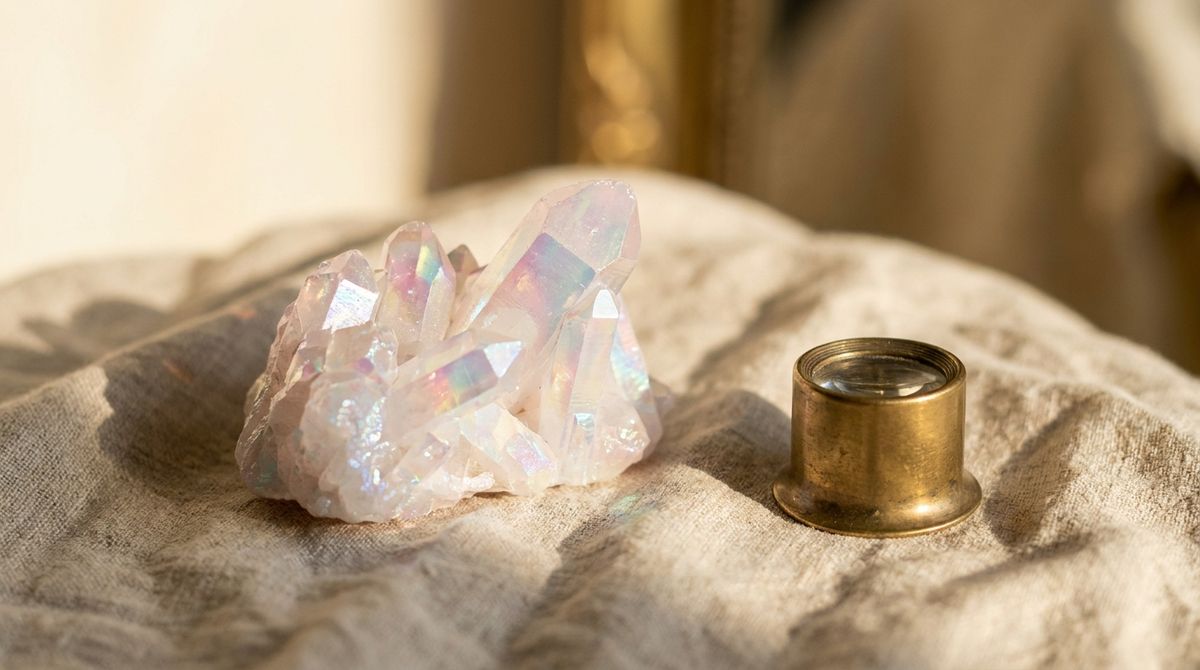
Angel aura quartz is the stone crystal shops sell for its shimmering, almost oil-slick sheen — soft washes of white, blue, and pink drifting across a clear crystal point. It looks like nothing else on the shelf, and that's because, strictly speaking, it isn't a mineral in its own right at all: it's ordinary clear quartz that's been given a permanent metallic coating in a lab. That doesn't make it fake, but it does make it a very different kind of "gemstone" from almost everything else in a crystal collection.
What Angel Aura Quartz Actually Is
Angel aura quartz starts as a natural clear quartz point or cluster — ordinary, uncolored quartz, the same mineral behind nearly every other "aura" crystal on the market. That quartz is placed in a vacuum chamber and heated to extremely high temperatures alongside a mix of precious metals, almost always platinum and silver. The heat vaporizes the metal, and the vapor bonds permanently to the surface of the quartz as it cools — a process called vapor deposition. The result is a crystal with the same internal structure as the clear quartz it started as, but wrapped in a microscopically thin metallic film that produces an iridescent, opalescent shimmer as light hits it from different angles.
The platinum-and-silver combination is specifically what separates angel aura from its closest relative, aqua aura quartz, which uses gold instead and produces a blue-green sheen rather than the pastel white-blue-pink of angel aura. Both are made the same way; only the metal changes. Neither is a naturally occurring color variety of quartz — you won't find either one in the ground.
Angel Aura vs. Aqua Aura vs. Natural Quartz
These get confused constantly, since they're all variations on the same base crystal:
- Angel aura quartz — natural clear quartz, vapor-coated with platinum and silver. Pale, iridescent white, blue, and pink sheen.
- Aqua aura quartz — natural clear quartz, vapor-coated with gold instead of platinum/silver. Blue-green, more saturated sheen rather than pastel.
- Natural (uncoated) clear quartz — the base mineral before any treatment: colorless, transparent, and without the metallic shimmer either aura variety is known for.
For more on the untreated base material, see our clear quartz meaning guide.
Is It Natural, Synthetic, or Something Else?
It's genuinely in between the two, which is part of why it confuses buyers. The crystal itself — the quartz — is 100% natural, mined the same way any other quartz point is. The color is not: it's a lab-applied metallic coating, not a mineral property the stone grew with. Reputable sellers disclose this as standard practice, since it's an established, decades-old treatment in the crystal trade rather than a recent attempt to pass off a fake. The honest way to describe it is a natural crystal with a permanent cosmetic treatment — closer to how a pearl can be dyed or a diamond can be clarity-enhanced than to an outright synthetic stone grown in a lab from scratch.
Physical Properties
Because the underlying crystal is natural quartz, angel aura quartz inherits quartz's physical properties almost entirely: a hardness of 7 on the Mohs scale, durable enough to resist everyday scratching. The metallic coating itself is a different story — it's a microscopically thin surface layer, not something fused all the way through the stone, so it can scratch, scuff, or wear thin with rough handling over years, particularly at edges and points that get knocked around in a pocket or a drawer with other stones.
In the crystal trade, angel aura quartz most commonly shows up as raw points, small clusters, and tumbled stones meant for display or meditation use rather than as a cut gemstone, since the coating is a surface effect that reads best on a crystal's natural facets. It does occasionally turn up set into jewelry — pendants and beads in particular — though the coating is more exposed to daily friction in that form than it is sitting on a shelf, which is part of why most angel aura quartz on the market stays in raw or tumbled form.
Metaphysical Meaning and Properties
In crystal healing traditions, angel aura quartz is associated with calm, spiritual connection, and clarity — themes that track its name and its soft, ethereal coloring more than any claim rooted in the mineral itself. Because the iridescent sheen reflects a blend of colors rather than one dominant hue, some practitioners treat it as a chakra-balancing stone, said to touch on several energy centers rather than one specific area. It's also sometimes paired with meditation or practices aimed at reducing stress, again tied more to its pale, luminous look than to any property specific to quartz as a mineral. None of this is a scientifically measured effect — it's a set of beliefs carried by the crystal healing and wellness community, the same way most metaphysical crystal associations are, and worth treating as tradition and personal meaning rather than established fact.
Buying and Caring for Angel Aura Quartz
A few practical things are worth knowing before buying a piece:
- Ask whether the coating is genuine vapor-deposited platinum/silver rather than a cheaper dyed or painted imitation — the real treatment produces a consistent, true iridescence across the whole surface, while a painted fake often looks uneven or flakes at the edges.
- Clean it gently: a soft, dry cloth is safest. Avoid ultrasonic cleaners, harsh chemical jewelry cleaners, and ultrasonic or steam cleaning, which can degrade the thin metallic coating over time.
- Keep it away from hard contact with other stones in storage — the coating can scuff against harder minerals, so a separate pouch or a lined compartment protects the shimmer better than tossing it in a bowl with other crystals.
- Moderate, indirect light is fine; there's no strong evidence the coating fades from normal indoor light the way some dyed stones do, but prolonged direct sun exposure is still worth avoiding as a general precaution with any treated stone.
General stone handling and cleaning overlaps with what's covered in our gemstone ring cleaning guide, though a raw angel aura point is usually a display piece rather than something set into jewelry and worn daily. If you'd rather carry a stone's shimmer with you than set it on a shelf, our personalized necklaces collection includes gemstone styles with a similar soft, luminous look. For the iridescent look in an entirely natural, untreated stone instead, see how it compares to moonstone, whose shimmer comes from its internal structure rather than a surface coating.
Frequently Asked Questions
Is angel aura quartz a real crystal?
Yes, in the sense that it's a genuine natural quartz crystal. What's not natural is the color — the iridescent sheen comes from a lab-applied platinum-and-silver coating, not from how the crystal formed underground.
What's the difference between angel aura quartz and aqua aura quartz?
Both are natural clear quartz treated with vapor-deposited metal, but angel aura uses platinum and silver (producing a pale white-blue-pink shimmer), while aqua aura uses gold (producing a more saturated blue-green sheen).
Does angel aura quartz lose its color over time?
The coating is permanent under normal handling, but it is a thin surface layer that can scuff or wear with rough contact against harder materials, so gentle handling and separate storage help it keep its shimmer longer.
Can angel aura quartz get wet?
Brief contact with water is unlikely to damage it, but prolonged soaking, ultrasonic cleaners, and harsh chemical cleaners are best avoided, since they can degrade the thin metallic coating over repeated exposure.
Is angel aura quartz the same hardness as regular quartz?
Yes — the coating doesn't change the crystal's structure, so angel aura quartz measures the same 7 on the Mohs hardness scale as any other clear quartz.