Clear quartz is the gemstone equivalent of a blank canvas — crystal healers call it the “Master Healer” for its supposed ability to amplify whatever intention it's paired with, while engineers have spent the last century putting it inside nearly every watch, phone and radio on Earth for a much more concrete reason. Here's the real geology, the real history, and the lore, kept separate from each other.
What Clear Quartz Actually Is
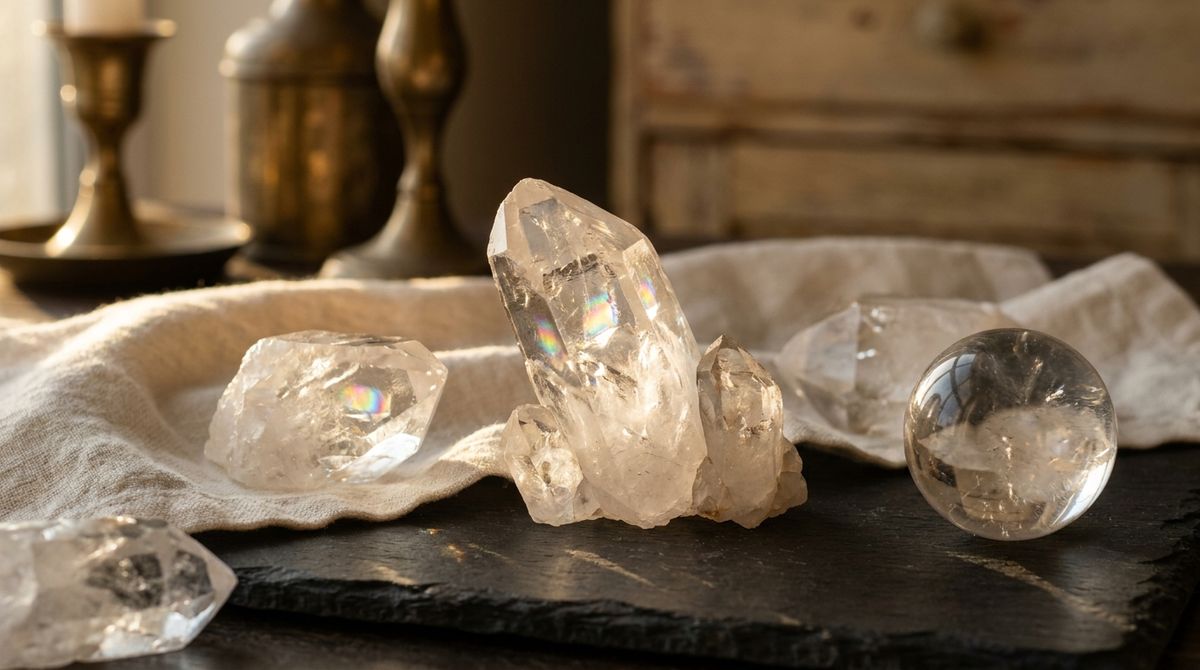
Clear quartz is silicon dioxide (SiO₂) that grew slowly enough underground to form a genuine crystal — typically a six-sided hexagonal prism capped with a point — rather than cooling too fast into a glass the way obsidian does. It sits at 7 on the Mohs hardness scale, the same as amethyst, citrine and smoky quartz, because they're all the same mineral colored (or left uncolored) by different trace elements and radiation exposure during formation. Quartz is also one of the most common minerals in Earth's crust, which is part of why clear quartz costs a few dollars a piece while genuinely rare clear gems like diamond do not.
The name has an old, specific origin: the Ancient Greeks called it krystallos, meaning “ice,” because they genuinely believed clear quartz was water frozen so deeply and permanently by the gods that it could never melt back — our modern word “crystal” descends directly from that belief.
The Reason It's Inside Your Watch and Your Phone
Clear quartz's biggest modern role has nothing to do with jewelry. In 1880, brothers Pierre and Jacques Curie discovered that pressing or bending a quartz crystal generates a small electric charge — and, run in reverse, applying electricity to quartz makes it vibrate at an extremely precise, stable frequency. That property, piezoelectricity, is what a “quartz watch” actually uses: a tiny sliver of quartz vibrating exactly 32,768 times a second, keeping time far more accurately than a mechanical balance wheel ever could.
Seiko proved it commercially first. The Seiko Quartz-Astron 35SQ, launched in Tokyo on December 25, 1969, was the world's first quartz wristwatch — accurate to within about 5 seconds a month, a dramatic jump over mechanical watches of the era. Within a few years quartz movements had upended the entire watch industry (an event the trade still calls “the Quartz Crisis”), and the same piezoelectric quartz crystal now sits inside computers, radios and phones as a timing oscillator, doing the same job at microscopic scale.
Clear Quartz's Meaning and Lore: Physical, Mental, and Metaphysical
Physical Properties
Mohs hardness 7, trigonal crystal system, vitreous (glassy) luster, and typically forms as pointed hexagonal prisms called “points” or terminated clusters. True clear quartz is genuinely transparent and colorless — any tint (rose, smoky, purple) means trace minerals or natural irradiation changed the underlying crystal, at which point it's usually sold and named as its own variety rather than as “clear” quartz.
Mental & Emotional Associations
In crystal-healing tradition, clear quartz is described as an amplifier rather than a stone with one narrow effect — the idea being that it strengthens focus, clarity and whatever intention it's paired with, which is also the reasoning behind pairing it with other stones in a set. None of this is a scientifically measured effect; it's a wellness and folklore tradition, presented here as exactly that.
Metaphysical Traditions
Crystal-healing practice most often assigns clear quartz to the crown chakra, tying it to mental clarity and spiritual connection, and it's the stone most commonly recommended for beginners specifically because practitioners describe it as compatible with, and amplifying to, nearly every other crystal rather than working against them.
Clear Quartz, Diamond, or Cubic Zirconia? How to Tell Clear Stones Apart
Because it's genuinely colorless and transparent, clear quartz gets mistaken for (or occasionally passed off as) other clear gems. Here's how the most commonly confused ones actually differ:
- Clear Quartz — Mohs 7, real mineral, moderate brilliance, no fire (color flashes), a few dollars per carat, warm to the touch relative to diamond.
- Cubic Zirconia — a lab-made crystal (zirconium dioxide), Mohs 8–8.5, much higher brilliance and fire than quartz, heavier than a diamond of the same size, still inexpensive.
- Diamond — Mohs 10, the hardest natural material, exceptional fire and brilliance, conducts heat almost instantly (the basis of a thermal diamond tester), priced per carat in the hundreds to thousands.
- Glass (“rock crystal” imitations) — Mohs 5–6, often shows tiny bubbles under magnification that real quartz never has, scratches far more easily.
The fastest home check: real clear quartz will scratch ordinary glass and a copper penny but will itself be scratched by a steel file or a diamond, since it sits in the middle of the hardness scale rather than at either end.
Where Clear Quartz Comes From
Clear quartz forms on every continent — major sources include Brazil (the largest producer of gem-quality quartz points and clusters), Arkansas's Ouachita Mountains (a source significant enough that Arkansas made quartz its official state mineral), Madagascar, and the Alps, where large, exceptionally clear specimens have been mined since Roman times.
How to Identify Real Clear Quartz (and How to Care for It)
Genuine clear quartz almost always shows some natural imperfection under magnification — a faint internal fracture (sometimes called a “rainbow” or “veil” where light catches it), a trace mineral inclusion, or a slightly uneven termination — because natural crystal growth is never perfectly uniform. A piece that looks flawless and perfectly symmetrical under a loupe is more likely cut glass or synthetic quartz. Quartz is durable enough for daily wear (harder than a steel knife blade) but can still chip on a sharp impact, and like most crystal jewelry it should come off before swimming, exercise or household chemicals; clean it the same way as most gemstone jewelry — warm water, mild soap, and a soft brush.
If you're building or refreshing a crystal collection, our personalized necklace line includes clear quartz and other everyday gemstone options set as pendants, and our Mohs hardness guide and gemstone ring cleaning guide cover care in more depth. Clear quartz belongs to the same mineral family as rose quartz and smoky quartz — same SiO₂ structure, different trace elements and irradiation history.
More gemstone identification guides live in our Gemstones & Crystals collection.
Frequently Asked Questions
Is clear quartz the same thing as a diamond?
No. They're unrelated materials that both happen to be clear — clear quartz is silicon dioxide at Mohs 7, while diamond is crystallized carbon at Mohs 10, the hardest natural material known. Diamond also shows far more fire and brilliance, and conducts heat almost instantly, which is how a diamond tester tells the two apart in seconds.
Why is clear quartz called the “Master Healer”?
That's a crystal-healing tradition, not a scientific claim: practitioners describe clear quartz as an energy amplifier compatible with every other stone, rather than one with a single narrow effect, which is why it's the stone most often recommended to beginners building a first collection.
Is clear quartz valuable?
Not in the way diamonds or emeralds are. Quartz is one of the most abundant minerals in Earth's crust, so even large, clear, well-formed pieces typically sell for a few to a few dozen dollars rather than the per-carat prices of true rare gemstones — its appeal is clarity and abundance, not scarcity.
Why is clear quartz used in watches and electronics?
Because of piezoelectricity, discovered in quartz by Pierre and Jacques Curie in 1880: applying electricity to a quartz crystal makes it vibrate at an extremely stable, precise frequency, which is exactly what a watch or a computer needs for accurate timekeeping. The first commercial quartz wristwatch, Seiko's Quartz-Astron, launched in 1969.
How can I tell if my clear quartz is real?
Look for small natural imperfections under a loupe — a faint internal fracture, a trace inclusion, a slightly uneven point — since real crystal growth is never perfectly uniform. It should scratch glass and copper but be scratched by steel or a diamond, consistent with its Mohs 7 hardness sitting in the middle of the scale.