Pyrite Meaning: The "Fool's Gold" That Ancient Cultures Turned Into Mirrors
Pyrite is the mineral almost everyone has heard of under its nickname first: fool's gold. Its brassy, metallic shine has fooled prospectors for centuries, but pyrite has never needed to borrow gold's reputation — it has its own long history as a fire-starting tool, a mirror-making material, and, more recently, a popular crystal-healing stone associated with protection and confidence. This guide covers what pyrite is actually made of, what people mean when they talk about its symbolism, how to tell it apart from real gold in under a minute, and how to look after it if you wear or collect it.
What Pyrite Symbolizes: Meaning and Metaphysical Properties
Pyrite's spiritual reputation is built almost entirely around one idea: it looks like wealth, so it has become a stand-in symbol for wealth, confidence, and self-worth in modern crystal healing circles. None of the claims below are scientifically established — they're beliefs and traditions, presented here as exactly that.
Physical. In crystal-healing frameworks, pyrite is described as an energizing stone, something practitioners keep on a desk or carry to counter fatigue or a sense of physical depletion during demanding stretches of work.
Mental. It's most often associated with confidence, willpower, and mental clarity — tied in these traditions to the solar plexus chakra, the energy center some belief systems link to personal power and self-esteem.
Metaphysical. The dominant association is protection: pyrite is described as a shield against negative energy, a reputation that traces back to the ancient Greeks, who set pyrite into amulets for exactly that purpose. Alongside protection, it's linked to abundance and manifestation — "fool's gold" reframed, in this belief system, as a stone that attracts the real thing.
None of this is about the mineral's chemistry. It's a belief system some people find genuinely useful and others treat as decorative folklore — both are reasonable ways to relate to a stone that, geologically, is just an iron sulfide.
Pyrite vs. Real Gold: How to Tell Fool's Gold From the Real Thing
Prospectors needed a fast field test long before anyone had a lab, and the differences are still the fastest way to check a find today:
- Hardness. Pyrite is a 6–6.5 on the Mohs scale; gold is a soft 2.5. A steel knife point will scratch gold easily and will barely mark pyrite.
- Streak. Drag either mineral across an unglazed porcelain tile. Gold leaves a golden-yellow streak; pyrite leaves a greenish-black to brownish-black streak — the single most reliable field test.
- Malleability. Gold is famously malleable — it dents and flattens under a hammer blow without breaking. Pyrite is brittle and shatters or chips instead.
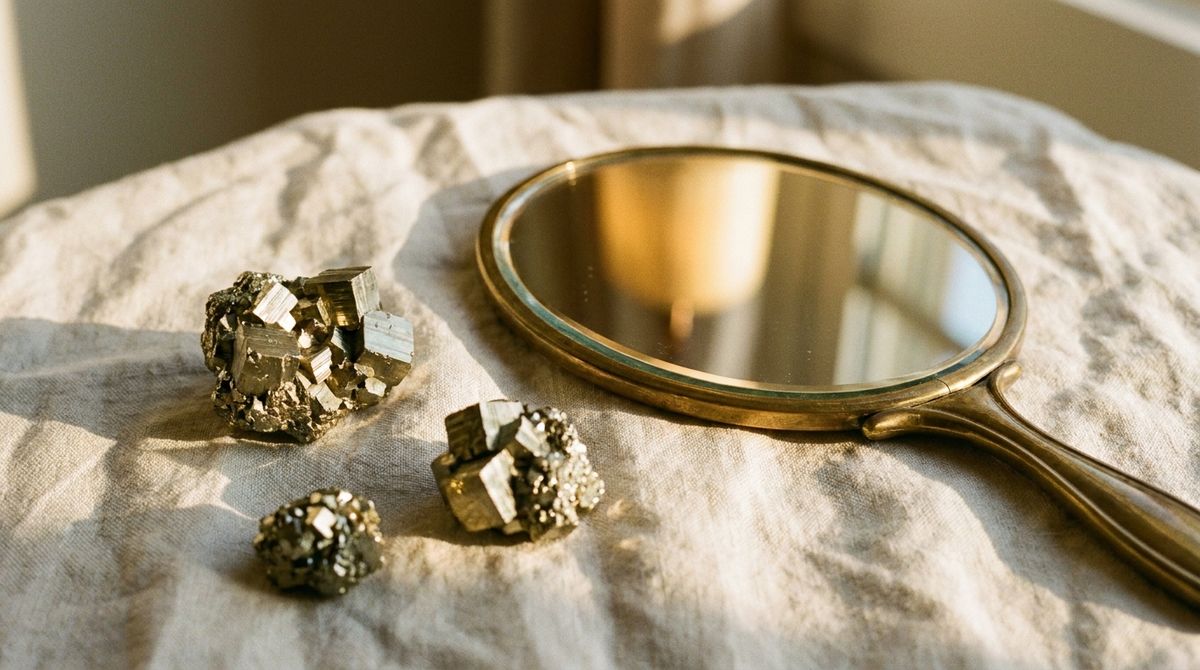
- Crystal shape. Pyrite commonly forms sharp, well-defined cubes or multi-faceted crystals with flat, geometric faces. Native gold is almost always irregular and rounded (anhedral), never a clean cube.
- Weight. This is the biggest tell of all. Gold's specific gravity is about 19.3 — nearly four times denser than pyrite's roughly 5.0. A gold nugget feels distinctly, surprisingly heavy for its size; a similarly sized pyrite crystal feels light by comparison.
The Geology: Formula, Hardness, and Where Pyrite Forms
Pyrite is iron disulfide, FeS₂, and it crystallizes in the cubic system — the reason it so often forms those recognizable, almost machine-cut-looking cubes. Some of the most famous cubic specimens come from Navajún, Spain, prized by mineral collectors for their geometric precision.
Pyrite has a near-identical twin worth knowing about: marcasite. Both are FeS₂, but marcasite crystallizes in the orthorhombic system rather than pyrite's cubic system, and it's far less stable — marcasite specimens degrade and flake apart at the surface much faster than pyrite does. Because of that instability, most jewelry sold as "marcasite" today, a Victorian-era staple, is actually cut pyrite; genuine marcasite is too fragile for regular wear.
The chart below shows how far apart pyrite really sits from gold in density, along with two other brassy lookalikes people sometimes confuse for one or the other.
A History of Fire, Mirrors, and Fool's Gold
Pyrite's practical history goes back much further than jewelry. Struck against flint, it throws a shower of hot sparks — Neanderthals were doing exactly this to start fires roughly 400,000 years ago, and the practice continued among various cultures, including Indigenous groups in South Australia, who paired pyrite with flintstone and stringybark tinder well into recorded history.
In Mesoamerica, pyrite took on a different role entirely. Early Olmec-tradition mirrors were ground from a single piece of hematite, but by the Middle to Late Formative period, artisans were assembling reflective mirrors from dozens of small, precisely cut pyrite tesserae — as many as 20 to 50 pieces, each beveled and fitted with remarkable accuracy, some as thin as 2 millimeters. Two of the earliest known examples, found at Chiapa de Corzo in Chiapas, Mexico, date to roughly 700–500 BCE and are considered forerunners of the more elaborate Classic-period pyrite mosaic mirrors used by Olmec, Maya, and later Aztec elites for fire-making, personal grooming, and divination.
Centuries later, pyrite found a mechanical use: 16th- and 17th-century wheellock firearms used a piece of pyrite pressed against a spinning steel wheel to throw the sparks that ignited the gunpowder charge, the same fire-making principle in a very different context. In the early 20th century, before vacuum tubes took over, a pyrite crystal was a common component in "cat's whisker" crystal radio detectors, a small irony for a mineral nicknamed after fooling people — it turned out to be genuinely useful for catching a real signal.
Pyrite still has industrial relevance today: it's a commercial source of sulfur, mined and processed into sulfur dioxide for sulfuric acid manufacturing and papermaking.
Wearing and Caring for Pyrite Jewelry
Pyrite is harder than gold, but it isn't maintenance-free — it's genuinely sensitive to moisture. Prolonged exposure to humidity or water can trigger "pyrite oxidation," a slow chemical breakdown that leaves a dull, sometimes rust-colored film on the surface. That means pyrite jewelry should come off before showering, swimming, or washing hands, and should be stored somewhere dry rather than a steamy bathroom cabinet. Skip ultrasonic and steam cleaners entirely; a soft, dry cloth is the safest way to keep the surface bright. For jewelry that goes on stones day after day, our gemstone ring cleaning guide covers safe at-home methods that work across most stone types, pyrite included.
If you like the idea of a stone with real geological character rather than a purely decorative one, pairing it with a piece you can make your own is worth considering — our personalized rings let you combine a birthstone or an accent stone with an engraved name or date, so the meaning isn't only in the mineral. Pyrite sits alongside other protection-associated stones some collectors pair it with, including our tiger's eye guide, if you're building out a collection around that theme. You can browse more stone-by-stone guides like this one in our gemstones and crystals archive.
Frequently Asked Questions
Is pyrite actually valuable?
Not in the way gold is. Pyrite itself is common and inexpensive — well-formed cubic specimens sell mostly on aesthetic and collector appeal, not metal value. Historically, though, pyrite deposits mattered commercially as a source of sulfur, and pyrite can sometimes occur alongside genuine gold deposits, which is part of how the fool's-gold confusion started in mining camps.
What's the fastest way to tell pyrite from real gold?
The streak test. Drag the mineral across a piece of unglazed porcelain: gold leaves a gold-yellow streak, pyrite leaves a greenish-black to brownish-black one. Weight is the other quick giveaway — gold is nearly four times denser than pyrite and feels noticeably heavier for its size.
Can pyrite jewelry get wet?
It's best avoided. Pyrite is prone to a slow surface oxidation when it's regularly exposed to moisture, which can leave a dull or discolored film over time. Take pyrite pieces off before swimming, showering, or heavy handwashing, and store them somewhere dry.
Is "marcasite" jewelry actually pyrite?
Usually, yes. Marcasite is a genuine, separate mineral with the same chemical formula as pyrite (FeS₂) but a different, less stable crystal structure, and true marcasite degrades too quickly for durable jewelry. Most jewelry historically sold under the "marcasite" name, especially Victorian-era pieces, is cut pyrite standing in for its more fragile cousin.
Is pyrite a birthstone?
No. Pyrite isn't one of the officially recognized monthly birthstones, and it doesn't carry a zodiac assignment with the same broad consensus that stones like garnet or peridot do — any zodiac pairing you see for it is folk association rather than a widely agreed standard.