Hematite is the stone most likely to be misidentified twice during the same store visit — once as “obsidian” because it is black and glossy, and once as “strongly magnetic” because the bracelet next to it snaps to the register drawer. Neither is quite right. The real mineral is iron oxide, and its name has nothing to do with magnets: the Greek scholar Theophrastus named it around 300 BCE from haima, blood, because rubbing it against a rough surface leaves a streak the color of dried blood, regardless of whether the stone itself looks black, silver-grey, or rust-red. That streak test is still the fastest way to tell genuine hematite from its many stand-ins. This guide covers what hematite actually is, the real science behind the magnet myth, its documented history from Roman seal rings to NASA's Mars rovers, and how to identify and care for it.
What Hematite Actually Is
Hematite is iron(III) oxide, Fe₂O₃ — one of the most abundant iron-bearing minerals on Earth, and the primary ore behind most of the world's steel. It crystallizes in the trigonal system, the same structural family as corundum (the mineral behind ruby and sapphire) and ilmenite. On the Mohs scale it sits at 5.5 to 6.5: hard enough to take a polish, soft enough that a steel file will mark it.
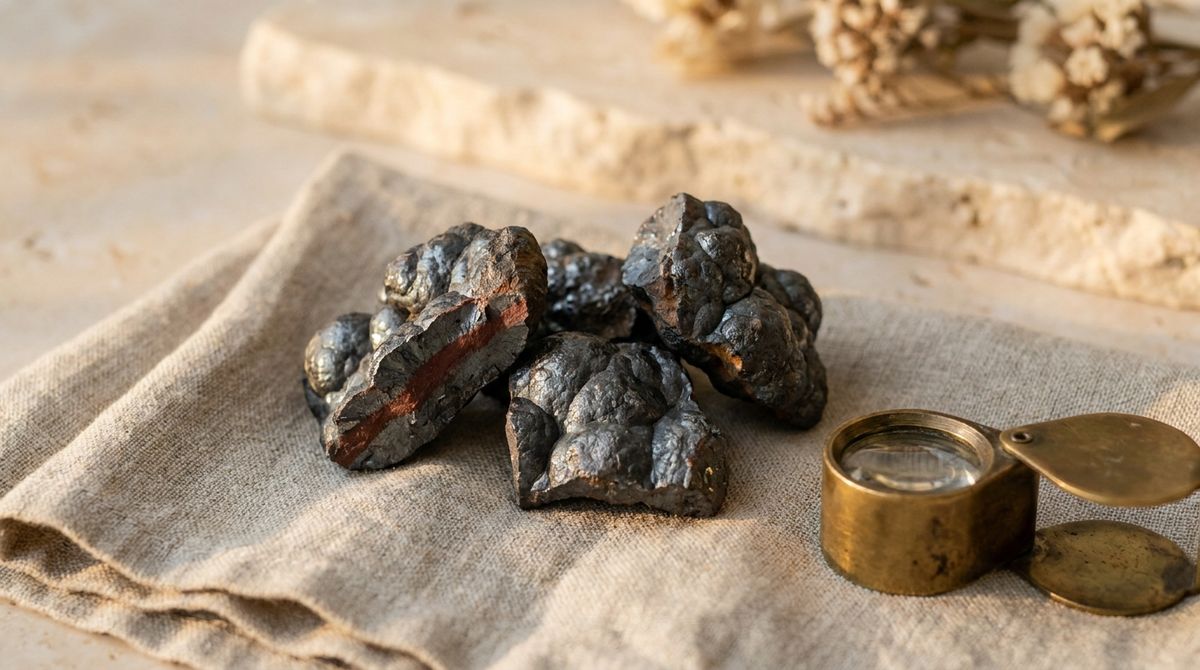
Two things identify it in the hand. First, its streak: drag a piece across an unglazed porcelain tile and it leaves a reddish-brown to blood-red line — the detail its name is built on — even when the specimen itself is metallic black or silver-grey. Second, its weight: specific gravity 5.26, roughly double that of quartz-family stones like onyx or agate, so a hematite bead feels noticeably heavier than its size suggests.
The largest modern deposits are in Australia's Pilbara region in Western Australia, where high-grade hematite ore runs up to 69.9% iron by weight; the Hamersley Range there holds an estimated 55 billion tonnes of ore at concentrations above 60% iron, among the largest iron deposits ever documented. Historic hematite districts also include the Lake Superior iron ranges of the United States and the Itabira district of Minas Gerais, Brazil.
Properties: Physical, Mental, and Metaphysical
Physical Properties
Set the crystal-shop language aside for a moment: hematite has one genuinely measurable physical quirk. It is magnetic — but only weakly. Below about −23°C (250 K) it is antiferromagnetic, with no net external pull; above that temperature, which covers essentially all normal wear conditions, it becomes weakly ferromagnetic. In practice, a strong magnet will nudge a loose hematite chip, but it will not snap two beads together the way a refrigerator magnet grabs a paperclip — a distinction covered in its own section below.
Mental & Emotional Properties
In crystal-healing traditions, hematite is described as a grounding, focus-sharpening stone — something to hold or wear on a scattered day, in the same category as smoky quartz or black tourmaline. That is a belief drawn from centuries of folk tradition, not a medical claim FARUZO makes about the stone.
Metaphysical Properties
Hematite's folk name literally means “blood stone,” and the metaphysical tradition around it follows directly from that etymology: several ancient and medieval lapidary texts describe carrying hematite into battle on the belief that a stone which “contained” blood in its name and color would command blood in the wearer's body, keeping a wound from bleeding out. Modern crystal-healing shops carry that forward as a general “protection and grounding” reputation, detached from the original battlefield-specific belief.
The Truth About “Magnetic Hematite” Jewelry
Most of what is sold as “magnetic hematite” — the shiny, uniformly dark, strongly magnetic beads in wellness bracelets — is not hematite at all. It is hematine (also branded Hemalyke or hemalike), a man-made barium-strontium ferrite manufactured to look like polished hematite and deliberately magnetized far beyond anything the natural mineral can do. Genuine natural hematite is only weakly magnetic, as described above; if a bead grabs another bead across a gap of air or clings hard to a steel surface, it is synthetic hematine, not natural hematite. Neither material is fraudulent to sell — reputable retailers label hematine correctly — but “magnetic hematite” as a phrase is, strictly, a contradiction: real hematite barely responds to a magnet at all.
Hematite in Deep Time
Hematite's documented history runs from a prehistoric pigment to a different planet.
Roman signet rings were carved from hematite in part for a practical reason: melted sealing wax does not stick to its surface, making it reusable for stamping letters and documents rather than a purely decorative choice. Centuries later, hematite reappears as a minor material in Victorian mourning jewelry — jet remained the dominant black stone of that era, but hematite's dense, dark polish made it an occasional substitute after Prince Albert's death in 1861 launched decades of formal mourning dress in Britain. Its most surprising modern role is off-planet: in 2004, NASA's Opportunity rover found small, round hematite “blueberries” scattered across Meridiani Planum on Mars, concretions that could only have formed in the presence of liquid water — physical evidence of the planet's wetter history, found with instruments built to look for exactly this mineral.
How to Tell Real Hematite From Its Lookalikes
Weight is the fastest field test: hold a piece in your palm, and genuine hematite or natural magnetite will feel distinctly heavier than a same-sized piece of black tourmaline, black onyx, or obsidian. Combine that with the magnet test above — a strong pull means synthetic hematine, not natural hematite or magnetite — and the streak test, which separates hematite (red streak) from magnetite (black streak) even though the two minerals can look nearly identical once cut into a finished bead.
How to Wear and Care for Hematite Jewelry
At 5.5–6.5 on the Mohs scale, hematite is durable enough for everyday rings, bracelets and bead necklaces, though it sits softer than quartz-family stones and can scratch if stored loose against them. Our gemstone ring cleaning guide covers safe methods that apply here too: a soft cloth with mild soap and water, and no ultrasonic or steam cleaners, which can loosen the polish or heat-shock a stone prone to fracturing along thin sections. Because hematite is iron oxide, prolonged moisture exposure can eventually dull its polish, so dry pieces before storing them rather than leaving them in a damp bathroom dish.
Hematite's grounding reputation puts it constantly in men's beaded bracelets, often alongside other dark protection stones like tiger's eye and black tourmaline — something to touch as much as to wear. For a broader look at how other stones' meanings compare, see our guide to gemstone meanings.
Frequently Asked Questions
Is hematite a birthstone?
No. Hematite is not one of the twelve modern birthstones recognized for any calendar month, though its long folkloric association with protection puts it in the same general category as black tourmaline and onyx — stones worn for meaning rather than a birth-month assignment.
Is hematite magnetic?
Only weakly. Genuine hematite is weakly magnetic because of its iron content, but nowhere near strong enough to snap beads together across a gap. Jewelry marketed as strongly “magnetic hematite” is almost always hematine, a synthetic ferrite made to imitate hematite's look.
Can hematite get wet?
Brief contact, like a quick handwash, will not harm it, but hematite should not be soaked or worn in the shower or pool long-term — as an iron oxide, sustained moisture can dull its polish over time. Dry it promptly and store it away from damp bathroom cabinets.
Why is hematite sometimes called bloodstone?
“Bloodstone” is also the common name for a separate, green-and-red-spotted variety of chalcedony (heliotrope), so the two are not interchangeable — but hematite earned a version of the same nickname independently, from its own red streak and its Greek name, which translates directly to “blood stone.”
Is hematite rare or expensive?
Not at all. Hematite is one of the most abundant iron minerals on Earth and the primary ore for most of the world's steel, which keeps jewelry-grade material inexpensive compared with harder, rarer gemstones.