Black tourmaline is the stone most likely to show up in a college dorm room, a therapist's office, and a mid-century U.S. Navy blast-measurement report — for three completely different reasons. Sold everywhere as “the ultimate protection stone,” it also happens to be one of the only crystals with a documented, testable physical property that 20th-century engineers actually built instruments around. Here's what black tourmaline really is, what's science and what's belief, and how to buy and care for it.
Black Tourmaline Meaning: Quick Answer
Black tourmaline's meaning splits into two separate claims, and they're worth keeping apart. In crystal-healing and spiritual traditions, it's sold as the quintessential "protection stone" — worn or displayed to ground a space, absorb negative energy, and ease anxiety. That's a belief with a long folk history, not a clinical finding. In mineralogy, black tourmaline is schorl, the iron-rich, piezoelectric variety of tourmaline — a mineral that generates a real, measurable electric charge under pressure or heat, which is the genuine physical property most likely behind its "protective" reputation in the first place. The rest of this guide covers both halves: the real mineral data (hardness, formula, where it's mined), and how to identify, buy and care for the real stone.
What Black Tourmaline Actually Is
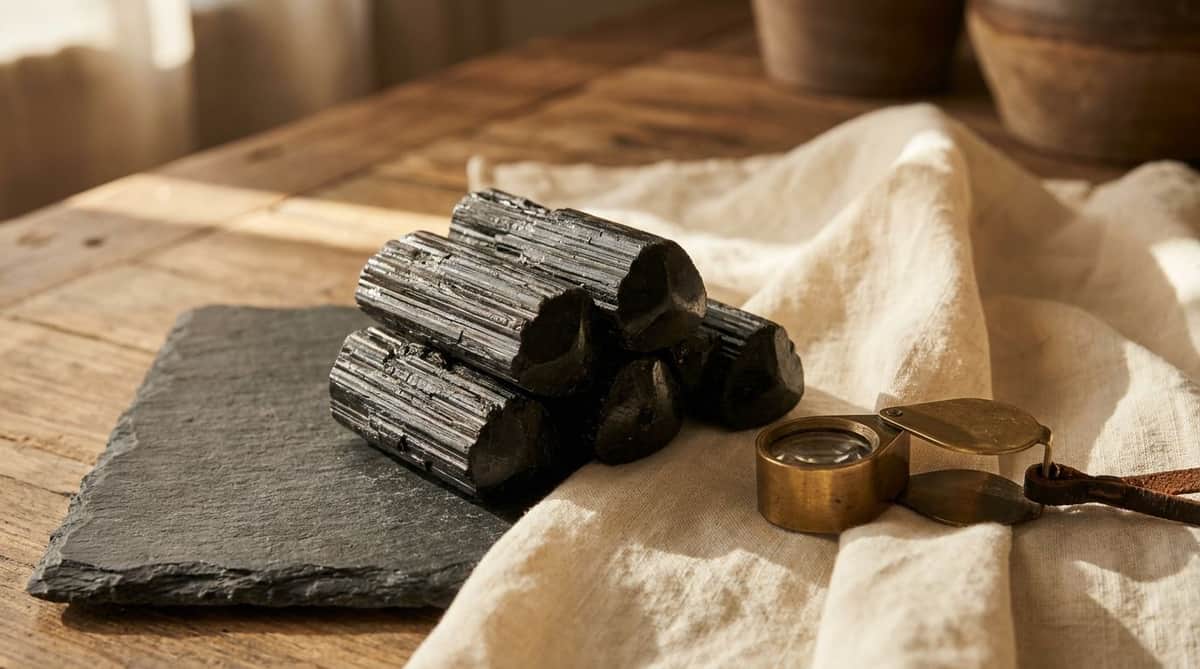
Black tourmaline is the trade name for schorl, the iron-rich member of the tourmaline mineral group — the same broad family covered in our guide to gemstone meanings. Schorl is by far the most common form: it makes up an estimated 95% of all natural tourmaline found on Earth.
Its chemical formula is NaFe₃Al₆(BO₃)₃Si₆O₁₈(OH)₄ — sodium, iron, aluminum, boron and silicon locked into a trigonal crystal system that grows in long, heavily striated prismatic columns, often with a rounded triangular cross-section. The deep, opaque black color comes from that high iron (Fe²⁺) content; strip the iron out of the same mineral structure and you get tourmaline's clear, pink, green or watermelon-colored cousins instead.
On the Mohs scale, black tourmaline sits at 7 to 7.5 — hard enough to resist everyday scratching from dust and grit, which is part of why it holds up well in bracelets and rings worn daily. Specific gravity runs 3.1 to 3.2, and its luster is usually described as submetallic, sometimes dull on unpolished faces. Its streak — the color left behind when scratched across an unglazed porcelain plate — is white, which is typical of minerals at or above the plate's own hardness.
Major deposits are mined in Brazil's Minas Gerais region, Namibia's Erongo region, Pakistan's Skardu district, Madagascar, and parts of California and New England in the U.S.
Properties: Physical, Mental, and Metaphysical
Physical Properties
Set the folklore aside for a moment: black tourmaline has one genuinely unusual, verifiable property. It's both piezoelectric and pyroelectric — squeeze or heat a tourmaline crystal and it generates a measurable electric charge across its opposite faces. That isn't crystal-shop marketing; it's documented mineralogy, and it's the reason 20th-century engineers actually built measuring instruments out of tourmaline (more on that below).
Mental & Emotional Properties
In crystal-healing traditions, black tourmaline is described as an anxiety-easing, mood-stabilizing stone — something to hold or wear during a stressful day to feel less scattered. That's a belief drawn from folk and New Age practice, not a clinical claim; no controlled study has measured a crystal's effect on mood, and none is cited here as one.
Metaphysical Properties
This is the stone most associated with the word “grounding” in crystal shops — the idea that it absorbs negative energy and forms a kind of energetic barrier around whoever is wearing it, which is why it turns up as often in doorway bowls and desk displays as it does in jewelry. Again: a belief system with a long folk history, not a scientific mechanism.
The Real Science Behind the “Protection Stone” Reputation
Piezoelectricity is a real, measurable phenomenon, and tourmaline is one of the minerals that shows it most strongly. Apply pressure to a tourmaline crystal and one end becomes positively charged while the other becomes negative; heat it, and the same thing happens — that's the pyroelectric half. Quartz shows a weaker version of the same effect, which is why quartz crystals run wristwatches, but for raw sensitivity to pressure, tourmaline was historically the better material.
That property had a genuinely important 20th-century use: gauges built from tourmaline crystals to measure the pressure of underwater shock waves. Research on “tourmaline gauges” dates to the UK in 1921, and the U.S. Navy relied on them through and after World War II to measure blast pressure from underwater explosives, because tourmaline's mechanical strength and chemical stability held up better under load than quartz or water-soluble alternatives.
None of that proves the metaphysical “protection” claims — a mineral responding to physical pressure with an electric charge is not the same as a stone protecting a person's energy. But it's plausibly the real-world property that got a plain black rock associated with an invisible, protective force in the first place.
How to Tell Real Black Tourmaline from Its Lookalikes
Black tourmaline gets confused with three other common black stones sold in the same jewelry aisle, and they're not interchangeable:
- Black onyx is banded chalcedony (a form of quartz) dyed a uniform black; the giveaway is a glassy, slightly translucent edge under strong light, where black tourmaline stays fully opaque.
- Obsidian is volcanic glass, not a crystal at all — it breaks with a true conchoidal (shell-like) fracture and shows no flat crystal faces, while tourmaline forms straight-sided, striated prisms.
- Hematite is a metallic-grey iron oxide that isn't actually black in reflected light — it photographs black but reads as silvery-grey in person, next to tourmaline's true matte black.
Hardness is a reasonable field test: black tourmaline (7–7.5) will scratch a piece of window glass and won't be scratched by a steel knife blade; onyx (6.5–7) behaves almost the same. Obsidian (5–5.5) and hematite (5.5–6.5) are both soft enough that a steel blade will leave a mark.
How to Wear and Care for Black Tourmaline Jewelry
At 7–7.5 on the Mohs scale, black tourmaline is durable enough for daily-wear bracelets and rings — harder than a fingernail (2.5), a copper penny (3.5), and window glass (5.5), which puts it comfortably above most accidental scratches from dust and grit.
Care is straightforward: clean it with a soft cloth and mild soap and water, and skip the ultrasonic and steam cleaners jewelry counters use on diamonds — our gemstone ring cleaning guide covers the safe methods in more detail. Tourmaline's cleavage plane makes it more vulnerable to a sharp knock than its Mohs number alone suggests, so store it away from harder stones like sapphire or diamond, and avoid sudden temperature swings — hot tub to snow, in short.
If you already lean on a physical object to settle a stressful moment — the same idea behind a spinner ring for anxiety — black tourmaline shows up constantly in men's beaded bracelets for the same reason: something to touch, not just wear. It pairs well with the same protective reputation carried by tiger's eye, another stone that shows up often in the same grounding-jewelry category.
Frequently Asked Questions
Is black tourmaline a birthstone?
No. Black tourmaline isn't one of the twelve official birthstones — pink, green and watermelon tourmaline are associated with October alongside opal, but the black variety (schorl) sits outside that list entirely.
Can black tourmaline get wet?
Yes, briefly — a quick rinse under the tap won't harm it. What to avoid is prolonged soaking, salt water, and harsh chemicals, plus the sudden temperature changes mentioned above.
Is black tourmaline the same as tourmalinated quartz?
No. Tourmalinated quartz is clear quartz with needle-like black tourmaline crystals growing inside it — two different minerals in one specimen, not a variety of tourmaline itself.
How rare is black tourmaline?
Not rare at all, geologically — schorl is the most abundant tourmaline variety, found on every continent except Antarctica. Its low price compared to colored tourmaline varieties reflects that abundance, not lower quality.
Does black tourmaline fade in sunlight?
Some tourmaline colors are known to shift or fade with prolonged UV exposure, but black tourmaline's color comes from iron content deep in the crystal structure rather than a surface treatment, so it's considered stable under normal wear and display.