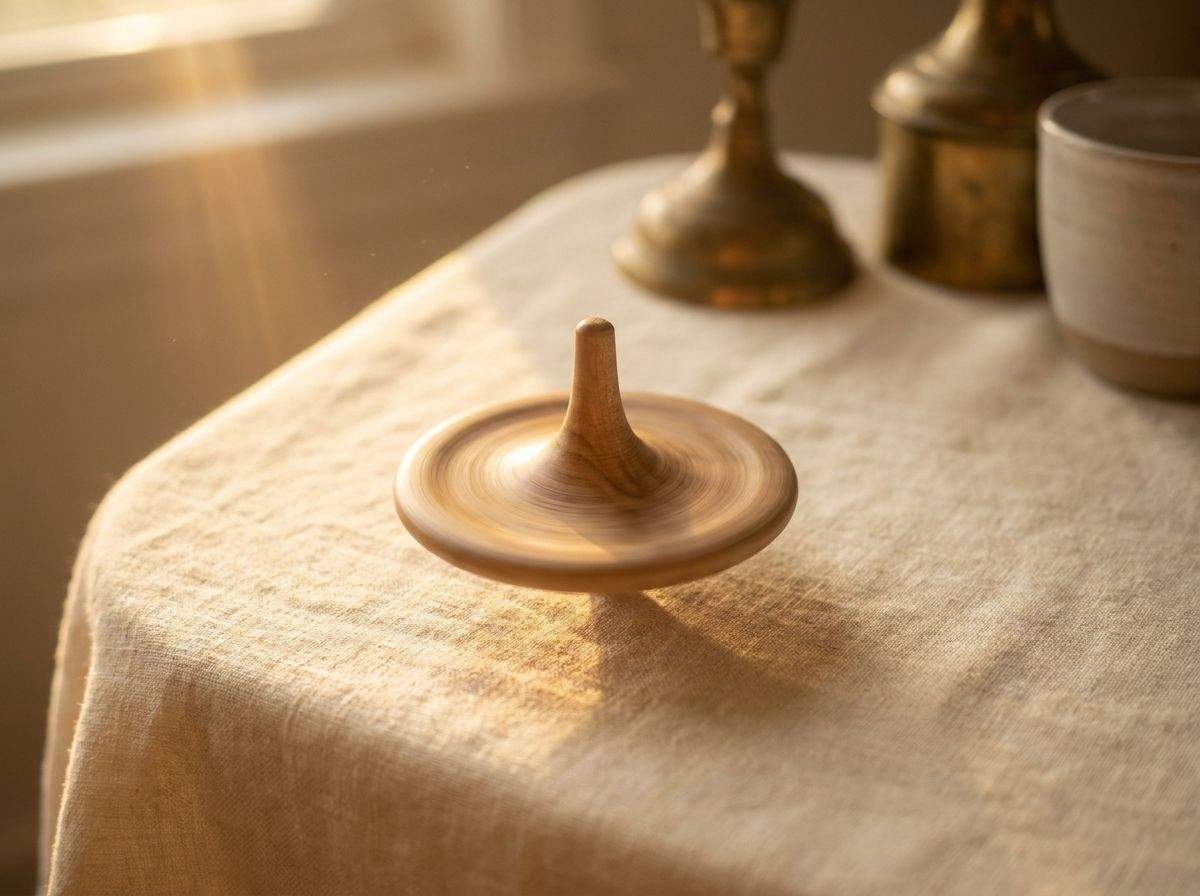
A spinner ring has a moving part, which is not something most jewelry admits to. One band sits still on the finger; a second, thinner band rides on top of it and turns freely with a flick of the thumb. That small mechanical fact is the whole reason people wear one.
What a spinner ring actually is
Strip away the branding and it is a plain ring with two parts instead of one: an outer band sized to fit, and an inner band that spins around it without coming off. Nothing lights up, nothing clicks into place, nothing needs charging. The entire object exists to give a fingertip something to do.
That is a narrower job than most jewelry takes on. A pendant is meant to be seen. A spinner ring is mostly meant to be touched, often by the person wearing it and often without looking down at their own hand.
Where the spinning came from
The mechanism is modern, but the instinct behind it is not. Tibetan Buddhist prayer wheels work on the same logic: a cylinder that turns under the hand, with the turning itself treated as the meaningful act, not just the getting-somewhere. Worry beads in Greece and Turkey do a version of the same thing with a string instead of a wheel, moving one bead at a time under the thumb.
A ring that spins on the finger is a small, secular descendant of that lineage. Nobody is required to believe anything for it to work. The repetition is doing the job on its own.
Why the motion helps with anxiety
Anxiety tends to live in the body before it shows up as a thought, which is why thinking your way out of it so often fails. A repetitive, low-stakes physical motion gives the nervous system somewhere to put that energy that is not the racing thought itself.
This is the same principle behind fidget spinners, worry stones, and the ordinary habit of clicking a pen. What a spinner ring adds is that it is already on the hand, already sized, already there before the anxious moment starts. There is nothing to dig out of a pocket and nothing to lose, because it never leaves the finger it lives on.
It will not resolve the underlying cause of anxiety, and no ring will. What it offers is a few seconds of somewhere else to go while the wave passes, which for a lot of people is exactly the gap they are missing.
How to actually wear one
Sizing matters more here than on an ordinary band. The outer ring needs to sit snugly, the way any correctly fitted ring does. The inner band needs enough clearance to turn smoothly without catching on a knuckle on the way off. Too loose and the whole ring slides around the finger instead of just the inner band turning; too tight and the spin sticks.
The usual fix, if a ring you already own runs slightly big or small, is the same one that applies to any ring: get it professionally sized rather than guessing. Measuring your ring size at home first will save a wasted trip.
Most people wear a spinner ring on the index or middle finger of their non-dominant hand, where the thumb can reach it easily without looking. There is no rule requiring that, only convenience.
What it is not
It is worth saying plainly: this is not a medical device, and it does not treat anxiety in any clinical sense. It is closer in spirit to a worry stone than to a prescription. Anyone dealing with anxiety that is interfering with daily life should be talking to a doctor or therapist, not a jewelry company, and a ring is not a substitute for that conversation.
Within that limit, it sits in familiar company. People already wear an evil eye charm for a small daily dose of reassurance rather than protection from anything specific. A spinner ring asks for even less belief than that, and gives the hand something to do while it works.
The same instinct behind a promise ring — choosing a piece for what it does or stands for, not how it photographs — is what makes a plain spinner band worth the drawer space next to the rest of a jewelry collection.
A note on where it sits in jewelry history
Rings that carry a job beyond decoration are not new. The Claddagh ring encodes a relationship status in its design, and the ouroboros ring turns an ancient symbol of continuity into something worn on a hand. A spinner ring belongs on that list for a different reason: not for what it depicts, but for what it does.