A compass necklace shows up constantly as a graduation gift, a "find your way" present for someone starting over, or a keepsake for someone who travels. None of that has much to do with actual navigation anymore — almost nobody is using the pendant to find north. The meaning people attach to it today is almost entirely symbolic, and it's worth being clear about where that symbolism comes from versus where it's mostly modern retail framing.
What a Compass Necklace Is Said to Symbolize
Strip away the product-page language and the recurring themes are consistent across jewelry sellers: guidance, staying on course, and trusting your own direction when the "right" path isn't obvious. A compass needle settles on true north regardless of how the case is turned, and that mechanical fact is the whole metaphor — it's read as a reminder to stay oriented to your own values even when circumstances spin you around. A second, related theme is protection on a journey, literal or figurative: a going-away gift, a reminder to someone moving, deploying, or starting a new chapter that they'll find their way. A third is the idea of an "inner compass" — trusting instinct over an exact map.
It's worth being honest that this is mostly a modern, retail-driven set of meanings rather than an unbroken ancient tradition with a single documented origin. Jewelry sellers converge on similar language because the object's function is such an obvious, legible metaphor — not because there's one historical text that assigned the compass this meaning. That doesn't make the symbolism less real to the person wearing it; it just means there's no single "true" interpretation to get right or wrong.
Where the Symbolism Actually Comes From
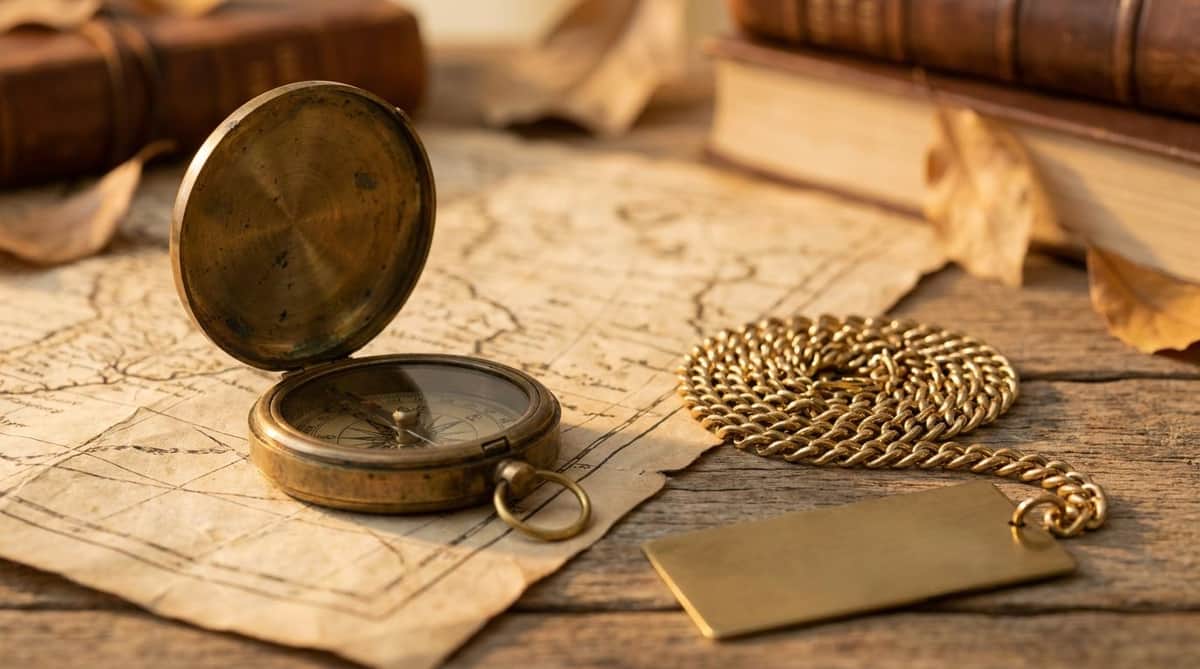
The literal object has real history, even if the sentimental meaning is newer. The magnetic compass is one of the oldest navigation tools still in everyday use, and compasses small enough to carry — pocket compasses, often built into a locket or watch-case form — were genuinely used by sailors, surveyors, and travelers for centuries before GPS existed. Carrying a compass on a journey wasn't symbolic then; it was the practical way to not get lost. The jewelry version inherited that association by proximity: an object once carried out of necessity on a journey became, once it stopped being necessary, a sentimental stand-in for the journey itself.
The "compass rose" — the stylized, multi-pointed star design showing the cardinal and intercardinal directions — is a separate but related image. It comes from old nautical charts, where cartographers drew an ornamental rose on the map itself to mark orientation. Most "compass necklaces" sold today use the compass rose as a flat decorative motif rather than a working needle, which is part of why the two get confused.
A Brief History of the Compass Itself
The magnetic compass predates jewelry's use of it by well over a thousand years. The earliest known magnetic-orientation devices were developed in ancient China, originally applied to geomancy and divination rather than travel, before the practical magnetized needle was adapted for sea navigation. From there it spread along trade routes to the Islamic world and medieval Europe, where sailors had adopted it for maritime navigation by the medieval period. For most of that history, a compass was instrumentation, not sentiment — a tool you checked, not a thing you wore to mean something. The pocket-sized, carryable compass — small enough to live in a coat or on a chain — is what eventually made the leap from navigation tool to personal keepsake, since an object you physically carry on your body is only one small step from an object you wear.
Compass Pendant vs. Compass Rose Pendant vs. Coordinates Necklace
These three get shopped for interchangeably, but they're different pieces with different points:
- Working compass pendant — a miniature functioning compass, usually in a locket-style case that opens, with a real floating needle. The closest thing to the historical object; bulkier and pricier than the other two.
- Compass rose pendant — a flat charm stamped or engraved with the decorative star pattern, no moving parts. The most common "compass necklace" in jewelry stores; reads as the symbol without the mechanism.
- Coordinates necklace — not a compass at all, but solves the same "guidance/place" sentiment differently: a specific latitude and longitude (a hometown, a wedding venue, a place someone was lost) engraved directly onto a bar or disc.
If the goal is the symbolism of direction and guidance in general, a compass rose pendant is the standard choice. If the goal is anchoring the gift to one specific, meaningful place rather than a universal idea of "guidance," a coordinates necklace is usually the better fit.
Common Occasions People Give One
A few recurring moments come up again and again in how these are gifted:
- Graduation — the most common single occasion; framed as "find your way" going into the next stage.
- A new job, move, or relocation — guidance for an unfamiliar place.
- Someone traveling or deploying — a keepsake tied to safe return.
- In memory of someone — sometimes engraved with a date or coordinates, read as "always finding your way back" to that person.
- Friendship or long-distance relationships — paired "you're always my direction" pieces.
Is a Compass Necklace a Religious Symbol?
No — unlike a cross, Star of David, or evil eye, a compass carries no specific religious doctrine or tradition behind it. It's a secular, functional object that picked up sentimental meaning through its use on journeys, which is part of why it works as a gift across different backgrounds without carrying religious weight either way.
How to Choose and Personalize One
A compass rose motif engraves cleanly onto a flat pendant, which is why it usually ships as an engraved piece rather than cast with fixed detail. FARUZO's engraved necklaces are plated over 316L stainless steel — nickel-safe, and far more durable for daily wear than plain silver-plated base metal, which is what most budget compass pendants use. If the point of the gift is a specific place rather than the general idea of direction, our coordinates finder converts an address into exact latitude/longitude to engrave on a bar or disc instead — a more literal way to carry "home."
For other sea- and journey-linked symbols with real history behind the charm, see our anchor symbol guide. If you'd rather give a piece that names a place directly instead of a symbol for direction, our key necklace meaning guide covers another common "keepsake for someone important" pendant.
A couple of practical notes before buying: a working compass pendant with an actual needle is more fragile than a flat compass rose charm, since it has a moving part that can jam or stop settling true if it's dropped or knocked around — fine for occasional wear or display, less ideal for something worn daily. A flat engraved pendant has nothing to break. On sizing, a compass or coordinates pendant reads best on a shorter chain (16–18 inches) that sits where the design is actually visible, rather than a long pendant-style chain that lets it disappear under clothing.
Frequently Asked Questions
What does a compass necklace mean?
Mainly guidance and staying true to your own direction — the compass needle settling on true north regardless of how it's turned is the core metaphor. It's also commonly read as protection on a journey and, for a gift, a wish that the wearer finds their way.
Is a compass necklace a religious symbol?
No. It's secular — a practical travel tool that picked up sentimental meaning over time, not a symbol tied to a specific faith or doctrine.
What's the difference between a compass pendant and a compass rose pendant?
A compass pendant is (or imitates) a working compass with a needle. A compass rose pendant is a flat decorative charm showing the star-shaped directional pattern used on old nautical charts, with no moving parts. Most jewelry sold as a "compass necklace" is actually the compass rose version.
What's a good occasion to give a compass necklace?
Graduation is the single most common occasion, followed by a move, a new job, someone traveling, or as a memorial keepsake. It reads as a "find your way" message in any of those transitions.
Can you engrave coordinates on a compass necklace instead of a compass design?
Yes — a coordinates necklace swaps the general symbol of direction for a specific latitude and longitude, usually engraved on a flat bar or disc rather than a compass-shaped charm. It's a more literal way to tie the piece to one exact place.