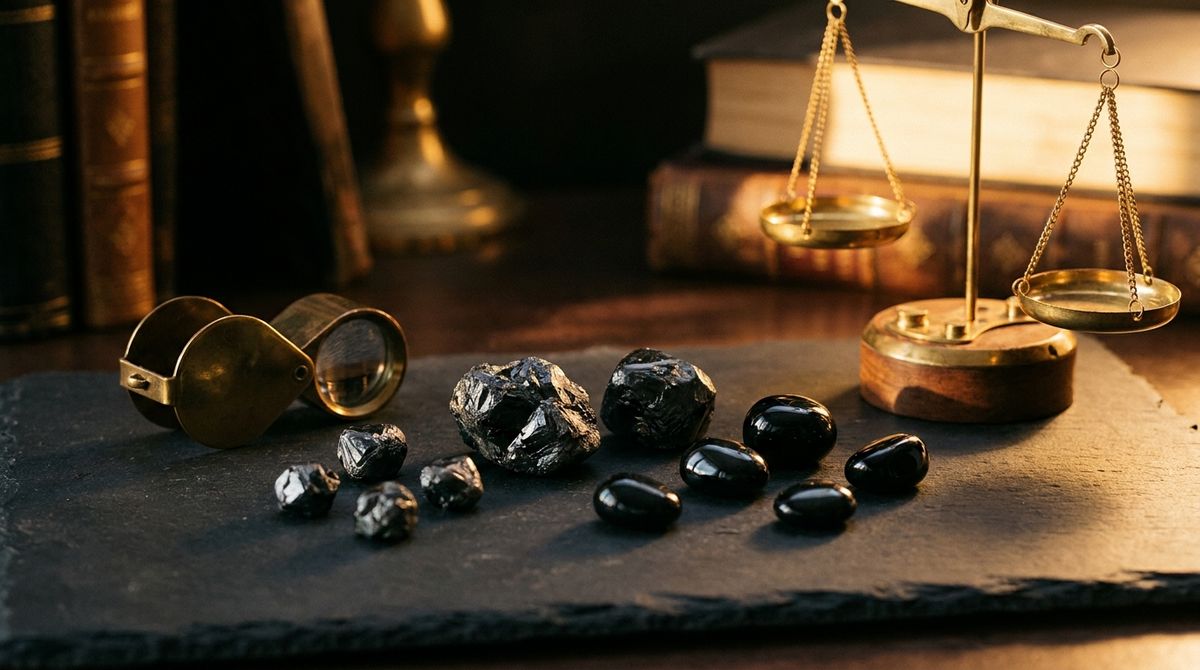
A black diamond is the jewelry industry's most misunderstood stone. It carries the same 10-out-of-10 Mohs hardness as a classic clear diamond, yet almost everything else about it — how it gets its color, what it's worth, and what people believe it means — is different enough that shoppers regularly walk into a jewelry store without knowing which questions to ask. Here's what a black diamond actually is, the meaning people attach to it, and how to buy one without paying colored-diamond prices for a stone that was never meant to be one.
What Actually Makes a Diamond Black?
A diamond is, at its purest, nothing but carbon arranged in a crystal lattice — which is why a flawless one is colorless rather than black or any other shade. According to the Gemological Institute of America (GIA), a natural diamond turns black because of what's trapped inside it, not because of its own chemistry: a heavy concentration of dark mineral inclusions — usually graphite or metallic sulfides — scattered densely enough through the stone to stop light from passing through. In rarer cases, the color instead comes from a network of hydrogen-related clouds running through the whole crystal rather than discrete inclusions. Either way, a natural black diamond is opaque because something inside it is blocking light, unlike a clear diamond that lets light bounce around and throw off its trademark sparkle.
Three Very Different Things Get Sold as "Black Diamond"
Ask three jewelers what a black diamond is and you may get three different answers, because the name genuinely covers three different materials at three different price points:
- Natural black diamond — a genuine single-crystal diamond colored black by dense graphite or sulfide inclusions (or, rarely, hydrogen clouds). The rarest and most expensive of the three.
- Carbonado — not a "colored diamond" in the usual sense at all. GIA describes it as a polycrystalline mass, countless microscopic diamond crystals fused together rather than one clean crystal, found naturally only in Brazil and the Central African Republic. Its formation is genuinely unresolved in geology — there's no confirmed kimberlite-pipe origin like there is for ordinary diamond.
- Treated black diamond — by far the most common option on the market. A lower-grade, heavily included diamond is deliberately turned black in a lab, either through irradiation (which technically leaves the stone a very dark green rather than a true black) or through low-pressure, high-temperature annealing that causes graphite to form along the stone's existing internal fractures. GIA will issue grading reports for these, since the color change is considered permanent under normal wear — but a seller should always disclose that a stone has been treated.
The Symbolism: Strength, Mystery, and Breaking With Tradition
Because a black diamond looks nothing like the stone most people picture, the meaning attached to it tends to skew away from the "purity and everlasting love" language given to a clear diamond and toward something more individual. Strength and resilience get borrowed from the stone's genuine physical hardness — a black diamond is exactly as hard as a clear one. Mystery comes from its opacity: you can't see into it the way you can a clear stone, and that visual weight reads as depth or secrecy. And choosing black over a traditional white diamond is, on its own, a statement about not following the expected script. In wellness and crystal-shop circles, black diamond is also sometimes described as "grounding" or protective — language worth treating as belief and marketing rather than a measured property of the stone, the same caution worth applying to any gemstone's metaphysical claims.
Black Diamonds in Engagement and Wedding Jewelry
Black diamond didn't start out as a jewelry stone at all — for most of its documented history it was valued industrially, for the same hardness that makes ordinary diamond useful in cutting and drilling tools, not for its looks. Industry accounts commonly trace its shift into fine jewelry to 1996, when the Swiss house de Grisogono introduced a black diamond jewelry and watch collection that put the stone in front of a luxury audience for the first time. It picked up momentum through celebrity engagements in the early 2000s, and pop culture gave it a mainstream push in 2010, when a black diamond engagement ring proposal in the film Sex and the City 2 is widely credited with a real spike in consumer interest afterward. Today it's a fairly established, if still niche, choice for engagement rings and wedding bands, often set in the same dark, modern styles covered in our guide to black wedding band meaning.
How to Buy One Without Getting Fooled
Since "black diamond" covers three genuinely different materials, the questions worth asking before you buy are practical ones. Ask directly whether the stone is natural, carbonado, or treated — a reputable seller will tell you without hesitation. Ask for a grading report from GIA or an equivalent lab, especially for anything priced as a natural or carbonado stone. Be skeptical of a "black diamond" priced like a mass-produced treated stone but marketed with rare-natural language. And confirm it isn't actually a different material sold under the diamond name, like black moissanite or black spinel — our moissanite vs. diamond comparison covers how those substitutes actually differ from the real thing, including under magnification.
How to Wear and Care for Black Diamond Jewelry
A black diamond shares a clear diamond's 10 Mohs hardness, so everyday scratch resistance isn't a concern. The one caveat is for treated stones colored by graphitization: because that process works along the stone's existing internal fractures, a hard, direct impact is more likely to chip along one of those lines than it would be on an untreated stone. Clean it the way you'd clean any diamond — warm water, a drop of mild soap, and a soft brush — and skip ultrasonic cleaners for any stone you know has been treated or heavily included. If you're drawn to the look but want to build a full piece around whatever stone you actually choose, FARUZO's personalized rings collection is a reasonable place to start.
Frequently Asked Questions
Is a black diamond a real diamond?
Yes, in most cases — a natural black diamond and a lab-treated black diamond are both genuine diamond, just colored differently than the clear stones people picture. Carbonado is also natural diamond material, just polycrystalline rather than a single crystal. It's only "not a real diamond" if it's actually a different material entirely, like black spinel, black moissanite, or glass sold under the diamond name.
Are black diamonds cheaper than clear diamonds?
Treated black diamonds are typically far less expensive than a comparable clear diamond, since they're made from lower-grade, heavily included stones to begin with. Natural black diamonds and carbonado, being genuinely rare, can cost as much as — or more than — a similar-size clear diamond.
Is it true that black diamonds are cursed?
The reputation mostly traces back to one famous stone: the 67.5-carat Black Orlov, also called the Eye of Brahma, whose legend claims it was stolen from a statue in India and later linked to the deaths of several owners, including two Russian princesses said to have died by suicide in the 1940s. Most historical accounts treat the story as embellished folklore layered onto real, separate tragedies rather than a documented curse — and it says nothing about black diamonds as a category. The stone was eventually cut into three pieces, partly in an attempt to "break" the legend.
Does a treated black diamond look different from a natural one?
Not reliably to the naked eye — this is exactly why a grading report matters. Under magnification, a gemologist can look for the specific patterns each origin leaves behind: dense, evenly distributed inclusions for natural stones, a fused polycrystalline structure for carbonado, or graphitization concentrated along existing fracture lines for treated stones.
How do black diamonds compare in durability to other black gemstones?
Diamond is the hardest natural material at 10 on the Mohs scale, well above other black stones people compare it to. For more on how diamond forms, is graded, and compares to look-alikes generally, see our diamond meaning guide.