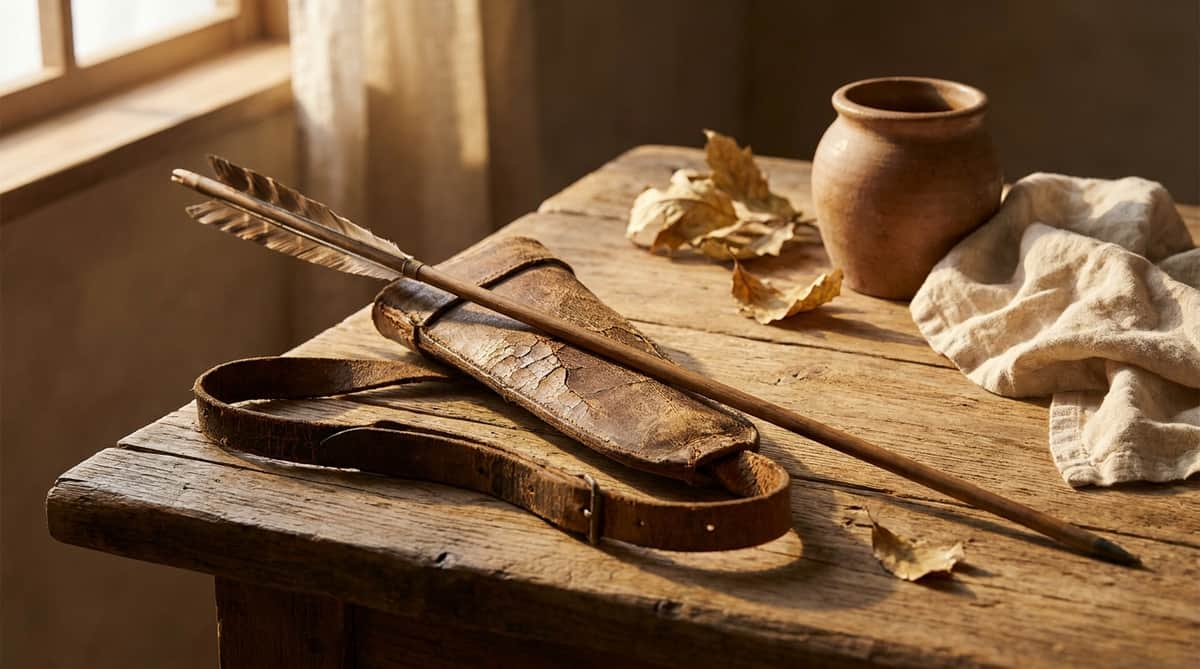
An arrow necklace is one of the more straightforward pendant shapes to read. A drawn arrow only does one thing, so every meaning people hang on it comes back to the same idea in slightly different words — which is probably why it's stayed popular for over a decade without going out of style.
Here's what the symbolism actually traces back to, how it compares to the other direction-themed pendants people buy alongside it, and what to know before choosing one.
At a glance
- Most common meaning: forward movement — an arrow only flies one direction.
- Two separate origins feed the symbolism: hunting/weaponry (direction and strength) and Cupid's arrow (romance) — it isn't a borrowed Native American symbol despite what some retail copy implies.
- Of the three "direction" pendants, an arrow is the only one that says the decision is already made — a compass is still finding the way, an anchor stays put.
- Most often given for graduations, new jobs, breakup recovery, and sobriety milestones, usually personalized with an engraved date or word.
What an Arrow Necklace Is Said to Symbolize
Jewelry sellers and style writers converge on a short list of readings, and unlike some symbols, they don't contradict each other much — they're mostly the same core idea stated a few different ways:
- Forward movement. The most common reading by far: an arrow only flies one direction, so the pendant gets worn as a reminder to keep moving ahead rather than look back. This is the version most often given as a graduation gift, a new-job gift, or a "new chapter" gift after a breakup or move.
- Overcoming resistance. A less literal reading ties the symbolism to how an arrow actually works — it has to be pulled backward, against tension, before it can go forward at all. Under this reading, the pendant stands for struggle that precedes progress, not just progress on its own.
- Protection and strength. A secondary theme, more common in heavier arrowhead-style pendants than slim straight ones, ties back to the arrow's original job as a weapon and hunting tool — worn as a stand-in for resilience or self-defense rather than direction.
- Love, via Cupid. A smaller but persistent thread: Cupid's arrow makes the symbol a stand-in for romantic love or being "struck" by it, which is why arrow motifs show up in a fair number of engagement and anniversary pieces alongside hearts.
None of these come from one documented, agreed-upon tradition. They're accumulated modern retail symbolism — the readings converge because the object's physical function (fly forward, pull back first, pierce on impact) gives jewelry copywriters an unusually clean metaphor to reach for.
That's not a knock on the meaning. It just means there's no single "correct" interpretation to get right, the way there might be with a specific religious symbol.
Where the Symbolism Actually Comes From
Two separate historical threads feed into how arrows get read today, and they pull in slightly different directions:
Weaponry and survival. For most of human history, an arrow was a tool whose entire purpose was accuracy and lethality — reaching a target in a straight line, with force. That practical history is why "direction" and "strength" show up together so often: the object's literal job was to go exactly where it was aimed, hard enough to matter.
Cupid's arrow. Separately, Western mythology gave the arrow its romantic meaning through Cupid (Eros in the Greek version) — the god said to strike people with love using a bow.
This is a much narrower, specifically literary origin. It explains why arrows appear in romantic jewelry, but it has nothing to do with the "moving forward" reading, which is newer and almost entirely a retail-era invention.
Worth being direct about one more thing: a lot of arrow-pendant marketing references Native American arrowhead symbolism in passing — usually as a vague gesture toward "ancient meaning" rather than anything specifically sourced.
Historical arrowheads are real archaeological objects with real cultural significance to the nations that made and used them. A mass-produced silver pendant isn't a continuation of that tradition, and treating "forward motion" retail copy as if it descends from a specific Indigenous symbol isn't accurate.
The honest version: modern arrow jewelry symbolism is mostly a 2010s-onward retail invention, loosely built on the object's general, cross-cultural associations with hunting and direction — not a borrowed tradition with one fixed meaning.
Arrow vs. Compass vs. Anchor: The Direction-Symbol Family
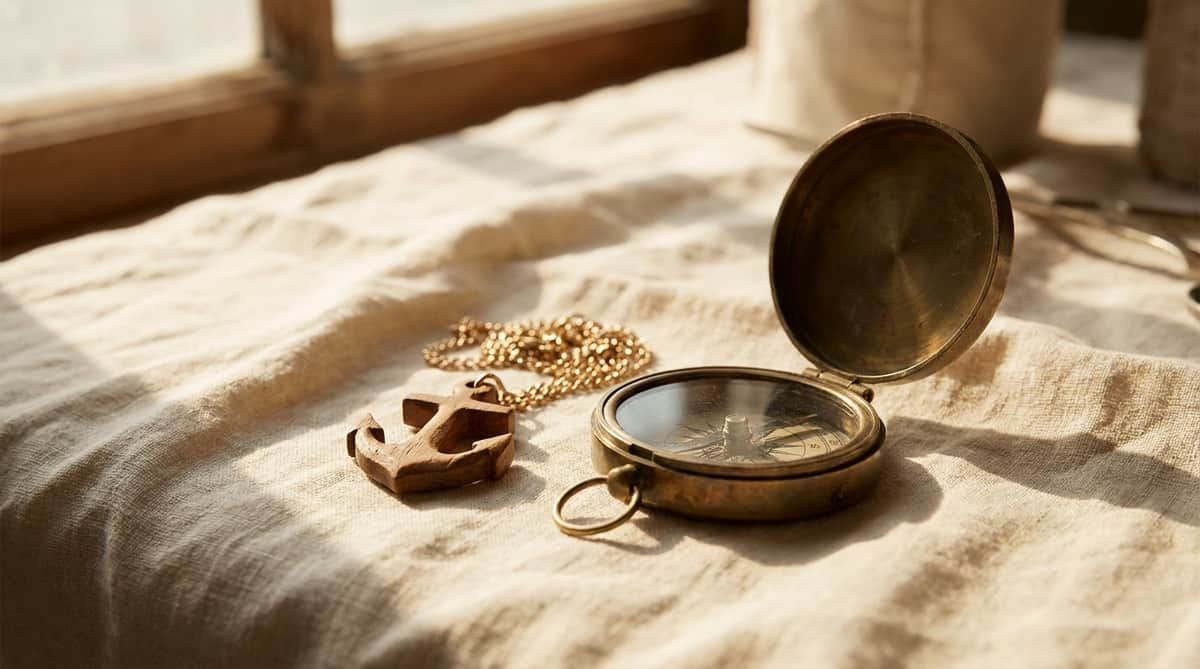
Arrow pendants don't exist alone — they're one of three shapes people reach for when they want jewelry that reads as "direction" or "staying the course," and the three read noticeably differently once you line them up:
- Arrow — the most literal and the most "forward-looking" of the three. Reads as momentum and intent: you're actively choosing where to go next. Best fit for a new-chapter gift (graduation, new job, divorce recovery, a big move).
- Compass — reads as guidance and not losing your way, rather than pure forward motion. A compass still works even when you're lost; an arrow implies you've already picked a direction. Best fit for a "find your way" or long-distance-relationship gift.
- Anchor — the odd one out: it symbolizes staying grounded and steady rather than moving at all. Where arrow and compass both point outward, anchor points down. Best fit for a "stay steady through hard times" or sobriety-milestone gift.
- Arrow + compass combined — a common pairing in multi-charm pieces, specifically because the two meanings complement rather than repeat each other: the compass says "know where you're going," the arrow says "now go."
That distinction is the main thing that separates the arrow from the other two: it's the only one of the three that implies the decision has already been made. If someone is still figuring out their direction, a compass is arguably the more accurate gift; if they've already decided and need the push, an arrow fits better.
When People Give (or Wear) One
Arrow necklaces show up most often around a handful of specific occasions, almost all tied to the "moving forward" reading rather than the love or protection readings:
- Graduations — high school, college, or finishing a program
- Starting a new job or career change
- Recovering from a breakup, divorce, or loss
- Sobriety or recovery milestones
- Moving to a new city
- A friendship or sister pendant set — each person keeps "half" the arrow, or matching arrows pointed the same direction
Because the symbolism is so tied to a moment of change, an engraved or personalized version — a date, a set of coordinates, or a short word like "forward" — tends to carry more weight than a plain unmarked pendant. The shape alone communicates the general idea; the engraving is what ties it to a specific person's specific moment.
How to Choose One
A few practical things matter more than the symbolism once you're actually picking a piece:
- Straight vs. arrowhead-only. A full arrow (shaft plus head) reads more clearly as "direction." An arrowhead alone, without the shaft, leans more toward the protection/strength reading and can look more like an abstract triangle if it's small or worn alone.
- Orientation. Most arrow pendants point downward when worn (tip toward the ground) simply because that's how a vertical pendant naturally hangs — it doesn't carry extra meaning on its own, but a horizontal bar-style arrow pendant reads more literally as "pointing forward" if that distinction matters to the giver.
- Personalization. Engraving a direction word, date, or coordinates on the shaft is the most common way to make a mass-produced shape feel specific rather than generic — our engraved necklaces let you add that detail to the pendant itself, and the coordinates finder tool looks up the exact latitude/longitude for a meaningful place if that's the route you want.
- Material. An arrow pendant worn daily takes regular contact with clothing and skin, so plating quality matters. FARUZO's bar necklaces and engraved pieces plate over 316L stainless steel rather than a thin silver-plated base — nickel-safe, and noticeably more resistant to everyday wear than budget plating.
Frequently Asked Questions
What does an arrow necklace symbolize?
Most commonly, forward movement and moving on from something — tied to the physical fact that an arrow only flies one direction. Secondary readings include overcoming resistance (since an arrow has to be pulled back before it flies forward), protection or strength, and romantic love via Cupid's arrow.
Is an arrow necklace a Native American symbol?
Arrowheads have real, specific cultural and historical significance to the Indigenous nations that made and used them, but a modern mass-produced arrow pendant isn't a continuation of that specific tradition.
The "moving forward" symbolism attached to retail arrow jewelry is a newer, mostly retail-era meaning loosely built on the object's general, cross-cultural association with hunting and direction — not a borrowed Indigenous symbol with one fixed meaning.
What's the difference between an arrow necklace and a compass necklace?
An arrow implies the direction has already been chosen — it's about momentum and intent. A compass implies the direction is still being found — it's about guidance and not losing your way. They're often paired in multi-charm pieces for exactly that reason: compass for "know where you're going," arrow for "now go."
When do people usually give an arrow necklace as a gift?
Most often around a change: graduation, a new job, recovering from a breakup or loss, a sobriety milestone, or moving somewhere new. Because the meaning is tied to a specific life moment, a personalized version — an engraved date, word, or set of coordinates — tends to carry more meaning than a plain unmarked pendant.
Does it matter which way an arrow pendant points?
Not by any fixed rule. Most vertical arrow pendants hang tip-down simply because of how pendants naturally fall on a chain, not as a deliberate symbolic choice. A horizontal bar-style arrow is sometimes chosen specifically because it reads more literally as "pointing forward."