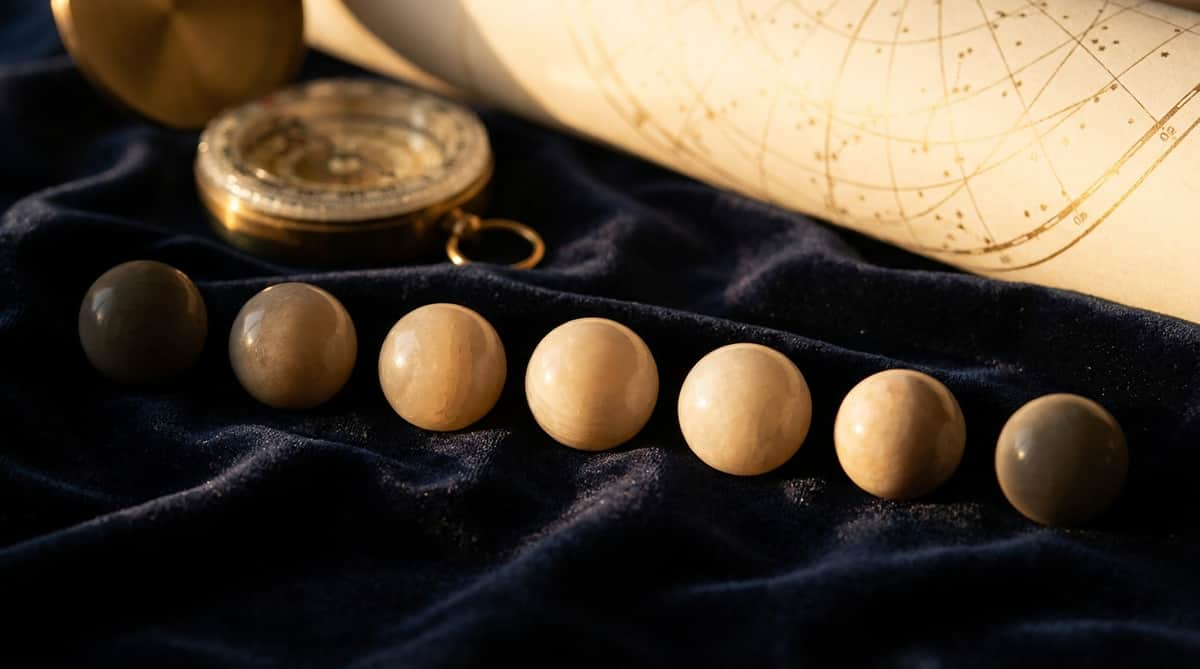
A moon phase necklace is a flat run of small pendants — usually eight, sometimes as few as five — each one showing the moon at a different point in its monthly cycle, from a slim new-moon sliver through to a full, round disc and back down again. Unlike most celestial jewelry, which just borrows the moon's shape for its own sake, this style is built directly on a real astronomical cycle, and the symbolism people hang on it is layered on top of something that's actually, verifiably true: the moon really does move through these exact phases, in this exact order, every 29.5 days.
That real cycle is also why the style lends itself so easily to personalization — more on that below — and why it's become one of the more requested formats in celestial and "meaningful date" jewelry over the past few years.
What a Moon Phase Necklace Actually Shows
The moon doesn't produce its own light; a moon phase pendant set is really a diagram of how much of the sunlit half of the moon is visible from Earth at a given moment. A full cycle, a "lunation," runs about 29.5 days and moves through eight named stages in order:
- New moon — the moon sits between Earth and the sun, its lit side facing away from us; it's effectively invisible, shown on a pendant as a plain dark disc.
- Waxing crescent — a thin, growing sliver of light appears on the right side (Northern Hemisphere view).
- First quarter — exactly half the visible face is lit; despite the name, this is the midpoint of the waxing half, not a quarter of the way through.
- Waxing gibbous — more than half lit, still growing toward full.
- Full moon — the entire visible face is lit; Earth sits roughly between the sun and moon.
- Waning gibbous — past full, beginning to shrink.
- Last quarter (also "third quarter") — half lit again, now on the opposite side from the first quarter.
- Waning crescent — a thin sliver again, shrinking back toward the next new moon.
A necklace set can show all eight stages across a row of pendants, a shorter four-stage version (new, first quarter, full, last quarter), or a single pendant cut to one specific phase.
What Each Phase Is Said to Mean
None of the symbolic readings below come from a single documented tradition the way, say, a wedding ring's meaning traces to a specific custom — they're accumulated modern folklore, repeated consistently enough across jewelry sellers and lunar-calendar/manifesting content that they've become a loose shared vocabulary. Treat this as the common reading in circulation, not settled fact:
- New moon — beginnings. Read as a blank slate: the moon is "empty," so the symbolism is starting fresh, setting an intention, or a clean break from what came before.
- Waxing crescent — early growth. Associated with the first steps on something: a new goal, an early relationship, momentum just starting to build.
- First quarter — commitment and friction. Often tied to the point where a plan meets its first real obstacle; the "decide whether to keep going" phase.
- Waxing gibbous — refinement. Read as the adjustment-and-patience stage, close to a goal but not there yet.
- Full moon — culmination. The most consistent reading across sources: completion, illumination, celebration, a relationship or project reaching its peak.
- Waning gibbous — gratitude and sharing. Tied to looking back on what the full-moon stage produced.
- Last quarter — release. Associated with letting go of what isn't working, clearing space.
- Waning crescent — rest and reflection. The quiet stage before the cycle restarts at the next new moon.
The through-line sellers lean on hardest for couples' jewelry specifically is continuity: the moon is always somewhere in this cycle, always moving, and a pendant can be read as "we go through phases, but we're still the same moon" — a sturdier metaphor than most celestial jewelry gets, precisely because the underlying astronomy is real rather than invented for the purpose.
The Personalized Version: "The Moon on the Night We Met"
The format that's driven a lot of recent demand isn't the full eight-pendant set — it's a single pendant cut to show the exact moon phase on one specific date: the night a couple met, a wedding date, a birth date, or an anniversary. Because real lunar phase data for any calendar date is a known, calculable fact (not a guess), this works the same way a coordinates necklace pins an exact latitude and longitude rather than a generic "map" symbol — see our coordinates necklace guide for the parallel. It's a piece of personalized jewelry where the "meaning" is literally, factually tied to one real date, with the folklore symbolism above layered on as an extra reading rather than the whole point.
FARUZO's couples necklaces collection takes the same approach already used for half-heart and sun-and-moon sets — pairing two pendants that only make full sense together — and a moon-phase-on-a-date pendant slots into that same gifting category: one fixed, factual detail (the date, the phase) carrying the sentimental weight, rather than a generic symbol doing all the work.
Moon Phase vs. Sun-and-Moon: Not the Same Symbol
It's easy to conflate this style with a classic sun-and-moon pendant set, but they're built on different ideas. Our sun and moon meaning guide covers that format in full: two separate pendants — one sun, one moon — usually split between a couple to represent two different, complementary people ("two souls who belong together" is the common framing, built on day/night duality). A moon phase necklace, by contrast, is one body (the moon) shown at different points in its own single cycle — the symbolism is about change and continuity within one thing, not the pairing of two different things. A couple choosing between the two styles is really choosing between "we're different and we complete each other" (sun and moon) and "we've been through phases together" (moon phase) — different metaphors, often confused because both are lunar/celestial and both get marketed to couples. For a broader look at how couples' jewelry handles this kind of shared-but-split symbolism, see our guide to couples matching necklaces.
Choosing and Caring for One
A few practical points that matter more than the symbolism once it's time to actually buy:
- Pendant count vs. readability: an eight-phase row looks striking in product photos but makes each individual disc tiny; a four-phase or single-phase pendant keeps the detail (the crescent's edge, the quarter line) visible at normal necklace size.
- Cutout vs. engraved phases: some designs cut the dark portion of the moon away entirely (true negative space), others engrave a shadow line into a solid disc — the cutout version reads more clearly from a distance, the engraved version holds up better structurally over years of wear since there's no thin cutout edge to bend.
- Chain length for a horizontal row: a multi-pendant phase bar needs a slightly longer chain than a single pendant to sit flat rather than curling — 18–20 inches is the more common choice for a full eight-phase bar versus 16–18 inches for a single moon pendant.
- Finish durability: a pendant this detailed (thin crescent points, fine engraved shadow lines) shows wear fastest at its thinnest edges. FARUZO plates over 316L stainless steel rather than a soft silver-plated base — nickel-safe, and noticeably more resistant to the everyday knocks that round off a crescent's sharp tip over time.
Frequently Asked Questions
What does a moon phase necklace mean?
Most commonly it's read as a symbol of growth and continuity — the idea that life, like the moon, moves through visible stages but remains fundamentally the same thing throughout. When personalized to a specific date, the "meaning" is also literal: it shows the real, calculable moon phase from that exact night.
What is the most popular moon phase for a necklace?
The full moon and new moon are the two most commonly chosen single pendants — full moon for its "culmination/celebration" reading, new moon for "new beginnings." Couples' pieces more often use a specific calculated date rather than picking a phase for its symbolism alone.
Is a moon phase necklace the same as a sun and moon necklace?
No. A sun and moon set pairs two different pendants (one sun, one moon) usually split between two people, symbolizing two complementary individuals. A moon phase necklace shows one moon at different points in its own single cycle, symbolizing change and continuity rather than pairing.
How do I find the moon phase for a specific date?
The real lunar phase for any date is a fixed astronomical fact rather than a style choice — most custom moon-phase jewelry sellers calculate it for you from a date you provide (a meeting date, wedding date, or birthday) rather than asking you to identify the phase yourself.
Does a moon phase necklace need special care?
The same care as any fine detailed pendant: avoid prolonged water exposure, store it separately so the fine crescent edges don't knock against other jewelry, and wipe it with a soft cloth after wear. A nickel-safe, stainless-steel-plated base holds its finish longer than thin silver plating on a piece with this much fine detail.