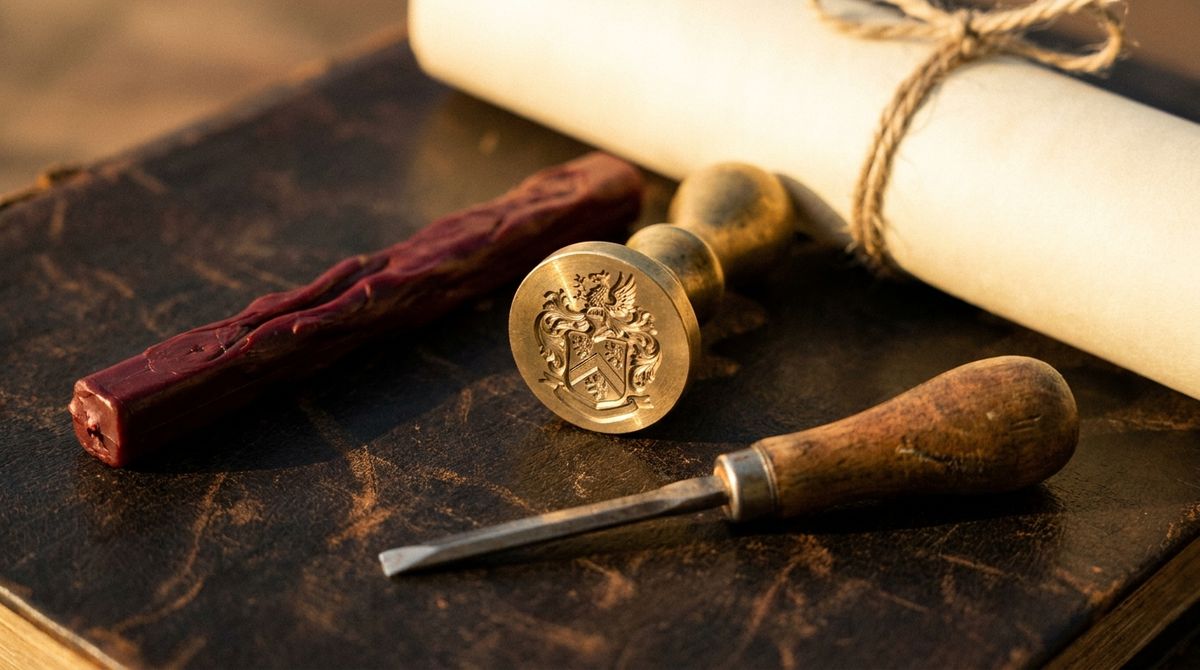
A signet ring looks, to most eyes today, like any other ring with a flat, engraved face. For most of its history it wasn't jewelry at all in the way we use the word now — it was a tool. Pressed into hot wax, that engraved face was how a person "signed" a letter, a contract, or a decree centuries before signatures on paper were common, which is exactly why a stray gold band with a flat top still reads, instinctively, as something that means more than decoration.
What a Signet Ring Actually Is
A signet ring is a ring with a flat or slightly domed face engraved with a design — traditionally a family crest, a monogram, or a personal emblem — cut in reverse (a mirror image) so that pressing it into soft wax or clay leaves a correctly readable impression. That reversed engraving is the detail that separates a true signet from a ring that merely looks like one: a decorative flat-top ring with a right-reading design was never meant to seal anything, while a genuine signet's engraving only makes sense once it's stamped into something soft.
Where It Started: Sealing Wax, Not Style
The practice is old even by jewelry standards. Engraved cylinder seals — rolled across wet clay rather than pressed — appear in Mesopotamia by around 3500 BCE, used to mark ownership and authenticate documents in some of the earliest writing systems on record. Ancient Egypt carried the idea into ring form, with officials and rulers wearing carved seal rings, sometimes in scarab shapes, as personal marks of identity and authority. By the Roman era, the signet ring as we'd recognize it — a ring, not a separate seal object — was standard equipment for anyone who needed to close a letter or authenticate a document: press the engraved face into a blob of wax, and the resulting impression was, for all practical purposes, that person's signature.
From Royal Seal to Family Heirloom
Through medieval Europe, signet rings became tied to rank, land, and lineage. Nobility and, over time, the growing merchant class used them to seal legal documents and correspondence with a mark that was difficult to forge — the engraving was usually unique enough, and the wax impression specific enough, that a seal stood in for an identity check. Because the ring's whole value depended on exactly one person holding it, signets were treated as serious property: passed down through a family rather than bought and sold casually, which is the root of why a signet ring reads as an heirloom today even on someone who has never sealed a letter in their life.
Why the Pinky Finger?
Signet rings are traditionally worn on the pinky — a custom with a genuinely practical origin, not just style. Wearing the seal on the smallest finger kept it out of the way of a handshake and easy to angle into the wax without removing the ring. Over time that positioning became a signal in its own right, particularly in British tradition, where a pinky signet is still read by some as a marker of old-money heritage or a signal of marital/family status depending on which hand and finger it sits on — conventions that vary by country and have never been universally fixed. If you're weighing finger placement more broadly, our guide to pinky ring meaning covers how that single finger carries different associations depending on culture and context.
Signet Ring Styles, Compared
Modern signets usually fall into one of four engraving styles, and the style you choose says something different than the ring itself does:
- Family crest or coat of arms — signals inherited heritage; historically required an actual documented right to the arms, though today it's worn more loosely as a design choice.
- Monogram or initials — the most common modern pick; reads as personal identity rather than lineage, and doesn't require any family history to "earn."
- Birthstone or gemstone face — swaps the engraved emblem for a flat-cut or cabochon stone; closer to a conventional ring, with less of the wax-seal signaling.
- Plain, unengraved face — worn purely for the shape and weight of the ring; the most common choice for someone who likes the signet silhouette without any specific symbolism attached.
A crest technically implies a documented claim to it — in places like the UK and Ireland, heraldic authorities still register coats of arms to specific families — but in everyday use, most people buying a signet ring today are choosing initials or a plain face rather than commissioning real heraldry.
What a Signet Ring Means Today
Almost nobody seals a letter with wax anymore, so a modern signet ring's meaning has shifted from function to statement. It's now worn mainly as a marker of personal identity (initials, a monogram) or inherited connection (a genuine family crest passed down, or a design chosen to evoke that idea), and it sits in the same broader category as other jewelry that turns a name or initial into something worn — our monogram necklace guide covers the same identity-through-initials idea in necklace form. Unlike an official hallmark — which is stamped by an independent assay office to certify a metal's purity — a signet's engraving is personal rather than regulatory: it identifies the wearer, not the metal.
Choosing (or Engraving) Your Own
You don't need a documented coat of arms to wear a signet ring with meaning — a monogram, a single initial, or a meaningful symbol works the same way a crest once did: it personalizes a recognizable shape. FARUZO's name rings take that same approach, engraving initials or a chosen design into a flat-faced ring — plated over nickel-safe 316L stainless steel rather than sterling silver or gold vermeil, which means the finish resists the everyday scuffs a soft gold signet face would show much faster. It's the same idea the Romans had — a wearable mark of identity — built for how rings actually get worn now.
Frequently Asked Questions
What does wearing a signet ring mean?
Traditionally, it meant the wearer held a seal used to authenticate documents — a personal or family mark pressed into wax. Today, with sealing largely obsolete, it's worn mostly as a symbol of personal identity (initials or a monogram) or inherited heritage (a family crest), without the original practical function.
Is a signet ring only for men?
No. Signet rings were historically associated with men of rank because seals were tied to legal and business authority largely held by men, but they're worn by anyone today, on whichever hand or finger the wearer prefers.
Which finger should a signet ring go on?
The pinky is the traditional placement, originally because it kept the ring clear of a handshake and easy to press into wax. There's no rule requiring it — many people today wear a signet on the ring or index finger simply because they prefer the fit.
Can I get a signet ring without a family crest?
Yes — most signet rings sold and worn today use initials, a monogram, or a plain unengraved face rather than a documented coat of arms. A genuine heraldic crest is really only meaningful if it's been formally registered to your family through a heraldic authority, which applies to very few buyers.
What's the difference between a signet ring and a class ring?
They share the same flat-faced silhouette, but a class ring commemorates a specific school or graduation year with a fixed design, while a signet ring is personalized to the individual wearer — by crest, monogram, or initials — and isn't tied to one institution or date.