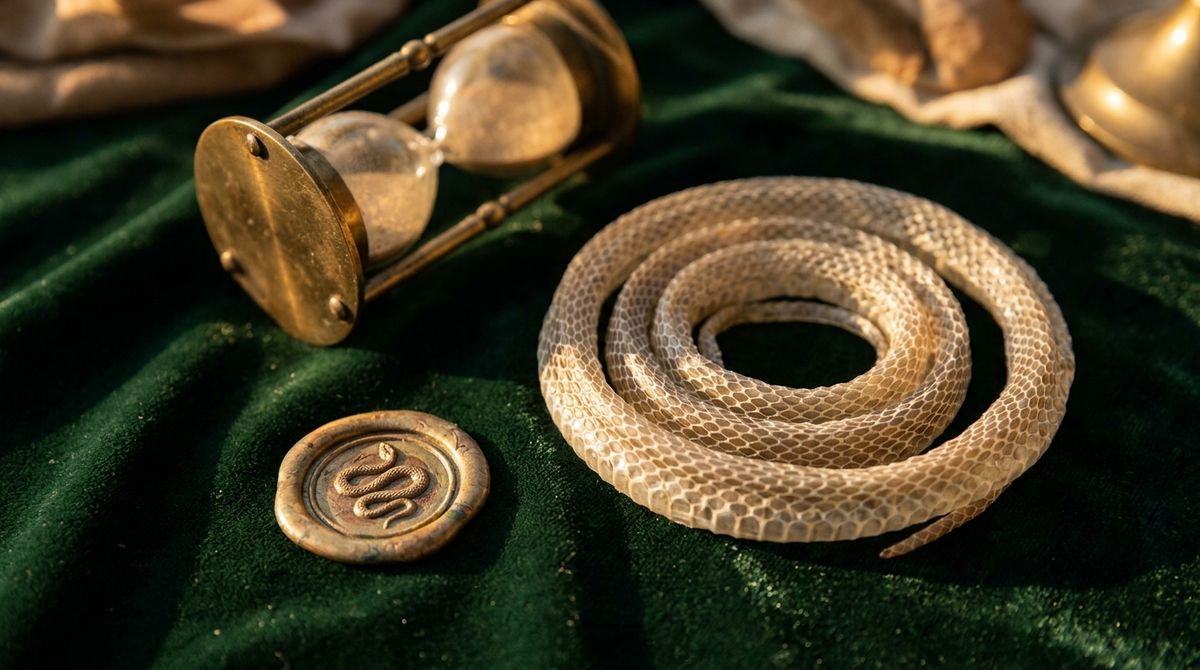
A snake coiled around a finger is one of the oldest symbols still in daily circulation. Queen Victoria made it a Western engagement-ring staple in 1839; crystal shops and tattoo parlors still invoke the snake eating its own tail as a shorthand for rebirth; and a quick search for "is it bad luck to wear a snake ring" turns up more confused shoppers than confident answers. Here's what a snake ring actually symbolizes, where the modern trend really comes from, and how to tell a snake ring apart from its closest cousin, the ouroboros.
What a Snake Ring Actually Symbolizes
Strip away the superstition and the core symbolism is consistent across cultures and centuries:
- Transformation and rebirth: a snake sheds its entire skin and emerges unmarked, which is why cultures from ancient Egypt to modern crystal shops read it as a symbol of shedding the old self.
- Eternal love and fidelity: a snake coiled in a continuous loop, with no beginning or end, became Victorian shorthand for a love meant to last.
- Protection and wisdom: in Greek mythology, snakes were sacred to Asclepius, the god of medicine (hence the snake-and-staff symbol still used in medicine today) — a lineage that still gets referenced in "protective snake ring" symbolism.
None of this reads as unlucky or sinister in the jewelry world. The "evil serpent" association comes mostly from a specific religious reading of one story (Genesis) — it isn't the dominant meaning in the broader history of snake jewelry, which leans heavily toward renewal and devotion.
Where the Modern Snake Ring Trend Actually Comes From
Snake rings are ancient — Egyptian and Roman jewelry both used coiled-serpent bands, often on armlets and bracelets rather than rings specifically, as a protective motif. But the piece that built the modern Western snake-ring trend has a precise, documented origin point.
In 1839, Prince Albert proposed to Queen Victoria with a ring shaped like a snake swallowing its own tail, set with an emerald — her birthstone — as its head. Victoria wore it as her engagement ring, and the ring's publicity around the royal wedding set off a snake-jewelry fashion across Victorian Britain that lasted for decades, worn as a statement about eternal love rather than anything occult.
That royal piece is technically an ouroboros ring, not a generic snake ring — the distinction is worth untangling, since the two get used interchangeably online but don't mean quite the same thing.
Snake Ring vs. Ouroboros Ring: What's the Difference
- Shape: an ouroboros ring is a snake biting or swallowing its own tail, forming a closed loop. A general snake ring can coil, wrap several times around the finger, or simply be shaped like a snake's head without ever closing the loop.
- Core meaning: ouroboros specifically symbolizes cyclical time, eternity, and the idea that destruction and creation are the same act. A non-looping snake ring leans more on transformation, protection, or love, without the eternity-loop layer.
- Cultural reference: ouroboros as an image traces back to ancient Egyptian funerary texts and later Greek alchemy. A plain coiled snake ring (like Victoria's cultural descendants worn today) reads more as Victorian-revival fashion than as an alchemical symbol.
- Where you'll see each: ouroboros rings are more common in symbolic/spiritual jewelry collections; plain snake rings show up more often in mainstream fashion jewelry and vintage-inspired collections.
For the full history of the closed-loop version, see our guide to ouroboros ring meaning. If you're comparing symbolic rings generally, it's also worth reading how the Claddagh ring encodes its own meaning (hands, heart, and crown) in a completely different visual language.
Snake Symbolism Across Different Cultures
The snake isn't a Western-only motif, and the meaning shifts slightly depending on which tradition you're drawing from:
- Ancient Egypt: the cobra (Wadjet) was a royal protection symbol, worn on the pharaoh's crown rather than as everyday jewelry — the lineage behind "protection" as a snake-ring meaning today.
- Hinduism: the serpent Vasuki appears in creation mythology, and the coiled-snake imagery of kundalini represents dormant spiritual energy at the base of the spine — part of why snake jewelry gets tied to "awakening" in some wellness contexts.
- Chinese zodiac: people born in a Year of the Snake are traditionally associated with wisdom, intuition, and cunning — a more flattering reading than the snake gets in most Western folklore.
- Ancient Greece: the snake was sacred to Asclepius, god of medicine and healing, which is why a snake coiled around a staff (the Rod of Asclepius) is still used as a medical symbol today.
Taken together, "protection," "renewal," and "wisdom" show up far more consistently across cultures than any single negative reading — which is part of why the ring has stayed in fashion rather than fallen out of it.
Is It Bad Luck to Wear a Snake Ring?
No — not in any consistent tradition. The idea shows up occasionally as a scattered superstition, but it isn't supported by the jewelry's actual history: Victorian brides wore snake engagement rings specifically because the symbolism read as positive (eternal love), and most crystal and jewelry sources describe snake rings as protective rather than cursed. If a specific culture or family superstition matters to you, that's a reasonable personal line to draw — but there's no broad historical consensus that a snake ring brings bad luck.
How to Wear a Snake Ring
There's no strict rule, which is part of the appeal. A snake ring on the thumb or index finger tends to read bolder and more statement-piece; worn on the ring finger, especially a closed ouroboros design, it leans toward the Victorian engagement-ring reading. Thin, simple coils stack well with other rings; a wraparound snake with a defined head usually works better worn alone.
If you're choosing a ring with meaning you want to keep for years rather than a passing trend, it's worth browsing designs built to be personalized — engraved with a date or name alongside (or instead of) a symbolic design, so the meaning doesn't rely on the motif alone.
Frequently Asked Questions
What does a snake ring symbolize?
Transformation and rebirth (from shedding skin), eternal love and fidelity (from the continuous coiled shape), and protection or wisdom, depending on the cultural tradition referenced.
Is a snake ring the same as an ouroboros ring?
Not exactly. Ouroboros specifically refers to a snake biting or swallowing its own tail in a closed loop, symbolizing eternity and cyclical time. A general snake ring can be shaped that way or simply coiled without closing the loop, and leans more on transformation or protection than on the eternity symbolism specifically.
Why did Queen Victoria wear a snake engagement ring?
Prince Albert gave her a snake-shaped ring with an emerald head in 1839, shortly before their engagement was announced; she wore it as her engagement ring, and the publicity set off a decades-long Victorian snake-jewelry trend built on the eternal-love reading of the symbol.
Is it bad luck to wear a snake ring?
There's no broad historical tradition that says so. The dominant readings across Egyptian, Roman, Greek, and Victorian jewelry are positive — transformation, protection, and devotion — not misfortune.
Which finger should a snake ring go on?
There's no fixed rule. Thumb or index tends to read as a bold statement piece; ring finger (especially for a closed ouroboros design) leans toward the traditional engagement-ring reading; a simple thin coil works on any finger, including stacked with other rings.
What metal is best for a snake ring?
Any durable metal works, since the symbolism lives in the shape rather than the material. Stainless steel options hold fine detail (like scale texture) well and resist tarnishing with daily wear, which matters for a ring with a raised, textured design.