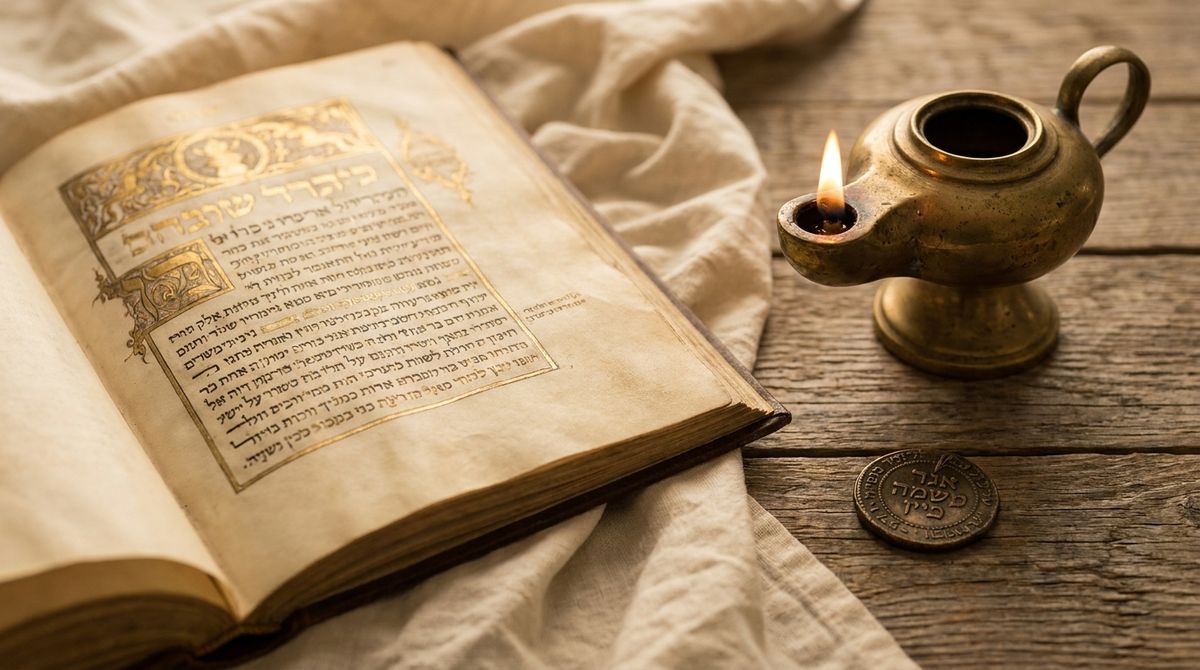
Long before it became a pendant, the ankh was a single, unmistakable shape: a cross topped with a loop, cut into stone and painted on plaster wall after wall. Anyone who has walked through an Egyptian temple or a museum hall of tomb art has seen it dozens of times without necessarily knowing its name — held in the hand of a god, carved beside a pharaoh's cartouche, repeated down the length of a coffin. Once you know what it means, you start seeing it everywhere it was meant to be seen.
What Is the Ankh?
The ankh is one of the oldest symbols still worn today: a cross topped with a loop, carved into Egyptian temple walls and tomb paintings for over four thousand years. To the Egyptians it was a hieroglyph, read simply as "life" or "living," and it shows up everywhere their language did — in royal inscriptions, on amulets, painted inside coffins, and in the hands of the gods themselves. It is one of the few hieroglyphic signs that also stood on its own as a full symbol, carried and worn the way we'd wear a word today.
Origins in Ancient Egypt
The ankh appears from the Early Dynastic Period onward, making it one of the longest-attested symbols in human history — thousands of years of continuous documentation in art, writing and burial goods, even though its popularity has risen and fallen over that span rather than running unbroken. Its exact origin is debated — theories point to a sandal strap, a knot of cloth, or a stylized representation of the sunrise on the horizon — but its meaning was never in doubt. In art, Egyptian deities are shown holding the ankh by its loop, often extending it toward the nose of a pharaoh, a gesture understood as the god breathing life into the ruler, renewing his reign and his right to rule.
The Key of Life
Because of that gesture, the ankh became known in later centuries as the "key of life" — not just a word for living, but a symbol of the power to grant, sustain and renew it. It was carved onto sarcophagi and tomb walls to protect the dead's passage into the afterlife, painted alongside the god Osiris in scenes of judgment and rebirth, and worn as an amulet by the living for the same reason: protection, vitality, and a claim on eternity. Small ankh amulets, often in faience or metal, have been recovered from burials across the whole span of Egyptian history, suggesting it was as personal an object then as a pendant is now.
The idea of "life" the ankh represented was rarely used alone. Egyptian inscriptions frequently pair it with two companion hieroglyphs, often translated together as "life, prosperity, health" — a formula stamped after a pharaoh's name almost the way a modern letter might close with "best wishes." The ankh carried the "life" portion of that blessing on its own often enough that, over time, it came to stand in for the whole idea. Egyptologists have also catalogued practical objects shaped like an ankh, including bronze hand mirrors whose handle takes the ankh's exact silhouette — a literal shape for something Egyptians associated with vitality, worn or used, not just carved into a wall.
The Ankh and the Cross
The ankh's cross-like shape gave it an afterlife of its own. Early Coptic Christians in Egypt adopted a version of it, the "crux ansata" (handled cross), blending the old symbol of life with the new faith's message of eternal life through resurrection. It's a rare case of a pre-Christian symbol carrying its core meaning — life beyond death — directly into a religious tradition that came centuries later, rather than being replaced by it. Historians who catalogue different types of crosses and their meanings usually place the ankh at the very start of that list, since almost every cross-shaped symbol that followed it in the Mediterranean world came after it, not before.
The Ankh in Modern Culture
The ankh's modern popularity has more than one root, and the two threads are worth keeping separate. From the 1960s onward, it became a widely recognized symbol of African and African-American cultural pride, adopted by Afrocentric and Kemetic spiritual movements as a direct link to ancient Egyptian heritage at a moment of renewed interest in that connection. Around the same period, it was also picked up by goth, pagan and New Age communities drawn to its age and its plain, universal meaning: life itself. A third, quieter thread runs through academic Egyptology and museum culture, where the ankh has simply never stopped being a recognizable, teachable symbol since the field began. Those histories are distinct, and the ankh carries real weight in each — it isn't borrowed from one group by another so much as reclaimed and reinterpreted by several, independently.
What an Ankh Pendant Says
Worn as a necklace, the ankh reads as a statement about vitality and continuity rather than a fleeting trend. Some choose it as a marker of heritage and connection to Egyptian or African history. Others wear it for its spiritual meaning — life, protection, balance between the physical and eternal — without any specific religious claim, in much the same way people wear a hamsa hand for its protective meaning without adopting a single tradition's full belief system. Because the ankh's meaning is unambiguous, an ankh pendant tends to read the same way to the wearer and to everyone who sees it: this is about life, not luck or fashion. That directness is part of its appeal — it doesn't need an explanation the way a more obscure symbol might.
Wearing the Story: Making It Personal
A symbol this old still leaves room for something personal. Pairing an ankh with a birthstone or an engraved name turns a historical emblem into something that also marks a specific life — a birth, a recovery, an anniversary, or simply a year someone wants to remember. Layering it with a smaller, related symbol, like a lotus flower — Egypt's own emblem of rebirth and renewal — keeps the whole story inside one culture rather than mixing unrelated traditions. Some people wear the ankh alone, deliberately, precisely because its meaning is complete on its own and doesn't need a second symbol to explain it.
When choosing an ankh pendant, look for a piece described honestly: 316L stainless steel with a plated finish, not vague "gold" or "silver" language that hides what the metal actually is. That matters most for anyone with sensitive skin, since genuine stainless steel is nickel-safe, which is what actually prevents irritation — the plating color is a finish choice, not a safety claim. Stainless steel also holds up better day-to-day than a soft precious metal would: it resists tarnish, keeps an engraving crisp for longer, and doesn't need the regular polishing a silver piece does to stay bright. For a symbol meant to represent something lasting, a metal that actually lasts is the more honest pairing anyway. If you're building a personal piece around the ankh, our personalized necklaces collection is a practical place to start: chain length, finish and an optional engraving all get decided before anything ships.
Why the Ankh Endures
Few symbols have carried one meaning — life — across four thousand years, multiple religions and multiple continents, through periods of prominence and periods of near-obscurity, without ever losing that core meaning. The ankh endures because that meaning never needed updating: it didn't have to be reinterpreted to stay relevant, only rediscovered. It said "life" to a Bronze Age Egyptian standing in a temple, and it says the same thing today to someone choosing it as a pendant, which is what makes it as much at home on a modern chain as it was on a temple wall.
Frequently Asked Questions
What does an ankh pendant mean?
An ankh pendant symbolizes life — its Egyptian hieroglyphic meaning — and by extension vitality, protection and continuity. Depending on who wears it, it can also signal a connection to Egyptian or African heritage, or a personal spiritual outlook, without requiring any single set of beliefs.
Is the ankh the same as a cross?
Not originally. The ankh predates Christianity by thousands of years and was an Egyptian symbol of life, not a religious execution device or a Christian emblem. Coptic Christians later adapted it into the "crux ansata," a cross-like form carrying a similar message of eternal life, but the two symbols have separate origins and only converged centuries after the ankh was already in wide use.
Who wears an ankh necklace?
People wear the ankh for different, equally valid reasons: as a marker of African or Egyptian heritage, as part of Kemetic or other spiritual practice, or simply as a piece drawn to its meaning and history. Its long, layered use across cultures means there isn't one single "correct" wearer or one required belief attached to it.
What's the difference between an ankh and other Egyptian symbols like the eye of Horus?
The ankh specifically represents life; other Egyptian symbols carry different meanings — the eye of Horus is tied to protection and healing, the scarab to rebirth and transformation. They're often worn together or alongside each other because they complement rather than duplicate each other's meaning, but each has its own distinct symbolism and history.
What metal is best for an ankh necklace if I have sensitive skin?
Look for pieces made from 316L stainless steel with a plated finish, described plainly rather than by color alone. Genuine stainless steel is nickel-safe, which is what actually prevents skin reactions — a metal's plating color on its own doesn't tell you what's underneath it or whether it's safe for sensitive skin.