
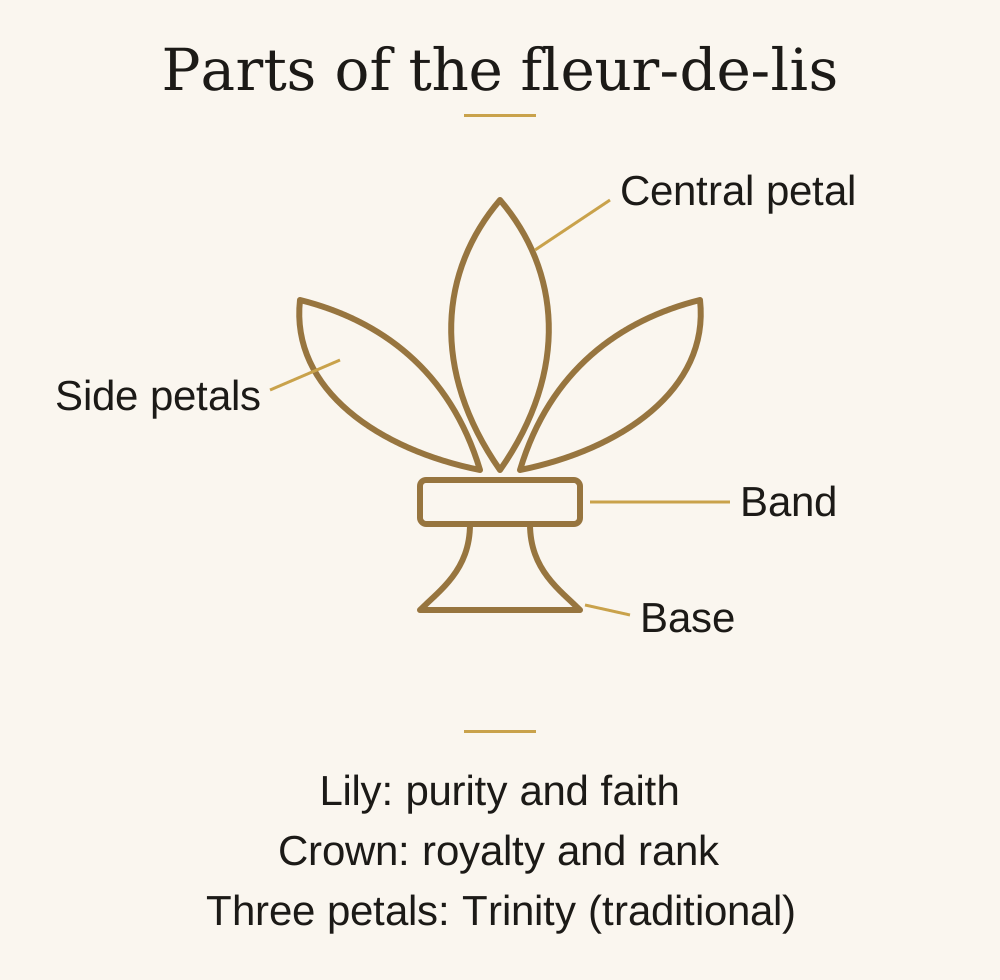
The fleur-de-lis is a stylized lily with three petals tied at the base by a band. It is best known as an emblem of the French monarchy, but it appears in many other places too. The name is French for "flower of the lily".
Below: what it means, how it became a royal symbol, a timeline of its early heraldic use, where else you will see it, and how it is worn today.
At a glance
- The fleur-de-lis is a stylized lily, traditionally linked to purity, royalty and faith.
- It is closely tied to the French monarchy, with royal use usually dated to the 12th century.
- Its origin is debated: stories mention Clovis, the Virgin Mary and even irises, and sources disagree.
- Today it appears on city emblems, flags, scouting badges and jewelry worldwide.
What does the fleur-de-lis mean?
In short: purity, royalty and devotion, with a strong link to France. The shape is a lily, a flower long used in Christian art as a sign of purity and often associated with the Virgin Mary. When French kings placed it on their shields and seals, it also came to suggest sovereignty and noble rank.
Three petals are sometimes read as the Holy Trinity, or as faith, wisdom and chivalry. These readings are traditional and popular rather than recorded by the first users of the symbol, so treat them as ways people have understood it, not as fixed rules.
Where does it come from?
The honest answer is that no one knows for sure. Heraldry experts and encyclopedias agree the design is older than the French kings who made it famous, and the exact reason for its adoption was never written down. Several explanations are told:
- The Clovis legend. By tradition, the Frankish king Clovis received a lily at his baptism, and the flower became a royal sign of purity. This is a medieval legend, not a documented event.
- A flower of the water. Some historians suggest the shape began as a stylized iris or water flag, and that the word "lis" may be tied to that plant. Others insist it is a lily. The botanical question remains open.
- A design older than France. Fleur-de-lis-like ornaments appear in much older art around the world, so the form had many roots before it became heraldic.
Whichever origin you prefer, the lily shape fit well with the religious language of medieval kingship, which may be why it lasted.
How it became a royal emblem
Writers differ on which king used it first. The Heraldry Society points to Louis VII (reigned 1137 to 1180) as the first to use it as a personal device, on a seal from around the middle of the 12th century. Other sources credit his father, Louis VI, or leave the question open. The first clearly heraldic picture, a shield scattered with fleurs-de-lis, is usually dated to about 1211, on a seal of the future Louis VIII.
Over the following centuries the emblem spread: a blue shield scattered with golden lilies became the arms of the French crown, and later the number was reduced to three. English kings also placed the lilies on their arms for a long time to mark their claim to the French throne.
Meaning across places and traditions
Because the shape is so recognizable, many groups have adopted it. A few well-known examples, described neutrally:
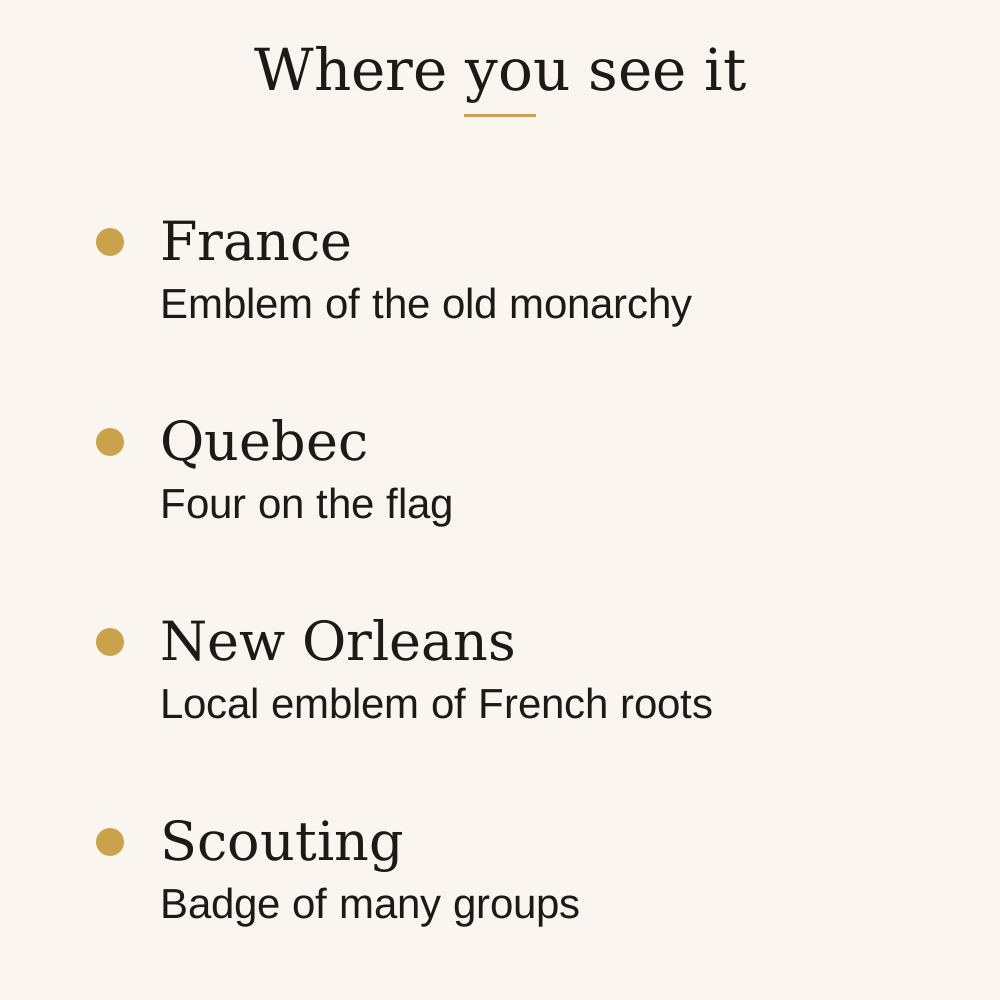
- France. A long-standing emblem of the old monarchy, it still appears in French heraldry and decoration, though it is no longer on the national flag.
- Quebec and the French-speaking world. The flag of Quebec carries four fleurs-de-lis, a nod to its French heritage.
- New Orleans, Louisiana. The symbol is widely used as a local emblem of the city's French roots.
- Florence, Italy. The city has long used a lily as an emblem, though its design is a little different from the French one.
- Scouting. The fleur-de-lis is used in the badge of many scouting groups. By tradition it echoes the north point on a compass rose.
- Christian art. The lily is a sign of purity, so the shape appears in church decoration and in some crosses.
Each of these uses has its own story, and the symbol means something different to each community.
How the design is drawn
The classic fleur-de-lis has the same few parts wherever you meet it: a tall central petal, two curling petals on either side, a horizontal band that gathers them, and a small base below. The curve of the side petals, the thickness of the band and the shape of the base vary from one era and one artist to the next.
That flexibility is part of its charm. Medieval seals, carved stone, wrought iron gates and modern logos all use slightly different versions, yet most people recognize the shape instantly.
Fleur-de-lis vs. lily, lotus and iris
The fleur-de-lis is often mixed up with real flowers and similar designs:
- Lily: the real flower the shape is named for. The fleur-de-lis is a heraldic simplification, not a botanical drawing.
- Iris: some historians think the shape began as an iris, but this is debated.
- Lotus: a separate symbol of rebirth and purity from Egypt and Asia. The lotus has rounded petals rising from water, while the fleur-de-lis has three clear petals and a band.
- Trefoil or clover: a plain three-lobed shape, not the same as the fleur-de-lis, though both have three parts.
The same comparison in a table:
| Symbol | Shape | What it is |
|---|---|---|
| Fleur-de-lis | Three petals tied by a band | A stylized lily, an emblem of French kings |
| Lily | A real flower | The flower the shape is named for |
| Lotus | Rounded petals rising from water | A separate symbol of rebirth and purity from Egypt and Asia |
| Trefoil or clover | A plain three-lobed shape | Not the same as the fleur-de-lis |
On maps and old instruments, you may also spot the shape marking north. See our guide to the compass, and the cross for another symbol that often carries lily-like ends.
How people wear it today
The fleur-de-lis is worn as a pendant, ring, cufflink or tattoo. People choose it to honour French or Louisiana roots, as a sign of faith or elegance, or simply because the symmetrical shape looks classic. It also works as a small, balanced design that suits both everyday and formal outfits. When choosing jewelry, look for a piece whose metal is described plainly, such as 316L stainless steel with a gold-plated, rose gold-plated or silver-tone plated finish, rather than vague "gold" or "silver" wording. Genuine stainless steel is nickel-safe, which is what helps with sensitive skin.
Frequently Asked Questions
What does the fleur-de-lis symbolize?
Traditionally, purity, royalty and faith, with a strong tie to France. Some people read the three petals as the Holy Trinity, or as faith, wisdom and chivalry.
Is the fleur-de-lis a lily or an iris?
Sources disagree. The name means "flower of the lily", and the lily is a Christian symbol of purity. Some historians think the shape came from an iris or water flag. Both ideas are still discussed.
Why did French kings use the fleur-de-lis?
No one wrote down the reason. Popular stories point to the baptism of Clovis and to the lily as a sign of purity, and it suited the religious language of medieval kingship. Royal use is usually dated to the 12th century.
Who first used the fleur-de-lis in France?
Sources differ. The Heraldry Society points to Louis VII around the middle of the 12th century, while others credit Louis VI. The first clear heraldic picture is usually dated to about 1211.
What do the three petals mean?
In Christian readings they are sometimes tied to the Holy Trinity. Others see faith, wisdom and chivalry. These are traditional interpretations, not official ones.
Is the fleur-de-lis only French?
No. It is best known as French, but it is also used in Quebec, in New Orleans, in scouting badges and in other places, and similar lily designs are much older than the French monarchy.


