
Mjölnir is the hammer of Thor, the Norse god of thunder, and one of the best-known symbols from Viking Age Scandinavia. Small hammer-shaped pendants, usually with a short handle and a loop at the top, have been dug up across northern Europe, and most scholars read them as amulets of protection and blessing.
Below: what the name means, what the myths say, what archaeologists have actually found, a timeline of dated examples, and how the symbol is worn now.
At a glance
- Mjölnir is Thor's hammer in Norse myth, tied to thunder, protection and blessing.
- Roughly 1,000 hammer pendants have been counted (a rough figure), from Scandinavia to England, the Baltic and Russia.
- Most date to the Viking Age (about the 9th to 11th centuries), and some turn up in graves, hoards and settlements.
- Pendants are generally read as amulets, but no Viking text explains exactly what each wearer meant by one.
What does Mjölnir mean?
In short: protection, strength and blessing. In the myths Thor uses the hammer to defend gods and people against the giants, and it is also brought out to bless. For wearers in the Viking Age, a small hammer was most likely a way of placing yourself under Thor's protection. That is an interpretation drawn from the objects and the stories, not a statement any Viking left in writing, so it is best read as a well-supported guess.
The name itself is debated. Linguists have suggested links to words for lightning, for "new snow" or for "to grind", and there is no settled answer.
What the myths say
Our written sources are late. The Poetic Edda and Prose Edda were compiled in 13th-century Iceland, long after the Viking Age began, and they were written down by Christians. They still give us the best picture of what the hammer was thought to do.
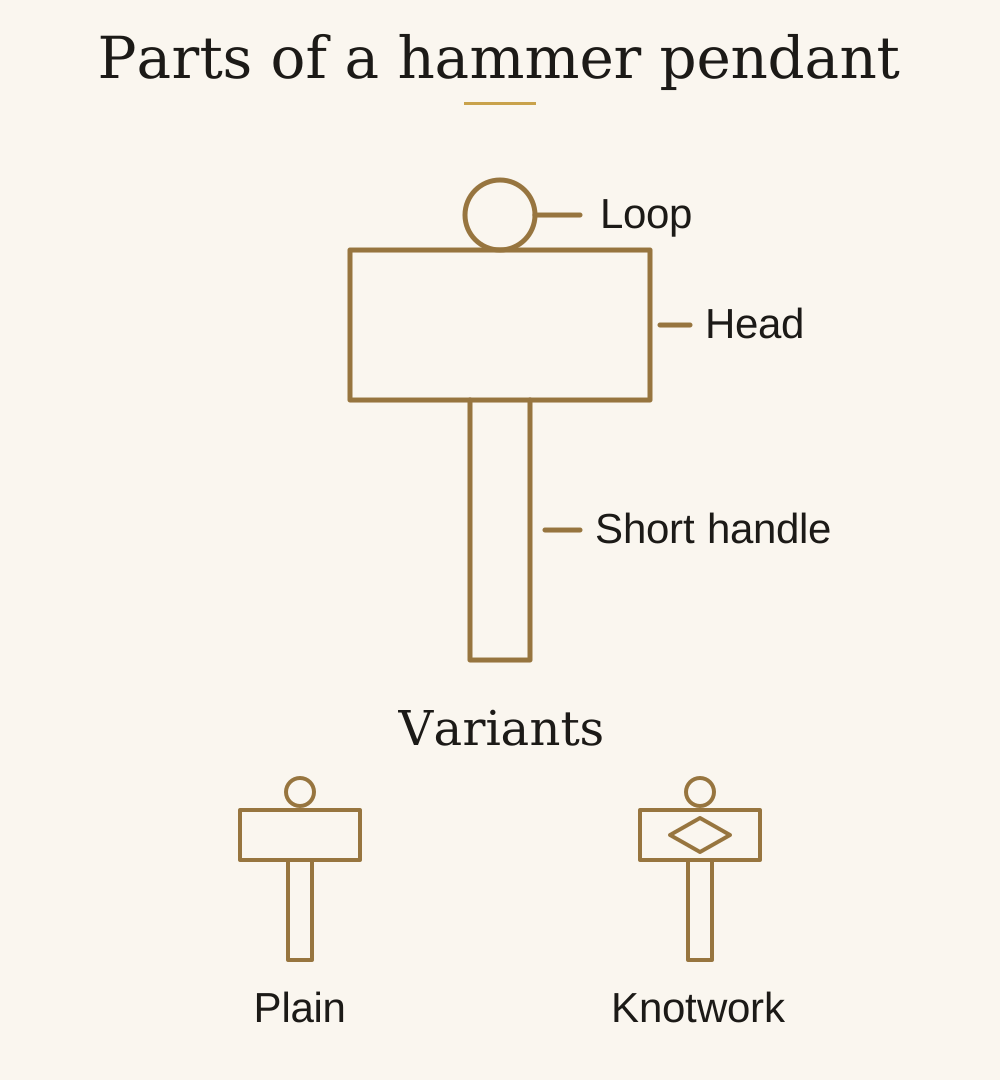
- A gift from the dwarfs. In the Skáldskaparmál, the dwarf brothers Eitri and Brokkr forge the hammer. A mishap leaves its handle short, which is why Mjölnir is drawn and cast with a stubby shaft.
- A weapon against giants. In poems such as the Þrymskviða, the hammer is stolen by the giant Þrymr and then won back. Thor, disguised as a bride, uses it to defeat the giants at the wedding feast.
- A blessing. In that same poem the hammer is laid in the bride's lap to bless her, which suggests it was linked to weddings and consecration, not only to battle.
- Life from the hammer. The Gylfaginning describes Thor reviving his goats by raising the hammer over them.
The hammer is also tied to thunder and lightning, since Thor was the thunder god. Some scholars have gone further and linked the hammer to older Bronze Age rock carvings and to thunder-god traditions found across many Indo-European cultures, though that is a broader and more debated idea.
For wearers in the Viking Age, a small hammer was most likely a way of placing yourself under Thor's protection.
What archaeologists have found
Hammer-shaped pendants have been found in Denmark, Sweden, Norway, Iceland, England, northern Germany, the Baltic region and Russia. They are made of iron, lead, silver, gold and amber, and some are plain while others are finely decorated.
- Not mainly grave goods. A count made in 2004 put only about 10% of finds in graves, nearly all cremations, and these are often identified as women's graves. The rest come from settlements, hoards and stray finds. That matters, because it means the pendants were not only worn by warriors.
- One with writing. A Danish hammer from Købelev, dated to the 10th century, carries a runic inscription that reads, in effect, "This is a hammer." It is the only hammer pendant we found with a runic inscription.
- A ring of nine. A ring hung with nine small hammers was found in a 10th-century woman's cremation grave in Hilde, Norway.
- An invocation. A copper amulet from Kvinneby on the Swedish island of Öland, dated to the 11th century, has a runic inscription that calls on Thor and his hammer.
- In England. A silver pendant found in Lincolnshire in 2011 is dated to roughly 850 to 1050 CE, and more than a dozen other hammer pendants have turned up in England alone.
Hammers and crosses
Some of the most discussed finds come from the period when Scandinavia was slowly turning Christian. The National Museum of Denmark describes a soapstone mould found at Trend in Himmerland, Jutland, with space for casting both crosses and Thor's hammers. A smith could make whichever amulet a customer asked for. The museum reads this as a sign that the two beliefs were not always seen as exclusive.
A few hammer pendants also carry cross-shaped punch marks. Archaeologists still debate how to read these, and not all scholars agree that the hammer was used as a deliberate reply to the cross. The simplest summary is that the evidence points to a mixed and changing religious world, not a clean line between old and new.
What the hammer symbolizes
Putting the myths and the objects together, the hammer is usually linked to a handful of ideas. None is certain, and different wearers may have meant different things.
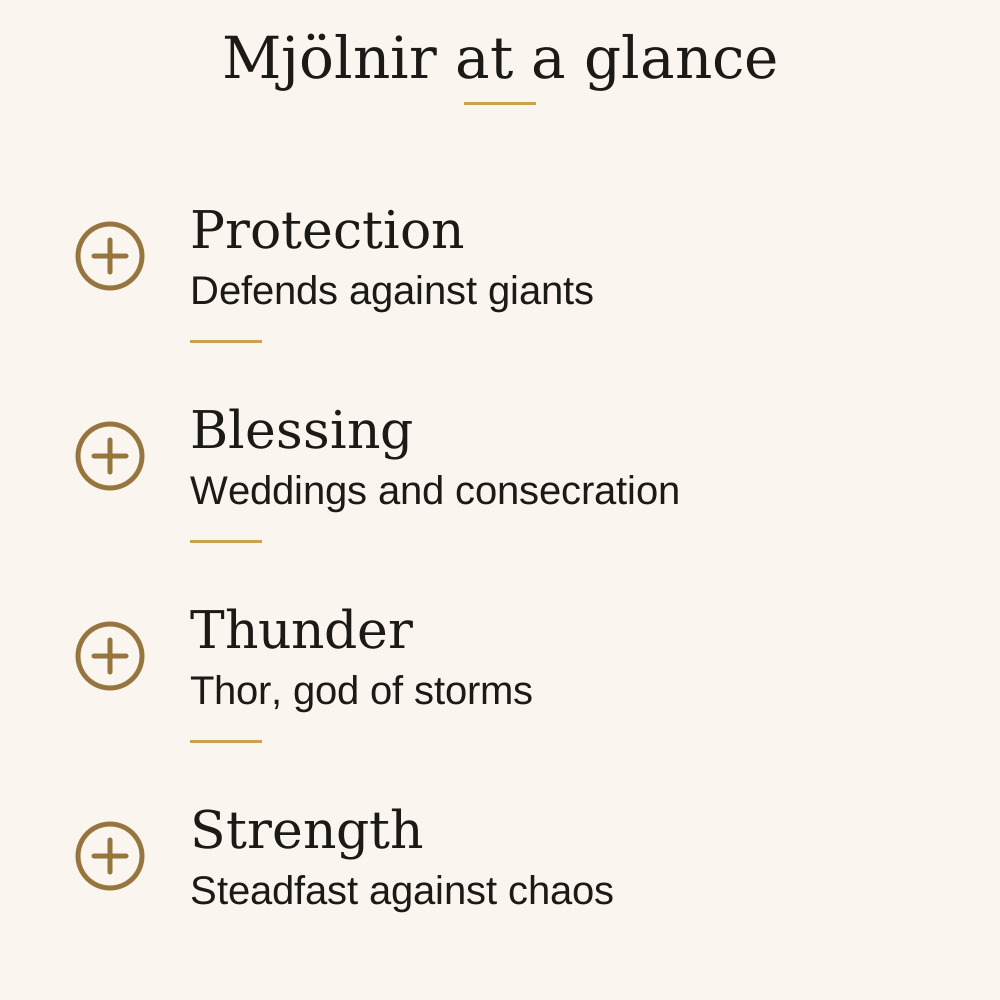
- Protection. The hammer defends against giants in the myths, and the pendant is generally read as a protective amulet.
- Blessing and consecration. The wedding scene suggests the hammer could sanctify as well as strike.
- Thunder and weather. Thor was a god of storms and, in some traditions, of the fertility that follows rain.
- Strength and courage. Thor is a strong, steadfast figure who stands between humans and chaos.
- Identity. A small hammer may also have been a way of saying who you worshipped.
Often confused with
Mjölnir is easy to recognise, but a few other symbols get mixed up with it.
Here is how Mjölnir compares with the symbols it is most often confused with:
| Symbol | Tradition | How it looks | Link to Mjölnir |
|---|---|---|---|
| Mjölnir | Norse | Short, thick head on a handle, like a stubby T | Thor's hammer |
| Cross | Christian | Two equal or crossing arms | Some finds blur the two |
| Celtic interlace | Ireland and Britain | Interlaced patterns | A separate tradition |
| Yggdrasil | Norse | The world tree | A different image altogether |
- The cross. A hammer pendant has a short, thick head and a handle, like a stubby T. A cross has two equal or crossing arms. Some finds blur the two, which is part of why the pendants are interesting. For the Christian side of the story, see our guide to different types of crosses.
- Celtic designs. Interlaced patterns from Ireland and Britain are often lumped together with "Viking" jewelry. They are a separate tradition, covered in our Celtic knot guide.
- Other Norse symbols. Yggdrasil, the world tree, is a different image altogether; see the tree of life for the tree symbol in general.
- Thor's club. One medieval writer, Saxo Grammaticus, described Thor with a club rather than a hammer, which shows that even the old sources do not agree.
How people wear it today
Today Mjölnir is worn as a pendant, charm or ring, usually for protection and strength, as a nod to Scandinavian heritage or history, or because people love the look of Norse myth and its stories. It is also a familiar image from books and films. Pendants can be plain and flat or carved with knotwork, and a short chain or leather cord is typical. Some people wear it as a quiet keepsake of a family link to Scandinavia.
When choosing jewelry, look for a piece whose metal is described plainly, such as 316L stainless steel with a gold-plated, rose gold-plated or silver-tone plated finish, rather than vague "gold" or "silver" wording. Genuine stainless steel is nickel-safe, which is what helps with sensitive skin.
Frequently Asked Questions
What does Thor's hammer symbolize?
Traditionally, protection, strength and blessing. In the Norse myths Thor uses Mjölnir against giants and also to bless, so the pendant is generally read as an amulet that placed the wearer under his protection.
How old are Thor's hammer pendants?
Most known examples date to the Viking Age, roughly the 9th to 11th centuries. A silver pendant from Lincolnshire is dated to about 850 to 1050 CE, and the Købelev hammer from Denmark to the 10th century. Dates are approximate.
Why is Thor's hammer handle short?
In the Prose Edda, the dwarfs who forged the hammer are interrupted and the handle comes out short. That is why Mjölnir is shown with a stubby shaft, and it explains the T-like shape of the pendants.
Were Thor's hammer pendants only worn by men?
Probably not. Only about a tenth of known pendants come from graves, but those that do are often identified as women's graves, and a ring of nine hammers was found with a woman in Hilde, Norway. Settlement and hoard finds do not tell us who wore them.
Did Vikings wear Thor's hammer and a cross together?
Some did, or at least some craftspeople served both. A soapstone mould from Trend in Jutland could cast both hammers and crosses. Scholars read this as a period of mixed belief, though interpretations differ.
Is Mjölnir the same as a cross?
No. A cross is the central Christian symbol, while Mjölnir belongs to the Norse tradition of Thor. They can look vaguely alike in small pendants, and some artefacts blend features of both.


