
The four-leaf clover is a clover with an extra leaflet, and it has been a charm for good luck in Europe and beyond for centuries. Because a plant with four leaflets instead of the usual three is uncommon, finding one has long felt like a small piece of luck.
Below: what it means, where the belief may come from, what the four leaves are said to represent, how it differs from the Irish shamrock, and how people wear it today.
At a glance
- The four-leaf clover is traditionally a symbol of good luck, and in some traditions of faith, hope, love and luck.
- It is a rare variation of the common three-leaf clover, which is a big part of why it feels special.
- The earliest written link to luck that we found is from 1620, though the belief is probably older.
- It is not the shamrock: the shamrock is a three-leaf Irish emblem, not a lucky charm.
What does a four-leaf clover mean?
In short: good luck, and the hope that something good is about to happen. The idea is simple. Most clover has three leaflets, so a four-leaf one stands out, and people read that rarity as a sign of fortune.
In some Christian-influenced traditions, each leaf is given its own meaning: faith, hope, love and luck (sometimes grace). This four-part reading is a later, popular tradition rather than something taken from an ancient text, so treat it as one common way of telling the symbol, not the single "true" meaning.
What is a four-leaf clover, really?
Clover is a plant with leaves that usually split into three leaflets. A four-leaf clover is a natural variation of that pattern. It is most often found in white clover, the common lawn and meadow kind, and it can appear without anyone planting it.
Researchers have not fully settled why it happens. It may involve genes, the environment, or both, and sources differ. Some plant breeders have even bred clover varieties that produce extra leaflets more often. You will see precise odds quoted online, such as "one in ten thousand", but we could not find a reliable source for any single figure, so we do not repeat one. What we can say is that a four-leaf clover is uncommon, not impossible, which is exactly why it makes a good charm.
Where does the luck belief come from?
Nobody knows exactly, and writers on folklore say so. Several explanations are told, and none is firmly proven:
- The Druid story. A popular tale says the Celtic Druids carried clover as a charm against harm. It is repeated often, but we could not find a firm early source for it, so it is best read as folklore.
- The Eve story. In a Christian legend, Eve took a four-leaf clover with her when she left the Garden of Eden, as a reminder of paradise. Again, this is a legend, not a record.
- The number four. Four is a number that appears across many traditions (the seasons, the compass directions, the classical elements), and some writers think this added to the clover's appeal.
- Plain rarity. The simplest explanation may be the best: something you rarely find becomes something you treasure.
What is better documented is a line in a 1620 English book, Astrologaster, or, the Figure-Caster by John Melton. In modern words (paraphrased), it says that a person who finds four-leaved grass while walking in the fields will soon after find something good. That is the earliest written link between a four-leaf clover and fortune that we found, and most writers think the belief existed by word of mouth before it was printed.
What the four leaves are said to stand for
Different people read the leaves differently. The most common version in jewelry and gift cards is:
- Faith
- Hope
- Love
- Luck
In some Christian readings the fourth leaf is "grace", and a few writers link the leaves to the four seasons or the four directions. There is no official list, so choose the reading that feels right to you. Many people simply wear the clover as a quiet wish for a good year ahead.
Four-leaf clover vs. shamrock
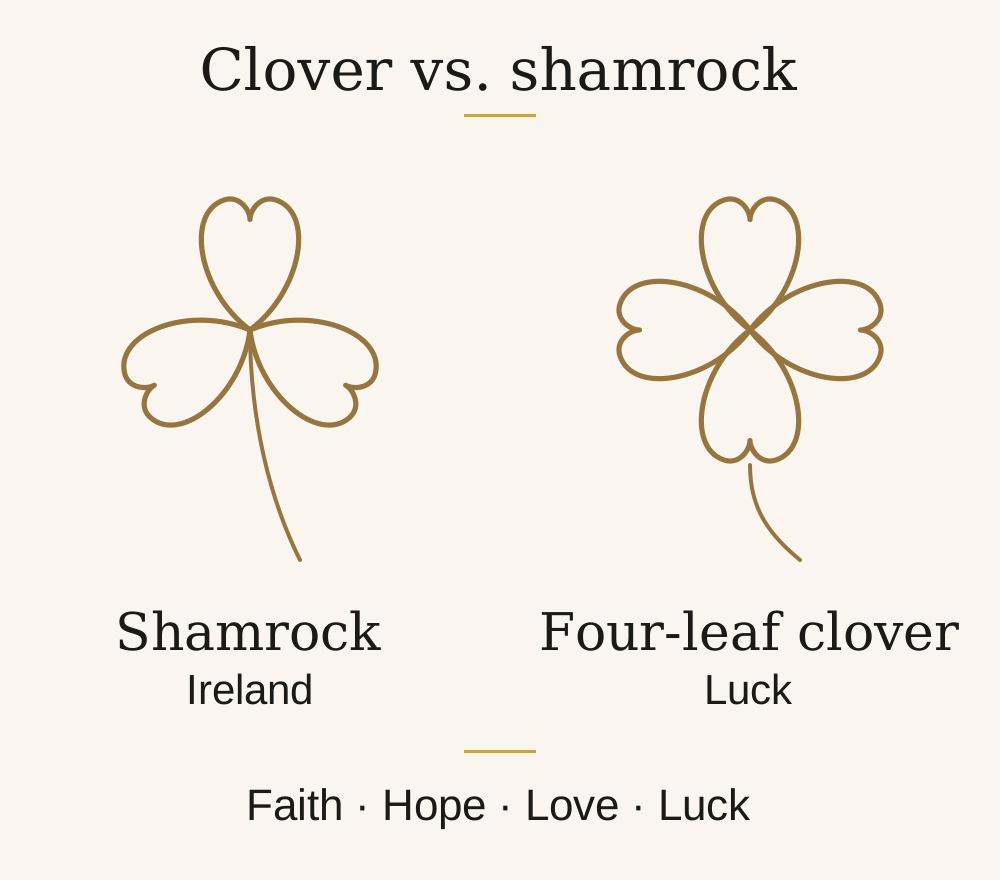
These two are often mixed up because both come from clover plants, but they are different symbols.
- Four-leaf clover: a rare four-leaflet clover, a charm of luck found in many countries.
- Shamrock: a three-leaflet clover that is an emblem of Ireland. It is tied to St. Patrick's Day and, by tradition, to St. Patrick, who is said to have used it to explain the Christian Trinity. Whether he really did is a legend rather than documented fact.
So a shamrock stands for Irish identity and heritage, while a four-leaf clover stands for luck. Each is sometimes called "a clover", and a few designs mix both, which adds to the confusion. The botanical identity of the "original" shamrock is itself debated, and several small three-leaf plants have been named.
Here is the difference in one table:
| Symbol | Leaflets | Stands for |
|---|---|---|
| Four-leaf clover | Four | Luck (in some traditions, faith, hope, love and luck) |
| Shamrock | Three | Ireland, linked to St. Patrick's Day |
| Common clover | Usually three | A plain meadow plant, most often white clover |
If you like Irish symbols, you may also enjoy the Claddagh and the Celtic knot.
Other lucky charms often grouped with it
The clover belongs to a family of small good-luck tokens that people have carried for generations:
- The horseshoe, traditionally hung or worn for luck in European and American folk custom.
- The wishbone, pulled apart by two people, with a wish for whoever keeps the larger piece.
Each has its own story, and none of them is a guarantee of anything. They are best thought of as small, hopeful traditions rather than rules.
A four-leaf clover is uncommon, not impossible, which is exactly why it makes a good charm.
How people wear it today
The four-leaf clover is popular as a pendant, charm, bracelet or ring, often given for a new job, a graduation, a new home, a first trip or simply "good luck". It also works for people who like a small, graphic shape with a positive meaning. Some wear it in the shape of four round, heart-like leaves with a small stem, and others in a simple outline.
When choosing jewelry, look for a piece whose metal is described plainly, such as 316L stainless steel with a gold-plated, rose gold-plated or silver-tone plated finish, rather than vague "gold" or "silver" wording. Genuine stainless steel is nickel-safe, which is what helps with sensitive skin.
Frequently Asked Questions
What does a four-leaf clover symbolize?
Traditionally, good luck. In some traditions the four leaves stand for faith, hope, love and luck. The most common reading is simply a hopeful wish for fortune.
Why is a four-leaf clover considered lucky?
The reasons are folklore rather than proof. A four-leaf clover is uncommon, so finding one feels special. Stories linking it to Eve, the Druids or the number four are told, but none is firmly documented. The earliest written link to luck we found is from 1620.
Is a four-leaf clover the same as a shamrock?
No. A shamrock has three leaflets and is an emblem of Ireland, linked to St. Patrick's Day. A four-leaf clover has four leaflets and is a charm of luck.
What do the four leaves represent?
A common tradition says faith, hope, love and luck. In some readings the fourth is grace, and some people link the leaves to the four seasons. There is no single official meaning.
How rare is a four-leaf clover?
It is uncommon, but there is no reliable single figure. You will see odds quoted online, yet we could not trace them to a trustworthy source, so it is safest to say it is rare without giving a number.
Is it good luck to wear a four-leaf clover?
Many people find it a lovely, hopeful charm, and it is a popular gift for a fresh start. Luck is a belief rather than a promise, so think of it as a small, positive reminder.


