
The Dharma wheel, or Dharmachakra, is one of the oldest symbols of Buddhism. It stands for the Buddha's teaching, and the act of "turning the wheel" means setting that teaching in motion. The most familiar form has eight spokes, which are generally read as the Noble Eightfold Path.
Below: what the wheel means, how it is tied to the first sermon at Sarnath, why the number of spokes varies, a short timeline of dated examples, and how it differs from similar wheels.
At a glance
- The Dharma wheel is a Buddhist symbol of the Buddha's teaching, known in Sanskrit as the Dharmachakra.
- The common eight spokes are generally read as the Noble Eightfold Path.
- It is traditionally tied to the Buddha's first sermon at the Deer Park in Sarnath.
- Spoke counts vary: wheels with 8, 12, 24 or more spokes exist, including the 24-spoke Ashoka wheel.
What does the Dharma wheel mean?
In short: the teaching of the Buddha, set in motion. In Buddhist tradition, the Buddha's first sermon is described as "turning the wheel of the Dharma," and the wheel has been the visual shorthand for that moment ever since. A wheel moves, keeps going, and can carry the teaching from place to place, which is part of why the image has lasted.
It is first of all a religious symbol. Buddhists treat it with respect, and this guide describes it as tradition and history.
The first sermon at Sarnath
According to Buddhist tradition, after his awakening the Buddha gave his first teaching at the Deer Park in Sarnath, near present-day Varanasi in India. This sermon is traditionally said to have set out the Four Noble Truths, and in many accounts the Eightfold Path, which is why the event is called the first turning of the wheel.
Buddhist art often shows a wheel flanked by two deer, a reminder of the Deer Park. You can see this pairing on many temple roofs in Tibetan Buddhist settings. Some traditions also describe further "turnings" of the wheel, which different schools count in different ways.
A wheel older than Buddhism
The wheel had meaning in India before Buddhist art took it up. Museum scholarship describes the wheel as an early Indian symbol for revealed knowledge. In some traditions, the chakravartin, or "wheel-turning" ruler, is a universal king whose power is shown by a wheel. Buddhists reshaped this idea: the Buddha is the one who turns a wheel of truth, rather than a wheel of conquest.
In the earliest Buddhist art, the Buddha was often not shown as a person at all. The wheel stood in his place, alongside the Bodhi tree, the stupa and footprints. Sites such as Sanchi and Bharhut, traditionally dated to around the 2nd to 1st century BCE, and Amaravati are often cited as places to see this.
What do the eight spokes mean?
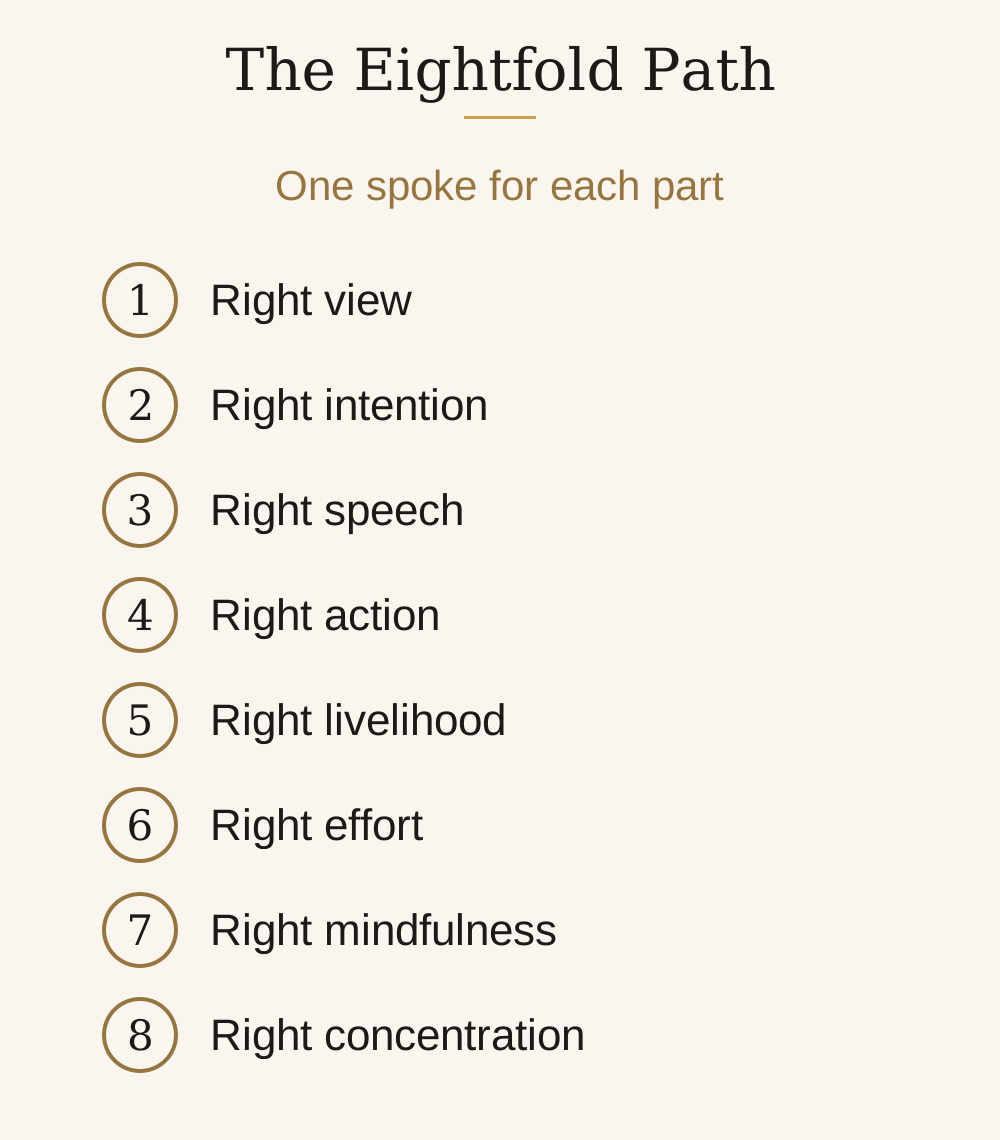
The eight-spoked wheel is generally read as the Noble Eightfold Path, the Buddha's practical guide to living, with one spoke for each part.
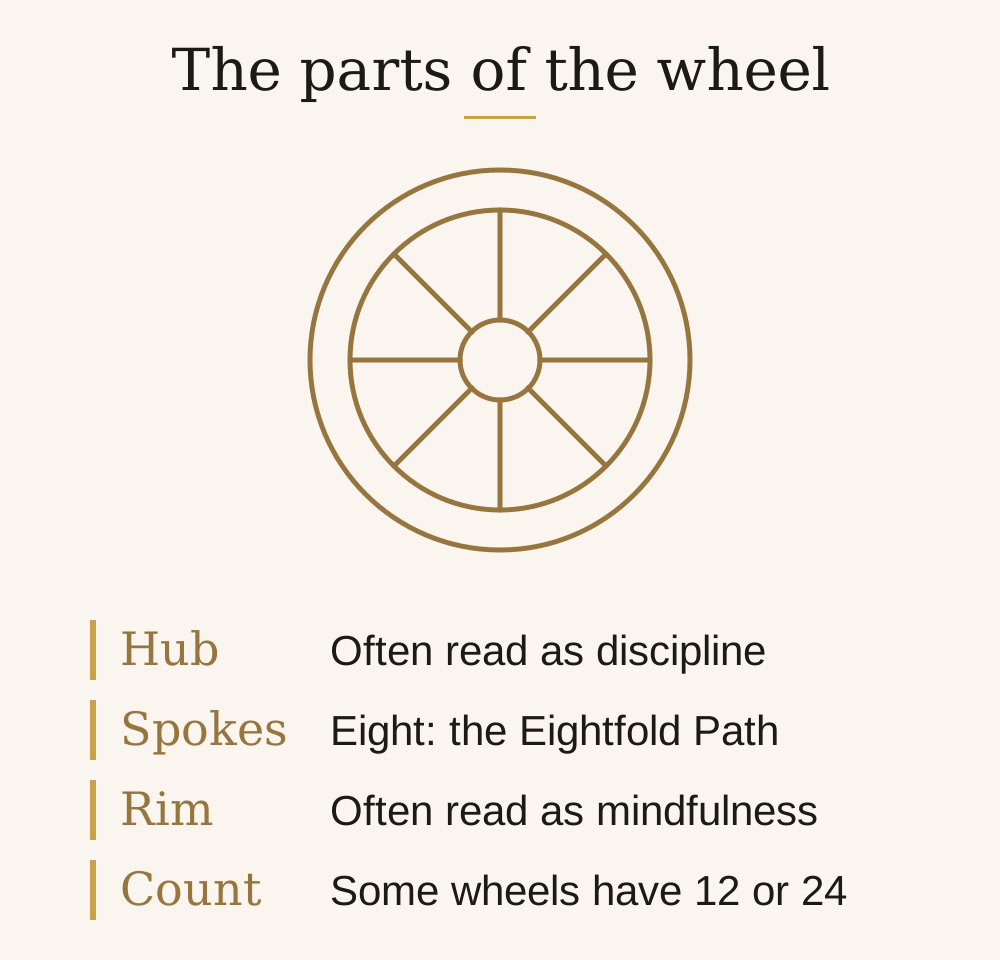
Other readings are layered on top, and they vary by school. In some explanations the hub stands for ethical discipline, the rim for mindfulness or concentration that holds everything together, and the spokes for wisdom. Treat these as helpful teaching images rather than one official definition.
Why do some wheels have 24 spokes?
Not every Dharma wheel has eight spokes. The wheel on the lion capital at Sarnath, dated to the reign of Ashoka in the 3rd century BCE, has 24. Writers note that the eight-spoke pattern had not been fixed in early times, and that the eight-spoke wheel became the standard form later. Other wheels have 12, and one museum record describes a limestone wheel with 23 spokes from a 7th-8th century site in central Thailand.
The 24-spoke Ashoka wheel also appears on the flag of India, adopted in 1947, where it is described as a wheel of law. That national symbol grew from the Ashokan wheel, and it is not used as a purely religious emblem.
The wheel in different Buddhist traditions
In Theravada countries such as Thailand and Sri Lanka, the wheel often appears in temples, on stone slabs and as a design in public art. In Tibetan Buddhism, the Dharma wheel is one of the eight auspicious symbols, a set of emblems used in art and decoration. The Dharmachakra mudra, a hand gesture with both hands held at the chest, is traditionally linked to the Buddha teaching.
In East Asia the wheel often appears alongside other Buddhist images, such as the lotus. Practices differ widely, so the same wheel can be a devotional emblem in one place and a decorative motif in another.
The Dharma wheel is a Buddhist emblem of the teaching, not only a design.
Often confused with
A few other wheels and spiritual symbols are easy to mix up with the Dharma wheel.
- Wheel of life (bhavachakra): a Tibetan diagram of the cycle of rebirth, held by a figure. It is a different image from the Dharma wheel.
- Lotus: a flower tied to purity and awakening in Buddhist and Hindu art.
- Om: a sacred syllable in Hindu, Buddhist and Jain traditions, shown as a written sign.
- Unalome: a spiral line with a modern spiritual reading about a winding path.
- Compass: a navigation symbol of direction, a different idea from a spoked wheel.
The table lines them up.
| Symbol | Shape | Stands for |
|---|---|---|
| Dharma wheel | Eight-spoked wheel | The Buddha's teaching and the Eightfold Path |
| Lotus | Flower | Purity and awakening |
| Om | Written syllable | A sacred sound in several Indian traditions |
| Compass | Round dial with points | Direction and finding your way |
How people wear it today
The Dharma wheel is worn as a pendant, ring, bracelet charm or tattoo, by Buddhists as a sign of faith and by others as a reminder of mindfulness or a path through life. Because it is a living religious symbol, many people prefer to learn what it means first, and some Buddhists feel sacred images should not be placed on the lower body or on the floor. If you are unsure, ask someone from the tradition what feels appropriate. When choosing jewelry, look for a piece whose metal is described plainly, such as 316L stainless steel with a gold-plated, rose gold-plated or silver-tone plated finish, rather than vague "gold" or "silver" wording. Genuine stainless steel is nickel-safe.
Frequently Asked Questions
What does the Dharma wheel symbolize?
In Buddhist tradition, the Buddha's teaching. Turning the wheel refers to the first sermon at Sarnath, and the eight spokes are generally read as the Noble Eightfold Path.
What do the eight spokes mean?
They are generally read as the parts of the Noble Eightfold Path: right view, right intention, right speech, right action, right livelihood, right effort, right mindfulness and right concentration.
Why do some Dharma wheels have 24 spokes?
The wheel on Ashoka's lion capital at Sarnath has 24 spokes, and the same wheel appears on India's flag. Spoke counts were not fixed in early times, and wheels with 8, 12, 23 or 24 spokes are known.
Is it disrespectful to wear a Dharma wheel?
Wearing it with respect is generally welcomed. It is a religious symbol, so many people prefer to learn its meaning and avoid treating it as a throwaway design.
Is the Dharma wheel the same as the Ashoka Chakra on India's flag?
They are closely related. The flag's wheel is based on the 24-spoke wheel of Ashoka's Sarnath capital, but it is a national symbol, described as a wheel of law.
What is the Dharmachakra mudra?
A hand gesture, often shown on Buddha figures, traditionally linked to the Buddha teaching. It is named after the wheel but is a separate symbol.


