
Om, also written Aum, is a sacred syllable in Hinduism and several other Indian traditions. The written sign, ॐ, is a curved figure with a small crescent and dot above it. It is traditionally chanted at the start and end of prayer and meditation, and it is often described as the sound that holds all other sounds.
Below: what Om means, where it comes from, how its parts are read, how it appears in different traditions, and what to know before wearing it.
At a glance
- Om (Aum) is a sacred syllable and symbol of Hinduism, also used in Buddhism and Jainism.
- It is traditionally chanted to open and close prayer, chant and meditation.
- Many teachers read it as three sounds, A, U and M, plus silence, often tied to waking, dreaming, deep sleep and a fourth, beyond state.
- It is not the same as the Sikh Ik Onkar, the unalome or the lotus, though they are often seen together.
What does the Om symbol mean?
In short: the sacred sound that represents ultimate reality, the whole of existence, or the divine, depending on the tradition. Hindu texts often connect it with Brahman, the highest reality. For many people it also works more simply as a sign of calm, focus and spiritual practice.
There is no single official definition. Different schools, texts and teachers explain it differently, and what follows is how the tradition describes it, not a claim about any effect on the wearer.
Where does Om come from?
Om is very old, but it is hard to give a precise date. It appears in the Upanishads, the philosophical texts that grew out of the Vedic tradition, and it is also discussed in some other early Sanskrit works. Scholars place the oldest Upanishads somewhere in the first millennium BCE, and the ranges they give differ.
Two texts are often cited:
- Chandogya Upanishad. It opens by telling the reader to meditate on Om, treating it as the essence of the chanted Vedic hymns.
- Mandukya Upanishad. A short text devoted entirely to the syllable, which reads it as a map of states of consciousness.
The Upanishads themselves offer several explanations of the word, and where it first came from is still debated. The timeline below uses broad ranges only.
How the parts of Om are read
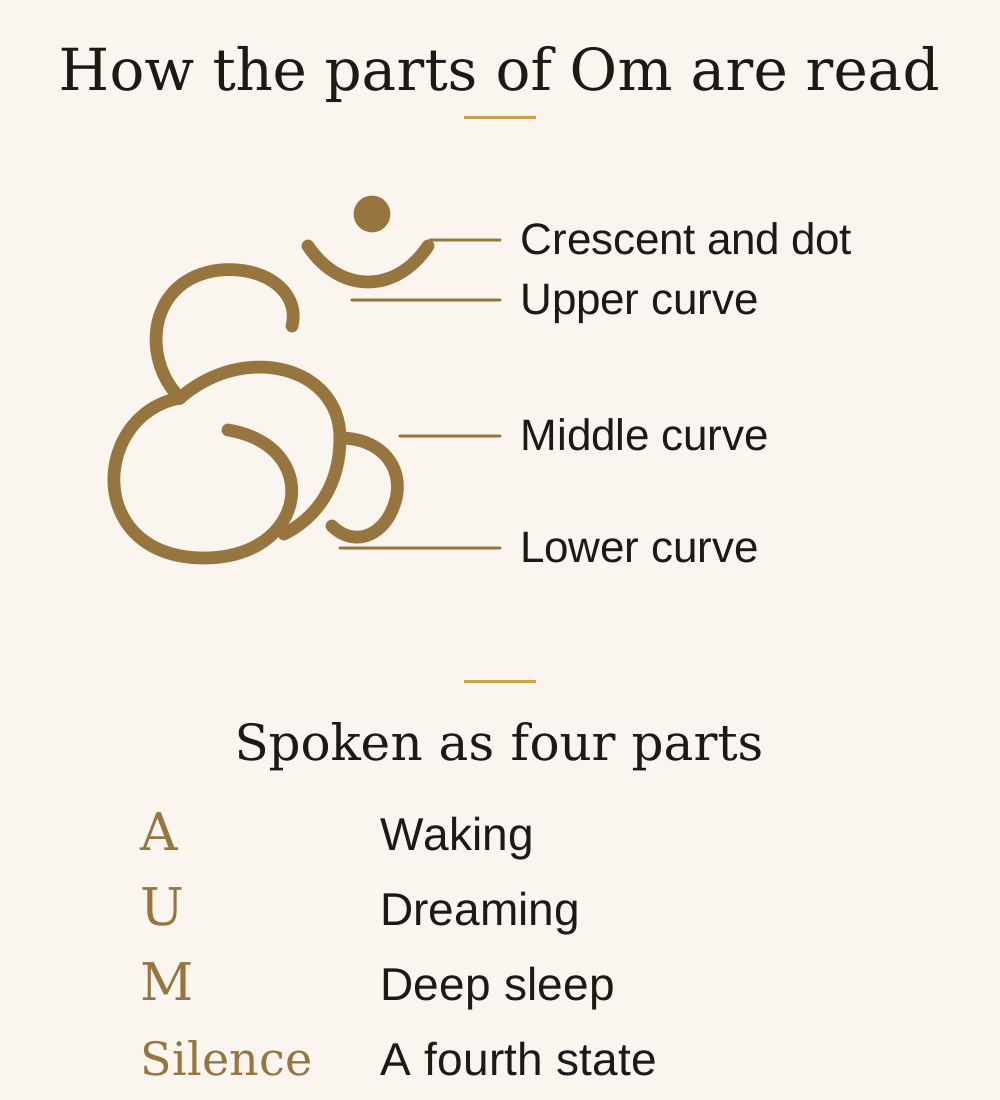
In the Mandukya tradition, Om is spoken as A, U and M, followed by silence. Teachers commonly explain the four parts like this:
- A — the waking state.
- U — the dream state.
- M — deep, dreamless sleep.
- Silence — a fourth state, beyond the other three.
You will also see popular readings that link the three sounds to creation, preservation and dissolution, or to the three Hindu deities Brahma, Vishnu and Shiva. These are widely repeated but are later or looser interpretations rather than one fixed doctrine.
The written sign is sometimes explained the same way: the large lower curve, the middle curve, the upper curve, then the crescent and dot. Again, exact explanations vary.
Om in different traditions
Hinduism. Om is spoken at the beginning of many prayers, mantras and readings, and at the close. It is part of yoga and meditation practice and appears on temples, in homes and in art.
Buddhism. Om appears at the start of many mantras. The best known is the six-syllable mantra Om mani padme hum, widely used in Tibetan Buddhism and linked to compassion. Buddhist traditions explain the syllable in their own ways.
Jainism. Om is used as a short form of reverence for the five supreme beings, according to Jain tradition.
Sikhism. Sikhism has a related but distinct symbol, Ik Onkar, which means "one creator". It is written in Gurmukhi and should not be treated as the same sign as Om.
Often confused with
- Ik Onkar. A Sikh symbol that begins with the numeral one. It looks different and has its own meaning.
- Unalome. A spiral-and-line design linked with a path to enlightenment in some modern Buddhist-inspired traditions. It is sometimes tattooed beside Om.
- Lotus flower. Another symbol of spiritual awakening in Hindu and Buddhist art. It often appears with Om, but it is a separate sign.
- Tibetan syllables. Some Buddhist mantras are written in other scripts that can look similar to non-readers.
The table sets Om beside the three signs it is most often seen with.
| Symbol | How it looks | Tradition and meaning |
|---|---|---|
| Om | Curved figure with a crescent and dot above | Sacred syllable of Hinduism, also used in Buddhism and Jainism |
| Ik Onkar | Begins with the numeral one, written in Gurmukhi | Sikh symbol meaning "one creator" |
| Unalome | Spiral and line | Path to enlightenment in some modern Buddhist-inspired traditions |
| Lotus | Flower | Spiritual awakening in Hindu and Buddhist art |
Wearing Om with respect
Om is a living religious symbol, not only a design. Many practicing Hindus, Buddhists and Jains wear it as part of their faith, and many others wear it for meditation, yoga or personal reasons. Most people see this as welcome when it is done with respect.
A few simple points:
- Placing it on the body, as a pendant or tattoo, is common. Some people prefer to keep it above the waist.
- Treat it as you would any religious sign: avoid using it as a joke or on items that are discarded carelessly.
- If you are unsure, ask someone from the tradition what feels appropriate.
Om is a living religious symbol, not only a design.
How people wear it today
Om is worn as a pendant, ring or bracelet charm, often as a reminder of calm, focus or a yoga and meditation practice, or as a sign of faith. The sign is usually shown on its own, sometimes inside a circle or lotus. When choosing jewelry, look for a piece whose metal is described plainly, such as 316L stainless steel with a gold-plated, rose gold-plated or silver-tone plated finish, rather than vague "gold" or "silver" wording. Genuine stainless steel is nickel-safe, which is what helps with sensitive skin.
Frequently Asked Questions
What does the Om symbol mean?
Traditionally, it is a sacred sound representing ultimate reality or the divine in Hinduism, and it is used in prayer and meditation. Many people also read it as a sign of calm and spiritual focus.
What is the difference between Om and Aum?
They are two spellings of the same syllable. "Aum" shows the three sounds A, U and M that the syllable is traditionally said to contain, while "Om" is how it is usually pronounced and written in English.
Is Om only a Hindu symbol?
No. It is most closely tied to Hinduism, but it is also used in Buddhism and Jainism, each with its own explanations. Sikhism has a related but separate symbol, Ik Onkar.
What do the three sounds of Om stand for?
In the Mandukya tradition, A, U and M are linked to waking, dreaming and deep sleep, with silence as a fourth state. Other popular readings connect them to creation, preservation and dissolution, but teachers differ.
Can anyone wear an Om necklace?
Yes, many people wear Om for meditation, yoga or personal reasons, and it is generally welcomed when worn respectfully. It is a religious symbol for many, so treat it with care.
How old is the Om symbol?
The syllable appears in the Upanishads, which scholars place in the first millennium BCE, though exact dates are debated. The written ॐ sign developed over time.


